
koala73/worldmonitorConnectors
Real-time global intelligence dashboard. AI-powered news aggregation, geopolitical monitoring, and infrastructure tracking in a unified situational awareness interface
86k
`origin-mcp` connects local AI clients to Origin and OriginPro through MCP. The server talks to a bridge that runs inside Origin, which lets the agent import data, edit worksheets, build plots, run analysis, and export results.
Builders who want their agent to control Origin and OriginPro on Windows.
You can turn agent instructions into Origin data processing and plotting steps inside the desktop app.
Import, edit, transform, and export Origin data objects.
Create and refine 2D, 3D, contour, statistical, and specialized plots.
Run fitting, signal processing, statistics, Peak Analyzer, and batch jobs.
Manage projects, folders, Notes, templates, analysis operations, and graph layouts.
Provides Origin bridge start/stop apps and CLI checks like `status` and `doctor`.
pip install origin-mcp
origin-mcp install-origin-app --force
origin-mcp status
origin-mcp doctor --ping-origin


origin-mcp is a local Model Context Protocol (MCP) server that lets AI
assistants control Origin/OriginPro on Windows. An authenticated local bridge
runs inside Origin so automation stays on its UI thread. The project is still
in testing; real-workflow feedback and contributions are welcome.
You need Windows, a licensed Origin/OriginPro installation, and Python 3.10+ for the MCP server. Origin 2026/2026b is the current target family; the bridge uses the Python bundled with Origin.
pip install origin-mcp
python.exe path if
python points to another environment):{
"mcpServers": {
"origin": {
"command": "python",
"args": ["-m", "origin_mcp"]
}
}
}
origin-mcp install-origin-app --force
origin-mcp status
origin-mcp doctor --ping-origin
Both diagnostic commands support --json. For manual bridge startup or
troubleshooting, see the bridge guide.
To let an AI agent install and configure origin-mcp, send it this instruction:
Fetch and follow https://raw.githubusercontent.com/Ge-Shun/origin-mcp/main/docs/agentic/origin-mcp-bootstrap.md end to end.
From a checkout, install with pip install -e . and run the full local gate:
python scripts/dev_check.py --tests
The bridge listens only on 127.0.0.1 and authenticates local requests by
default with a per-session token. Treat the token as a credential, keep its
handshake file in a user-private directory, and avoid
ORIGIN_MCP_BRIDGE_NO_AUTH unless every local process is trusted. Set
ORIGIN_MCP_ALLOWED_ROOTS to restrict which files tools may access.
MIT. See LICENSE.
Sign in to join the discussion.
No comments yet. Be the first to say what this is good for.
Real-time global intelligence dashboard. AI-powered news aggregation, geopolitical monitoring, and infrastructure tracking in a unified situational awareness interface
High-performance code intelligence MCP server. Indexes codebases into a persistent knowledge graph — average repo in milliseconds. 158 languages, sub-ms queries, 99% fewer tokens. Single static binary, zero dependencies.
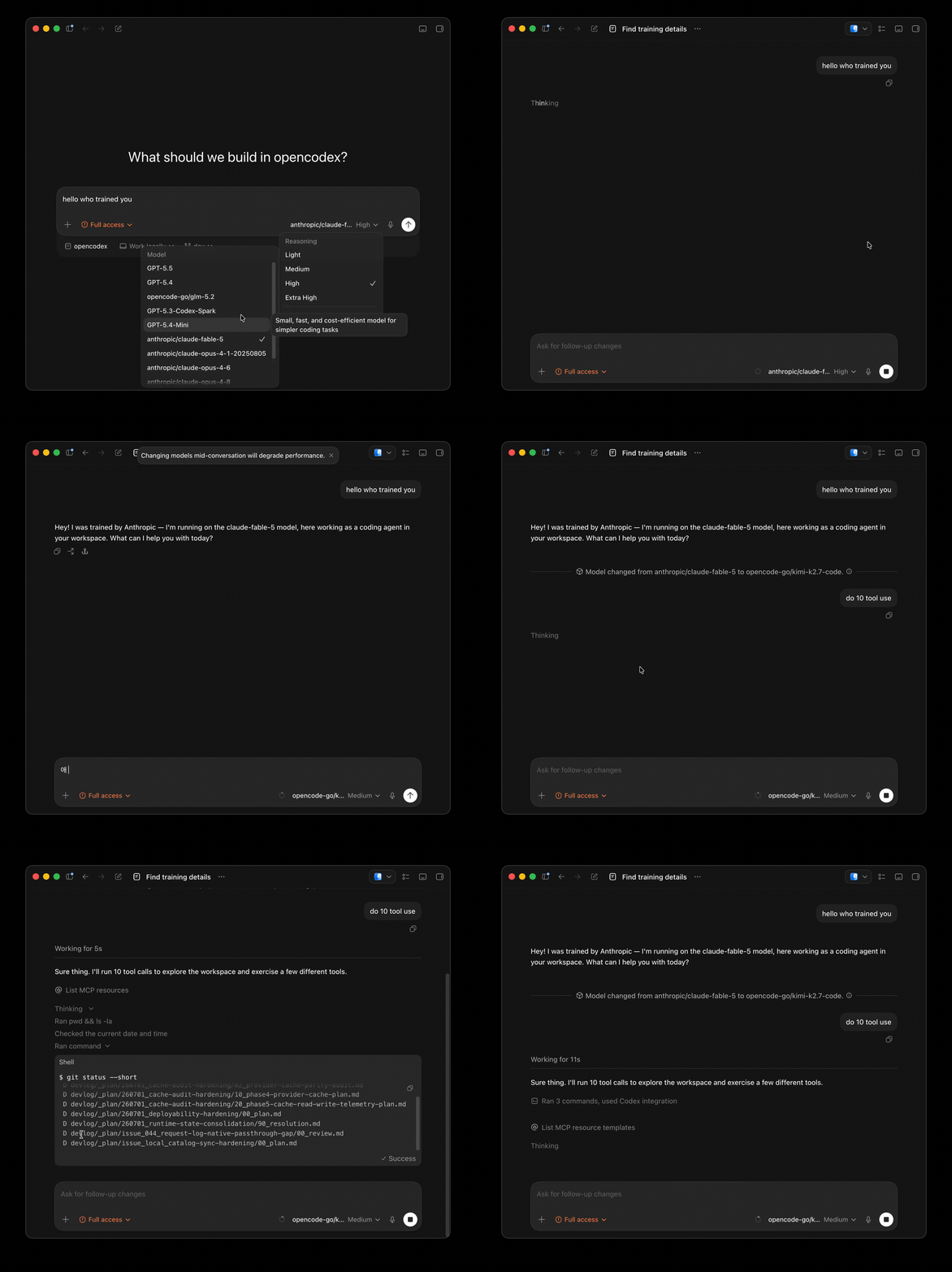
Universal provider proxy for OpenAI Codex & Claude Code — use any LLM (Claude, Gemini, Grok, DeepSeek, Ollama…) with Codex CLI, App, SDK, and Claude Code

Git-native persistent memory for AI coding agents. Implements Google OKF v0.2 with sub-300µs in-memory BM25 search, embedded MCP server, and progressive disclosure. Slashes token bloat by 80% with zero external databases or dependencies. Built in pure Go.

Local-first code intelligence graph for MCP and CLI. Builds a persistent map of your codebase so AI coding tools read only what matters, with benchmarked context reductions on reviews and large-repo workflows.

Stop your AI from making things up — it proposes, deterministic tools decide, every claim checked against ground truth with evidence. Grounded facts and context survive resets. Reverse engineering is the proving ground. MCP server + CLI.