
koala73/worldmonitorConnectors
Real-time global intelligence dashboard. AI-powered news aggregation, geopolitical monitoring, and infrastructure tracking in a unified situational awareness interface
86k
Piyaz keeps a live project graph for tasks, blockers, decisions, and execution history, then serves that context through an MCP server and editor plugins. Builders can plan work in plain language, pick the next ready task, and review agent output before it merges.
Builders who want their coding agents to share project state, task context, and review flow across sessions.
You can run agent-led work with shared context, clearer task handoffs, and review before merge.
Breaks an idea or existing codebase into tasks with dependencies, blockers, decisions, and execution history attached.
Exposes the workspace through a remote MCP server so connected agents can plan, pick up, and update work.
Lets several agents work on the same project at once while keeping a shared view of what is ready, blocked, and done.
Keeps agent work in review until a reviewer checks the diff and approves or sends it back.
Ships plugin bundles for Claude Code, Codex, Cursor, and Antigravity so the workspace is available inside those tools.
/piyaz I want a cli that generates changelogs from conventional commits, with monorepo support
what should I work on next?
review MET-1. File-cited, do not rubber-stamp. Read the diff first.
/piyaz:composer

The agentic workspace where people and coding agents work on the same project.


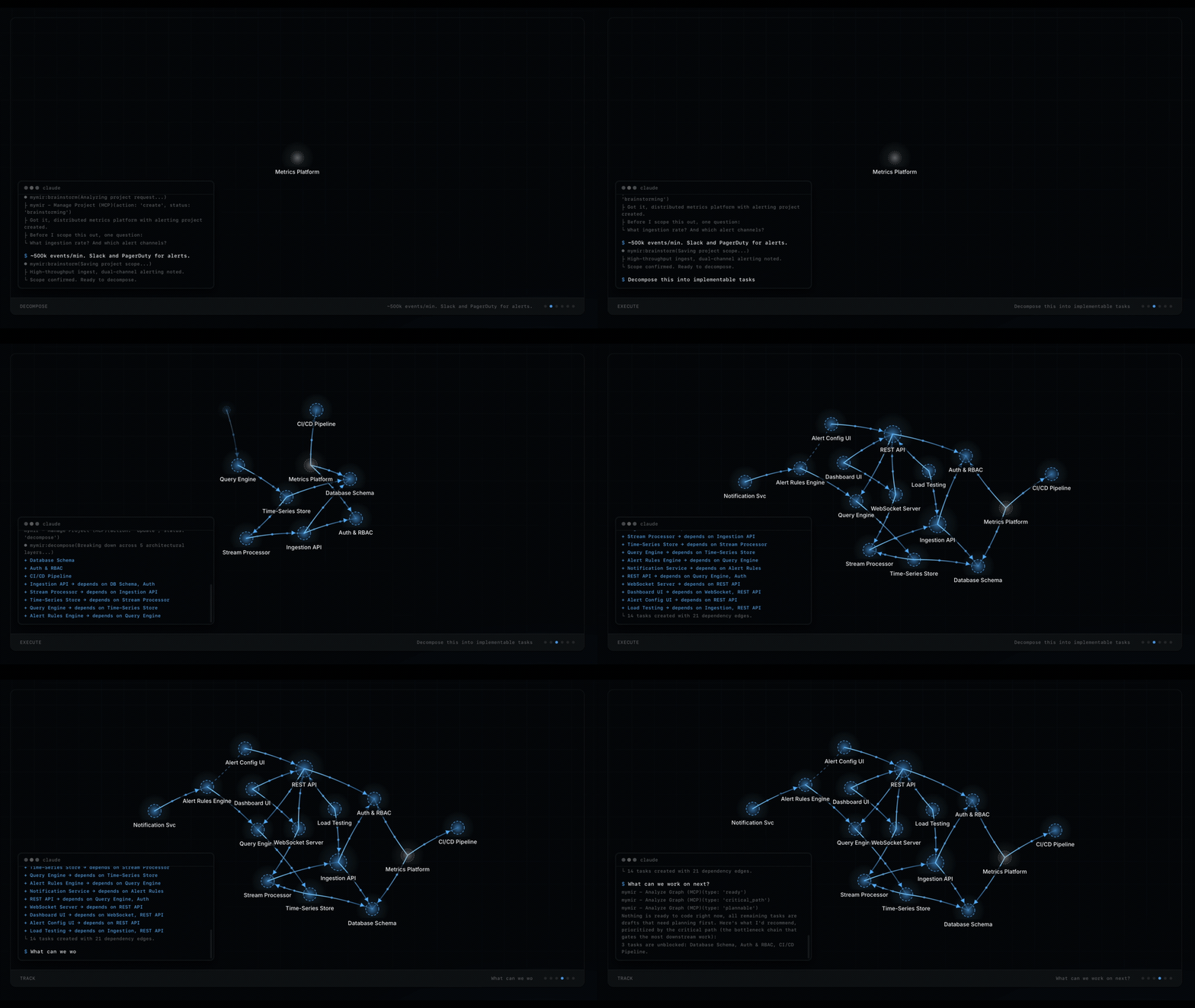
Piyaz is an agentic workspace for project management, where people and coding agents work on the same project. It runs as an MCP server with a web app on top, and it holds your project as a graph, every task wired to what blocks it, with the decisions and the execution history attached. Piyaz keeps that work consistent to the engineering process a real codebase needs, from decomposing an idea to reviewing the code before it merges.
Using Piyaz, several agents can build at the same time; each in its own harness and with no API keys to wire up, while engineers are free to steer them as needed. One agent can implement a task while you refine another or add a new feature.
Drop in an idea or an existing codebase, and Piyaz breaks it into small, concrete tasks on that graph. When an agent picks up a task, it already has the plan, the standards, and the decisions behind the work. No agent starts from a raw read of a task description.
Full setup, guides, and reference can be found at docs.piyaz.ai.
Piyaz is open for signup at app.piyaz.ai/sign-up. Create an account and verify your email to get in.
Then install the plugin for your agent (Claude Code, Codex, Cursor, or Antigravity) and sign in once. Piyaz is then available in every project you open. Per-harness setup instructions can be found at docs.
Self-hosting is free under AGPL-3.0. You can run the Piyaz server yourself and register an MCP server in your editor that points at it. You need Bun and Docker for PostgreSQL. Full setup and upgrade steps are in the self-host guide.
Stop explaining the project twice. Every task carries its own context: the plan, the decisions behind it, and how it connects to the rest of the project. Your next session picks up where the last one left off instead of asking you to explain the project again.
Ship a big project without the quality falling off. Piyaz breaks large work into small tasks with clear dependencies and hands each one exactly the context it needs, so the tenth task lands as cleanly as the first.
Put more than one agent on the same project. People and agents across Claude Code, Codex, Cursor, and Antigravity share one view of what's done, what's ready, and what's blocked, so their work doesn't collide or drift.
Start from an idea or from code you already have. Describe something new and Piyaz plans it out, or point it at an existing codebase and it maps the work you've already shipped into a tracked project.
Talk, don't configure. You say what you want in plain language. Piyaz plans the work, tracks it, and keeps the record current. No need for informing your agent with the necessary context manually.
On Claude Code, Composer can take a task the whole way on its own: it researches the task against your codebase, writes the plan, implements it, opens up a pull request, reviews it and fixes what review flags, then moves to the next ready task. You decide what merges.
Piyaz keeps a live map of your project, the context network: every task, the dependencies between them, and the decisions behind each one. You work in plain language from your agent, and Piyaz keeps that map current as the work moves. Here is the loop.
Plan a project. Describe an idea and Piyaz brainstorms it into a brief, then decomposes it into a task graph with dependencies, asking one focused question at a time and pushing back on weak choices.
/piyaz I want a cli that generates changelogs from conventional commits, with monorepo support
Pick up the right work. Ask what is next and Piyaz names the top ready task on the critical path. It claims the task, pulls the context it needs, and records what it built when it is done, so the next session starts from ground truth instead of a raw task description.
what should I work on next?
Review before it merges. An agent's work stops at in_review, never done. A review agent reads the diff and returns a verdict across security, performance, reliability, observability, and codebase standards, with a file and line for every finding. You approve or send it back. This is the mechanism that keeps low-quality code from landing.
review MET-1. File-cited, do not rubber-stamp. Read the diff first.
Or hand over the whole loop (Claude Code). Composer takes a task from research to an open PR all on its own: research, plan, implement, review, and a bounded fix loop, then it picks up the next ready task. You decide what merges.
/piyaz:composer
We build Piyaz using Piyaz, so every feature here is something we use day to day.
For more details, see the docs:
Piyaz is a remote MCP server at https://app.piyaz.ai/api/mcp (Streamable HTTP, OAuth 2.1, no API keys); the plugin wires it up for you, so the endpoint only matters when connecting a client by hand or pointing at your own instance. Nine ref-first tools cover the loop from planning to review: the full reference lives at docs.piyaz.ai/docs/reference/mcp-overview and registry metadata in server.json.
Next.js 16, TypeScript 6, React 19, PostgreSQL, Drizzle ORM, Better-Auth, Tailwind CSS v4, Motion, and the official MCP TypeScript SDK.
See CONTRIBUTING.md for setup instructions and PR guidelines.
Piyaz is licensed under AGPL-3.0. A commercial license is also available, see LICENSING.md for details.
Sign in to join the discussion.
No comments yet. Be the first to say what this is good for.
Real-time global intelligence dashboard. AI-powered news aggregation, geopolitical monitoring, and infrastructure tracking in a unified situational awareness interface
High-performance code intelligence MCP server. Indexes codebases into a persistent knowledge graph — average repo in milliseconds. 158 languages, sub-ms queries, 99% fewer tokens. Single static binary, zero dependencies.
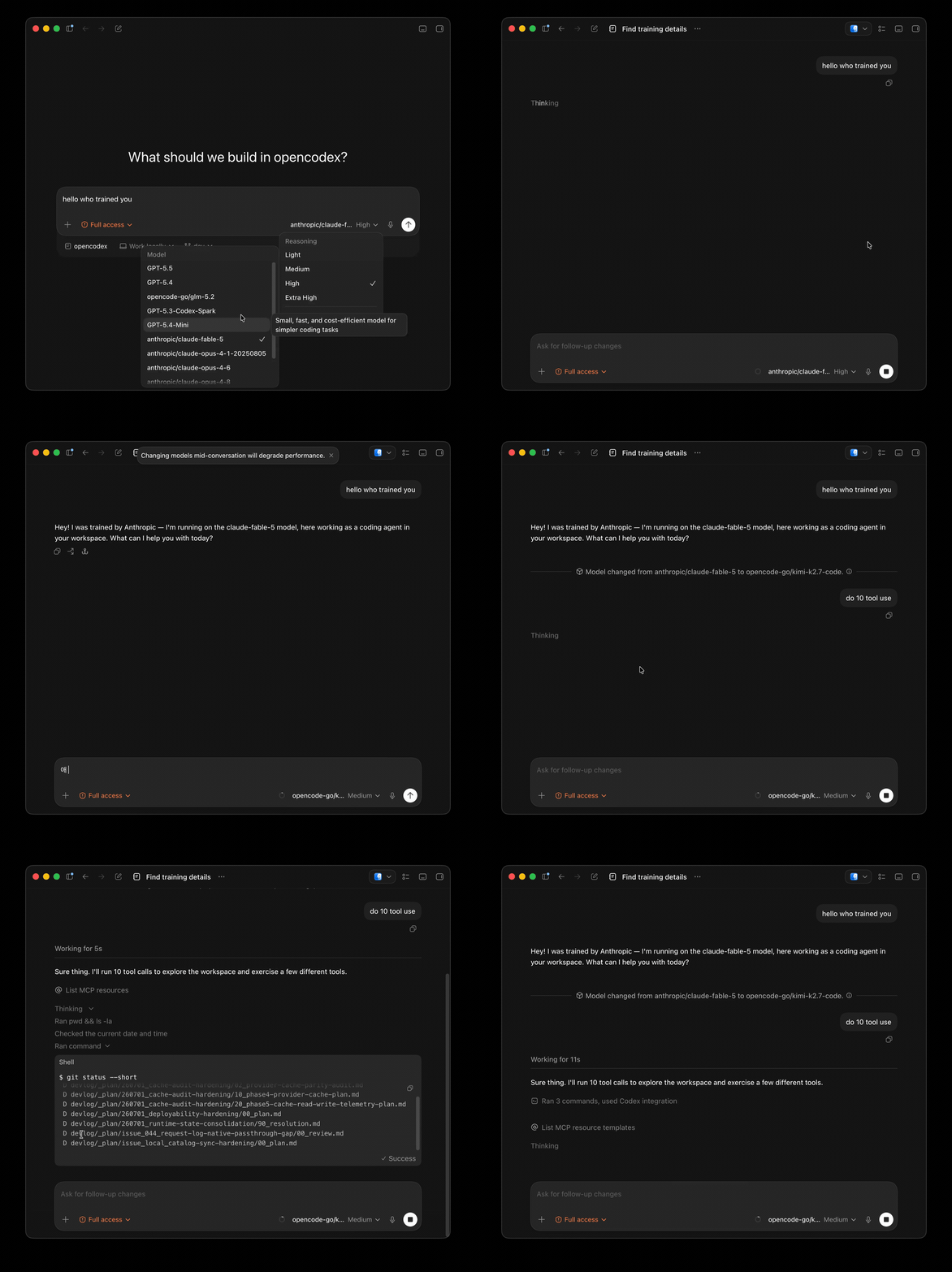
Universal provider proxy for OpenAI Codex & Claude Code — use any LLM (Claude, Gemini, Grok, DeepSeek, Ollama…) with Codex CLI, App, SDK, and Claude Code

Git-native persistent memory for AI coding agents. Implements Google OKF v0.2 with sub-300µs in-memory BM25 search, embedded MCP server, and progressive disclosure. Slashes token bloat by 80% with zero external databases or dependencies. Built in pure Go.

Local-first code intelligence graph for MCP and CLI. Builds a persistent map of your codebase so AI coding tools read only what matters, with benchmarked context reductions on reviews and large-repo workflows.

Stop your AI from making things up — it proposes, deterministic tools decide, every claim checked against ground truth with evidence. Grounded facts and context survive resets. Reverse engineering is the proving ground. MCP server + CLI.