
koala73/worldmonitorConnectors
Real-time global intelligence dashboard. AI-powered news aggregation, geopolitical monitoring, and infrastructure tracking in a unified situational awareness interface
86k
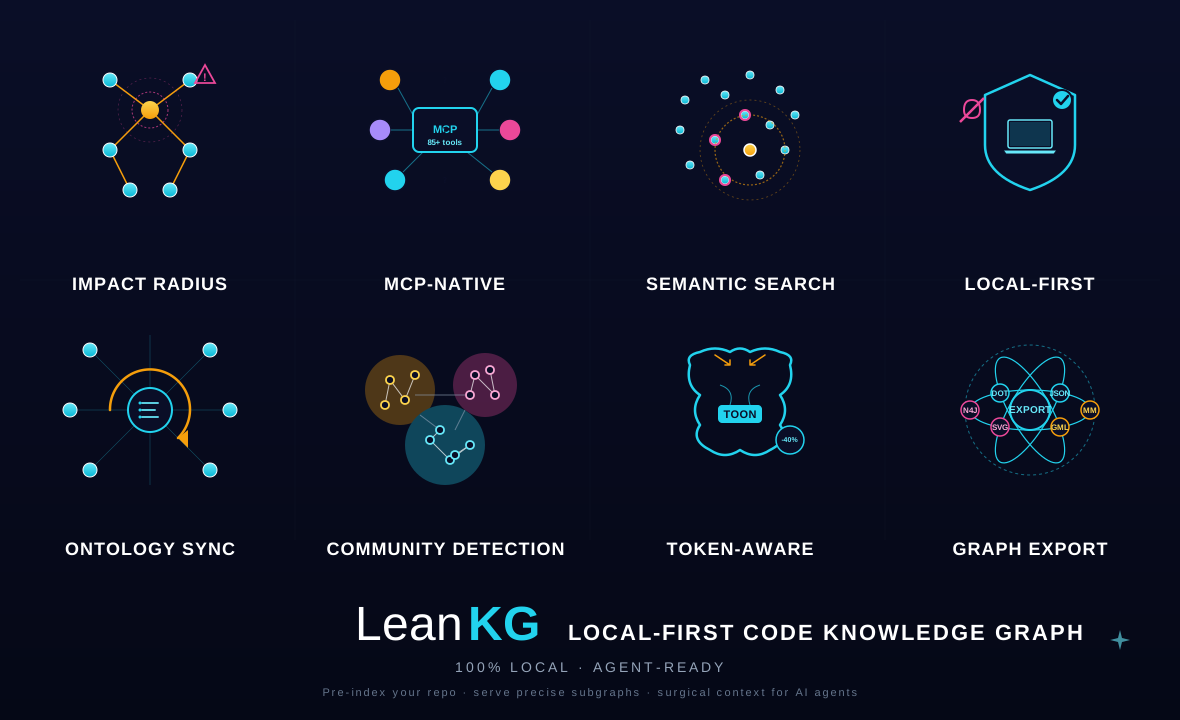
LeanKG indexes a project into a code knowledge graph and serves it over MCP and HTTP. Agents can ask for search, impact, call graphs, traceability, and team context instead of rebuilding everything from scratch.
Builders who want their agent to remember code structure, dependencies, and project context across sessions.
You can give your agent focused code context and cut down on repeated token-heavy file browsing.
Serves one MCP surface that routes many context tasks through `leankg_context`.
Indexes a repo with `leankg init && leankg migrate && leankg index ./src` and stores it in sqlite by default.
Find callers, dependencies, blast radius, and shortest paths between symbols or files.
Handles shared indexes, environment governance, service graphs, and incident or ownership queries.
Includes plugin and config bundles for Claude, Cursor, Codex, Gemini, OpenCode, and related setups.
Provides a REST API and a browser UI for exploring the graph locally.
# Agent — binary + MCP wiring (cursor | claude | opencode | gemini | kilo | antigravity | update)
curl -fsSL https://raw.githubusercontent.com/FreePeak/LeanKG/main/scripts/install.sh | bash -s -- cursor
cargo install leankg
# or: git clone https://github.com/FreePeak/LeanKG.git && cd LeanKG && cargo build --release
# Status: print the resolved repo list without running anything
LEANKG_REPOS="github.com/org/repo-a,github.com/org/repo-b" leankg setup --status

# Clone + index + embed each repo under LEANKG_CLONE_ROOT (default: cwd)
LEANKG_REPOS="github.com/org/repo-a,github.com/org/repo-b" \
  LEANKG_GIT_REF=main \
  LEANKG_CLONE_ROOT=/srv/repos \
  leankg setup --clone --index --embed

Enterprise-ready code knowledge graph for AI coding agents
Multi-repo · env governance · incidents & services · req↔code · −65% tokens / −85% tool calls



None — sqlite is the default storage engine. No Postgres, no Docker.
Postgres remains available as an explicit opt-in (LEANKG_DB_ENGINE=postgres + LEANKG_PG_URL) for server-scale deployments, but nothing in the default flow touches it.
# Agent — binary + MCP wiring (cursor | claude | opencode | gemini | kilo | antigravity | update)
curl -fsSL https://raw.githubusercontent.com/FreePeak/LeanKG/main/scripts/install.sh | bash -s -- cursor
cargo install leankg
# or: git clone https://github.com/FreePeak/LeanKG.git && cd LeanKG && cargo build --release
# 1. Per project: init -> migrate -> index (sqlite default — zero config)
cd your-project
leankg init && leankg migrate && leankg index ./src

# 2a. Wire up an AI client — one command (also: cursor | codex | gemini)
leankg connect claude-code           # add --remote http://host:9699 to reuse a shared server

# 2b. ...or serve MCP over HTTP yourself
leankg mcp-http --port 9699          # GET /health returns 200 when ready
Self-check any deployment: leankg doctor --deep — index freshness, migrations,
embedding coverage, orphan edges, duplicate names (exit 0 pass / 1 warn / 2 fail).
Measured timings (scripts/quickstart_smoke.sh, run weekly in CI): full e2e smoke 88 s
vs a 300 s budget; indexing a small repo takes well under 2 minutes.
MCP HTTP: pass the project checkout directory as project=.
leankg setup with no flags keeps the legacy client-side behavior (register
MCP + hooks). Pass pipeline flags to instead clone a list of repos and index
each one server-side:
# Status: print the resolved repo list without running anything
LEANKG_REPOS="github.com/org/repo-a,github.com/org/repo-b" leankg setup --status

# Clone + index + embed each repo under LEANKG_CLONE_ROOT (default: cwd)
LEANKG_REPOS="github.com/org/repo-a,github.com/org/repo-b" \
  LEANKG_GIT_REF=main \
  LEANKG_CLONE_ROOT=/srv/repos \
  leankg setup --clone --index --embed
Repo sources:
LEANKG_REPOS — comma-separated host/namespace paths to clone.LEANKG_PROJECT_DIRS — comma-separated dirs already mounted on disk
(skips clone; falls back to indexing what exists when no git token is set).Env knobs: LEANKG_GIT_HOST (default github.com), LEANKG_GIT_REF
(default main), LEANKG_CLONE_ROOT / CLONE_ROOT, LEANKG_ENV (default
local), git token via GITLAB_TOKEN / GIT_TOKEN / GITHUB_TOKEN.
Each cloned repo gets a minimal .leankg/leankg.yaml, then leankg index
and leankg embed --wait run inside it. A setup.done marker prevents
re-runs.
Set LEANKG_SETUP=1 on leankg mcp-http to run the same pipeline once after
the server binds (spawned as a background task; the server stays healthy).
UI talks REST (:8080), not MCP (:9699). Start the API, then the Vite app in ui-v2/:
# Terminal A — REST API (+ embedded UI if assets are in src/embed/)
leankg serve --port 8080
# open http://127.0.0.1:8080/

# Terminal B — hot-reload explorer (recommended for local UI work)
cd ui-v2
npm install
npm run dev
# open http://127.0.0.1:5173/?path=src
Vite proxies /api → 127.0.0.1:8080. Status should show connected.
Details: ui-v2/README.md · docs/archive/web-ui.md
Peers in this space are mostly personal / single-repo. LeanKG is the company platform: shared index, ops graph, and measured agent economics.
| Pillar | Ships as |
|---|---|
| Multi-repo server | MCP HTTP :9699 (sqlite default; PG opt-in); LEANKG_PROJECT_DIRS |
| Env governance | env=, promote_environment, find_env_conflicts |
| Ops & ownership | get_service_graph, query_incidents, get_team_map |
| Req ↔ code | index_prd, get_traceability, get_traceability_matrix |
| Mega-graph | Frontier-local queries; 100k–700k+ elements |
| Agent surface | 1 MCP tool (leankg_context) serving ~76 capabilities as verbs; peers typically ~1–17 raw tools |
| Cost | A/B −65% tokens, −85% tool calls, 2.5× vs grep/cat |
| Capability | LeanKG | GitNexus | Graphify | Codanna | Context7 |
|---|---|---|---|---|---|
| Multi-repo team deploy | Yes | Partial | Limited | Limited | n/a |
| Env / incidents / team map | Yes | No | No | No | No |
| PRD traceability | Yes | No | Partial | No | No |
| Mega-graph (100k+) | Yes | Partial | Viz capped | Varies | n/a |
| MCP depth | 77 | ~17 | ~10 | ~5 | docs only |
Deep dives (archived): ROI vs Graphify · Competitive one-pager · Research matrix
Agents normally rebuild structure with grep → open files → huge context. LeanKG returns a targeted subgraph (callers, dependents, blast radius, tests, docs) plus the team layer (env, services, incidents, requirements) over MCP.
| Without | With LeanKG |
|---|---|
| Many tool calls, large context | Surgical subgraph + TOON (~40% smaller payloads) |
| No blast radius | Severity-graded impact |
| Keyword only | Keyword + HNSW semantic + ontology |
| Single-repo guesswork | Multi-repo index + ops tools |
--features embeddings)ontology/workflows.yaml → kg_trace_workflowimports, calls, tested_by, http_calls, service_callsleankg serve + cd ui-v2 && npm run dev)Discover first — do not open with query_graph:
leankg_context → get_overview_context → mcp_status → concept_search / semantic_search / search_code → impact / deps / get_context
| Question | First tools |
|---|---|
| Any question (default) | leankg_context (intent is auto-classified; degrades L3→L0 instead of erroring) |
| Fuzzy / domain NL | concept_search → semantic_search → search_code |
| Exact symbol / file | search_code |
| How A↔B? | shortest_path |
| Expand after seeds | query_graph |
Catalog: docs/archive/mcp-tools.md · Setup: docs/archive/agentic-instructions.md
leankg init | index ./src | status | update
leankg impact <file> --depth 3
leankg path <from> <to> | explain <symbol> | graph-query "<q>"
leankg embed --init && leankg embed   # --features embeddings
leankg mcp-stdio --watch | mcp-http --port 9699 | serve --port 8080
leankg ontology sync | ontology trace <workflow>
UI hot-reload: cd ui-v2 && npm install && npm run dev → http://127.0.0.1:5173
Full reference: docs/archive/cli-reference.md
The documentation set lives in docs/ — a single unified PRD (docs/prd.md) + task tracker (docs/prd-task-tracker.md). All historical design docs, analyses, reports, and plans are preserved under docs/archive/.
| Doc | |
|---|---|
| PRD | Unified product requirements + HLD (single SoT) |
| Task tracker | Done / in-progress / todo |
| Architecture (archived) | Design & data model (historical) |
| MCP tools (archived) | Tool catalog (historical) |
| CLI (archived) | All commands (historical) |
| Benchmarks (archived) | Methodology (historical) |
| Embeddings | HNSW / ops |
| Postgres migration (archived) | Engine notes (historical) |
| AGENTS.md | Agent notes |
| Issue | Fix |
|---|---|
| High RAM (macOS) | LEANKG_MMAP_SIZE=134217728 — see INSTRUCTION.md |
| MCP “not initialized” in Docker | Use container project=/workspace, not the host path |
| Embeddings / cold embed | src/embeddings/EMBEDDINGS.md |
Requirements: macOS or Linux · Docker recommended for teams · Rust 1.75+ only when building from source.
cargo build --release && cargo testSign in to join the discussion.
No comments yet. Be the first to say what this is good for.
Real-time global intelligence dashboard. AI-powered news aggregation, geopolitical monitoring, and infrastructure tracking in a unified situational awareness interface
High-performance code intelligence MCP server. Indexes codebases into a persistent knowledge graph — average repo in milliseconds. 158 languages, sub-ms queries, 99% fewer tokens. Single static binary, zero dependencies.
Universal provider proxy for OpenAI Codex & Claude Code — use any LLM (Claude, Gemini, Grok, DeepSeek, Ollama…) with Codex CLI, App, SDK, and Claude Code

Git-native persistent memory for AI coding agents. Implements Google OKF v0.2 with sub-300µs in-memory BM25 search, embedded MCP server, and progressive disclosure. Slashes token bloat by 80% with zero external databases or dependencies. Built in pure Go.

Local-first code intelligence graph for MCP and CLI. Builds a persistent map of your codebase so AI coding tools read only what matters, with benchmarked context reductions on reviews and large-repo workflows.

Stop your AI from making things up — it proposes, deterministic tools decide, every claim checked against ground truth with evidence. Grounded facts and context survive resets. Reverse engineering is the proving ground. MCP server + CLI.