

koala73/worldmonitorConnectors
Real-time global intelligence dashboard. AI-powered news aggregation, geopolitical monitoring, and infrastructure tracking in a unified situational awareness interface
86k
This project adds a multi-agent sequential-thinking tool to any MCP-compatible client. The server always follows the same `full_exploration` path: complexity analysis, initial synthesis, parallel specialist agents, and final synthesis. It can also use Exa research when `EXA_API_KEY` is set.
Builders who want their MCP client to reason through problems with a fixed multi-agent workflow.
You can send a thought step to an MCP tool and get a structured, multi-perspective answer back.
Exposes one tool, `sequentialthinking`, for step-by-step reasoning inside an MCP client.
Runs every request through the same route: analysis, initial synthesis, specialist agents, then final synthesis.
Uses factual, emotional, critical, optimistic, creative, and metacognitive agents at the same time.
Attaches ExaTools to the agents when `EXA_API_KEY` is set.
Supports DeepSeek, Groq, OpenRouter, GitHub Models, Anthropic, and Ollama with separate enhanced and standard models.
Includes persistent memory and request validation/rate limiting in the server code.
git clone https://github.com/FradSer/mcp-server-mas-sequential-thinking.git
cd mcp-server-mas-sequential-thinking

uv pip install .        # or: pip install .
mcp-server-mas-sequential-thinking        # installed script
uv run mcp-server-mas-sequential-thinking  # or via uv



English | 简体中文
An MCP server that processes sequential thoughts through a team of specialized AI agents, each analyzing the problem from a different cognitive perspective.
This is an MCP server, not a standalone application. It runs as a background service that extends an MCP-compatible LLM client (like Claude Desktop) with structured sequential-thinking capabilities. It exposes one tool, sequentialthinking, that runs every thought through a fixed multi-agent workflow: an initial synthesis, several specialist agents thinking in parallel, and a final synthesis that answers the original question.
The system uses a fixed full_exploration strategy for every request. The AI complexity analyzer still runs to record diagnostic metadata (complexity score, problem type, required thinking modes), but it no longer changes the execution path — all thoughts take the same route:
flowchart TD
    A[Input Thought] --> B[AI Complexity Analyzer]
    B --> C[Complexity Metadata Stored]
    C --> D[Fixed Strategy: full_exploration]
    D --> E[Step 1: Initial Synthesis]
    E --> F[Step 2: Parallel Specialist Agents]
    F --> G[Step 3: Final Synthesis]
    G --> H[Unified Response]
Each request runs six specialist agents in parallel, plus a synthesis agent that runs twice (once at the start, once at the end). Every specialist except synthesis can optionally use web research via ExaTools.
| Agent | Thinking direction | Focus | Time budget |
|---|---|---|---|
| Factual | factual | Objective facts and verified data | 120s |
| Emotional | emotional | Intuition and gut reactions | 30s |
| Critical | critical | Risks, weaknesses, logical flaws | 120s |
| Optimistic | optimistic | Benefits, opportunities, value | 120s |
| Creative | creative | New ideas and alternatives | 240s |
| Meta-cognitive | metacognitive | Bias detection and reasoning-process evaluation | 90s |
| Synthesis | synthesis | Integration and final answer | 60s |
Key properties:
asyncio.gather.Two models are configured per provider:
ExaTools is attached to every agent except synthesis. Research is optional — it activates only when EXA_API_KEY is set. Without it, the system works on pure reasoning.
sequentialthinking ToolThe server exposes one MCP tool.
{
  thought: string,               // One focused reasoning step
  thoughtNumber: number,         // 1-based step index; increment each call
  totalThoughts: number,         // Planned number of steps
  nextThoughtNeeded: boolean,    // true for intermediate steps, false on final step
  isRevision: boolean,           // true only when revising earlier conclusions
  branchFromThought?: number,    // Set with branchId to branch from a prior step
  branchId?: string,             // Branch identifier (required when branching)
  needsMoreThoughts: boolean     // true only when extending beyond totalThoughts
}
{
  should_continue: boolean,      // Canonical continuation signal
  next_thought_number: number?,  // Recommended next thoughtNumber
  stop_reason: string,           // Why to continue/stop/retry
  current_thought_number: number,
  total_thoughts: number,
  next_call_arguments?: {        // Suggested next-call arguments when applicable
    thoughtNumber: number,
    totalThoughts: number,
    nextThoughtNeeded: boolean,
    needsMoreThoughts: boolean
  },
  parameter_usage: Record<string, string>
}
structuredContent.should_continue.should_continue is false.isRevision=true.structuredContent.next_thought_number and next_call_arguments when building the next request.| Provider | Env var | Default enhanced model | Default standard model |
|---|---|---|---|
| DeepSeek (default) | DEEPSEEK_API_KEY | deepseek-chat | deepseek-chat |
| Groq | GROQ_API_KEY | openai/gpt-oss-120b | openai/gpt-oss-20b |
| OpenRouter | OPENROUTER_API_KEY | deepseek/deepseek-chat-v3-0324 | deepseek/deepseek-r1 |
| GitHub Models | GITHUB_TOKEN | openai/gpt-5 | openai/gpt-5-min |
| Anthropic | ANTHROPIC_API_KEY | claude-3-5-sonnet-20241022 | claude-3-5-haiku-20241022 |
| Ollama | none | devstral:24b | devstral:24b |
EXA_API_KEY for web researchuv package manager (recommended) or pipgit clone https://github.com/FradSer/mcp-server-mas-sequential-thinking.git
cd mcp-server-mas-sequential-thinking
uv pip install . # or: pip install .
Add to your MCP client configuration:
{
  "mcpServers": {
    "sequential-thinking": {
      "command": "mcp-server-mas-sequential-thinking",
      "env": {
        "LLM_PROVIDER": "deepseek",
        "DEEPSEEK_API_KEY": "your_api_key",
        "EXA_API_KEY": "your_exa_key_optional"
      }
    }
  }
}
# LLM provider (required)
LLM_PROVIDER="deepseek"  # deepseek, groq, openrouter, github, anthropic, ollama
DEEPSEEK_API_KEY="sk-..."

# Optional: override the models per provider (prefixed by provider name)
# DEEPSEEK_ENHANCED_MODEL_ID="deepseek-chat"
# DEEPSEEK_STANDARD_MODEL_ID="deepseek-chat"

# Optional: web research (enables ExaTools)
# EXA_API_KEY="your_exa_api_key"

# Optional: custom endpoint
# LLM_BASE_URL="https://custom-endpoint.com"

# Optional: team orchestration mode (standard/broadcast, route, coordinate)
# TEAM_MODE="standard"
mcp-server-mas-sequential-thinking        # installed script
uv run mcp-server-mas-sequential-thinking  # or via uv
# Install with dev dependencies
uv pip install -e ".[dev]"

# Code quality
uv run ruff check . --fix
uv run ruff format .
uv run mypy .

# Run tests
uv run pytest tests/

# Or use the Makefile
make test        # all tests with coverage + quality checks
make test-fast   # fast run without coverage
make check-all   # all quality checks
npx @modelcontextprotocol/inspector uv run mcp-server-mas-sequential-thinking
Open http://127.0.0.1:6274/ and test the sequentialthinking tool.
The multi-agent architecture consumes significantly more tokens than a single-agent tool — roughly 5-10x more per sequentialthinking call, because every call invokes multiple specialist agents. The tradeoff is deeper, multi-perspective analysis.
mcp-server-mas-sequential-thinking/
├── src/mcp_server_mas_sequential_thinking/
│   ├── main.py                          # MCP server entry point (MCPServer)
│   ├── processors/
│   │   ├── multi_thinking_core.py       # Specialist agent definitions
│   │   └── multi_thinking_processor.py  # Parallel sequence execution
│   ├── routing/
│   │   ├── ai_complexity_analyzer.py    # AI complexity analysis
│   │   ├── complexity_types.py          # Complexity metric models
│   │   └── multi_thinking_router.py     # Fixed full_exploration routing
│   ├── services/
│   │   ├── server_core.py               # ThoughtProcessor implementation
│   │   ├── processing_orchestrator.py   # Agno Team orchestration
│   │   ├── workflow_executor.py
│   │   └── context_builder.py
│   ├── infrastructure/
│   │   ├── persistent_memory.py         # SQLite session storage
│   │   └── learning_resources.py        # Agent learning machine
│   ├── security/rate_limiter.py         # Rate limiting and request validation
│   └── config/
│       ├── modernized_config.py         # Provider strategies
│       └── constants.py                 # System constants
├── scripts/mcp_python_client_smoke.py   # Protocol smoke test
├── tests/                               # Unit and integration tests
├── pyproject.toml
└── Makefile
See CHANGELOG.md for version history.
Contributions are welcome. Please ensure:
This project does not yet declare a license. See the LICENSE discussion if you need to reuse it.
Sign in to join the discussion.
No comments yet. Be the first to say what this is good for.
Real-time global intelligence dashboard. AI-powered news aggregation, geopolitical monitoring, and infrastructure tracking in a unified situational awareness interface
High-performance code intelligence MCP server. Indexes codebases into a persistent knowledge graph — average repo in milliseconds. 158 languages, sub-ms queries, 99% fewer tokens. Single static binary, zero dependencies.
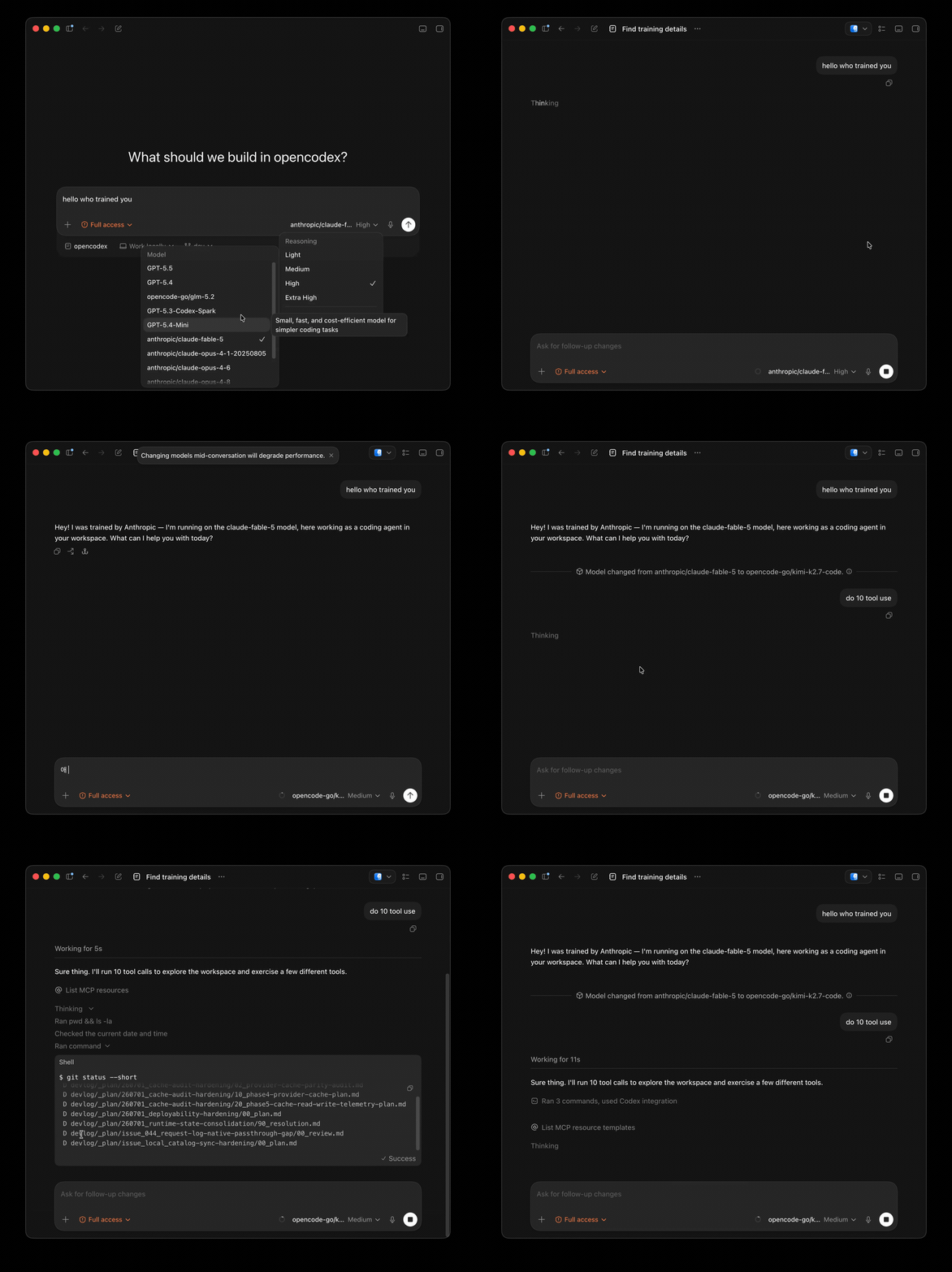
Universal provider proxy for OpenAI Codex & Claude Code — use any LLM (Claude, Gemini, Grok, DeepSeek, Ollama…) with Codex CLI, App, SDK, and Claude Code

Git-native persistent memory for AI coding agents. Implements Google OKF v0.2 with sub-300µs in-memory BM25 search, embedded MCP server, and progressive disclosure. Slashes token bloat by 80% with zero external databases or dependencies. Built in pure Go.

Local-first code intelligence graph for MCP and CLI. Builds a persistent map of your codebase so AI coding tools read only what matters, with benchmarked context reductions on reviews and large-repo workflows.

Stop your AI from making things up — it proposes, deterministic tools decide, every claim checked against ground truth with evidence. Grounded facts and context survive resets. Reverse engineering is the proving ground. MCP server + CLI.