

koala73/worldmonitorConnectors
Real-time global intelligence dashboard. AI-powered news aggregation, geopolitical monitoring, and infrastructure tracking in a unified situational awareness interface
86k
ontomics builds a semantic index of a repo’s concepts, conventions, and behavior, then serves that index through MCP. It parses source with tree-sitter, clusters concepts and logic with embeddings, and stores the result locally for fast repeated use.
Builders who want their agent to query concepts, naming patterns, and similar logic inside a codebase.
You can answer domain questions about a repo with one agent tool call instead of a long search trail.
Find concepts, related terms, abbreviations, naming patterns, and where each one appears with tools like `query_concept`, `list_concepts`, and `list_conventions`.
Compare function bodies by behavior with `find_similar_logic` and `describe_logic` to surface duplicated or related implementations.
Inspect files, entity maps, and type flow with `describe_file`, `concept_map`, `type_flows`, and `trace_type`.
Export repo knowledge as YAML with `export_domain_pack` so conventions can be reused in other projects.
Builds and stores the index in `<repo>/.ontomics/index.db`, then reloads it locally on later runs.
npm install -g @ontomics/ontomics
brew install EtienneChollet/tap/ontomics
curl --proto '=https' --tlsv1.2 -LsSf https://github.com/EtienneChollet/ontomics/releases/latest/download/ontomics-installer.sh | sh
git clone https://github.com/EtienneChollet/ontomics.git
cd ontomics
cargo build --release
claude mcp add -s user ontomics -- ontomics
codex mcp add ontomics -- ontomics





ontomics gives any coding agent instant knowledge of your codebase. One tool call instead of 19. ~20x fewer tokens.
https://github.com/user-attachments/assets/01afa8a0-1bc2-4686-94d7-965fef7610c3
Visualization for the voxelmorph project -- a library for unsupervised learning in image registration
Tested with Claude Sonnet — same question, with and without ontomics.
"What does 'transform' mean in this codebase?" on voxelmorph (full transcript):
| With ontomics | Without | |
|---|---|---|
| Tool calls | 1 | 19 |
| Tokens | ~3.7k | ~76k |
| Time | 5s | 1m 15s |
| Answer quality | Complete | Complete |
"What are the main domain concepts in this codebase?" on ScribblePrompt (full transcript):
| With ontomics | Without | |
|---|---|---|
| Tool calls | 1 | 26 |
| Tokens | ~3.7k | ~61.6k |
| Time | ~5s | 56s |
| Answer quality | Complete | Complete |
Both conditions produced complete, correct answers. ontomics got there in one call.
Search tells you where a string appears. An LSP tells you where a symbol is defined and referenced. Neither answers: what are the domain concepts in this codebase? How do they relate? What naming conventions emerged? What changed in the domain vocabulary since last release? Which functions behave similarly, regardless of what they're named?
ontomics builds a semantic index of your project's domain — clustering related symbols into concepts, detecting naming conventions from usage frequency, resolving abbreviations, grouping functions by behavioral similarity, and tracking how the vocabulary evolves over time. That index can be exported as a portable artifact to bootstrap conventions in other repos.
Beyond naming and concepts, ontomics embeds raw function bodies using CodeRankEmbed (768-dim, contrastive code retrieval) and clusters them by behavioral similarity. This surfaces relationships that neither naming nor call graphs expose:
❯ What functions behave like spatial_transform()?

  random_transform()   nn/functional.py:352   0.80
  spatial_transform()  functional.py:596      0.69
  random_transform()   functional.py:1399     0.67
  random_disp()        nn/functional.py:275   0.65
  integrate_disp()     functional.py:764      0.65
  compose()            nn/functional.py:216   0.63
  disp_to_trf()        functional.py:343      0.62
The result also reveals that random_transform appears at two locations with different similarity scores — a sign of implementation duplication that concept-level search would miss entirely.
Install once, available in every project. No configuration needed — ontomics auto-detects the repo and indexes it on first run.
ontomics requires a git repository (.git/ directory). It will refuse to index home, root, or temp directories. To index a non-git directory, pass --force.
npm (macOS/Linux):
npm install -g @ontomics/ontomics
macOS (Homebrew):
brew install EtienneChollet/tap/ontomics
Shell installer (macOS/Linux):
curl --proto '=https' --tlsv1.2 -LsSf https://github.com/EtienneChollet/ontomics/releases/latest/download/ontomics-installer.sh | sh
From source:
git clone https://github.com/EtienneChollet/ontomics.git
cd ontomics
cargo build --release
Claude Code:
claude mcp add -s user ontomics -- ontomics
Codex:
codex mcp add ontomics -- ontomics
OpenClaw:
openclaw mcp set ontomics '{"command":"ontomics"}'
pi-coding-agent:
pi install npm:@ontomics/ontomics
Share with your team — drop an .mcp.json in your repo root:
{
  "mcpServers": {
    "ontomics": {
      "command": "npx",
      "args": ["-y", "@ontomics/ontomics", "--repo", "."]
    }
  }
}
Python, TypeScript, JavaScript, Rust. Auto-detected from file extensions.
| Tool | What it does |
|---|---|
query_concept | Find all variants, related concepts, and occurrences of a term |
locate_concept | Find the key signatures, classes, and files for a concept |
describe_symbol | Get the signature, docstring, and relationships for a function or class |
trace_concept | Trace how a concept flows through the codebase via call chains |
list_concepts | List the top domain concepts by frequency |
list_conventions | List all detected naming patterns (prefixes, suffixes, conversions) |
list_entities | List code entities (classes, functions) filtered by concept, role, or kind |
check_naming | Check an identifier against project conventions; suggests the canonical form |
suggest_name | Generate an identifier name that fits the project's vocabulary |
vocabulary_health | Measure convention coverage, naming consistency, and cluster cohesion |
ontology_diff | Show new, changed, or removed domain concepts since a git ref |
export_domain_pack | Export domain knowledge as portable YAML for use in other repos |
| Tool | What it does |
|---|---|
find_similar_logic | Find functions with behaviorally similar implementations, ranked by embedding similarity |
describe_logic | Get the behavioral description, body text, and logic cluster membership for a function |
compact_context | Assemble tiered context (concepts + logic) for a symbol, optimized for LLM consumption |
| Tool | What it does |
|---|---|
describe_file | Overview of a file's entities, concepts, and relationships |
concept_map | Show which modules contain which domain concepts |
type_flows | Show dominant types and how data flows through the codebase |
trace_type | Trace how a specific type propagates across files and call sites |
| Resource | What it does |
|---|---|
ontomics://briefing | Session briefing: top conventions, abbreviations, key concepts, contrastive pairs, and vocabulary warnings. Also available via ontomics briefing CLI. |
ontomics runs a multi-stage pipeline entirely on your machine — no API keys required:
Both embedding models are downloaded once on first run and cached locally. The index lives at <repo>/.ontomics/index.db — subsequent startups load from cache and watch for file changes.
Configuration via .ontomics/config.toml in the repo root. All fields have sensible defaults. See SPEC.md for the full design contract.
Sign in to join the discussion.
No comments yet. Be the first to say what this is good for.
Real-time global intelligence dashboard. AI-powered news aggregation, geopolitical monitoring, and infrastructure tracking in a unified situational awareness interface
High-performance code intelligence MCP server. Indexes codebases into a persistent knowledge graph — average repo in milliseconds. 158 languages, sub-ms queries, 99% fewer tokens. Single static binary, zero dependencies.
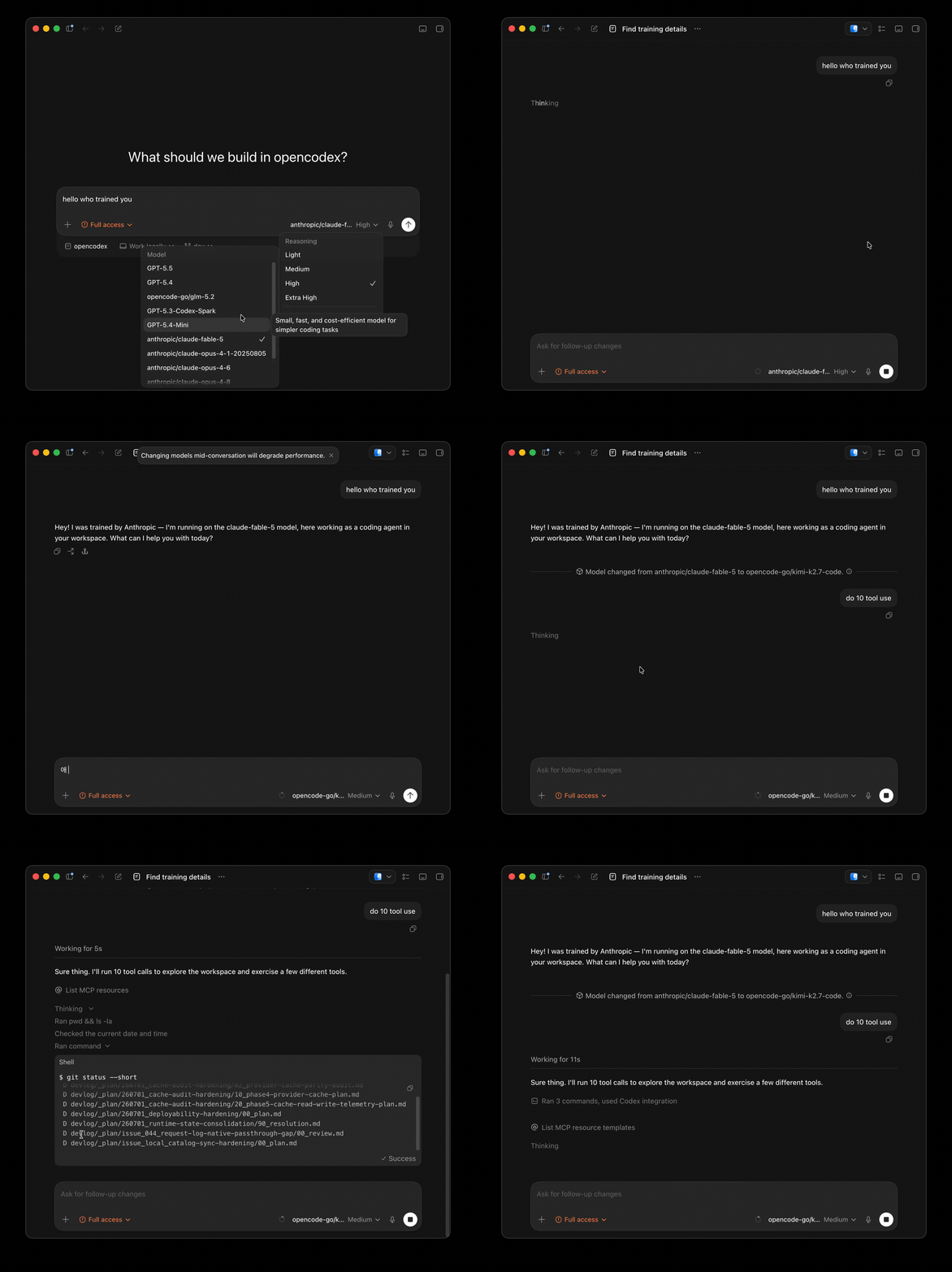
Universal provider proxy for OpenAI Codex & Claude Code — use any LLM (Claude, Gemini, Grok, DeepSeek, Ollama…) with Codex CLI, App, SDK, and Claude Code

Git-native persistent memory for AI coding agents. Implements Google OKF v0.2 with sub-300µs in-memory BM25 search, embedded MCP server, and progressive disclosure. Slashes token bloat by 80% with zero external databases or dependencies. Built in pure Go.

Local-first code intelligence graph for MCP and CLI. Builds a persistent map of your codebase so AI coding tools read only what matters, with benchmarked context reductions on reviews and large-repo workflows.

Stop your AI from making things up — it proposes, deterministic tools decide, every claim checked against ground truth with evidence. Grounded facts and context survive resets. Reverse engineering is the proving ground. MCP server + CLI.