
koala73/worldmonitorConnectors
Real-time global intelligence dashboard. AI-powered news aggregation, geopolitical monitoring, and infrastructure tracking in a unified situational awareness interface
86k
Pentest MCP is a Model Context Protocol server that exposes common security tooling to an agent. It supports stdio for local use, streamable HTTP for network use, and legacy SSE for compatibility.
Builders who want their agent to run authorized penetration-testing tools from one MCP server.
You can ask your agent to scan, enumerate, brute-force, and draft reports without wiring each tool by hand.
Runs tools such as `nmapScan`, `subfinderEnum`, `httpxProbe`, `ffufScan`, and `nucleiScan`.
Provides `runJohnTheRipper`, `runHashcat`, and `hydraBruteforce` for cracking and brute-force workflows.
Includes `trafficCapture`, `privEscAudit`, and `extractionSweep` for packet capture and testing tasks.
Stores engagement records and can create client reports from selected records or scope text.
Supports stdio, streamable HTTP, and deprecated SSE, plus bearer auth with OIDC JWKS or introspection.
npm install -g pentest-mcp
pentest-mcp
pentest-mcp inspector
pentest-mcp inspector --help
MCP_TRANSPORT=http MCP_SERVER_HOST=0.0.0.0 MCP_SERVER_PORT=8000 pentest-mcp
MCP_TRANSPORT=sse MCP_SERVER_PORT=8001 pentest-mcp

Professional penetration-testing MCP server with modern transport/auth support and expanded recon tooling.
@modelcontextprotocol/sdk@^1.26.0@modelcontextprotocol/inspector@^0.20.0) with bundled launcherMCP_TRANSPORT=http)subfinderEnum, httpxProbe, ffufScan, nucleiScan, trafficCapture, hydraBruteforce, privEscAudit, extractionSweeplistEngagementRecords, getEngagementRecordscopeMode=ask) with safe template fallbackhttpx-toolkit (preferred) or validated ProjectDiscovery httpx, avoiding Python httpx CLI collisionspentest-mcp inspector)nmapScanrunJohnTheRipperrunHashcatgobusterniktosubfinderEnumhttpxProbeffufScannucleiScantrafficCapturehydraBruteforceprivEscAuditextractionSweepgenerateWordlistlistEngagementRecordsgetEngagementRecordcreateClientReportcancelScannpm install -g pentest-mcp
pentest-mcp
pentest-mcp inspector
You can forward Inspector flags directly:
pentest-mcp inspector --help
MCP_TRANSPORT=http MCP_SERVER_HOST=0.0.0.0 MCP_SERVER_PORT=8000 pentest-mcp
MCP_TRANSPORT=sse MCP_SERVER_PORT=8001 pentest-mcp
stdio: default for local MCP clients.http: modern network transport. Recommended.sse: compatibility only. Deprecated and will be removed in a future major release.pentest-mcp inspector launches the bundled @modelcontextprotocol/inspector CLI.node <this-package-entrypoint> stdioSet these env vars when using MCP_TRANSPORT=http (or sse if needed):
MCP_AUTH_ENABLED=true
MCP_AUTH_MODE=bearer
MCP_AUTH_SCOPES=read,write
MCP_AUTH_AUDIENCE=
MCP_OIDC_ISSUER=https://issuer.example.com
MCP_OIDC_JWKS_URL=https://issuer.example.com/.well-known/jwks.json
# optional alternative/backup validation mode:
MCP_OIDC_INTROSPECTION_URL=https://issuer.example.com/oauth/introspect
MCP_OAUTH_CLIENT_ID=...
MCP_OAUTH_CLIENT_SECRET=...
Legacy aliases are still accepted temporarily:
MCP_OAUTH_ENABLEDMCP_OAUTH_PROVIDER_URLMCP_OAUTH_SCOPEScreateClientReport now supports SoW handling modes:
scopeMode=ask: prompt user via MCP elicitation (recommended)scopeMode=provided: use scopeOfWork value directlyscopeMode=template: use built-in generic authorized-testing templateIf elicitation is declined/unavailable, the report automatically falls back to the template.
There is no separate file-upload API yet. Current options are:
{
  "tool": "createClientReport",
  "arguments": {
    "title": "Q1 External Pentest",
    "assessmentType": "external-network",
    "scopeMode": "ask"
  }
}
scopeOfWork{
"tool": "createClientReport",
"arguments": {
"title": "Q1 External Pentest",
"assessmentType": "external-network",
"scopeMode": "provided",
"scopeOfWork": "Authorized targets: ...\nOut-of-scope: ...\nTesting window: ...\nRules of engagement: ..."
}
}
{
  "tool": "createClientReport",
  "arguments": {
    "title": "Q1 External Pentest",
    "assessmentType": "external-network",
    "scopeMode": "template"
  }
}
recordId=...) with invocation context.listEngagementRecords to pull all work artifacts quickly.recordIds (or latest records by default) instead of manual copy/paste.ask)provided)template)These are planned specifically to reduce pentest admin overhead.
scopeFilePath ingestion (load SoW from a local file path on the MCP host)scopeDocument chunked upload flow (send SoW content directly through MCP for remote clients)recordId) to findings and report sectionsnuclei, nikto, etc.)Adoption note:
scopeFilePath and scopeDocument because most teams already maintain SoW in docs/PDF and want to avoid repeated paste-and-reformat steps.{
"tool": "subfinderEnum",
"arguments": {
"domain": "example.com",
"recursive": true,
"allSources": true
}
}
{
  "tool": "httpxProbe",
  "arguments": {
    "targets": ["example.com", "api.example.com"],
    "includeTitle": true,
    "includeStatusCode": true
  }
}
{
  "tool": "ffufScan",
  "arguments": {
    "targetUrl": "https://example.com/FUZZ",
    "wordlist": "/usr/share/seclists/Discovery/Web-Content/common.txt",
    "threads": 40
  }
}
{
  "tool": "nucleiScan",
  "arguments": {
    "targets": ["https://example.com"],
    "severities": ["medium", "high", "critical"]
  }
}
{
  "tool": "trafficCapture",
  "arguments": {
    "networkInterface": "eth0",
    "packetCount": 200,
    "bpfFilter": "tcp port 80"
  }
}
{
  "tool": "hydraBruteforce",
  "arguments": {
    "target": "10.10.10.20",
    "service": "ssh",
    "usernameList": "/usr/share/seclists/Usernames/top-usernames-shortlist.txt",
    "passwordList": "/usr/share/seclists/Passwords/Common-Credentials/10k-most-common.txt"
  }
}
{
  "tool": "extractionSweep",
  "arguments": {
    "targetUrl": "https://target.local/item.php?id=1",
    "risk": 2,
    "level": 3
  }
}
docker-compose --profile http up
docker-compose --profile stdio up
docker-compose --profile sse up
The Docker image installs:
nmap, john, hashcat, gobuster, nikto, ffuf, hydra, sqlmap, tcpdumpsubfinder, httpx + httpx-toolkit alias, nucleiEnsure the binaries are in PATH:
which nmap john hashcat gobuster nikto subfinder httpx-toolkit ffuf nuclei hydra sqlmap tcpdump
If httpx-toolkit is not installed, a validated ProjectDiscovery httpx binary is accepted as fallback.
Authorized use only. Run against systems/networks where you have explicit written permission.
Last updated: 2026-03-23
Model Context Protocol (MCP) is still one of the most useful interoperability layers for tools and agents. The tradeoff is that large MCP servers can expose many tools, and naive tool-calling can flood context windows with schemas, tool chatter, and irrelevant call traces.
In practice, "more tools" is not always "better outcomes." Tool surface area must be paired with execution patterns that keep token use bounded and behavior predictable.
Recent workflows increasingly move complex orchestration out of chat context and into code execution loops. This reduces repetitive schema tokens and makes tool usage auditable and testable.
Core reading:
For users who want reproducible and lower-noise MCP usage, start with a codemode-oriented setup:
Practical caveat: even with strong setup, model behavior can still be inconsistent across providers and versions. Keep retries, guardrails, and deterministic fallbacks in place.
A high-leverage pattern is wrapping MCP servers into callable code interfaces and task-focused CLIs instead of exposing every raw tool to the model at all times.
Reference tooling:
This space changes fast. If you are reading this now, parts of this guidance may already be stale.
Prompt injection remains an open security problem for tool-using agents. It is manageable, but not "solved."
Primary risks:
Consequences:
Mitigation baseline:
Treat every tool output as untrusted input unless explicitly verified.
This server targets MCP protocol version 2025-11-25 and SDK @modelcontextprotocol/sdk@^1.27.1.
| Feature | Status |
|---|---|
| stdio transport | Supported (default) |
| Streamable HTTP transport | Supported (MCP_TRANSPORT=http) |
| SSE transport (legacy) | Deprecated compatibility mode |
| Tool annotations | All tools annotated with title, readOnlyHint, destructiveHint, idempotentHint, openWorldHint |
| Bearer auth (OIDC/JWKS) | Supported |
| Origin validation (HTTP) | 403 on invalid Origin when MCP_ALLOWED_ORIGINS is set |
| JSON Schema 2020-12 | Zod-generated schemas |
| Structured tool errors | isError flag with descriptive messages for model self-correction |
| Elicitation | Used for SoW capture in report generation |
Sign in to join the discussion.
No comments yet. Be the first to say what this is good for.
Real-time global intelligence dashboard. AI-powered news aggregation, geopolitical monitoring, and infrastructure tracking in a unified situational awareness interface
High-performance code intelligence MCP server. Indexes codebases into a persistent knowledge graph — average repo in milliseconds. 158 languages, sub-ms queries, 99% fewer tokens. Single static binary, zero dependencies.
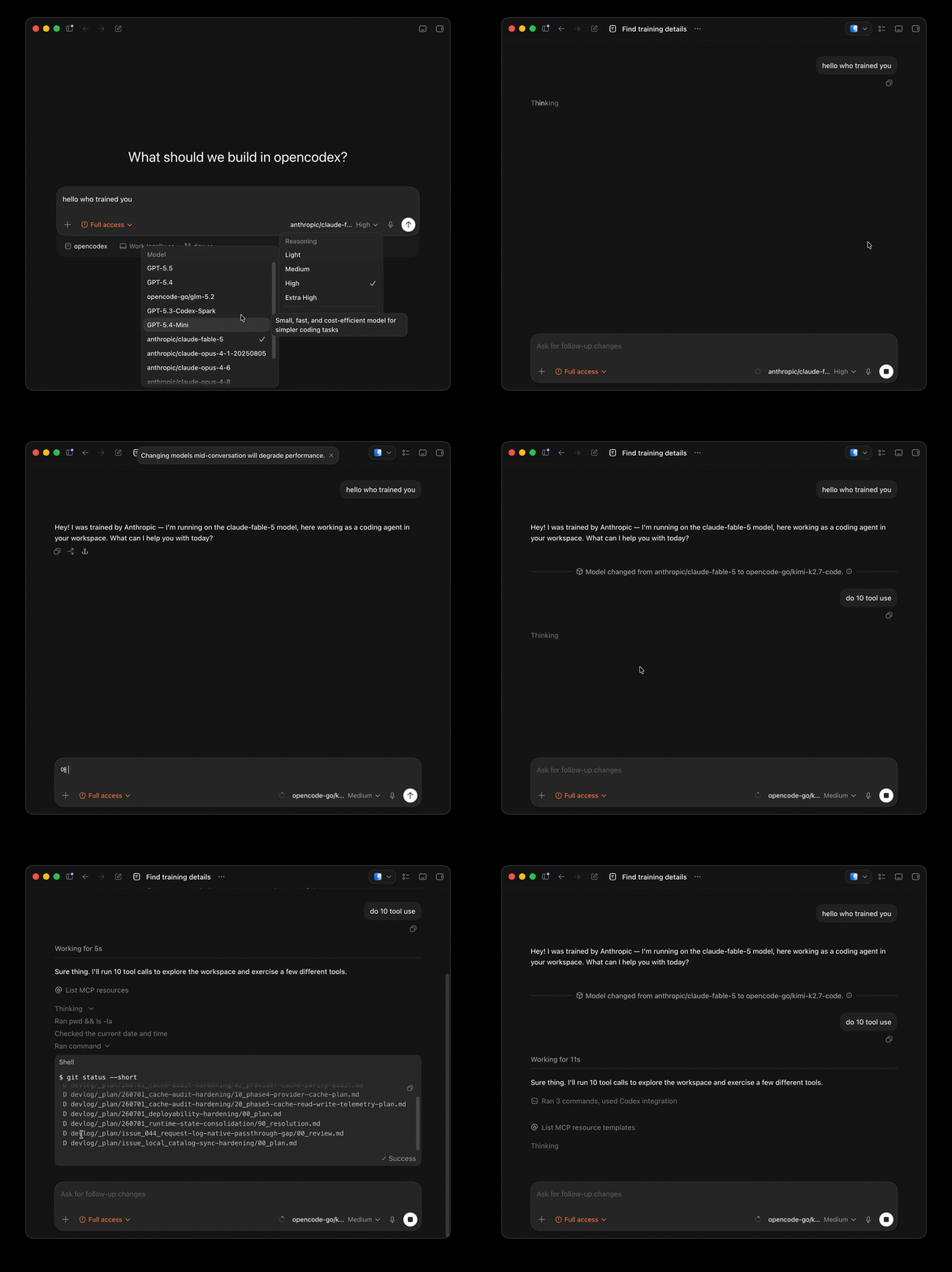
Universal provider proxy for OpenAI Codex & Claude Code — use any LLM (Claude, Gemini, Grok, DeepSeek, Ollama…) with Codex CLI, App, SDK, and Claude Code

Git-native persistent memory for AI coding agents. Implements Google OKF v0.2 with sub-300µs in-memory BM25 search, embedded MCP server, and progressive disclosure. Slashes token bloat by 80% with zero external databases or dependencies. Built in pure Go.

Local-first code intelligence graph for MCP and CLI. Builds a persistent map of your codebase so AI coding tools read only what matters, with benchmarked context reductions on reviews and large-repo workflows.

Stop your AI from making things up — it proposes, deterministic tools decide, every claim checked against ground truth with evidence. Grounded facts and context survive resets. Reverse engineering is the proving ground. MCP server + CLI.