
koala73/worldmonitorConnectors
Real-time global intelligence dashboard. AI-powered news aggregation, geopolitical monitoring, and infrastructure tracking in a unified situational awareness interface
86k
This server plugs MCP clients into printer management systems and model-processing tools. It handles printer status, file uploads, job control, temperature changes, slicing, and STL edits, with extra support for Bambu workflows and FULU OrcaSlicer-bambulab.
Builders who want an agent to control printers, slice models, and inspect print state from Claude Code, Codex, Cursor, or another MCP client.
You can ask your agent to manage print jobs and prepare models without leaving your chat or editor.
Gets status, lists files, uploads G-code, starts or cancels jobs, and sets temperatures across supported printer systems.
Scales, rotates, translates, extends the base, and edits sections of STL files.
Produces detailed STL analysis and multi-angle SVG previews for a model.
Slices STL files into G-code and supports direct Bambu 3MF printing.
Uses the FULU Bambu slicer path for Bambu-compatible 3MF export and setup checks.
Reads Bambu Studio printer, filament, and process preset files as MCP resources.
Runs over `stdio` or `streamable-http` depending on environment configuration.
npm install -g mcp-3d-printer-server
git clone https://github.com/dmontgomery40/mcp-3d-printer-server.git
cd mcp-3d-printer-server
npm install
npm link  # Makes the command available globally
docker-compose up --build -d
dism.exe /online /enable-feature /featurename:Microsoft-Windows-Subsystem-Linux /all /norestart
dism.exe /online /enable-feature /featurename:VirtualMachinePlatform /all /norestart
powershell.exe -NoProfile -ExecutionPolicy Bypass -File .\install_runtime.ps1 -PackageDir . -PluginDir .
powershell.exe -NoProfile -ExecutionPolicy Bypass -File .\verify_runtime.ps1 -PackageDir . -PluginDir .
export FULU_ORCA_PLUGIN_DIR="/Applications/OrcaSlicer.app/Contents/MacOS"
bash "$FULU_ORCA_PLUGIN_DIR/install_runtime_macos.sh" -PackageDir "$FULU_ORCA_PLUGIN_DIR" -PluginDir "$FULU_ORCA_PLUGIN_DIR"
bash "$FULU_ORCA_PLUGIN_DIR/verify_runtime_macos.sh" -PackageDir "$FULU_ORCA_PLUGIN_DIR" -PluginDir "$FULU_ORCA_PLUGIN_DIR"
Thank you to the FULU Foundation and Louis Rossmann for standing up for consumer ownership, open source developers, repair rights, and users who should not have working hardware made worse by locked-down software. This MCP server treats the FULU OrcaSlicer-bambulab fork as a first-class Bambu project slicer target.








stdio and streamable-http runtime modes with environment-based transport selection.orcaslicer-bambulab / fulu_orca slicer support for Bambu project 3MF export, and made it the default Bambu slicer target when no slicer is configured.startJob, setTemperature, and print_3mf.blender_mcp_edit_model with optional execution mode for model-edit collaboration workflows.initialize, tools/list, success + failing tools/call, origin rejection).getStatus for Bambu to subscribe to MQTT reports and maintain real-time state..3mf slicer config or user overrides for the MQTT print command..3mf Print Overrides: Add logic to the print_3mf tool to handle user-provided overrides (e.g., calibration flags) and potentially common slicer settings if feasible via MQTT/G-code..3mf file in the MQTT print command (optional but recommended by protocol).bambu-js FTP operations (getFiles, uploadFile) with direct MQTT methods if possible/stable, or contribute FTPS support to bambu-js..3mf Support: Add .3mf printing support for other printer types where applicable.This is a server that allows MCP users to connect with the API endpoints of these 3D Printers:
This server is a Model Context Protocol (MCP) server for connecting Claude with 3D printer management systems. It allows MCP to interact with 3D printers through the APIs of various printer management systems such as OctoPrint, Klipper (via Moonraker), Duet, Repetier, and Bambu Labs printers.
Note on Resource Usage: This MCP server includes advanced 3D model manipulation features that can be memory-intensive when working with large STL files. Please see the "Limitations and Considerations" section for important information about memory usage and performance.
.3mf files directly on Bambu Lab printers (via MQTT command)SLICER_TYPE=orcaslicer-bambulab) and auto-slice unsliced 3MF files before Bambu printing when a project slicer is configuredcheck_fulu_orca_setup) and call safe-by-default FULU bridge RPC methods for diagnostics and development (fulu_bambu_network_rpc)npm install -g mcp-3d-printer-server
git clone https://github.com/dmontgomery40/mcp-3d-printer-server.git
cd mcp-3d-printer-server
npm install
npm link  # Makes the command available globally
You can also run the server using Docker and Docker Compose for a containerized environment.
.env.example to .env and configure your settings.docker-compose up --build -d
Please note that the default Docker setup cannot directly use a slicer installed on your host machine. Mounting the slicer executable directly from the host into the container is unreliable due to operating system and library differences between your host and the container.
The recommended approach is to install your preferred slicer inside the Docker image. This makes the container self-sufficient.
To do this, you will need to modify the Dockerfile. Here's a conceptual example of how you might add PrusaSlicer, OrcaSlicer, or the FULU OrcaSlicer-bambulab build (specific commands may vary depending on the slicer, its dependencies, and current Alpine packages):
# ... other Dockerfile commands ...

# Example: Install PrusaSlicer, OrcaSlicer, or FULU OrcaSlicer-bambulab (adjust command as needed)
# Check Alpine package repositories first (e.g., apk add prusaslicer or apk add orcaslicer)
# If not available, download and install manually (e.g., AppImage):
# RUN apk add --no-cache fuse # FUSE might be needed for AppImages
# RUN wget https://example.com/path/to/OrcaSlicer_Linux_Vxxxx.AppImage -O /usr/local/bin/orcaslicer && \
#     chmod +x /usr/local/bin/orcaslicer

# Set the SLICER_PATH env var accordingly in docker-compose.yml or when running
# Example for installed executable:
ENV SLICER_PATH=/usr/local/bin/orcaslicer

# ... rest of Dockerfile ...
After modifying the Dockerfile, rebuild your image (docker-compose build). You'll also need to ensure the SLICER_PATH environment variable in your .env file or docker-compose.yml points to the correct path inside the container (e.g., /usr/local/bin/orcaslicer). For the FULU Bambu-enabled fork, set SLICER_TYPE=orcaslicer-bambulab.
Apologies for not including a specific slicer out-of-the-box, but given the wide variety of slicers (PrusaSlicer, OrcaSlicer, Cura, etc.) and configurations available, pre-installing one would unnecessarily bloat the image for many users. If a particular slicer becomes a very common request, I can certainly look into adding official support for it in a future version.
Create a .env file in the directory where you'll run the server or set environment variables:
# Required for authentication with your printer management system
API_KEY=your_api_key_here

# Default printer connection settings
PRINTER_HOST=localhost
PRINTER_PORT=80 # Port for non-Bambu HTTP APIs
PRINTER_TYPE=octoprint  # Options: octoprint, klipper, duet, repetier, bambu, prusa, creality

# Optional: Directory for temporary files
TEMP_DIR=/path/to/temp/dir

# Bambu Labs specific configuration
BAMBU_SERIAL=your_printer_serial # REQUIRED for Bambu
BAMBU_TOKEN=your_access_token    # REQUIRED for Bambu
BAMBU_MODEL=p1s                  # REQUIRED for Bambu: p1s, p1p, x1c, x1e, a1, a1mini, h2d
BED_TYPE=textured_plate          # Bed plate: textured_plate, cool_plate, engineering_plate, hot_plate
NOZZLE_DIAMETER=0.4              # Nozzle diameter in mm (default: 0.4)

# Slicer configuration (for slice_stl tool)
# For Bambu projects, the default is orcaslicer-bambulab unless SLICER_TYPE is set.
SLICER_TYPE=orcaslicer-bambulab  # Options: prusaslicer, cura, slic3r, orcaslicer, orcaslicer-bambulab, bambustudio
SLICER_PATH=/path/to/slicer/executable
SLICER_PROFILE=/path/to/slicer/profile

# Optional aliases for FULU OrcaSlicer-bambulab when SLICER_PATH is not set
FULU_ORCA_PATH=/path/to/FULU/OrcaSlicer
ORCASLICER_BAMBULAB_PATH=/path/to/FULU/OrcaSlicer
FULU_ORCA_PLUGIN_DIR=/path/to/FULU/OrcaSlicer.app/Contents/MacOS
ORCASLICER_BAMBULAB_PLUGIN_DIR=/path/to/FULU/OrcaSlicer.app/Contents/MacOS

# Optional FULU BambuNetwork bridge runtime
# macOS default runtime dir:
# /Users/you/Library/Application Support/OrcaSlicer/macos-bridge/runtime
PJARCZAK_MAC_RUNTIME_DIR=
FULU_BAMBU_BRIDGE_COMMAND=

# Optional: Path to Bambu Studio user config dir (for loading presets)
# Example macOS: /Users/your_user/Library/Application Support/BambuStudio/user/YOUR_USER_ID
# Example Windows: C:\Users\your_user\AppData\Roaming\BambuStudio\user\YOUR_USER_ID
# Example Linux: /home/your_user/.config/BambuStudio/user/YOUR_USER_ID
BAMBU_STUDIO_CONFIG_PATH=

# MCP transport configuration
MCP_TRANSPORT=stdio             # Options: stdio, streamable-http
MCP_HTTP_HOST=127.0.0.1
MCP_HTTP_PORT=3000
MCP_HTTP_PATH=/mcp
MCP_HTTP_STATEFUL=true
MCP_HTTP_JSON_RESPONSE=true
MCP_HTTP_ALLOWED_ORIGINS=http://localhost

# Optional bridge command for blender_mcp_edit_model execute=true mode
BLENDER_MCP_BRIDGE_COMMAND=

# Accept per-call executable selectors instead of reading commands and paths
# from server environment configuration. Off by default: slicer_path,
# bridge_command, and active-probe path overrides can select which local
# executable launches. MCP_ALLOW_BRIDGE_COMMAND_ARG remains a legacy alias for
# bridge commands and bridge-derived probe paths only.
MCP_ALLOW_EXECUTABLE_ARG=false
Add this server to your MCP client's config (Claude Desktop, Claude Code, Cursor, Codex, or any MCP-compatible client). Most JSON-based clients use an mcpServers entry with the command and env vars:
{
  "mcpServers": {
    "3dprint": {
      "command": "npx",
      "args": ["-y", "mcp-3d-printer-server"],
      "env": {
        "PRINTER_HOST": "your_printer_ip",
        "PRINTER_TYPE": "bambu",
        "BAMBU_SERIAL": "your_printer_serial",
        "BAMBU_TOKEN": "your_access_token",
        "BAMBU_MODEL": "p1s",
        "SLICER_TYPE": "orcaslicer-bambulab",
        "SLICER_PATH": "/path/to/FULU/OrcaSlicer",
        "FULU_ORCA_PLUGIN_DIR": "/Applications/OrcaSlicer.app/Contents/MacOS"
      }
    }
  }
}
For non-Bambu printers, replace the Bambu-specific env vars with API_KEY and the appropriate PRINTER_TYPE (see Supported Printer Management Systems).
Use FULU-Foundation/OrcaSlicer-bambulab as the first-class Bambu project slicer by setting:
PRINTER_TYPE=bambu
SLICER_TYPE=orcaslicer-bambulab
SLICER_PATH=/path/to/FULU/OrcaSlicer
FULU_ORCA_PLUGIN_DIR=/path/to/FULU/runtime/payload
BAMBU_MODEL=p1s
Accepted aliases include fulu_orca, fulu-orca, orca-studio, and orca_bambulab. For Bambu printers, this is the default slicer family when SLICER_TYPE is not set.
What the integration does:
slice_stl uses the FULU/Orca project CLI shape (--slice 0 --export-3mf) to produce a sliced Bambu-compatible 3MF.print_3mf can auto-slice an unsliced 3MF through FULU OrcaSlicer-bambulab, then upload and start the sliced project through this server's Bambu print path.check_fulu_orca_setup verifies the FULU executable, platform runtime payload, setup commands, and optional BambuNetwork bridge handshake.fulu_bambu_network_rpc can call the FULU bridge protocol for diagnostics and development. Read-only methods are allowed by default; mutating methods require allow_mutating_method=true; FULU print methods still require bambu_model.What stays deliberately explicit:
BAMBU_SERIAL, BAMBU_TOKEN, and PRINTER_HOST.BAMBU_MODEL remains mandatory for Bambu print operations because wrong machine presets can produce dangerous G-code.This integration has been tested against the current FULU macOS release artifacts and a local Benchy smoke test. The MCP-side bug found during that bench was real: Bambu-family project slicers must use Orca/Bambu preset JSON with --load-settings, not the invalid --load-machine flag. That is fixed here.
The old Bambu Studio fallback still works. Set:
SLICER_TYPE=bambustudio
SLICER_PATH=/Applications/BambuStudio.app/Contents/MacOS/BambuStudio
With that fallback, the same Benchy 3MF sliced successfully through Bambu Studio's CLI into a Bambu-compatible project 3MF. This is the known-good path while FULU platform packaging settles.
macOS is not proven green yet. On this Mac, the FULU arm64 and x86_64 macOS release bundles hit the same CLI slice problem during Benchy testing: one path crashed with SIGSEGV inside OrcaSlicer CLI processing, and repeated attempts left uninterruptible macOS UE processes that ignored SIGKILL. The MCP now avoids pretending that is solved. check_fulu_orca_setup can inspect the bundle and bridge payload, but macOS users should treat FULU CLI slicing as active feedback territory until FULU ships a stable macOS CLI/runtime combination.
We need Windows testers. The WSL 2 setup path, payload checks, and bridge command shape are represented in this MCP, but the full Windows path still needs real reports from people who can validate install_runtime.ps1, verify_runtime.ps1, bridge probing, CLI slicing, and a known-safe print workflow on their own machine.
We will keep iterating with user and contributor feedback. Please report the OS, CPU architecture, FULU release asset name, check_fulu_orca_setup result, slicer command stderr, and whether the Bambu Studio fallback works on the same model.
The FULU README currently says macOS is work in progress, but the source tree already ships macOS Lima runtime scripts and Windows WSL runtime scripts. This MCP knows those file layouts and returns the exact commands through check_fulu_orca_setup.
Windows:
dism.exe /online /enable-feature /featurename:Microsoft-Windows-Subsystem-Linux /all /norestart
dism.exe /online /enable-feature /featurename:VirtualMachinePlatform /all /norestart
Restart Windows, then run the FULU package scripts from the directory that contains install_runtime.ps1:
powershell.exe -NoProfile -ExecutionPolicy Bypass -File .\install_runtime.ps1 -PackageDir . -PluginDir .
powershell.exe -NoProfile -ExecutionPolicy Bypass -File .\verify_runtime.ps1 -PackageDir . -PluginDir .
Linux:
Install the FULU OrcaSlicer-bambulab build normally, set SLICER_TYPE=orcaslicer-bambulab, and point SLICER_PATH at the executable. If you want bridge-level diagnostics, set FULU_BAMBU_BRIDGE_COMMAND to the packaged pjarczak_bambu_linux_host.
macOS:
Set the app payload directory, then run the scripts that FULU copies into the app bundle:
export FULU_ORCA_PLUGIN_DIR="/Applications/OrcaSlicer.app/Contents/MacOS"
bash "$FULU_ORCA_PLUGIN_DIR/install_runtime_macos.sh" -PackageDir "$FULU_ORCA_PLUGIN_DIR" -PluginDir "$FULU_ORCA_PLUGIN_DIR"
bash "$FULU_ORCA_PLUGIN_DIR/verify_runtime_macos.sh" -PackageDir "$FULU_ORCA_PLUGIN_DIR" -PluginDir "$FULU_ORCA_PLUGIN_DIR"
The default installed runtime is:
~/Library/Application Support/OrcaSlicer/macos-bridge/runtime
The bridge command shape is:
"/Applications/OrcaSlicer.app/Contents/MacOS/pjarczak-bambu-linux-host-wrapper" "$HOME/Library/Application Support/OrcaSlicer/macos-bridge/runtime/pjarczak_bambu_linux_host"
If your app is named Orca Studio.app or lives somewhere else, pass its real Contents/MacOS path as plugin_dir or FULU_ORCA_PLUGIN_DIR.
Ask your MCP client to call check_fulu_orca_setup, or call it from an agent with arguments like:
{
  "platform": "darwin",
  "slicer_path": "/Applications/OrcaSlicer.app/Contents/MacOS/OrcaSlicer",
  "plugin_dir": "/Applications/OrcaSlicer.app/Contents/MacOS",
  "run_bridge_probe": true,
  "bridge_command": "\"/Applications/OrcaSlicer.app/Contents/MacOS/pjarczak-bambu-linux-host-wrapper\" \"$HOME/Library/Application Support/OrcaSlicer/macos-bridge/runtime/pjarczak_bambu_linux_host\""
}
The result reports missing payload files, install/verify commands, the MCP env values to use, and bridge handshake/capability/runtime info when probing is enabled.
Per-call executable selectors require
MCP_ALLOW_EXECUTABLE_ARG=1. By default the bridge command and its derived paths are read from server environment configuration. Passingbridge_command, or passingslicer_path,plugin_dir, orruntime_dirwithrun_bridge_probe=true, returns an error naming the opt-in flag. Non-executing setup inspection can still use the path arguments without the flag. These values select which local executable this server launches, so accepting them for a probe lets whatever is steering the model — a downloaded model's description, a README in an archive, 3MF metadata — choose that program. The same gate applies toslicer_pathon slicing tools. Set the flag only for trusted iterative diagnostics; leave it off for normal use.
fulu_bambu_network_rpc speaks the FULU bridge frame protocol from the MCP side. The protocol is little-endian binary frames with JSON bodies, using methods such as bridge.handshake, bridge.capabilities, bridge.runtime_info, and net.get_user_print_info.
Safe diagnostic example:
{
  "method": "bridge.runtime_info",
  "bridge_command": "\"/Applications/OrcaSlicer.app/Contents/MacOS/pjarczak-bambu-linux-host-wrapper\" \"$HOME/Library/Application Support/OrcaSlicer/macos-bridge/runtime/pjarczak_bambu_linux_host\""
}
Mutating methods are intentionally gated:
{
  "method": "net.start_print",
  "allow_mutating_method": true,
  "bambu_model": "p1s",
  "payload": {
    "client_job_id": 1,
    "params": {
      "dev_id": "YOUR_PRINTER_ID"
    }
  }
}
That second example is intentionally incomplete because real BambuNetwork print calls need the full FULU/Bambu print parameter payload. The important part is that the MCP exposes the bridge without pretending a cloud print can be safely inferred from a local filename.
Where this config lives depends on your client and OS:
| Client / scope | macOS / Linux location | Windows location |
|---|---|---|
| Claude Desktop (macOS / Windows) | ~/Library/Application Support/Claude/claude_desktop_config.json | %APPDATA%\Claude\claude_desktop_config.json |
| Claude Desktop (Linux) | Not officially supported for local MCP yet; Claude Desktop docs still list Linux support as coming soon. | N/A |
| Claude Code (project-shared MCP) | .mcp.json in the project root | .mcp.json in the project root |
| Claude Code (user/local MCP) | ~/.claude.json | %USERPROFILE%\.claude.json |
| Claude Code settings (not MCP server definitions) |
Sign in to join the discussion.
No comments yet. Be the first to say what this is good for.
Real-time global intelligence dashboard. AI-powered news aggregation, geopolitical monitoring, and infrastructure tracking in a unified situational awareness interface
High-performance code intelligence MCP server. Indexes codebases into a persistent knowledge graph — average repo in milliseconds. 158 languages, sub-ms queries, 99% fewer tokens. Single static binary, zero dependencies.
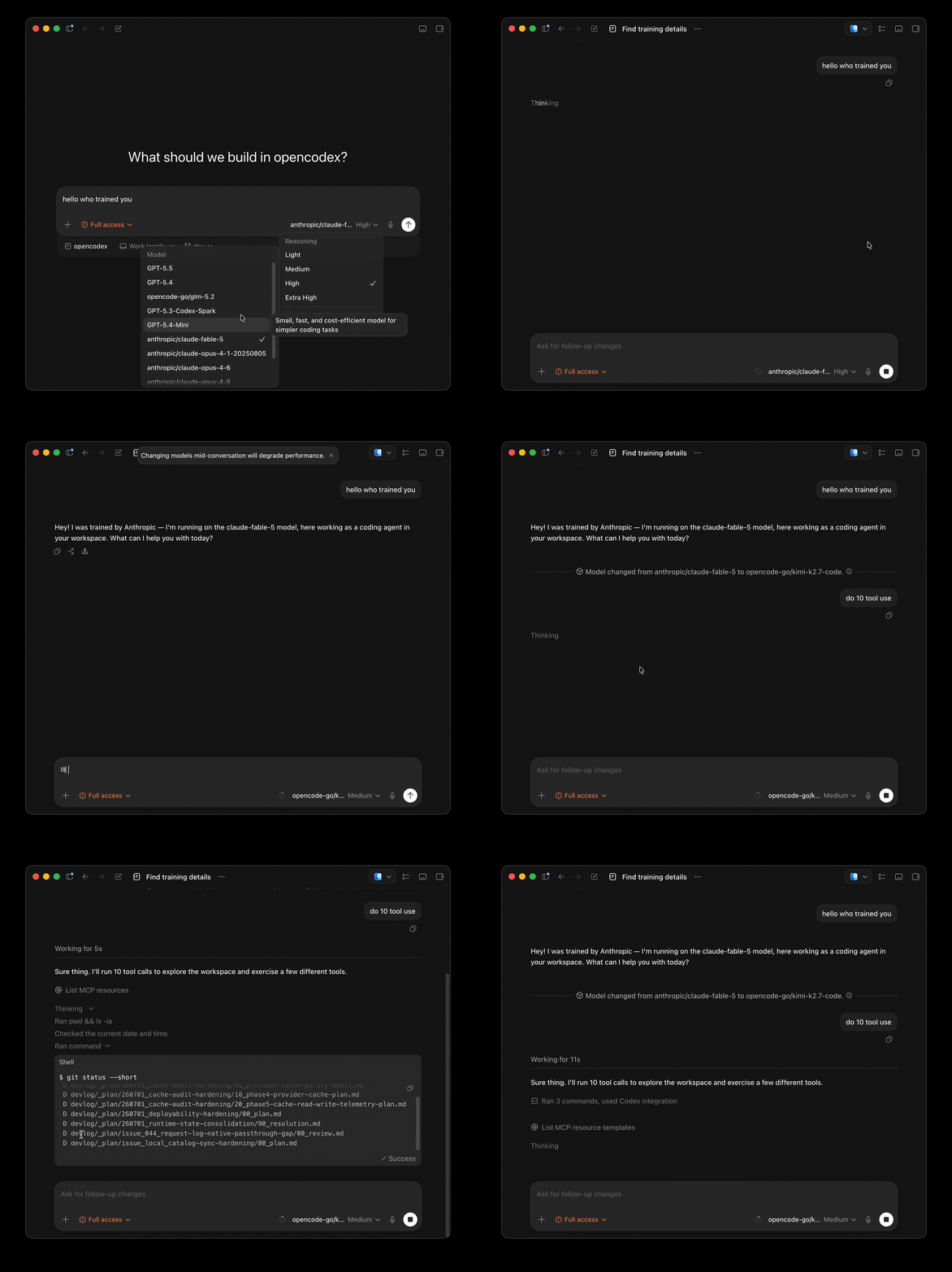
Universal provider proxy for OpenAI Codex & Claude Code — use any LLM (Claude, Gemini, Grok, DeepSeek, Ollama…) with Codex CLI, App, SDK, and Claude Code

Git-native persistent memory for AI coding agents. Implements Google OKF v0.2 with sub-300µs in-memory BM25 search, embedded MCP server, and progressive disclosure. Slashes token bloat by 80% with zero external databases or dependencies. Built in pure Go.

Local-first code intelligence graph for MCP and CLI. Builds a persistent map of your codebase so AI coding tools read only what matters, with benchmarked context reductions on reviews and large-repo workflows.

Stop your AI from making things up — it proposes, deterministic tools decide, every claim checked against ground truth with evidence. Grounded facts and context survive resets. Reverse engineering is the proving ground. MCP server + CLI.