

heygen-com/hyperframesFrameworks & SDKs
Write HTML. Render video. Built for agents.
49k
OpenGUI gives agents a way to inspect Android screens, plan the next step, and perform actions on real devices. The repository pairs a server-side execution graph with an Android accessibility client, plus skills for bootstrap and remote control.
Builders who want their agent to control Android apps through the GUI.
You can run mobile tasks on a real phone instead of re-explaining each step to your agent.
Reads screenshots from a real device and turns them into structured task steps.
Uses backend graph pieces to plan work, run actions, and summarize results.
Accepts tasks through CLI, Discord, and other dispatch paths when the phone is on standby.
Provides `skills/open-gui-bootstrap/SKILL.md` so Claude Code or Codex can set up the stack with fewer manual steps.
Provides `skills/open-gui-remote-control/SKILL.md` for listing devices, sending tasks, and checking execution status.
Uses the Android accessibility client to install, launch, and operate apps on-device.
cd server
pnpm opengui -- devices --json
pnpm opengui -- do "Observe the current Android screen and summarize what you see" --json
pnpm opengui -- status <executionId> --json
pnpm opengui -- cancel <executionId> --json
Read ./skills/open-gui-bootstrap/SKILL.md and help me run OpenGUI. Only ask me for phone-side actions.
Read ./skills/open-gui-bootstrap/SKILL.md and bootstrap OpenGUI with the latest Claude Opus model family for planning, supervision, review, and vision.
Read ./skills/open-gui-bootstrap/SKILL.md and set up OpenGUI with Qwen 3.6 Plus for Planner and Supervisor, and Doubao Pro for VLM execution.
Read ./skills/open-gui-bootstrap/SKILL.md and use my existing model APIs to get OpenGUI working.
cd server
./start.sh
Language: English | 简体中文 | 日本語








A mobile GUI agent framework for Android.
OpenGUI helps AI agents see, understand, and operate Android app interfaces on real devices.
Recommended: use OpenGUI directly in DeepSeek Harness.
Paste one prompt into Codex. It downloads the verified plugin, installs it into DSH, and opens DSH. No full backend deployment is required.
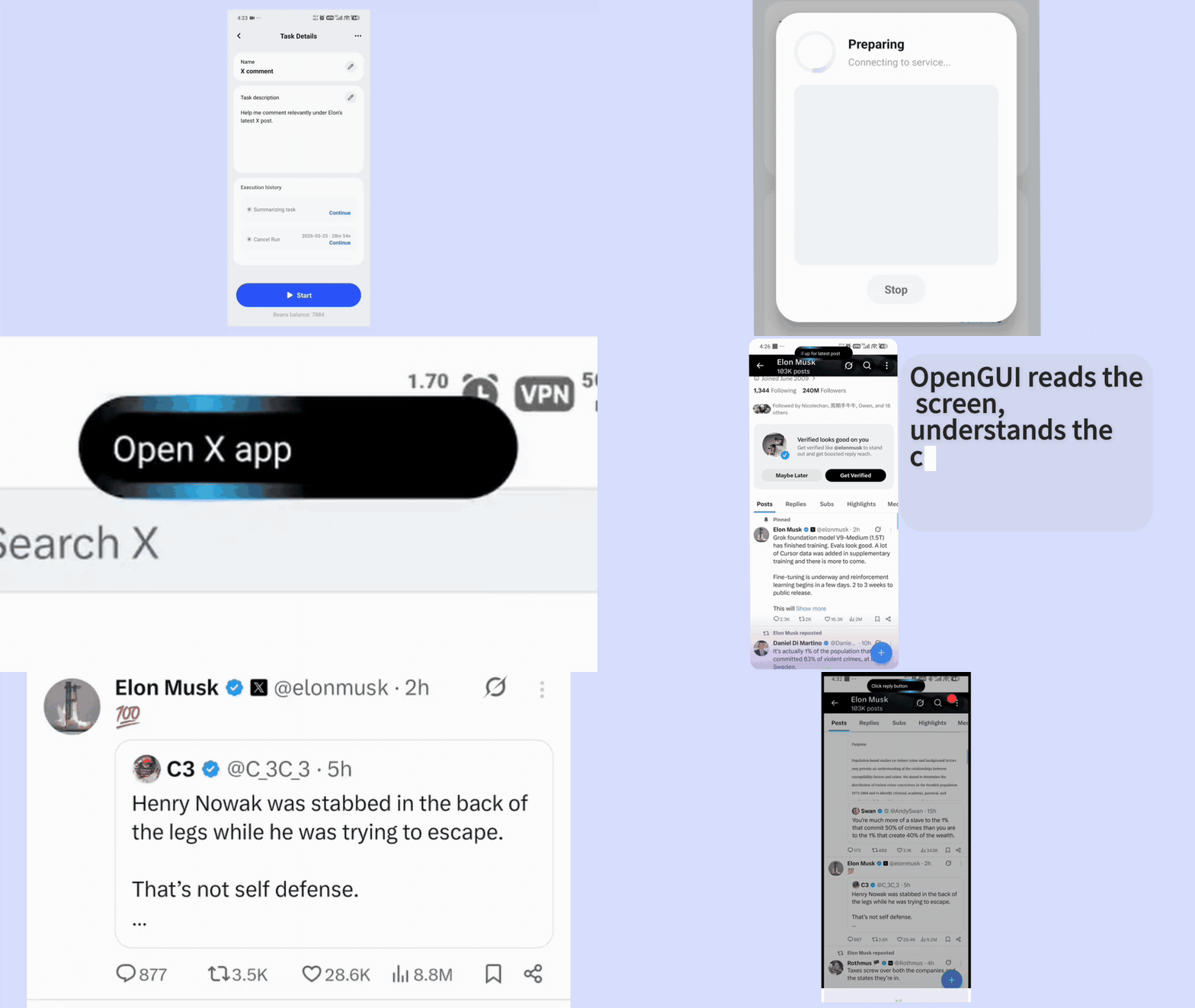
OpenGUI reads a real Android app UI, plans the next step, takes mobile actions, and returns structured results.
The shortest path on macOS is to let Codex run the stable installer Skill from main. Each run resolves the latest stable OpenGUI plugin release, while an explicit version remains available for rollback. It requires Node.js 22.19+ or 24+ and installs the compatible DSH version automatically. Paste this as one prompt:
Install and run the OpenGUI installer Skill from https://github.com/Core-Mate/OpenGUI/tree/main/deepseek-harness-plugin/skills/opengui-coremate-install for my DSH web profile. Install the latest stable release. Proceed autonomously, and only pause when I need to authorize or select a phone, add or select a DSH workspace, or provide fallback visual-model credentials.
The Skill downloads the public release package and checksum, verifies SHA-256, installs only the OpenGUI plugin, starts DSH when needed, and opens DSH. It preserves unrelated DSH plugins and settings. The installer reports whether it reloaded a managed DSH or whether you need to quit an existing process and rerun it. For Linux or Windows, use the manual package guide.
OpenGUI supports DSH 0.1.0-rc.7, 0.1.0-rc.8, 0.1.1-rc.1, and 0.1.1-rc.2; new installs default to 0.1.1-rc.2. The macOS installer reuses a PATH runtime only when it exactly matches the selected version, otherwise it installs an isolated managed runtime under the OpenGUI DSH home. Use --dsh-version VERSION to select a supported version. DSH 0.1.2-alpha.4 is not supported. Existing DSH installations, workspaces, model settings, credentials, and phone authorizations are preserved. DSH 0.1.0 RCs cannot read the versioned credential store written by DSH 0.1.1 RCs, so the installer refuses that state downgrade before changing any files and recommends a separate DSH home.
After installation, add or select a DSH workspace, connect and select an authorized Android phone, then send:
@OpenGUI Open Settings and report the Android version
The plugin adds phone and browser operation to DSH without requiring the full OpenGUI backend stack. The current source implementation admits one OpenGUI task per DSH session and separate tabs on non-conflicting phone sets; the managed browser remains globally serial. This source behavior is not a release claim. See more use cases or download the v0.1.13 release package.
Good fits include:
For GUI execution, our current recommendation order is:
| Priority | Model family | Guidance |
|---|---|---|
| 1 | Doubao VLM | Recommended first for visual GUI execution. |
| 2 | Qwen VLM | A practical alternative, but some social media prompts may be more sensitive to model safety policies. |
| 3 | OpenAI vision-capable models | Capable, but generally the higher-cost option for screenshot-heavy tasks. |
| 4 | Grok vision-capable models | Experimental for this workflow; tool use and action reliability still need more validation. |
Model availability, pricing, and policy behavior vary by version and region. Whichever provider you choose, the model must support both image input and tool calling.
WorkBuddy has a separate MCP + Skill + Hooks connector. It uses WorkBuddy's current visual model to operate Android phones and opens read-only scrcpy windows by default. No DSH installation, full OpenGUI backend, or extra model API key is required.
Version 0.2.0 is a local candidate in PR #95, not a published Release or marketplace installation. Start with macOS and WorkBuddy 5.5.3; Windows/Linux package checks do not establish phone-control support. Follow the macOS installation steps to build the candidate and install its MCP, opengui Skill and lifecycle Hooks together. The installer preserves other plugins and backs up the affected WorkBuddy configuration.
After restarting WorkBuddy, enable/trust the opengui MCP if prompted, connect a USB-debugging-authorized Android phone, select /opengui, and send:
Open Settings and report the Android version on my phone.
Phone tasks send screenshots to the selected model. For local viewing only, ask “Show my phone screens without taking screenshots for the model or operating the phones.” Task completion leaves the mirrors open. Closing a mirror does not cancel a running task; use WorkBuddy's stop control to stop execution.
If /opengui is missing or tasks do not continue automatically, see installation checks and troubleshooting. MCP alone does not install the Skill or Hooks.
To run the full OpenGUI backend and Android client, let Claude Code, Codex, or OpenCode bootstrap it for you.
Open Claude Code, Codex, or OpenCode from the OpenGUI repository root and paste:
Read ./skills/open-gui-bootstrap/SKILL.md and help me run OpenGUI. Only ask me for phone-side actions.
In this bootstrap flow, the coding agent reads the skill, starts the local backend, builds or installs the Android client, runs the required adb setup, and checks whether the phone is visible to OpenGUI.
This explicit prompt also works in OpenCode. The repository keeps the Skill in
skills/, so OpenCode users should include the path as shown instead of relying
on automatic Skill discovery. See the OpenCode Agent Skills documentation
for its native .opencode/skills/ and .agents/skills/ locations.
Root access and an unlocked bootloader are not required. OpenGUI uses standard
Android AccessibilityService APIs for screenshots and actions. ADB is used
only to install and launch the APK and configure local port forwarding with
adb reverse; it does not root the device or modify the Android system.
You will need:
Permission names and menu locations vary across Android vendors. Complete the Android permission setup guide before running the first task.
The bootstrap flow uses the repository scripts to start the backend and install the Android client:
cd server
./start.sh
cd client
./start.sh
After the backend and Android client are running, send a first task:
cd server
pnpm opengui -- devices --json
pnpm opengui -- do "Observe the current Android screen and summarize what you see" --json
do starts the execution asynchronously and returns after the execution is
created; it does not stream progress or wait for completion. The response
includes an executionId. Use it to check the current status:
pnpm opengui -- status <executionId> --json
status returns one snapshot, so run it again whenever you want an update.
Check executionStatus and, when present, statusMessage, currentStep,
executionResult, or errorMessage. PENDING means the execution is waiting
to start on the phone, RUNNING means it is active, and FINISHED means it has
completed. Fine-grained fields are not always present, so a RUNNING snapshot
may not distinguish a model wait from a phone wait. If do itself does not
return an executionId, treat that as a request or startup problem rather than
normal asynchronous execution. Keep the same executionId if you need to stop
the active task:
pnpm opengui -- cancel <executionId> --json
Manual setup guide: docs/get-started.md.
[2026.5.16] Added Codex / Claude Code remote control with a local REST API, pnpm opengui -- ... CLI, and the open-gui-remote-control Skill for dispatching Android app tasks from coding agents.[2026.5.12] Added a troubleshooting guide for backend connection, Android permissions, model configuration, and local Redis/PostgreSQL conflicts.[2026.5.9] Added a Discord IM channel for remote Android task dispatch, including prefix commands, slash commands, allowlists, and guild-scoped command registration.[2026.5.7] Hardened local startup to avoid common PostgreSQL and Redis port conflicts during Docker-based backend setup.[2026.5.1] Improved backend onboarding with .env.example, startup checks, and graph-agent VLM environment configuration.OpenGUI provides an Android GUI agent stack for screen understanding, task planning, action execution, review, and recovery.
You can use the same repository in four practical ways:
Operate mainstream Android apps: let AI handle mobile tasks inside X, Reddit, Hacker News, Telegram, WeChat, Weibo, Xiaohongshu, and other Android apps on a real phone.
Run shipped workflows: the repository already includes a runnable backend, Android client, standby dispatch path, and a set of built-in task capabilities.
Let an AI coding agent bootstrap it for you: point Claude Code, Codex, or OpenCode at skills/open-gui-bootstrap/SKILL.md, describe the goal in plain language, and let it handle setup, build, install, and local debugging.
Let an AI coding agent control Android apps: after OpenGUI is running, point Claude Code, Codex, or OpenCode at skills/open-gui-remote-control/SKILL.md to list devices, dispatch tasks, and track executions through the local CLI.
Operate phones as remote workers: dispatch tasks through Feishu, Telegram, Discord, or REST API, keep devices on standby, and get structured results back from the backend.
Plan Supervisor maintains task state and continuation, Executor Graph runs screenshot, vision, action, and call-user loops on top of live device state, and Summarizer closes the run with a structured result.OpenGUI is built as a mobile operator system with explicit orchestration layers.
The source code currently exposes these pieces:
server/apps/backend/src/modules/graph-agent/graph/mobile-agent.graph.ts for the main graphserver/apps/backend/src/modules/graph-agent/graph/executor.graph.ts for the device-side execution loopserver/apps/backend/src/common/ws/standby.gateway.ts for standby device dispatchclient/core_network/.../StandbySocketManager.kt for persistent device standby connectionsclient/core_accessibility/.../GestureService.kt for Android-side action execution| Dimension | Typical phone-agent demo | OpenGUI |
|---|---|---|
| Execution model | Short interactive loop | Main graph plus executor subgraph |
| Task state | Usually local and session-bound | Task state managed in the backend graph |
| Device path | Often laptop-driven control | Android client with standby and execution sockets |
| Model usage | One model does most of the work | Planning and VLM paths can be split across providers |
| Remote operation | Optional add-on | Feishu, Telegram, Discord, REST API, and standby dispatch are built into the backend |
Start with skills/open-gui-bootstrap/SKILL.md.
The intended flow is:
It should only stop for:
Under the hood, OpenGUI still needs both the local backend and Android client running. The bootstrap skill is the guided path for getting those pieces running without manually following every setup step.
After the backend and Android client are running, use skills/open-gui-remote-control/SKILL.md to let Claude Code, Codex, or OpenCode control the phone through the local CLI:
cd server
pnpm opengui -- devices --json
pnpm opengui -- do "Observe the current Android screen and summarize what you see" --json
pnpm opengui -- status <executionId> --json
pnpm opengui -- cancel <executionId> --json
Recommended profiles:
Use the latest Claude Opus model family across planning, supervision, review, and vision when you want the strongest overall quality.
This is the easiest way to get the best execution quality, and it is the most expensive path.
Use Qwen 3.6 Plus for text-side roles such as Planner and Supervisor, and use Doubao Pro for the VLM side.
This usually preserves the overall system shape while lowering model cost by roughly 10x to 15x compared with an all-Opus setup, depending on task length, screenshot volume, and token mix.
Recommended prompts:
Read ./skills/open-gui-bootstrap/SKILL.md and help me run OpenGUI. Only ask me for phone-side actions.
Read ./skills/open-gui-bootstrap/SKILL.md and bootstrap OpenGUI with the latest Claude Opus model family for planning, supervision, review, and vision.
Read ./skills/open-gui-bootstrap/SKILL.md and set up OpenGUI with Qwen 3.6 Plus for Planner and Supervisor, and Doubao Pro for VLM execution.
Read ./skills/open-gui-bootstrap/SKILL.md and use my existing model APIs to get OpenGUI working.
Use the repository scripts directly:
cd server
./start.sh
cd client
./start.sh
Reference docs:
Discord can be enabled as an optional IM channel. A Discord bot receives commands
such as !opengui devices or !opengui do ..., then the backend dispatches the
task to a standby Android phone and posts progress back to the same channel.
This is not required for local use. If DISCORD_BOT_TOKEN is empty, the backend
starts normally and skips Discord.
Full setup guide: docs/DISCORD.md.
flowchart LR
    U["User or IM command"] --> BS["Bootstrap Skill / API / IM entry"]
    BS --> SP["Plan Supervisor"]

    SP --> EX["Executor Graph"]
    EX --> AC["Android Client"]
    AC --> GX["AccessibilityService + screenshots + actions"]
    EX --> RV["Execution review and retry"]
    RV --> SP

    SP --> SM["Summarizer"]
    SM --> SR["Structured Results"]

    RD["Feishu / Telegram / Discord / REST API"] --> ST["Standby Gateway"]
    ST --> AC

    SP --> MR["Model Routing"]
    MR --> MA["Claude / GPT / Gemini / Kimi / MiniMax / compatible"]
    EX --> MR
server/apps/backend/src/modules/graph-agent/graph/server/apps/backend/src/modules/task/task.controller.tsserver/apps/backend/src/common/ws/standby.gateway.tsserver/apps/backend/src/modules/im-channel/client/core_network/src/main/java/com/coremate/opengui/network/websocket/StandbySocketManager.ktclient/core_accessibility/src/main/java/com/coremate/opengui/accessibility/GestureService.ktJoin the OpenGUI Discord community to discuss GUI agent development, share real use cases, and get release updates. A verified WeChat community entry will be published here when it is ready.
Community members will also be able to apply for trial Agent credits when the hosted OpenGUI Agent service opens. Availability, eligibility, and validity will be announced with the service.
The most useful project feedback is:
OpenGUI is source-available under the Business Source License 1.1 (BUSL-1.1).
You may copy, modify, distribute, and use the source for non-production purposes. Production use, commercial use, hosted services, and integration into commercial products require a separate commercial license from Core-Mate.
For this version:
This is public source, but it is not OSI-approved open source until the Change Date.
See LICENSE.
Sign in to join the discussion.
No comments yet. Be the first to say what this is good for.
Write HTML. Render video. Built for agents.
Ultra-lightweight, open-source, self-hosted personal AI agent framework in Python with WebUI, tools, memory, MCP, multi-agent workflows, automation, and chat apps

SkillOpt is a text-space optimizer that trains reusable natural-language skills for frozen LLM agents through trajectory-driven edits, validation-gated updates, and deployable best_skill.md artifacts.
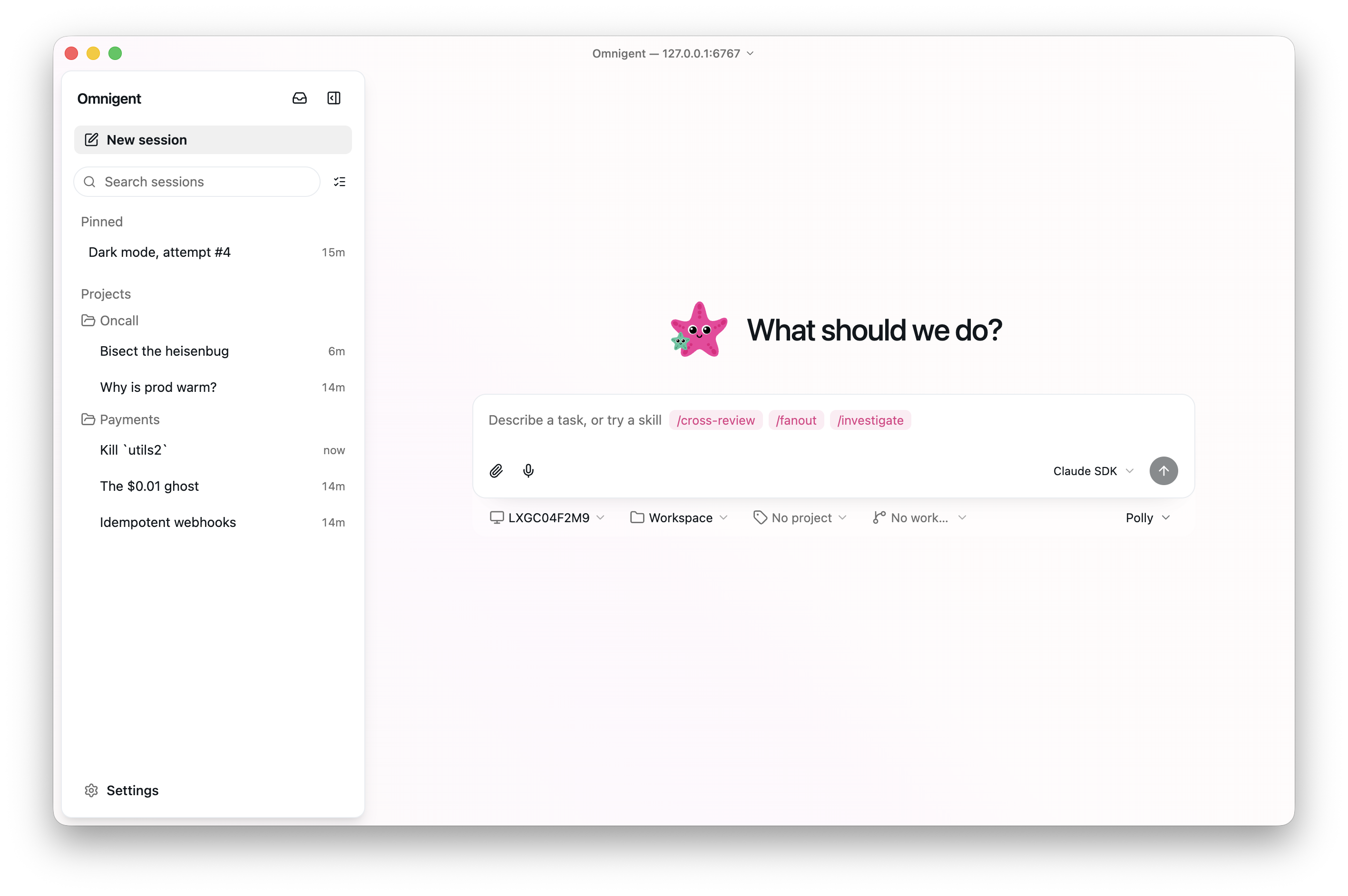
Omnigent is an open-source AI agent framework and meta-harness: orchestrate Claude Code, Codex, Cursor, Pi, and custom agents — swap harnesses without rewriting, enforce policies and sandboxing, and collaborate in real time from any device.

A theoretical reconstruction of the Claude Mythos architecture, built from first principles using the available research literature.
🕷️ An adaptive Web Scraping framework that handles everything from a single request to a full-scale crawl!