

heygen-com/hyperframesFrameworks & SDKs
Write HTML. Render video. Built for agents.
49k
AtlasClaw gives you a core agent runtime for enterprise workflows, with APIs, streaming, sessions, memory, skills, tools, and provider loading. It is designed so the core stays thin while system-specific integrations live in external provider packages.
Builders who want one agent layer over CRM, ITSM, monitoring, HR, finance, or other internal systems.
You can add agent-driven workflows to enterprise systems without rebuilding the agent stack from scratch.
Runs prompt building, tool selection, routing, and execution orchestration in `app/atlasclaw/agent/`.
Stores conversation context and retrieval logic in `app/atlasclaw/session/` and `app/atlasclaw/memory/`.
Loads external provider packages from `providers_root` so system-specific logic stays outside the core.
Registers reusable skills and built-in tools for business scenarios and actions.
Exposes REST, SSE, WebSocket, and webhook entry points through `app/atlasclaw/api/` and `app/atlasclaw/channels/`.
Supports both embedding inside a host app and running as a separate enterprise agent layer.
python3 -m venv .venv
source .venv/bin/activate
pip install -r requirements.txt
pip install -r requirements-dev.txt
# For Kimi (Anthropic-compatible API)
export ANTHROPIC_BASE_URL="https://api.moonshot.cn/anthropic"
export ANTHROPIC_API_KEY="your-api-key"

# For Doubao (OpenAI-compatible API)
export DOUBAO_BASE_URL="https://ark.cn-beijing.volces.com/api/v3"
export DOUBAO_API_KEY="your-api-key"
uvicorn app.atlasclaw.main:app --reload --host 0.0.0.0 --port 8000
http://127.0.0.1:8000/
cd app/frontend
npm install
npm run build
[!NOTE] This repository contains the AtlasClaw core implementation, including the agent runtime, API layer, channel adapters, provider registry, skills, tools, and session/memory management,see atlasclaw.ai.
Concrete providers are not implemented in this repository. AtlasClaw loads provider packages from
providers_root. In a sibling-repository layout, a common value is../atlasclaw-providers/providers.
AtlasClaw is an enterprise agent framework that lets employees interact with multiple enterprise systems through one conversational AI interface. Instead of switching between separate consoles, dashboards, and approval portals, users can use natural language to trigger workflows, query operational data, and complete cross-system tasks from a single entry point.
Enterprise software teams often need to work across CRM, ITSM, Monitoring, HR, Finance, OA and other internal systems. The challenge is not only system fragmentation, but also the mismatch between data models, workflow boundaries, authorization models, and user experience across those systems.
AtlasClaw is designed around two practical developer questions:
AtlasClaw addresses those problems with a developer-oriented agent framework:
The framework is built to help teams add agent capabilities to existing enterprise software without weakening governance. AtlasClaw does not bypass RBAC, does not escalate privileges, and keeps platform-specific authorization and auditing where they already belong.
AtlasClaw supports two practical usage modes for enterprise software teams.
AtlasClaw can be embedded into an existing enterprise system as a module inside that system. In this mode, the AI Agent becomes part of the product itself, serving that system's own users, data, and business scenarios.
embedded=1&surface=menuThe formal integration component is the configured HostApp Provider inside AtlasClaw. It maps Enterprise System pages to business objects, Domain Skills, and state-aware actions without requiring a new service in the Enterprise System. See Embedded Integration for the Cookie, surface, Context, and message contracts.
AtlasClaw can also run as an independent enterprise AI Agent system that connects multiple existing systems together. In this mode, it acts as a unified AI layer above those systems rather than belonging to only one of them.
AtlasClaw is organized around a thin core plus rich providers.
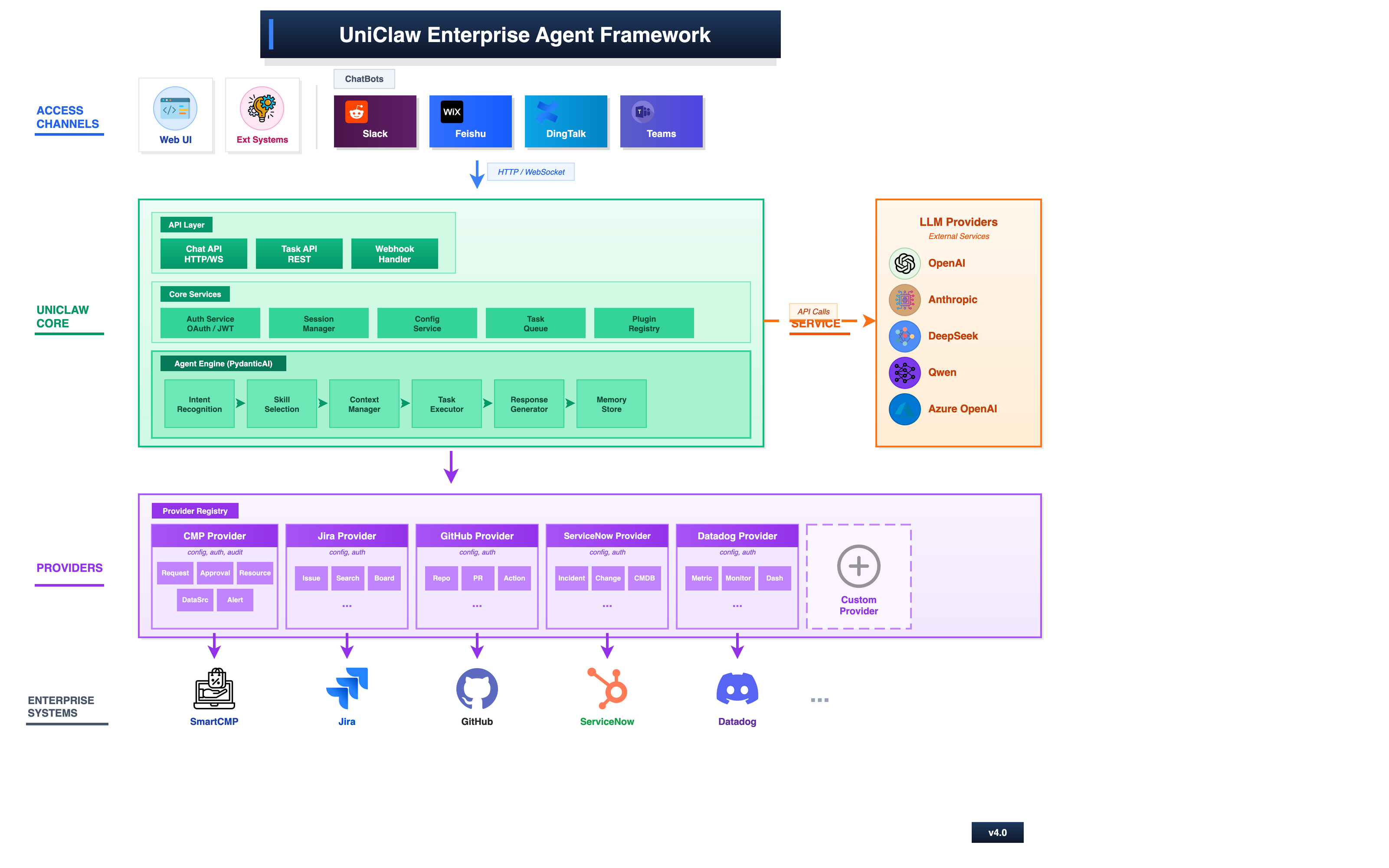
At a high level, requests enter through one of the supported channels, pass through the AtlasClaw Core, and are executed against enterprise systems through Providers. Embedded mode exposes two independent entry points inside an existing Enterprise System: a full menu UI for ordinary conversations and a compact floating UI for page-scoped assistance. Both receive the same Enterprise System Cookie authentication context, so they represent the same signed-in user and reuse that user's existing permissions. The menu requires only a nested Agent entry. The floating UI additionally requires the Enterprise System to manage its launcher/iframe and provide a secure page-change bridge, but Enterprise System code does not resolve objects or invoke Agent and Tool APIs. The surfaces can also share a bootstrap-validated active Chat Session, while only the floating UI consumes page changes. For each change, Core deterministically matches the normalized path against the configured HostApp Provider's Context routes, and that Provider resolves the visible business object and its current actions. The resulting Context is bound to the matching existing Skill and the authenticated user's permissions before it enters the normal Chat and Tool execution path. In standalone mode, AtlasClaw exposes an independent AI Agent interface that sits above multiple enterprise systems. In both cases, the core remains lightweight and reusable, while each Provider contains the system-specific integration logic.
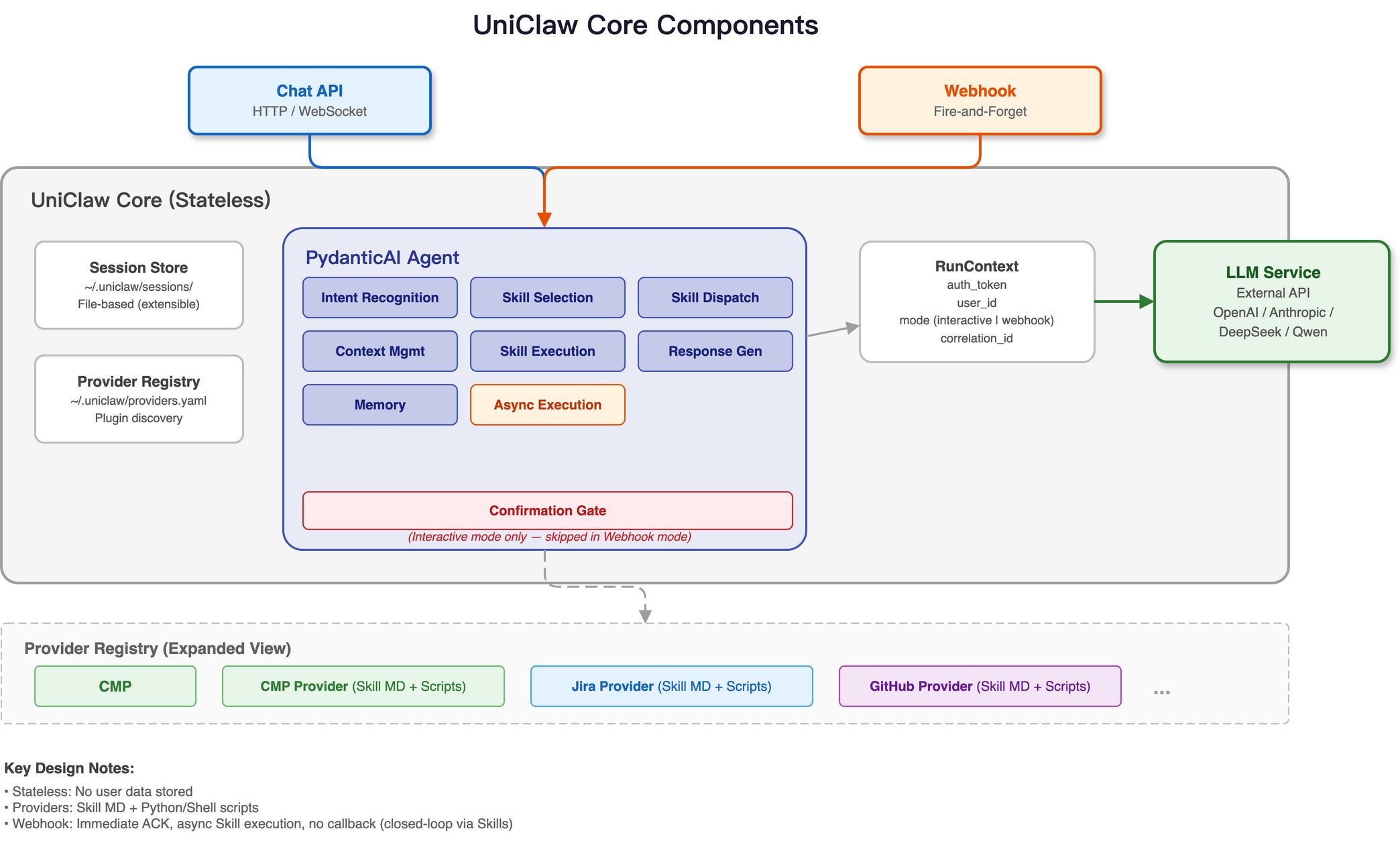
The core runtime in this repository centers on:
API Layer: interactive APIs, WebSocket streaming, and webhook endpoints for both user-driven and programmatic invocationAgent Engine: routing, prompt building, tool selection, and execution orchestrationSession & Memory: conversation context, persistence, and retrievalTools & Skills: reusable execution units exposed to the agentProvider Registry: registration and discovery of enterprise integrationsExecution Context: dependency injection for auth, tenant, and runtime-scoped dataproject-root/
├── app/atlasclaw/api/ # REST, SSE, WebSocket, gateway orchestration
├── app/atlasclaw/agent/ # Agent runner, routing, streaming, prompt building
├── app/atlasclaw/channels/ # Channel adapters and registries
├── app/atlasclaw/core/ # Config, execution context, provider registry
├── app/atlasclaw/memory/ # Memory manager and retrieval
├── app/atlasclaw/session/ # Session context, queue, and manager
├── app/atlasclaw/skills/ # Skill loading and registry
├── app/atlasclaw/tools/ # Built-in tools and tool catalog
├── app/atlasclaw/workflow/ # Workflow engine and orchestrator
├── docs/ # Concepts, tools, channels, and design notes
└── tests/ # Pytest test suite
python3 -m venv .venv
source .venv/bin/activate
pip install -r requirements.txt
For development and test execution, install the development manifest instead; it includes all runtime dependencies plus the test runner:
pip install -r requirements-dev.txt
AtlasClaw uses atlasclaw.json for configuration. Create a configuration file in the project root:
{
  "providers_root": "../atlasclaw-providers/providers",
  "model": {
    "primary": "kimi/kimi-k2.5",
    "temperature": 0.7,
    "providers": {
      "kimi": {
        "base_url": "${ANTHROPIC_BASE_URL}",
        "api_key": "${ANTHROPIC_API_KEY}",
        "api_type": "anthropic"
      }
    }
  }
}
The example above assumes a sibling atlasclaw-providers repository. The
schema default for providers_root remains ../providers.
Configuration options:
providers_root - Root directory for provider packages, resolved relative to atlasclaw.json (schema default: ../providers)providers_root are registered as provider:skill to avoid name collisionsmodel.primary - Primary model in format provider/model-namemodel.providers - Provider configurations with base_url, api_key, and api_typeapi_type - API type: openai (default) or anthropicEnvironment variables are expanded from ${VAR_NAME} format. Set them before starting:
# For Kimi (Anthropic-compatible API)
export ANTHROPIC_BASE_URL="https://api.moonshot.cn/anthropic"
export ANTHROPIC_API_KEY="your-api-key"

# For Doubao (OpenAI-compatible API)
export DOUBAO_BASE_URL="https://ark.cn-beijing.volces.com/api/v3"
export DOUBAO_API_KEY="your-api-key"
# Run all tests
pytest tests/atlasclaw -q

# Run LLM integration tests (requires API credentials)
export ANTHROPIC_BASE_URL="https://api.moonshot.cn/anthropic"
export ANTHROPIC_API_KEY="your-api-key"
pytest tests/atlasclaw/test_agent_integration.py -v -m llm

# Run e2e tests (requires running service)
pytest tests/atlasclaw/test_e2e_api.py -v -m e2e
Start the backend API server:
uvicorn app.atlasclaw.main:app --reload --host 0.0.0.0 --port 8000
The API will be available at http://127.0.0.1:8000.
Once the service is running, open your browser and navigate to:
http://127.0.0.1:8000/
The Web UI provides:
The frontend is located in app/frontend/ and supports two deployment modes:
Open Source Mode (default):
app/frontend/scripts/ and refresh browserEnterprise Mode:
cd app/frontend
npm install
npm run build
dist/app.min.jsindex.html to reference the bundled fileRun Frontend Tests:
cd app/frontend
npm test
app/atlasclaw/main.py - FastAPI application with lifespan managementapp/atlasclaw/api/app/atlasclaw/agent/, app/atlasclaw/workflow/, and app/atlasclaw/tools/providers_root (schema default: ../providers; common sibling-repo layout: ../atlasclaw-providers/providers)If you are integrating AtlasClaw into a host service, start by wiring the API layer, execution context, provider registry, and session manager together in your application bootstrap.
Sign in to join the discussion.
No comments yet. Be the first to say what this is good for.
Write HTML. Render video. Built for agents.
Ultra-lightweight, open-source, self-hosted personal AI agent framework in Python with WebUI, tools, memory, MCP, multi-agent workflows, automation, and chat apps

SkillOpt is a text-space optimizer that trains reusable natural-language skills for frozen LLM agents through trajectory-driven edits, validation-gated updates, and deployable best_skill.md artifacts.
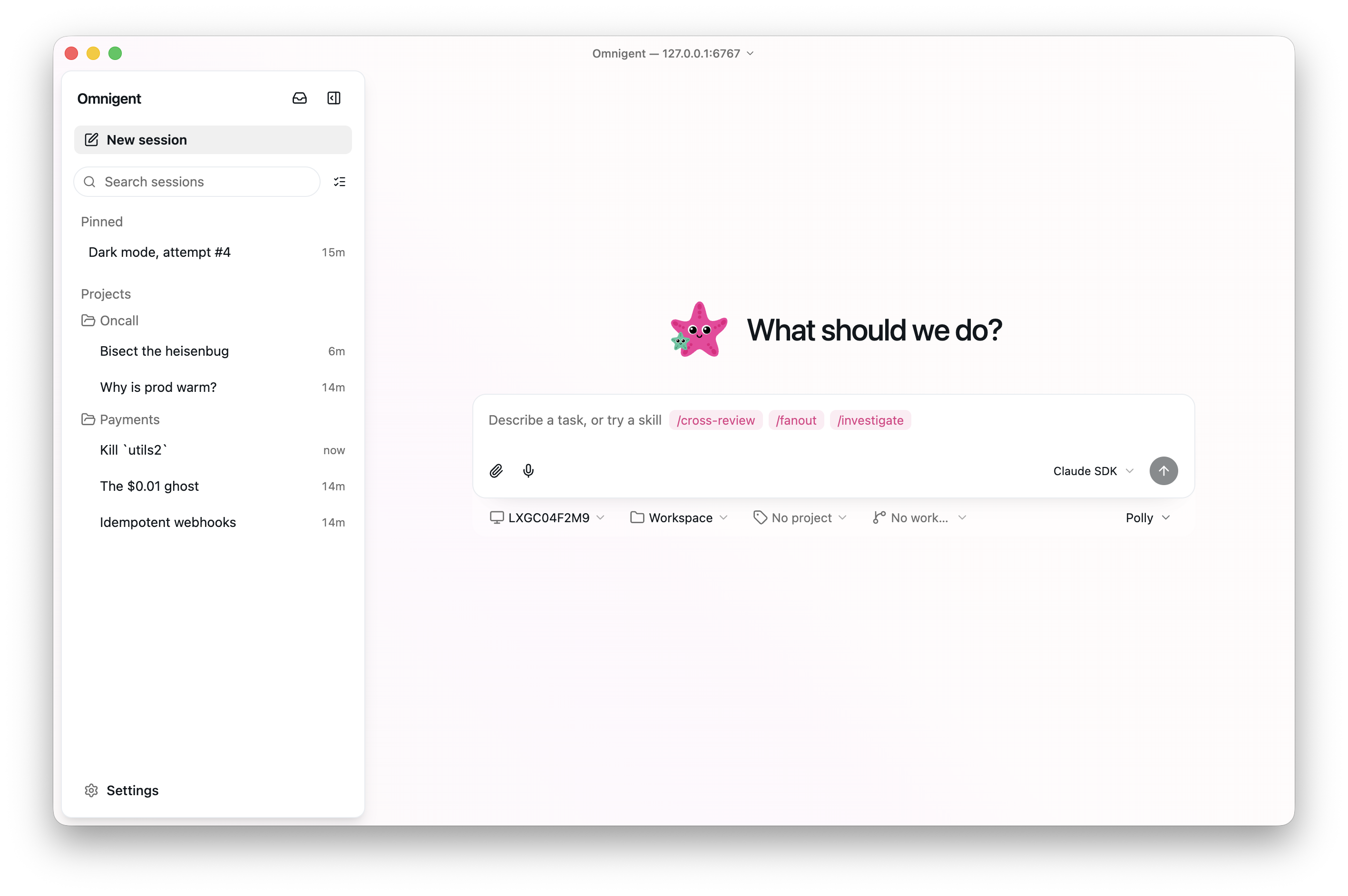
Omnigent is an open-source AI agent framework and meta-harness: orchestrate Claude Code, Codex, Cursor, Pi, and custom agents — swap harnesses without rewriting, enforce policies and sandboxing, and collaborate in real time from any device.

A theoretical reconstruction of the Claude Mythos architecture, built from first principles using the available research literature.
🕷️ An adaptive Web Scraping framework that handles everything from a single request to a full-scale crawl!