
koala73/worldmonitorConnectors
Real-time global intelligence dashboard. AI-powered news aggregation, geopolitical monitoring, and infrastructure tracking in a unified situational awareness interface
86k
This repo ships Perplexity access as an MCP server, plus a VS Code extension that bundles the server, dashboard, and auto-config for other IDEs. It uses a long-lived browser session with your Perplexity account, so agents can search, reason, and research without a separate API key.
Builders who want their coding agents to call Perplexity for search, reasoning, and research.
You can let your agent look things up and synthesize answers from Perplexity without switching tools or re-authenticating.
Exposes Perplexity actions as MCP tools, including `perplexity_search`, `perplexity_ask`, `perplexity_reason`, `perplexity_research`, and `perplexity_compute`.
Bundles the MCP runtime into a VS Code extension with a webview dashboard and login flow.
Writes MCP configs and rules files for tools like Cursor, Claude Code, Windsurf, Codex CLI, and others.
Runs Perplexity through a logged-in Chromium session with patchright so it can use your existing account.
Ships the server as `perplexity-user-mcp` for use with any MCP client that speaks stdio.
git clone https://github.com/Automations-Project/VSCode-Perplexity-MCP.git
cd VSCode-Perplexity-MCP

npm install
npm run build          # shared → mcp-server → webview → extension (in that order)
npm test               # vitest across all packages
npm run package:vsix   # produces packages/extension/perplexity-vscode-<version>.vsix
code --install-extension packages/extension/perplexity-vscode-<version>.vsix

Long‑lived Perplexity browser session, auto‑config for 20+ IDEs, and a VS Code extension – all in one monorepo.






Not affiliated with Perplexity AI, Inc. This is a community-maintained project.
Experimental — This project is under active development and not intended for production use. APIs, tools, and behavior may change without notice.
▶ Watch the demo on YouTube
| IDE | Install |
|---|---|
 Visual Studio Code Visual Studio Code |  |
| VS Code Insiders |  |
 Cursor Cursor |  |
 Windsurf Windsurf |  |
 Trae Trae |  |
| Open VSX (Gitpod · Theia · Coder) |  |
A monorepo that ships the Perplexity MCP runtime two ways:
perplexity-vscode – native VS Code extension with an embedded MCP daemon, webview dashboard, and auto‑config for 20+ MCP‑capable IDEs.1perplexity-user-mcp – the same MCP server as a standalone npm package for Cursor, Claude Desktop, Claude Code, Windsurf, Cline, Amp, Codex CLI, and any other MCP client that talks stdio.Both wrap a long‑lived patchright browser session against your existing Perplexity account, so the tools consume your logged‑in plan (Free / Pro / Max) instead of an API key.2
| You want to… | Use | How |
|---|---|---|
| Use Perplexity inside VS Code with a dashboard, login flows, and auto‑config for other IDEs. | perplexity-vscode (extension) | Install the VSIX or from Marketplace, run Perplexity: Login, optionally enable auto‑config. |
| Run the MCP server standalone for Cursor / Claude Desktop / Windsurf / Cline / Amp / Codex CLI. | perplexity-user-mcp (npm CLI) | npm install -g perplexity-user-mcp or npx perplexity-user-mcp, point your MCP client at it. |
| Keep a long‑lived HTTP MCP daemon with tunnels (Cloudflare Quick Tunnels / ngrok). | Daemon mode (mcp‑server daemon/) | Use the daemon entrypoint & tunnel providers under packages/mcp-server/src/daemon/. |
Four npm workspaces under packages/. Almost every aggregate task builds shared first because the extension host and the webview both import its contracts from source.3
packages/shared – message contracts, IdeTarget / DashboardState types, and the PERPLEXITY_RULES_SECTION_START/END markers used by auto‑config.packages/mcp-server – Perplexity MCP runtime. Ships standalone as perplexity-user-mcp and is bundled into the extension’s dist/mcp/server.mjs (ESM only).packages/webview – React 19 + Vite + Tailwind v4 + zustand dashboard. Built assets copied into packages/extension/media/webview/.packages/extension – VS Code extension host (CommonJS via tsup, target: node20). Registers the bundled MCP server via mcpServerDefinitionProviders, owns the webview, auto‑config, and the embedded daemon.Prerequisites:
git clone https://github.com/Automations-Project/VSCode-Perplexity-MCP.git
cd VSCode-Perplexity-MCP

npm install
npm run build          # shared → mcp-server → webview → extension (in that order)
npm test               # vitest across all packages
npm run package:vsix   # produces packages/extension/perplexity-vscode-<version>.vsix
Install the unpacked extension into VS Code:
code --install-extension packages/extension/perplexity-vscode-<version>.vsix
Build order matters.
packages/sharedmust build before the other three. The root scripts enforce this; keep that invariant when adding new scripts.
The MCP server automates a real Chromium browser via patchright to survive Cloudflare and serve Perplexity.[^browser]
| Priority | Runtime | Env hints | Notes |
|---|---|---|---|
| #1 | Google Chrome | PERPLEXITY_BROWSER_CHANNEL=chrome | Recommended, best Cloudflare compatibility. |
| #2 | Microsoft Edge | PERPLEXITY_BROWSER_CHANNEL=msedge | All three platforms, works like Chrome. |
| #3 | System Chromium | PERPLEXITY_BROWSER_CHANNEL=chromium | Mainly Linux; good for headless servers. |
| #4 | Brave | auto‑detected | Chromium‑based; works with no special flags. |
| #5 | Patchright’s bundled Chromium |
npx patchright install chromiumthen auto‑detected | Fallback when nothing else is present. |
Extra overrides:
PERPLEXITY_BROWSER_PATH – absolute browser executable path (wins over detection).PERPLEXITY_CHROME_PATH – legacy alias for PERPLEXITY_BROWSER_PATH.PERPLEXITY_CONFIG_DIR – overrides ~/.perplexity-mcp (profiles, vault, daemon state).Perplexity serves a Cloudflare Turnstile on first run; the server opens a headed browser for you to log in, then caches cf_clearance + session in ~/.perplexity-mcp/.[^login]
~/.perplexity-mcp/profiles/<name>/.vault.enc (keytar with passphrase fallback). On boxes without an OS keychain, run npx perplexity-user-mcp setup-vault to generate a strong passphrase and get OS-specific persistence snippets (PowerShell / setx / zsh / bash / systemd / MCP-client env block)..reinit sentinel, which running MCP servers watch and hot‑reload from (no restart required). v0.8.40+ also watches the active-pointer file, so switching the active profile in the extension dashboard propagates to running MCP servers automatically.Delete ~/.perplexity-mcp/ to start over completely, or use PERPLEXITY_HEADLESS_ONLY=1 once a valid clearance is cached.
This MCP mirrors Perplexity's web app source picker more closely than the official API-key MCP server. The search-style tools accept a sources array with these values:
web - general web search. This is the default.scholar - scholarly / academic source focus.social - social discussion source focus.The source selector is explicit. If your MCP client calls a tool without sources, the server sends ["web"]. Ask your agent for the source mode you want, or pass it directly when your client exposes tool arguments.
Examples:
{
  "tool": "perplexity_search",
  "arguments": {
    "query": "recent papers on retrieval augmented generation evaluation",
    "sources": ["scholar"],
    "language": "en-US"
  }
}
{
  "tool": "perplexity_ask",
  "arguments": {
    "query": "What are practitioners saying about Cursor versus Windsurf for large TypeScript repos?",
    "sources": ["social"],
    "mode": "copilot"
  }
}
{
  "tool": "perplexity_research",
  "arguments": {
    "query": "Compare academic evidence and practitioner discussion around code review automation",
    "sources": ["scholar", "social"],
    "language": "en-US"
  }
}
Natural-language prompts usually work too, as long as they are specific:
perplexity_ask with sources: [\"social\"] and keep the answer concise."Useful shorthand:
perplexity_search for quick lookup and source discovery.perplexity_ask for a synthesized answer with citations.perplexity_reason for multi-step analysis.perplexity_research for longer reports.perplexity_compute when the account has Computer-mode access.For ASI / Computer mode, ask for perplexity_compute by name when precision matters:
{
  "tool": "perplexity_compute",
  "arguments": {
    "query": "Model the true cost of a 5 kW residential solar installation in the Philippines versus investing the same cash at 6% annually over 10 and 20 years. Show assumptions, calculations, and sensitivity cases.",
    "language": "en-US"
  }
}
When no optional arguments are supplied:
| Tool | Model default | Mode default | Sources default | Language default |
|---|---|---|---|---|
perplexity_search | Authenticated: pplx_pro; anonymous: turbo | Authenticated: copilot; anonymous: concise | ["web"] | en-US |
perplexity_ask | PERPLEXITY_SEARCH_MODEL or pplx_pro | copilot | ["web"] | en-US |
perplexity_reason | PERPLEXITY_REASON_MODEL or claude46sonnetthinking | copilot | ["web"] | en-US |
perplexity_research | PERPLEXITY_RESEARCH_MODEL or pplx_alpha | copilot | ["web"] | en-US |
perplexity_compute | Tool argument, then PERPLEXITY_COMPUTE_MODEL, then account ASI default, then pplx_asi | asi | web-only Computer mode | en-US |
Model defaults are configurable with environment variables:
PERPLEXITY_SEARCH_MODELPERPLEXITY_REASON_MODELPERPLEXITY_RESEARCH_MODELPERPLEXITY_COMPUTE_MODELperplexity_ask, perplexity_reason, and perplexity_compute also accept a per-call model argument. perplexity_ask accepts mode: "concise" | "copilot". perplexity_search, perplexity_reason, perplexity_research, and perplexity_ask accept sources and language.
For search-style tools, the MCP server builds the same kind of request body the Perplexity web app sends: query_str, selected model, mode, source list, language, and optional follow-up thread context. It posts that body from the logged-in browser session to https://www.perplexity.ai/rest/sse/perplexity_ask.
Perplexity responds as a Server-Sent Events stream. The MCP runtime reads the stream and turns it into a normal tool response: answer text, citation sources, media items, suggested follow-ups, follow-up context, and the Perplexity thread URL. This is why the server can use your existing Free / Pro / Max account features without a Perplexity API key, but it also means the request shape can drift if Perplexity changes its private web endpoint.
packages/extension/src/auto-config/index.ts is a static copy of the tool list and summaries. Tests keep it in sync with registered tool names, but summaries and usage guidance still have to be updated by hand. A future improvement would generate the rules block from the MCP tool schemas, or share one typed catalogue between the runtime and auto-config.sources defaults to ["web"] even for queries that clearly ask for papers or social discussion. We can either document prompt patterns, as above, or add a small routing layer that infers scholar / social from the user's request before calling Perplexity.perplexity_search uses browser-backed search by default. Experimental browser-free search exists behind PERPLEXITY_EXPERIMENTAL_IMPIT_SEARCH=1, but it is intentionally opt-in because Perplexity's private search request body can change.perplexity_models already uses a warm disk cache before launching the browser. Similar cache-first behavior may help for repeated model/tier/rate-limit checks from agents.Auto‑config writes MCP configs and rulesets for 15+ IDEs and agents; the same server also runs everywhere else.[^ide]
| Client | How it’s wired | Config artifact |
|---|---|---|
| VS Code | Native extension, embedded daemon, webview dashboard. | settings.json, Perplexity: Login, agent MCP config. |
| Cursor | Auto‑written MCP settings + rules section. | .cursor/rules/*.mdc, mcp.json. |
| Claude Desktop / Claude Code | Config + rules docs, upsert between markers. | claude_desktop_config.json, CLAUDE.md. |
| Windsurf, Cline, Amp, Codex CLI | MCP config and rules files per target. | mcp_config.json, .rules, .github/instructions/*, etc. |
| Visual Studio 2022, VS Code MCP | Workspace‑scoped MCP config under servers root key. | <sln>/.mcp.json, .vscode/mcp.json. |
| OpenCode | Auto‑written under mcp root key with OpenCode's local‑server entry shape. | ~/.config/opencode/opencode.json, AGENTS.md. |
| Antigravity, Kiro, Firebase Studio, Goose, Amazon Q, LM Studio, Trae | Detected and listed in the dashboard; auto‑config gated by primary‑source verification (registry only for some). | .idx/mcp.json, .kiro/settings/mcp.json, ~/.gemini/antigravity/mcp_config.json, … |
| GitHub Copilot CLI, Factory Droid, Qwen Code | User‑scoped MCP config + AGENTS.md rules section. | ~/.copilot/mcp-config.json, ~/.factory/mcp.json, ~/.qwen/settings.json. |
Auto‑config uses IDE_METADATA in packages/shared/src/constants.ts and upserts PERPLEXITY-MCP-START / PERPLEXITY-MCP-END sections without touching hand‑written content.
All commands run from the repo root.
npm install

npm run build          # shared → mcp-server → webview → extension
npm run typecheck      # tsc --noEmit across all four packages
npm test               # builds shared, then runs vitest
npm run test:coverage  # vitest with v8 coverage; enforces per-file thresholds
npm run package:vsix   # full build + vendored deps + vsce package

npm run dev:webview    # Vite dev server for dashboard
npm run dev:extension  # tsup --watch for extension host
npm run clean          # rm dist + media/webview across packages
Single‑file / single‑test runs:
npx vitest run packages/mcp-server/test/redact.test.js
npx vitest run packages/extension/tests/auth-manager.login.test.ts
npx vitest run -t "resolves .reinit sentinel"
Coverage thresholds are enforced: e.g., redact.js / vault.js ≥ 95%, profiles.js / cli.js ≥ 85%.
A few cross‑cutting pieces that matter:
Bundled MCP with curated externals.
packages/extension/package.json build:mcp tsups packages/mcp-server/src/index.ts into dist/mcp/server.mjs, renames index.mjs → server.mjs, and copies the mcp‑server package.json next to it. Externals
(patchright, got-scraping, tough-cookie, gray-matter, express, @ngrok/ngrok, helmet, keytar, …) are deliberately left out of the bundle and vendored into dist/node_modules/ by packages/extension/scripts/prepare-package-deps.mjs.
Daemon + pluggable tunnels.
packages/mcp-server/src/daemon/ runs a long‑lived HTTP MCP server with OAuth 2.1 (via @modelcontextprotocol/sdk’s mcpAuthRouter) and pluggable tunnels under daemon/tunnel-providers/ (cf-quick and ngrok). Daemon state lives in <configDir>/daemon.lock, daemon.token, tunnel-settings.json, and ngrok.json.
Browser detection & download manager.
packages/extension/src/browser/browser-detect.ts probes Chrome → Edge → system Chromium → Brave → patchright’s Chromium, with BrowserDownloadManager managing patchright install chromium into VS Code’s globalStorage and AuthManager syncing env to the detached daemon.
For deeper internals, see:
| Registry | Link |
|---|---|
| VS Code Marketplace | Nskha.perplexity-vscode |
| npm | perplexity-user-mcp |
| MCP Registry | io.github.Automations-Project/perplexity-user-mcp |
This project is built and maintained with the help of AI coding tools. If you find it useful and want to support continued development (new tools, updates, bug fixes), you can contribute by gifting Claude Code credits — the primary tool used to build this project.
Interested? Open an issue or reach out to discuss feature requests and sponsorship.
Contributions are welcome! Conventions:
main and open a PR (protected).docs/smoke-tests.md on Windows 11, macOS 14+, and Ubuntu 22+ before tagging a release.packages/extension and packages/mcp-server together and add a CHANGELOG entry that follows Keep a Changelog + SemVer.PERPLEXITY-MCP-START / PERPLEXITY-MCP-END.The repository is licensed under the MIT License – see LICENSE.
Important notice
This project is an unofficial, community‑maintained integration for Perplexity. It is not affiliated with, endorsed by, or sponsored by Perplexity AI, Inc. in any way.
The MCP server works by automating a logged‑in Perplexity browser session on your local machine. This may be considered automated access / scraping / technical misuse under Perplexity’s Terms of Service and Acceptable Use Policy, and Perplexity may change or block this behaviour at any time.
By using this project, you are solely responsible for ensuring your use complies with Perplexity’s terms, policies, and any applicable law, and you accept the risk that your Perplexity account could be rate‑limited, suspended, or terminated.
This software is provided “as is”, on an experimental basis, without any warranty. Do not use it for anything where reliability, correctness, or policy compliance are critical.
See CHANGELOG.md for current version and release notes. ↩
Browser and profile details: packages/mcp-server and Architecture notes. ↩
See tsconfig.base.json and vitest.config.ts for workspace wiring and test globs. ↩
Sign in to join the discussion.
No comments yet. Be the first to say what this is good for.
Real-time global intelligence dashboard. AI-powered news aggregation, geopolitical monitoring, and infrastructure tracking in a unified situational awareness interface
High-performance code intelligence MCP server. Indexes codebases into a persistent knowledge graph — average repo in milliseconds. 158 languages, sub-ms queries, 99% fewer tokens. Single static binary, zero dependencies.
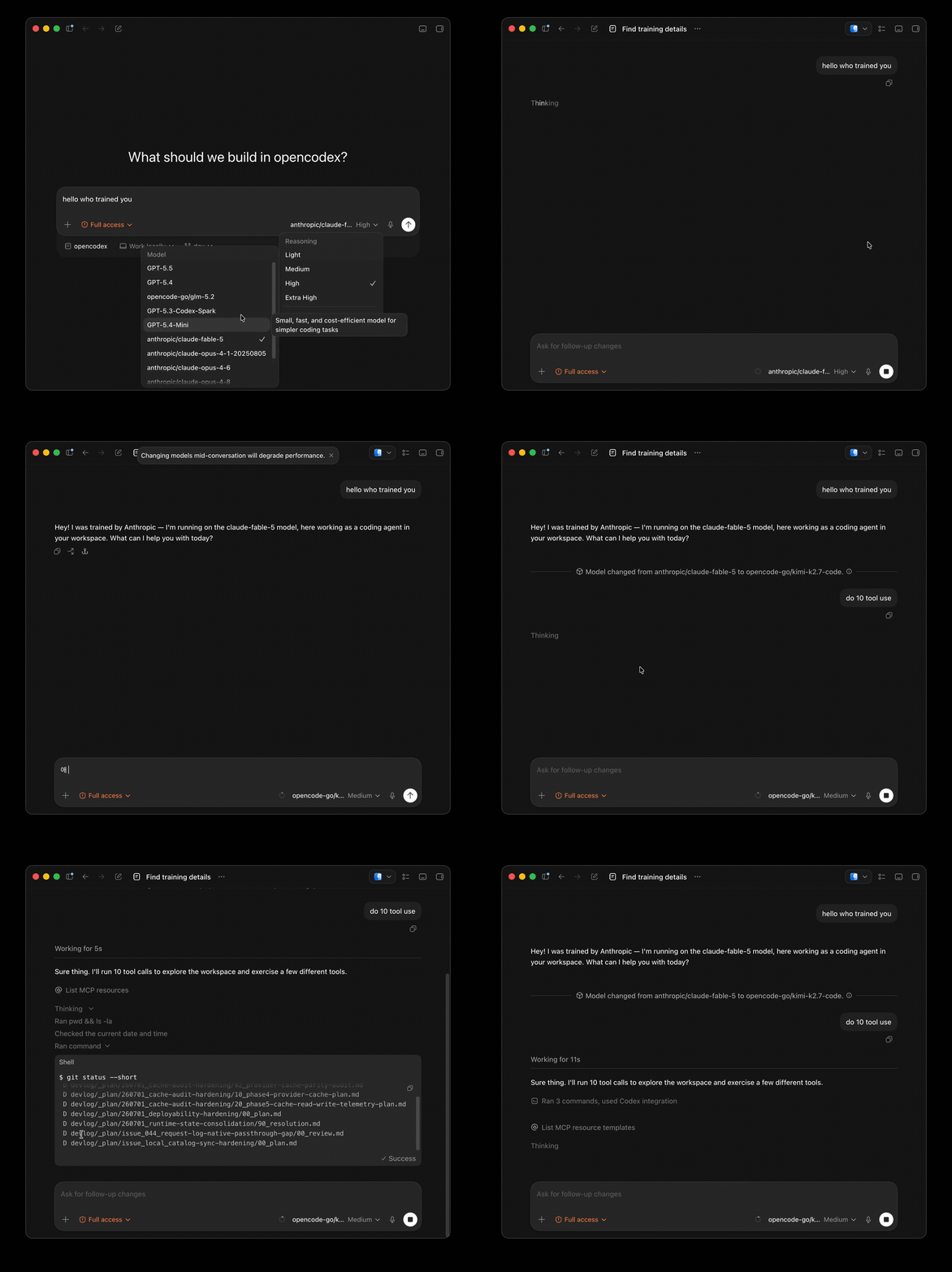
Universal provider proxy for OpenAI Codex & Claude Code — use any LLM (Claude, Gemini, Grok, DeepSeek, Ollama…) with Codex CLI, App, SDK, and Claude Code

Git-native persistent memory for AI coding agents. Implements Google OKF v0.2 with sub-300µs in-memory BM25 search, embedded MCP server, and progressive disclosure. Slashes token bloat by 80% with zero external databases or dependencies. Built in pure Go.

Local-first code intelligence graph for MCP and CLI. Builds a persistent map of your codebase so AI coding tools read only what matters, with benchmarked context reductions on reviews and large-repo workflows.

Stop your AI from making things up — it proposes, deterministic tools decide, every claim checked against ground truth with evidence. Grounded facts and context survive resets. Reverse engineering is the proving ground. MCP server + CLI.