
koala73/worldmonitorConnectors
Real-time global intelligence dashboard. AI-powered news aggregation, geopolitical monitoring, and infrastructure tracking in a unified situational awareness interface
86k
This server connects an agent to PubChem so it can search compounds, inspect structures, read properties, and fetch assay and safety data. It uses MCP tools plus resource templates to return compound records, similarity results, and other chemical informatics data.
Builders who want their agent to query PubChem for chemical and bioassay data.
You can ask your agent to retrieve compound facts, similarity matches, and assay results without leaving your workflow.
Search compounds by name, CAS number, formula, SMILES, InChI, or CID, then fetch detailed compound info and synonyms.
Find similar compounds, run substructure and superstructure searches, and inspect 3D conformers and stereochemistry.
Get molecular properties, calculate descriptors, predict ADMET properties, assess drug-likeness, and map pharmacophore features.
Search assays, read assay protocols, fetch compound bioactivities, search by target, and compare activity profiles.
Look up GHS hazards, toxicity data, environmental fate, and regulatory information.
Pull links to external databases, search patents and literature, and process up to 200 compounds at once.
1. Target Discovery: UniProt → STRING → AlphaFold
2. Chemical Discovery: PubChem ← → ChEMBL
3. Complete Workflow: Protein → Structure → Interactions → Small Molecules → Bioactivity
A comprehensive Model Context Protocol (MCP) server for accessing the PubChem chemical database. This server provides access to over 110 million chemical compounds with extensive molecular properties, bioassay data, and chemical informatics tools.
Access PubChem data through URI patterns:
pubchem://compound/{cid} - Complete compound datapubchem://structure/{cid} - 2D/3D structure informationpubchem://properties/{cid} - Molecular propertiespubchem://bioassay/{aid} - Bioassay datapubchem://similarity/{smiles} - Similarity search resultspubchem://safety/{cid} - Safety and toxicity data# Clone or create the server directory
cd pubchem-server
# Install dependencies
npm install
# Build the server
npm run build
# Run the server
npm start
// Search for compounds by name
{
  "tool": "search_compounds",
  "arguments": {
    "query": "aspirin",
    "max_records": 10
  }
}

// Get detailed compound information
{
  "tool": "get_compound_info",
  "arguments": {
    "cid": 2244
  }
}
// Find similar compounds
{
  "tool": "search_similar_compounds",
  "arguments": {
    "smiles": "CC(=O)OC1=CC=CC=C1C(=O)O",
    "threshold": 85,
    "max_records": 50
  }
}

// Analyze molecular properties
{
  "tool": "get_compound_properties",
  "arguments": {
    "cid": 2244,
    "properties": ["MolecularWeight", "XLogP", "TPSA"]
  }
}
// Get bioassay information
{
  "tool": "get_assay_info",
  "arguments": {
    "aid": 1159607
  }
}

// Search compounds by target
{
  "tool": "search_by_target",
  "arguments": {
    "target": "cyclooxygenase",
    "max_records": 100
  }
}
// Get safety classifications
{
  "tool": "get_safety_data",
  "arguments": {
    "cid": 2244
  }
}
// Process multiple compounds
{
  "tool": "batch_compound_lookup",
  "arguments": {
    "cids": [2244, 5090, 3672],
    "operation": "property"
  }
}
This PubChem server integrates perfectly with other chemical/biological databases:
1. Target Discovery: UniProt → STRING → AlphaFold
2. Chemical Discovery: PubChem ← → ChEMBL
3. Complete Workflow: Protein → Structure → Interactions → Small Molecules → Bioactivity
PubChem API guidelines:
The server includes comprehensive error handling:
This server uses:
MIT License - See LICENSE file for details.
For issues with:
// 1. Search for anti-inflammatory compounds
{
  "tool": "search_compounds",
  "arguments": {
    "query": "anti-inflammatory",
    "max_records": 100
  }
}

// 2. Analyze drug-likeness
{
  "tool": "assess_drug_likeness",
  "arguments": {
    "cid": 2244
  }
}

// 3. Check safety profile
{
  "tool": "get_safety_data",
  "arguments": {
    "cid": 2244
  }
}

// 4. Find bioactivity data
{
  "tool": "search_by_target",
  "arguments": {
    "target": "COX-2",
    "activity_type": "IC50"
  }
}
// 1. Find similar compounds
{
  "tool": "search_similar_compounds",
  "arguments": {
    "smiles": "your_query_smiles",
    "threshold": 90
  }
}

// 2. Compare molecular properties
{
  "tool": "batch_compound_lookup",
  "arguments": {
    "cids": [1234, 5678, 9012],
    "operation": "property"
  }
}

// 3. Analyze structural features
{
  "tool": "analyze_stereochemistry",
  "arguments": {
    "cid": 1234
  }
}
The server is built with a modular architecture:
This makes it the most comprehensive chemical informatics MCP server available!
If you use this project in your research or publications, please cite it as follows:
author = {Moudather Chelbi},
title = {PubChem MCP Server},
year = {2025},
howpublished = {https://github.com/Augmented-Nature/PubChem-MCP-Server},
note = {Accessed: 2025-06-29}
Sign in to join the discussion.
No comments yet. Be the first to say what this is good for.
Real-time global intelligence dashboard. AI-powered news aggregation, geopolitical monitoring, and infrastructure tracking in a unified situational awareness interface
High-performance code intelligence MCP server. Indexes codebases into a persistent knowledge graph — average repo in milliseconds. 158 languages, sub-ms queries, 99% fewer tokens. Single static binary, zero dependencies.
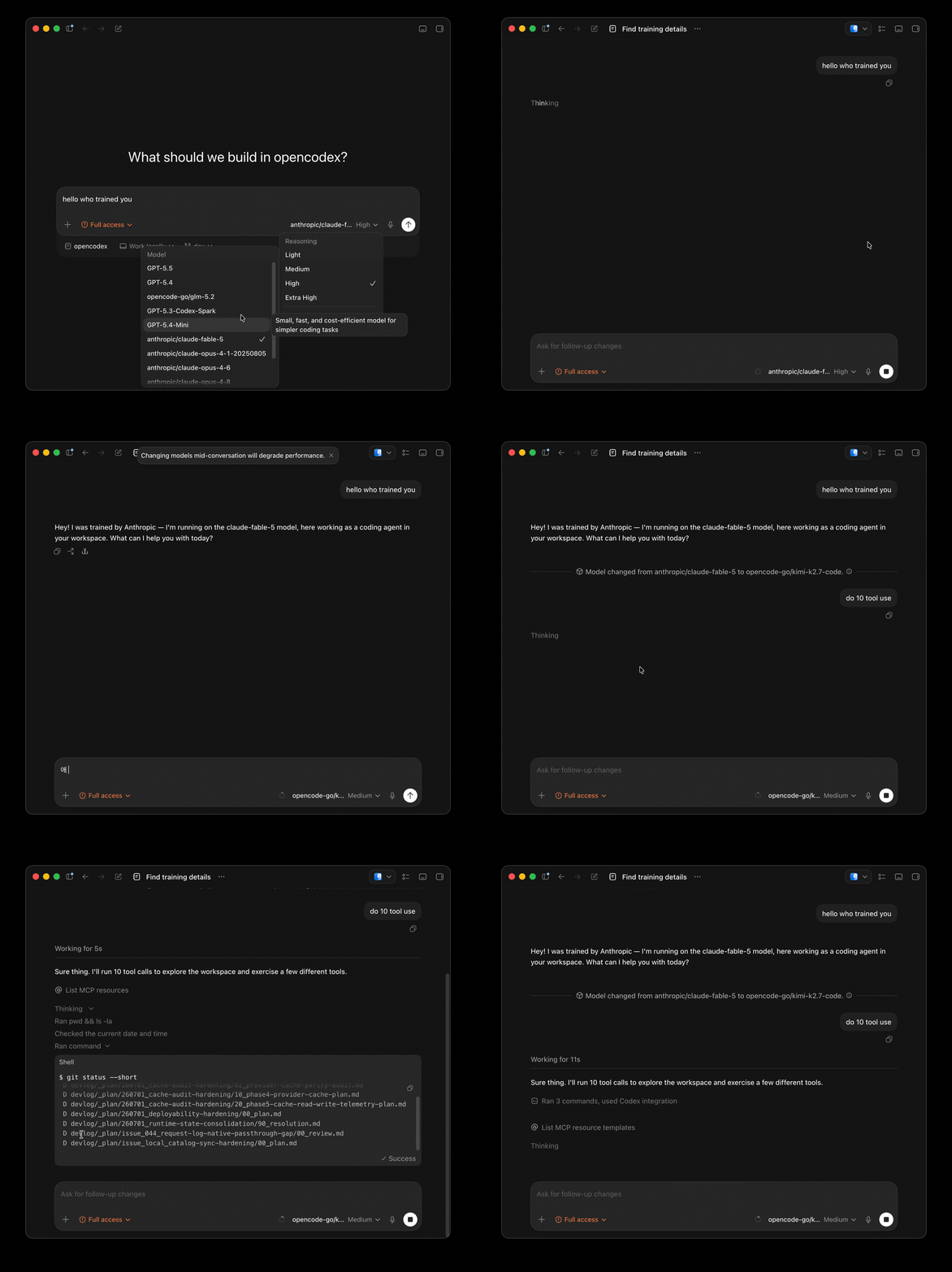
Universal provider proxy for OpenAI Codex & Claude Code — use any LLM (Claude, Gemini, Grok, DeepSeek, Ollama…) with Codex CLI, App, SDK, and Claude Code

Git-native persistent memory for AI coding agents. Implements Google OKF v0.2 with sub-300µs in-memory BM25 search, embedded MCP server, and progressive disclosure. Slashes token bloat by 80% with zero external databases or dependencies. Built in pure Go.

Local-first code intelligence graph for MCP and CLI. Builds a persistent map of your codebase so AI coding tools read only what matters, with benchmarked context reductions on reviews and large-repo workflows.

Stop your AI from making things up — it proposes, deterministic tools decide, every claim checked against ground truth with evidence. Grounded facts and context survive resets. Reverse engineering is the proving ground. MCP server + CLI.