
koala73/worldmonitorConnectors
Real-time global intelligence dashboard. AI-powered news aggregation, geopolitical monitoring, and infrastructure tracking in a unified situational awareness interface
86k
This repo exposes ActivityWatch data through the Model Context Protocol so an agent can inspect your tracked activity. It ships tools for listing buckets, running queries, reading raw events, and checking settings, with a default connection to the local ActivityWatch API.
Builders who want their agent to query ActivityWatch while they work.
You can ask an agent about your tracked apps, websites, and settings without leaving your chat or editor.
Returns available ActivityWatch buckets, with optional type filtering and bucket data.
Executes AQL queries over one or more time periods, with support for named queries.
Fetches event records directly from a chosen bucket with optional start, end, and limit filters.
Returns all ActivityWatch settings or one named setting key.
Lets you point the server at a different API base with `AW_API_BASE` or `--aw-api-base`.
# Global installation
npm install -g activitywatch-mcp-server

# Or install locally
npm install activitywatch-mcp-server
git clone https://github.com/8bitgentleman/activitywatch-mcp-server.git
cd activitywatch-mcp-server
npm install
npm run build
version=$(npm pkg get version | tr -d '"')
podman build . -t activitywatch-mcp-server:${version}# Using environment variable export AW_API_BASE=http://mydesktop.local:5600/api/0 node dist/index.js # Or using command-line flag node dist/index.js --aw-api-base=http://mydesktop.local:5600/api/0
A Model Context Protocol (MCP) server that connects to ActivityWatch, allowing LLMs like Claude to interact with your time tracking data.
You can install the ActivityWatch MCP server either from npm or by building it yourself.
# Global installation
npm install -g activitywatch-mcp-server
# Or install locally
npm install activitywatch-mcp-server
Clone this repository:
git clone https://github.com/8bitgentleman/activitywatch-mcp-server.git
cd activitywatch-mcp-server
Install dependencies:
npm install
Build the project:
npm run build
Open your Claude for Desktop configuration file:
%APPDATA%\Claude\claude_desktop_config.json~/Library/Application Support/Claude/claude_desktop_config.jsonAdd the MCP server configuration:
{
"mcpServers": {
"activitywatch": {
"command": "activitywatch-mcp-server",
"args": []
}
}
}
If you built from source, use:
{
"mcpServers": {
"activitywatch": {
"command": "node",
"args": ["/path/to/activitywatch-mcp-server/dist/index.js"]
}
}
}
Restart Claude for Desktop
Look for the MCP icon in Claude's interface to confirm it's working
Make sure to build the image first with:
version=$(npm pkg get version | tr -d '"')
podman build . -t activitywatch-mcp-server:${version}
This example uses the override for Activity Watch not being available on
127.0.0.1 (see next section). If not required, you may omit the AW_API_BASE
environment variable.
{
"mcpServers": {
"activitywatch-mcp-server": {
"command": "/usr/bin/podman",
"args": [
"run",
"--rm",
"--interactive",
"--userns=keep-id",
"-e",
"AW_API_BASE",
"localhost/activitywatch-mcp-server:1.2.1"
],
"env": {
"AW_API_BASE": "http://mydesktop.local:5600/api/0"
}
}
}
}
If you want to run this MCP server from inside Windows Subsystem for Linux,
for instance within a container, the AW server running in Windows will not be
available at 127.0.0.1. To override the standard localhost connection, use the
environment variable AW_API_BASE or the --aw-api-base flag, as below:
# Using environment variable
export AW_API_BASE=http://mydesktop.local:5600/api/0
node dist/index.js

# Or using command-line flag
node dist/index.js --aw-api-base=http://mydesktop.local:5600/api/0
NOTE: The AW server may be fussy about the name used to connect to it, but it
will accept a name that matches the computer name where it is running with a
.local suffix.
Here are some example queries you can try in Claude:
Lists all available ActivityWatch buckets with optional type filtering.
Parameters:
type (optional): Filter buckets by type (e.g., "window", "web", "afk")includeData (optional): Include bucket data in responseRun a query in ActivityWatch's query language (AQL).
Parameters:
timeperiods: Time period(s) to query formatted as array of strings. For date
ranges, use format: ["2024-10-28/2024-10-29"]query: Array of query statements in ActivityWatch Query Language, where each
item is a complete query with statements separated by semicolonsname (optional): Name for the query (used for caching)IMPORTANT: Each query string should contain a complete query with multiple statements separated by semicolons.
Example request format:
{
  "timeperiods": ["2024-10-28/2024-10-29"],
  "query": ["events = query_bucket('aw-watcher-window_UNI-qUxy6XHnLkk'); RETURN = events;"]
}
Note that:
timeperiods should have pre-formatted date ranges with slashesquery array is a complete query with all statementsGet raw events from an ActivityWatch bucket.
Parameters:
bucketId: ID of the bucket to fetch events fromstart (optional): Start date/time in ISO formatend (optional): End date/time in ISO formatlimit (optional): Maximum number of events to returnGet ActivityWatch settings from the server.
Parameters:
key (optional): Get a specific settings key instead of all settingsActivityWatch uses a simple query language. Here are some common patterns:
// Get window events
window_events = query_bucket(find_bucket("aw-watcher-window_"));
RETURN = window_events;

// Get only when not AFK
afk_events = query_bucket(find_bucket("aw-watcher-afk_"));
not_afk = filter_keyvals(afk_events, "status", ["not-afk"]);
window_events = filter_period_intersect(window_events, not_afk);
RETURN = window_events;

// Group by app
window_events = query_bucket(find_bucket("aw-watcher-window_"));
events_by_app = merge_events_by_keys(window_events, ["app"]);
RETURN = sort_by_duration(events_by_app);

// Filter by app name
window_events = query_bucket(find_bucket("aw-watcher-window_"));
code_events = filter_keyvals(window_events, "app", ["Code"]);
RETURN = code_events;
The server connects to the ActivityWatch API at http://localhost:5600 by
default. If your ActivityWatch instance is running on a different host or port,
you can override it as described in the Override ActivityWatch server host/port
section above.
If ActivityWatch isn't running, the server will show connection errors. Make
sure ActivityWatch is running and accessible at the specified host/port
address (http://localhost:5600 unless you have overridden it).
If you're encountering query errors:
If Claude reports errors when running queries through this MCP server, it's likely due to formatting issues. Make sure your query follows this exact format in your prompts:
{
  "timeperiods": ["2024-10-28/2024-10-29"],
  "query": ["events = query_bucket('aw-watcher-window_UNI-qUxy6XHnLkk'); RETURN = events;"]
}
Common issues:
The most frequent error is when Claude splits each query statement into its own array element like this:
{
  "query": [
    "browser_events = query_bucket('aw-watcher-web');",
    "afk_events = query_bucket('aw-watcher-afk');",
    "RETURN = events;"
  ],
  "timeperiods": ["2024-10-28/2024-10-29"]
}
This is INCORRECT. Instead, all statements should be in a single string within the array:
{
  "timeperiods": ["2024-10-28/2024-10-29"],
  "query": ["browser_events = query_bucket('aw-watcher-web'); afk_events = query_bucket('aw-watcher-afk'); RETURN = events;"]
}
When prompting Claude, be very explicit about the format and use examples. For instance, say:
"Run a query with timeperiods as ["2024-10-28/2024-10-29"] and query as
["statement1; statement2; RETURN = result;"]. Important: Make sure ALL query
statements are in a single string within the array, not split into separate
array elements."
Contributions are welcome! Please feel free to submit a Pull Request.
Sign in to join the discussion.
No comments yet. Be the first to say what this is good for.
Real-time global intelligence dashboard. AI-powered news aggregation, geopolitical monitoring, and infrastructure tracking in a unified situational awareness interface
High-performance code intelligence MCP server. Indexes codebases into a persistent knowledge graph — average repo in milliseconds. 158 languages, sub-ms queries, 99% fewer tokens. Single static binary, zero dependencies.
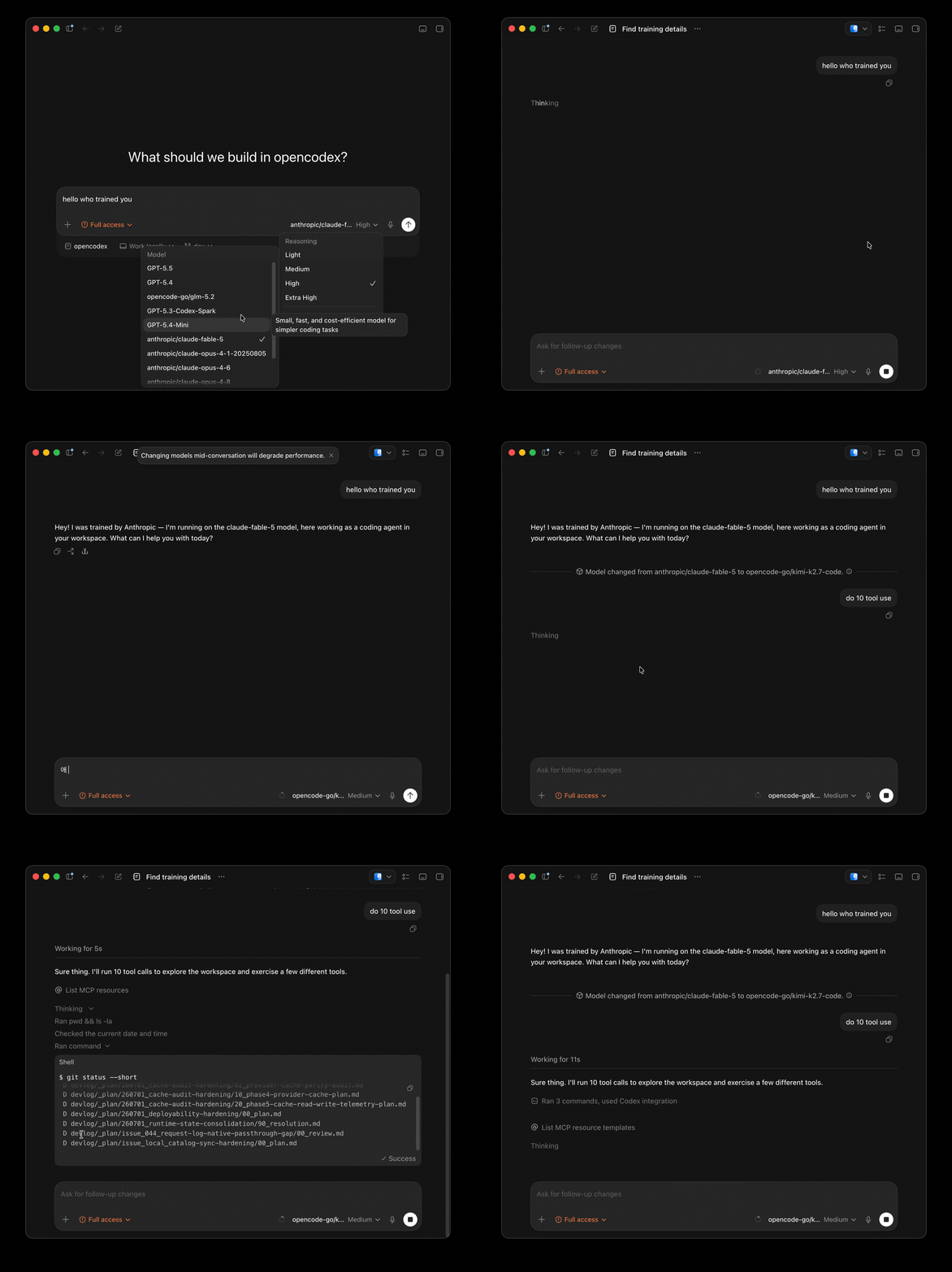
Universal provider proxy for OpenAI Codex & Claude Code — use any LLM (Claude, Gemini, Grok, DeepSeek, Ollama…) with Codex CLI, App, SDK, and Claude Code

Git-native persistent memory for AI coding agents. Implements Google OKF v0.2 with sub-300µs in-memory BM25 search, embedded MCP server, and progressive disclosure. Slashes token bloat by 80% with zero external databases or dependencies. Built in pure Go.

Local-first code intelligence graph for MCP and CLI. Builds a persistent map of your codebase so AI coding tools read only what matters, with benchmarked context reductions on reviews and large-repo workflows.

Stop your AI from making things up — it proposes, deterministic tools decide, every claim checked against ground truth with evidence. Grounded facts and context survive resets. Reverse engineering is the proving ground. MCP server + CLI.