
JuliusBrussee/
caveman

🪨 why use many token when few token do trick — Claude Code skill that cuts 65% of tokens by talking like caveman
105k
1 add
Heimdall watches the MCP config and server files that local agents load, then fingerprints them with BLAKE3 and compares them against a signed baseline. If something changes, it can show a diff, accept or revert the change, quarantine a suspect server, and export an audit report. It works across Claude Desktop, Claude Code, Cursor, Windsurf, and LM Studio, with both a GUI and a headless CLI. The trust state is anchored in the OS keystore through `trustroot`, so the baseline is harder to forge quietly.
Builders who use local MCP hosts and want a watcher for config and server file tampering.
You can catch hostile MCP changes, inspect the diff, and roll back or quarantine the suspect server.
Watches MCP host config files and full server source trees, then fingerprints them and alerts on any change.
Stores MAC-signed state through `trustroot` with the key in the OS keystore, making silent baseline rewrites harder.
Shows syntax-highlighted diffs and lets you accept or revert changes per file or all at once.
Reads Claude logs such as `mcp-info.json` and `mcp-server-*.log` to build a timeline of recent additions, error spikes, and orphans.
Can disable a suspect server and restore it later, or rebuild the baseline from the current files with `reinit`.
Provides `heimdall watch`, `check`, `report`, `status`, `quarantine`, and other commands for always-on use.
git clone https://github.com/2alf/Claude-Defender
cd Claude-Defender/claudeDefender-tauri
npm run setup            # frontend deps
npm run tauri build      # native bundle → src-tauri/target/release/bundle/
# or: npm run tauri dev  # run without packaging
sudo apt install libdbus-1-dev libwebkit2gtk-4.1-dev libgtk-3-dev \
  libappindicator3-dev librsvg2-dev patchelf pkg-config
The watchman for your local AI agents' MCP layer.




Heimdall fingerprints the MCP config and server files that Claude Desktop, Claude Code, Cursor, Windsurf, and LM Studio load, and sounds the alarm the instant one is altered behind your back.
Named for the Norse watchman who guards the one bridge into Asgard and blows the horn when enemies approach — it guards your entry points, it watches and warns, and it doesn't pretend to be a wall. (Formerly Claude Defender, renamed once it grew past just Claude.)
Living-off-the-land attackers don't bring malware — they subvert the legitimate tools already on your machine. An MCP server is a perfect target: a trusted program your agent launches with full access. Poison its source, or slip a malicious server into a config an agent reads, and you have a trojanised entry point that runs every time — and nothing looks wrong. That's the point of LOTL.
Heimdall's job is to notice: it fingerprints every config and server file, and the instant one changes it shows you exactly what changed and lets you revert.
flowchart LR
  subgraph Hosts["MCP hosts (auto-discovered)"]
    A[Claude Desktop]
    B[Claude Code]
    C[Cursor]
    D[Windsurf]
    E[LM Studio]
  end
  Hosts -->|configs + server files| W[Filesystem watcher<br/>event-driven]
  W --> Core[Detection core<br/>BLAKE3 fingerprints]
  Core <-->|sign / verify| TR[trustroot<br/>keyed-MAC state]
  TR <-->|MAC key| KS[(OS keystore)]
  Logs[Claude logs] --> IA[Intrusion analysis]
  Core --> V{Verdict}
  IA --> V
  V -->|clean| OK[Protected]
  V -->|changed| DIFF[Diff → accept / revert]
  V -->|state forged| TAMPER[Tamper alert]
Event-driven: it wakes only when a watched file changes, so at rest it does effectively no work, and detection is sub-second.
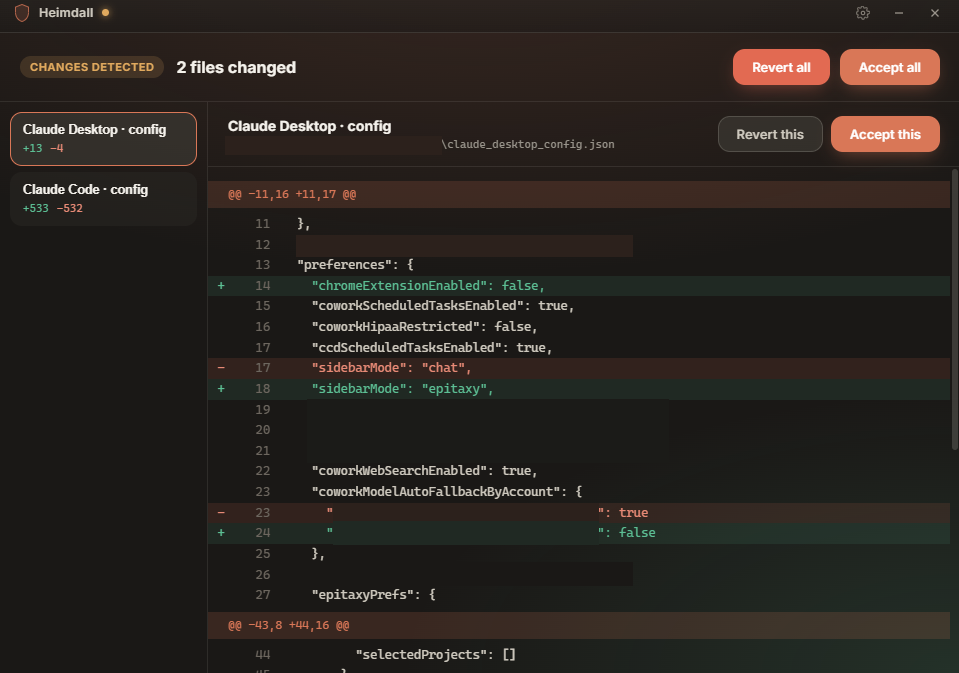 Changes detected — a real syntax-highlighted diff with per-file or all-at-once accept / revert. |
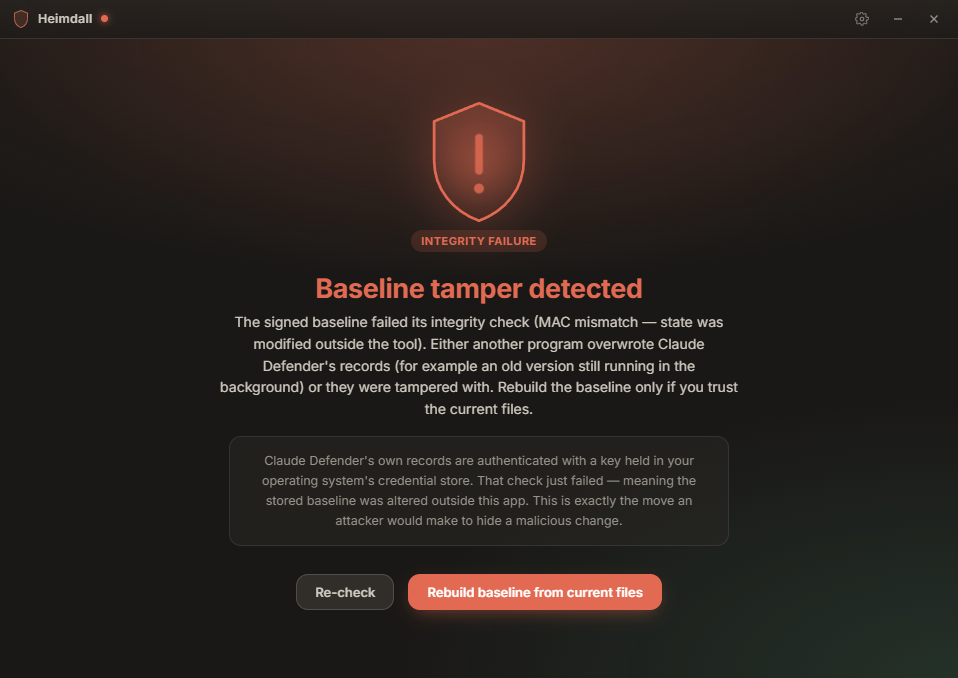 Baseline tamper — the keystore-anchored integrity alert, with one-click rebuild from the current files. |
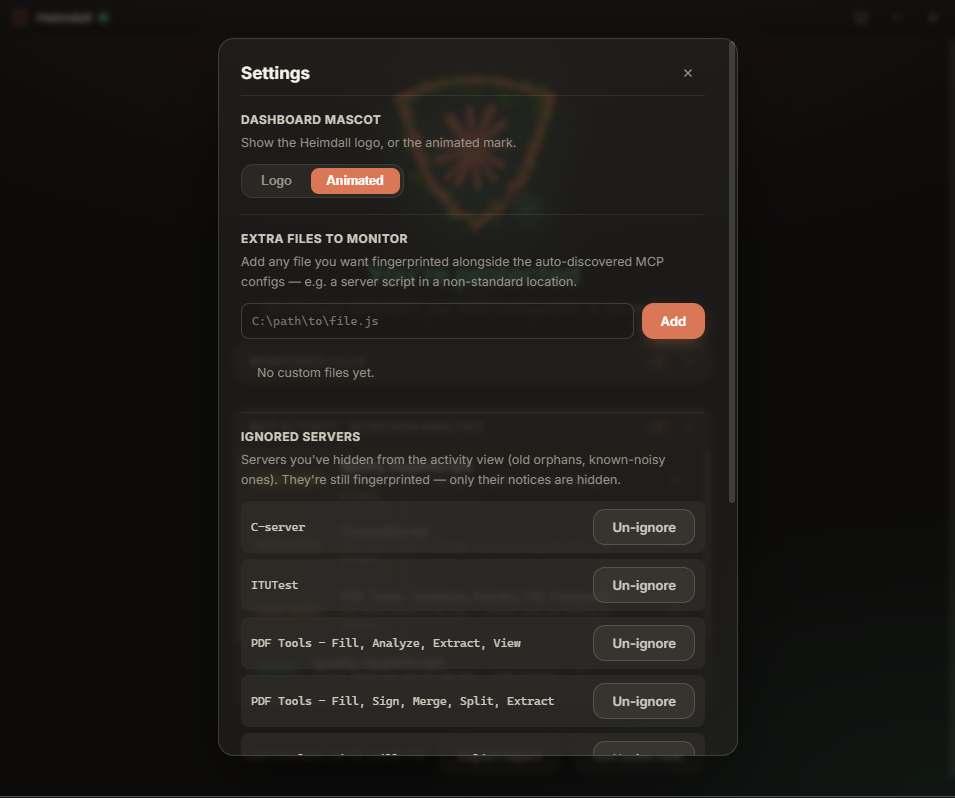 Settings — toggle the mascot, add custom files to watch, and manage the intrusion-notice ignore list. |
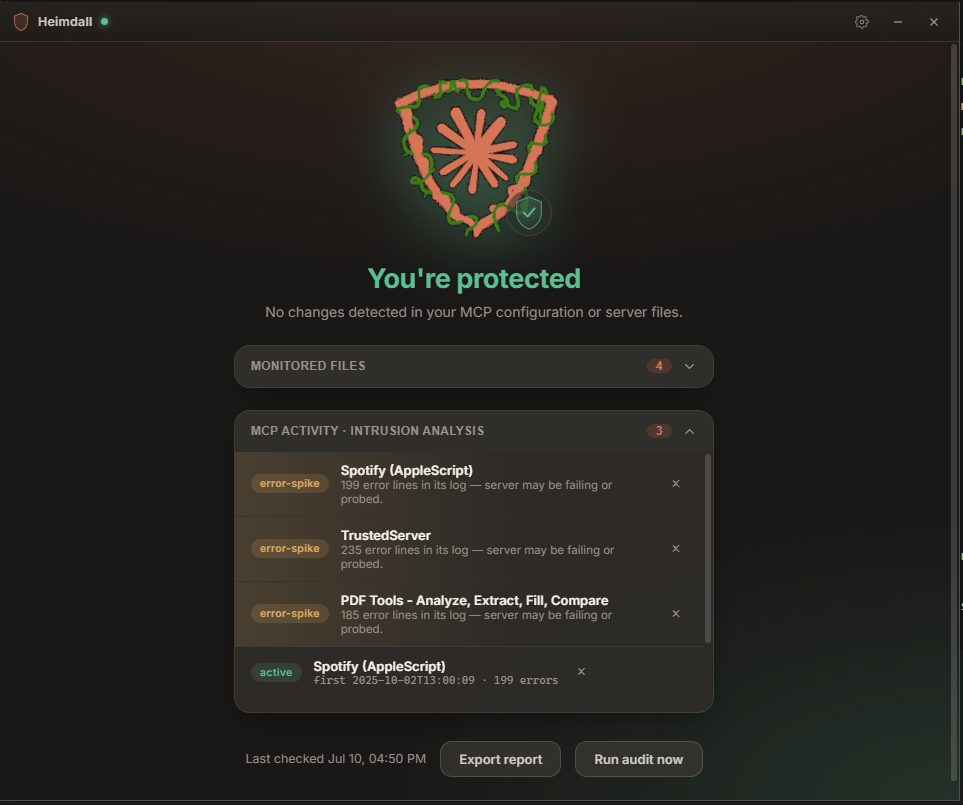 Protected (logo mode) — the same dashboard with the static crest instead of the animated mark. |
A tamper detector is only as trustworthy as its baseline. If that's an ordinary file, the attacker who edits your server can rewrite the baseline to match in the same breach — and the next check sees "no change."
Heimdall closes that with trustroot: every record (hashes,
snapshots, pending queue, audit log) is authenticated with a keyed BLAKE3
MAC whose key lives in your OS keystore (Credential Manager / Keychain /
Secret Service), not on disk.
sequenceDiagram
  participant Atk as Attacker (file write)
  participant State as baseline
  participant KS as OS keystore
  participant H as Heimdall
  Atk->>State: rewrite hashes to hide the change
  Note over Atk,KS: can't read the MAC key — it's in the keystore
  H->>State: verify MAC
  State-->>H: invalid → TAMPER 🔔
Forging the baseline now needs code execution as you, not just file-write — and deleting it doesn't help, since a missing baseline after setup is treated as tampering. It is not tamper-proof against an attacker who already has code-exec as you, or a compromised OS. See what it is — and isn't.
Auto-discovered — a host is watched only if its config exists. Install one later and a re-scan picks it up.
| Host | Config |
|---|---|
| Claude Desktop | %APPDATA%\Claude\claude_desktop_config.json (+ OS equivalents) |
| Claude Code | ~/.claude.json |
| Cursor | ~/.cursor/mcp.json |
| Windsurf | ~/.codeium/windsurf/mcp_config.json |
| LM Studio | ~/.lmstudio/mcp.json |
| Custom | any file you add in Settings |
mcp-info.json,
mcp-server-*.log) into a per-server timeline, flagging recently-added,
error-spikes, and orphans. Dismiss noise per-row or in bulk.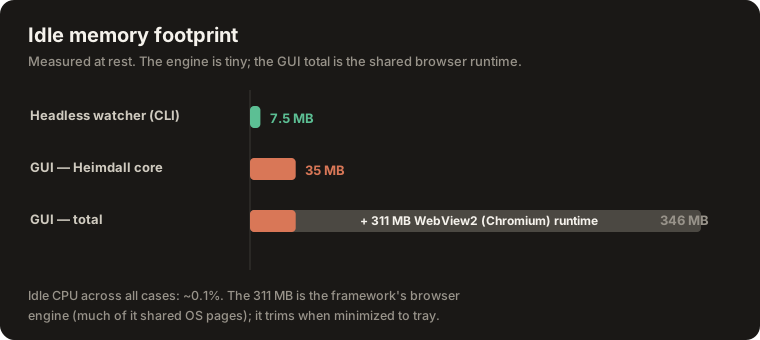
watch): ~7.5 MB, ~0.1% CPU — no browser, no polling.Run the headless watch for always-on protection; open the GUI to review.
Reproducible (Ryzen 9 8945H, release) — see BENCHMARKS.md.
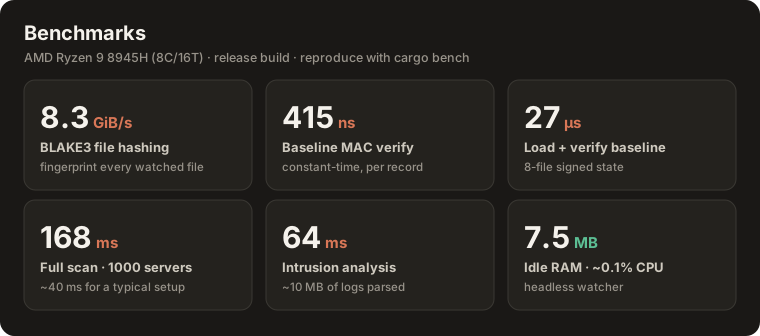
cargo bench).check ~40 ms on a typical config; 1000 servers in ~170 ms (~0.12 ms/file).Grab the .msi or .exe from
Releases; it installs to the
tray, adds itself to startup, and establishes your baseline on first launch. The
installer is unsigned, so SmartScreen will warn — More info → Run anyway.
Verify the download against the SHA-256 published on the release.
There are no prebuilt macOS/Linux bundles yet, and Tauri can't cross-compile, so build the native installer on the target OS:
git clone https://github.com/2alf/Claude-Defender
cd Claude-Defender/claudeDefender-tauri
npm run setup            # frontend deps
npm run tauri build      # native bundle → src-tauri/target/release/bundle/
# or: npm run tauri dev  # run without packaging
Prerequisites: Rust + Node 18+. On Linux also install the webview/keystore build deps:
sudo apt install libdbus-1-dev libwebkit2gtk-4.1-dev libgtk-3-dev \
  libappindicator3-dev librsvg2-dev patchelf pkg-config
Platform status: built and tested on Windows. The macOS and Linux paths (Keychain / Secret Service,
notify, native dialogs) are implemented but not yet verified — testers welcome.
The same core, headless:
heimdall watch                # real-time monitoring (~8 MB, no GUI)
heimdall check                # scan once — exit 0 clean / 1 changes / 2 tamper
heimdall accept | revert      # accept/revert pending changes
heimdall reinit               # rebuild baseline from current files (recovery)
heimdall intrusion            # MCP install/run trace from logs
heimdall report               # export an audit report (Markdown + JSON)
heimdall quarantine <server>  # disable a suspect server (restore to undo)
heimdall status               # watched files + last verdict
heimdall reset --yes          # factory reset: wipe all state + keystore anchors
Override paths with CLAUDE_DEFENDER_CONFIG / CLAUDE_DEFENDER_STATE_DIR.
The binary currently ships as
claude-defender-cli;heimdallis the rename target. The original Python script is retired tolegacy/.
A detective, tamper-evident control. Honesty about that is the point of the name.
Is: a real-time watcher that tells you what changed and when each server appeared; a trust anchor whose baseline can't be silently forged; one-click revert/quarantine.
Isn't: a wall (it warns; you decide) · tamper-proof against code-exec
as your user or a compromised OS · an antivirus/sandbox. For the
pre-execution shell side of LOTL (curl … | sh from a poisoned README), see the
sibling project whatif.
Signed releases + SBOM · remote anchoring of the audit chain · richer log↔config correlation · a non-WebView UI for a tens-of-MB GUI · full identifier rename (binaries, bundle id).
Open source. Disclosures welcome — see the
VDP. State lives
under MCPMonitor/ (all MAC-signed; hash-chained audit.log.json; pre-revert
backups/). GPL-3.0.
Thanks to everyone who's helped — Hall of Fame.
Sign in to join the discussion.
No comments yet. Be the first to say what this is good for.
🪨 why use many token when few token do trick — Claude Code skill that cuts 65% of tokens by talking like caveman

Orca is the ADE for working with a fleet of parallel agents. Run any coding agent with your own subscription. Available on desktop, mobile and remote runtime.

Claude Code is an agentic coding tool that lives in your terminal, understands your codebase, and helps you code faster by executing routine tasks, explaining complex code, and handling git workflows - all through natural language commands.
Fast, efficient, battle-tested at Alibaba's scale. Hybrid architecture code review tool: deterministic pipelines + LLM Agent, precise line-level comments, built-in multi-language ruleset (NPE, thread-safety, XSS, SQL injection), OpenAI & Anthropic compatible.
An open-source AI agent that brings the power of Gemini directly into your terminal.

AAS Core is the local, agent-first control plane for complete catalog discovery, agent-owned selection, stack validation, and planning, backed by 2,115+ agentic skills. Includes CLI, local MCP, catalog, plugins, and Workbench.