
rohitg00/ai-engineering-from-scratchTutorials & Guides
Learn it. Build it. Ship it for others.
54k
This is a reverse-engineering walkthrough of Claude Code’s harness, written as a long-form guide with diagrams, code snippets, and chaptered analysis. It explains how the agent loop, tools, permissions, sandbox, hooks, and context management fit together, plus two deeper findings on Grove and anti-distillation.
Builders who want to study Claude Code’s harness design before building or tuning their own agent workflows.
You can learn how a large agent harness is structured and reuse those ideas in your own workflow design.
Breaks down the main loop, error recovery paths, and continue points in Claude Code’s execution flow.
Explains how Claude Code groups tools and why reads and writes are handled differently.
Maps the layered permission checks and sandbox boundaries used around agent actions.
Covers the hook system as a set of lifecycle events and extension points.
Describes the hidden training-data pipeline, retention changes, telemetry flow, and BigQuery path.
Shows the layered defenses used to detect or discourage model distillation.
Includes a hands-on section that builds a small runnable harness in Python.




Reverse-engineering all 512,664 lines of Claude Code's TypeScript source — agent loop, tool system, permission model, sandbox, context engineering. A 16-chapter textbook (~50,000 words, 147 code blocks, 77 diagrams) on how Anthropic actually builds an agent harness.
📣 Featured in Chinese AI media — Republished by QingkeAI (青稞AI) and other WeChat publications, with 20,000+ reads and 2,000+ shares. Original Chinese article.
Two findings you won't see elsewhere:
👉 Read the full English version online
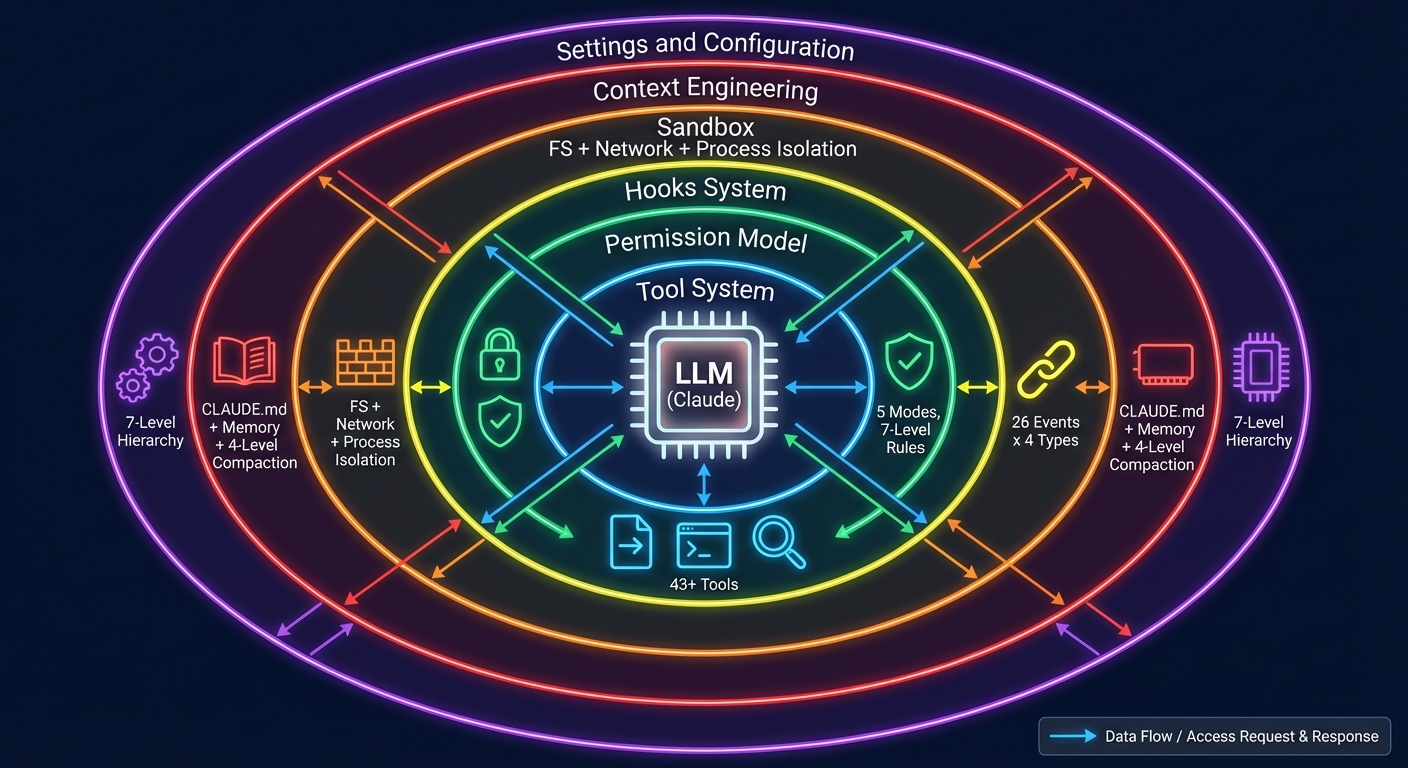
基于 Claude Code 全部 512,664 行 TypeScript 源码的系统性逆向分析,拆解 Anthropic 在 Agent Loop、工具系统、权限模型、沙盒安全、上下文工程等方面的设计决策与工程取舍。
📣 媒体报道:Harness Engineering 主分析已被 青稞AI 等公众号转发,累计阅读 20,000+,转发 2,000+。原文链接
首次发现 Anthropic 从用户键盘到 BigQuery 训练数据仓库的完整数据链路:
messages.ts:245 + sessionStorage.ts:4388flowchart TD
USER["用户交互"] --> GROVE{"grove_enabled?"}
GROVE -->|ON| RETAIN["数据保留 5 年"]
GROVE -->|OFF| DEFAULT["数据保留 30 天"]
RETAIN --> EVENTS["796 个 tengu_* 事件"]
DEFAULT --> EVENTS
EVENTS --> DD["Datadog(脱敏)"]
EVENTS --> BQ["BigQuery 特权列(完整数据)"]
BQ --> TRAIN["开发者注释:'training data'"]
style GROVE fill:#fff3e0,stroke:#ff9800,color:#333
style RETAIN fill:#ffebee,stroke:#f44336,color:#333
style BQ fill:#e3f2fd,stroke:#2196f3,color:#333
style TRAIN fill:#e8f5e9,stroke:#4caf50,color:#333
从源码中拆解 Anthropic 防止模型被盗的 5 层工程实现:
flowchart LR
    subgraph 五层防御
        L1["1. Attestation<br/>客户端认证"]
        L2["2. Fingerprint<br/>请求指纹"]
        L3["3. Fake Tools<br/>蜜罐工具"]
        L4["4. Signature<br/>签名绑定"]
        L5["5. Streamlined<br/>输出防护"]
    end

    L1 --> L2 --> L3 --> L4 --> L5

    style L1 fill:#ffebee,stroke:#f44336,color:#333
    style L2 fill:#fff3e0,stroke:#ff9800,color:#333
    style L3 fill:#e8f5e9,stroke:#4caf50,color:#333
    style L4 fill:#e3f2fd,stroke:#2196f3,color:#333
    style L5 fill:#f3e5f5,stroke:#9c27b0,color:#333
16 章 · ~50,000 字 · 147 段代码块 · 77 张图表 · 中英双语
| 章节 | 内容 | 核心发现 |
|---|---|---|
| 第 1 章 | Harness Engineering 概论 | 只改 Harness 就能让跑分从 52.8% 提升到 66.5% |
| 第 2 章 | Claude Code 架构全景 | 512K LOC 的模块分布与启动时序 |
| 第 3 章 | Agent Loop | 30 行 while(true) + 1800 行错误恢复 + 7 个 continue 站点 |
| 第 4 章 | Tool System | 43+ 工具的分区算法:读操作并行、写操作串行 |
| 第 5 章 | Permission Model | 6 层纵深防御,累计绕过概率 0.00000002% |
| 第 6 章 | Hooks System | 26 事件 × 4 类型的生命周期可扩展架构 |
| 第 7 章 | Sandbox & Security | 文件系统 + 网络 + 进程三维隔离 |
| 第 8 章 | Context Engineering | 180K → 45K 的四级压缩管道 |
| 第 9-12 章 | Settings / MCP / SubAgent / Skills | 7 级设置层级、多智能体编排、插件生态 |
| 第 13-14 章 | 实战指南 + 设计哲学 | 10 条可复用的 Harness 设计原则 |
| 第 15 章 | Hands-on: Mini Harness | 200 行 Python 从零实现一个可运行的 Harness |
| 第 16 章 | 竞品对比 | Claude Code vs Cursor vs Copilot 12 维对比 |
| 资源 | 说明 |
|---|---|
| learn-claude-code | 渐进式 12 节动手课程,适合从零构建 Harness |
| claude-code-harness | 生产级 Plan→Work→Review 插件 |
| Martin Fowler: Harness Engineering | 三大支柱的概念框架 |
| arXiv:2603.05344 | 学术论文:scaffolding vs harness 架构 |
WanLanglin · 微信: felixwll · Open to Agentic AI opportunities · 欢迎交流
Educational and research purposes. Claude Code is property of Anthropic, Inc.
Sign in to join the discussion.
No comments yet. Be the first to say what this is good for.
Learn it. Build it. Ship it for others.

Bash is all you need - A nano claude code–like 「agent harness」, built from 0 to 1

A visual, example-driven guide to Claude Code — from basic concepts to advanced agents, with copy-paste templates that bring immediate value.

Specification and documentation for Agent Skills
💻 vibe coding 101|The first course for AI-native product builders.

End-to-end, code-first tutorials for building production-grade GenAI agents. From prototype to enterprise deployment.