
koala73/worldmonitorConnectors
Real-time global intelligence dashboard. AI-powered news aggregation, geopolitical monitoring, and infrastructure tracking in a unified situational awareness interface
86k
ComPDF MCP exposes ComPDF document processing through MCP so agents can convert PDFs and images, extract structured data, and run PDF editing tasks. It also supports async jobs and presigned uploads for longer or multi-file work.
Builders who want Claude Code, Codex, Cursor, or Copilot to process documents before they analyze or route them.
You can turn raw PDFs and images into cleaner text, tables, and files that your agent can use with less noise and lower token cost.
Converts PDFs and images into Word, Excel, PowerPoint, HTML, RTF, CSV, TXT, JSON, Markdown, searchable PDF, and more.
Merges, splits, rotates, deletes, inserts, extracts, compresses, encrypts, decrypts, adds watermarks, and compares PDFs.
Parses documents into structured output and extracts business data from PDFs and images.
Shows setup for Claude Code, Codex, Cursor, and GitHub Copilot, all using the same MCP service URL.
Includes task tools for long-running work plus presigned upload flows for supported one-file operations.
python -m venv .venv
.venv\Scripts\Activate.ps1
pip install -e .
Copy-Item .env.example .env
compdf-streaming-mcp
python3 -m venv .venv
source .venv/bin/activate
pip install -e .
cp .env.example .env
compdf-streaming-mcp
$env:COMPDF_API_KEY = "your-own-compdf-api-key"
ComPDF MCP is built for MCP clients and AI agent platforms. It provides PDF/image parsing and data extraction, PDF conversion, PDF editing, and image conversion capabilities. It helps users process raw documents first, then pass lighter, cleaner, and more structured results into AI, reducing token usage, lowering AI costs, and improving overall processing efficiency.
- If you find ComPDF MCP useful, please consider giving us a ⭐ Star on GitHub. It helps us grow and improve.
- Got questions or ideas? Join the conversation in our Discussions.



Why Choose ComPDF MCP • Capabilities • Technical Architecture • Quick Start • Deployment and Operations • License and Free Access • Use Cases and Example Prompts • Support
The core reason users choose ComPDF MCP is not simply to let AI work with PDFs. It is to process complex, lengthy, and noisy source documents into inputs that are easier for models to understand before handing them off to AI for analysis, summarization, Q&A, or automation.
Raw PDFs, scanned files, and image files are often larger, noisier, and less stable in structure. By using ComPDF MCP for conversion, extraction, and page-level processing first, then sending the results into AI, users can:
This approach is especially valuable when processing reports, contracts, invoices, tables, scanned files, and similar documents in bulk. In these cases, a "process documents first, then call AI" workflow is usually more cost-efficient and better suited for downstream automation than sending original files directly to the model.
ComPDF MCP focuses on three major capability groups: document conversion, PDF operations, and intelligent parsing and data extraction.
| Capability | Description |
|---|---|
| PDF to Word | Convert PDF files into editable Word documents while preserving the original layout, text, images, and formatting as much as possible. |
| PDF to Excel | Convert PDF files into Excel workbooks with support for tables, numbers, and structured business data. |
| PDF to Slide | Convert PDF pages into editable PowerPoint slides while preserving the original layout and visual structure as much as possible. |
| PDF to HTML | Convert PDF files into HTML for web display and content reuse while retaining text, images, tables, and layout. |
| PDF to RTF | Convert PDF files into RTF documents with support for text and image content. |
| PDF to Image | Convert PDF pages into PNG or JPG images with configurable resolution and DPI. |
| PDF to CSV | Extract tables from PDF files and export them as CSV, either table by table or as merged output. |
| PDF to TXT | Extract text from PDF or scanned PDF files and save it as plain text. |
| PDF to JSON | Extract text, tables, and images from PDF files and save them as structured JSON. |
| PDF to Markdown | Convert PDF files into Markdown for easier reuse in knowledge bases, developer docs, blog systems, and AI workflows. |
| PDF to Searchable PDF | Run OCR on scanned PDFs and output searchable PDFs with selectable, copyable, and highlightable text for retrieval, archiving, and downstream processing. |
| PDF to OFD | Convert PDF files into OFD files for OFD archiving, document circulation, and localized office scenarios. |
| Word to PDF | Convert Word documents into PDF while preserving layout, fonts, images, and page structure as much as possible for sharing, archiving, and printing. |
| PNG to PDF | Convert PNG images into PDF for easier packaging, sharing, printing, and archiving of screenshots, design files, or supporting image materials. |
| RTF to PDF | Convert RTF documents into PDF while preserving core text styling and layout for consistent cross-device viewing and formal output. |
| Excel to PDF | Convert Excel workbooks or spreadsheets into PDF for report sharing, printing, archiving, and preventing accidental formula edits. |
| TXT to PDF | Convert plain TXT files into PDF, making logs, notes, and text instructions easier to organize as fixed-layout documents. |
| CSV to PDF | Convert CSV table data into PDF for snapshot sharing, review, printing, and business archiving. |
| Slide to PDF | Convert PowerPoint presentations into PDF for presentation distribution, cross-device viewing, and formal record keeping. |
| HTML to PDF | Convert HTML pages or content fragments into PDF for webpage preservation, report export, email archiving, and printable output. |
| Image to Word | Convert JPG, JPEG, PNG, and BMP image files into editable Word documents. |
| Image to Excel | Convert image files into Excel workbooks with support for tables, text, and numeric content. |
| Image to PPT | Convert image files into editable PowerPoint slides while preserving visible layout and content structure as much as possible. |
| Image to PDF | Convert JPG, JPEG, PNG, BMP, and similar image files into PDF for consolidating, sharing, printing, and archiving one or multiple images. |
| Image to HTML | Convert image files into HTML while preserving text, layout, tables, and major visual elements as much as possible. |
| Image to RTF | Convert image files into RTF documents with support for extracted text and images. |
| Image to CSV | Extract tables from image files and export them as CSV. |
| Image to TXT | Extract text from image files and save it as plain text. |
| Image to JSON | Extract text, tables, and images from image files and save them as structured JSON. |
| Capability | Description |
|---|---|
| Merge PDF Files | Combine multiple PDF files into a single PDF document. |
| Split PDF Files | Split one PDF file into multiple smaller PDF files. |
| Rotate PDF Pages | Rotate selected PDF pages by 90, 180, or 270 degrees. |
| Delete PDF Pages | Remove one or more pages from a PDF file. |
| Insert PDF Pages | Insert pages from another PDF into an existing PDF. |
| Extract PDF Pages | Extract selected pages or page ranges and save them as a new file. |
| Convert PDF Standard | Convert a PDF conformance or archival standard. |
| Add Watermark | Add text or image watermarks to PDF files for branding or usage control. |
| Remove Watermark | Remove text or image watermarks from supported PDF files. |
| Compress PDF | Reduce PDF file size for easier storage, upload, and sharing. |
| Encrypt PDF | Protect PDF files with AES encryption and permission controls. |
| Decrypt PDF | Remove passwords from authorized PDF files for internal processing or reuse. |
| Compare PDFs | Compare the content differences between two PDF files. |
| Capability | Description |
|---|---|
| Intelligent Document Parsing | Parse PDFs and images into structured document output for agents, automation workflows, and downstream systems. |
| Intelligent Data Extraction from PDFs and Images | Extract valuable business data such as text, tables, and content fields from PDFs and images. |
This project is an MCP Streamable HTTP service built with Python, FastMCP, and Starlette. Tool parameter schemas are generated from the bundled official OpenAPI parameter snapshot, and the service rejects unknown parameters.
Clients can access every tool through the aggregate endpoint:
http://127.0.0.1:8000/mcp
If you only need part of ComPDF MCP, use the module endpoints below:
| Module | MCP Endpoint | Business Tools | Representative Tools |
|---|---|---|---|
| PDF and Image Conversion | /mcp/conversion/mcp | 28 | pdf_to_word, pdf_to_markdown, image_to_json, word_to_pdf, and more |
| Intelligent Parsing and Data Extraction | /mcp/ai/mcp | 2 | document_parse, document_extract |
| PDF Editing, Protection, and Comparison | /mcp/pdf/mcp | 13 | merge_pdf, add_watermark, encrypt_pdf, compare_pdf, and more |
| All capabilities | /mcp | 44 | All tools above |
All business tools use a shared file-input shape. Keys in options must use the camelCase parameter names from the ComPDF API documentation. Only htmlFile, templateFile, dataFile, imageFile, and iccFile may be uploaded through special_files.
{
  "files": [
    {
      "filename": "report.pdf",
      "content_base64": "JVBERi0xLjc...",
      "content_type": "application/pdf"
    }
  ],
  "options": {
    "pageRanges": "1-3,6",
    "enableOcr": 1
  },
  "special_files": {
    "imageFile": {
      "filename": "watermark.png",
      "content_base64": "iVBORw0..."
    }
  }
}
The decoded size of an individual Base64 file is limited to 100 MB. Synchronous tool responses include the ComPDF result, the relevant official documentation URL, and a statement that download URLs expire after 24 hours.
Prerequisite: Python 3.10+. From the repository root, create a virtual environment and install the package in editable mode.
Windows:
python -m venv .venv
.venv\Scripts\Activate.ps1
pip install -e .
Copy-Item .env.example .env
compdf-streaming-mcp
Linux / macOS:
python3 -m venv .venv
source .venv/bin/activate
pip install -e .
cp .env.example .env
compdf-streaming-mcp
The service listens on 0.0.0.0:8000 by default. Use these endpoints to check its status:
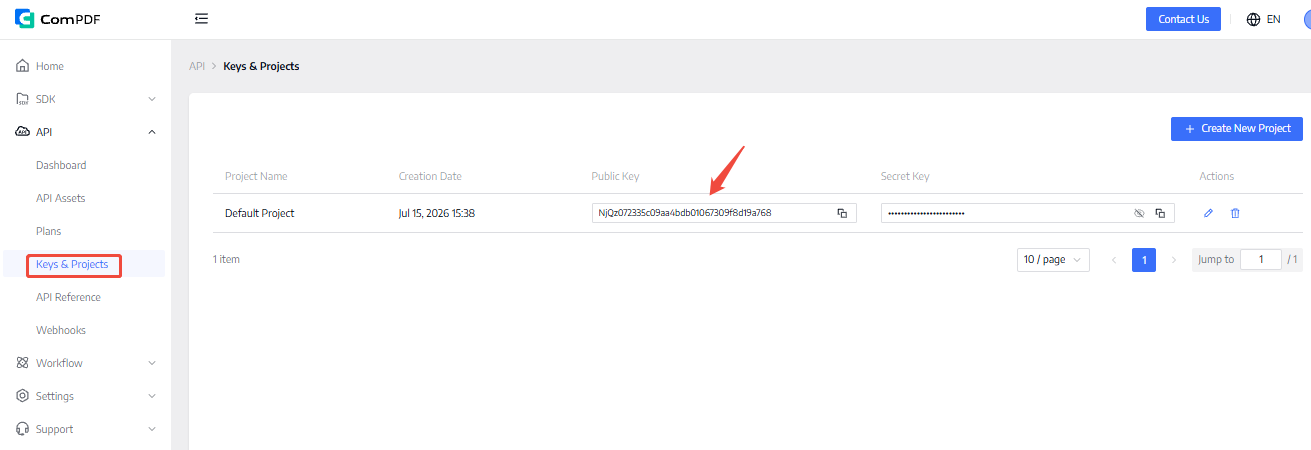
GET /healthz: service status and mounted MCP routes.GET /readyz: readiness status without calling the upstream ComPDF API.GET /metrics: request counters in Prometheus text format.Copy .env.example to .env, then adjust settings for the deployment environment. The server does not store or configure a user's ComPDF API key. Each MCP request supplies that user's key through the X-ComPDF-API-Key header. You can sign up for ComPDF Portal and copy your free API key from the location shown below.
COMPDF_API_BASE_URL=https://api-server.compdf.com/server
COMPDF_API_TIMEOUT_SECONDS=180
MCP_HOST=0.0.0.0
MCP_PORT=8000
MCP_ALLOWED_HOSTS=localhost,localhost:*,127.0.0.1,127.0.0.1:*,mcp.example.com
MCP_RATE_LIMIT_PER_MINUTE=120
For mainland China accounts, use COMPDF_API_BASE_URL=https://api-server.compdf.cn/server. In production, add the reverse-proxy domain to MCP_ALLOWED_HOSTS; include a non-default port or use mcp.example.com:* when appropriate.
The examples below use the unified MCP URL http://127.0.0.1:8000/mcp. For a remote deployment, replace it with the public HTTPS address, for example https://your-domain.example/mcp.
First obtain a personal ComPDF API key (sign up to get your free API key). For clients that use environment variables, set it on the client machine first:
$env:COMPDF_API_KEY = "your-own-compdf-api-key"
Add the remote MCP service to ~/.codex/config.toml:
[mcp_servers.compdf]
url = "http://127.0.0.1:8000/mcp"
env_http_headers = { "X-ComPDF-API-Key" = "COMPDF_API_KEY" }
tool_timeout_sec = 180
Add the following MCP server to the user-level configuration file ~/.claude.json. COMPDF_API_KEY must be available in the terminal session used to start Claude Code:
{
  "mcpServers": {
    "compdf": {
      "type": "http",
      "url": "http://127.0.0.1:8000/mcp",
      "headers": {
        "X-ComPDF-API-Key": "${COMPDF_API_KEY}"
      }
    }
  }
}
If ~/.claude.json already has configuration, merge compdf into the existing mcpServers object instead of overwriting the file.
Run MCP: Open User Configuration from the VS Code Command Palette, or create .vscode/mcp.json in the workspace, then add the following configuration. VS Code prompts for the API key in a password field on first use:
{
  "inputs": [
    {
      "type": "promptString",
      "id": "compdf-api-key",
      "description": "ComPDF API Key",
      "password": true
    }
  ],
  "servers": {
    "compdf": {
      "type": "http",
      "url": "http://127.0.0.1:8000/mcp",
      "headers": {
        "X-ComPDF-API-Key": "${input:compdf-api-key}"
      }
    }
  }
}
Open Cursor Settings > Tools & MCP, select New MCP Server, or edit ~/.cursor/mcp.json, then add:
{
  "mcpServers": {
    "compdf": {
      "url": "http://127.0.0.1:8000/mcp",
      "headers": {
        "X-ComPDF-API-Key": "your-own-compdf-api-key"
      }
    }
  }
}
This Cursor configuration stores the key in a local configuration file. Do not commit ~/.cursor/mcp.json or a project-level configuration file that contains the key.
All clients must send X-ComPDF-API-Key with every MCP request. Do not pass the key as a tool argument, URL parameter, or chat message.
In addition to the 44 synchronous business tools, each module provides list_operations and these task tools:
start_async_operation: invokes the matching /v2/processAsync/... endpoint for long-running or multi-file work.get_task_status: queries task status from /v2/task/taskInfo.create_presigned_upload, upload_presigned_file, and start_presigned_operation: create a presigned task, upload the file, and start the task in sequence.Presigned uploads support only operations with one standard file. Use asynchronous mode for PDF merging, comparison, page inserting, and more. The presigned URL remains only in the creating module server's memory and is never exposed as a tool argument or response field.
Build and run the service with Docker Compose:
docker compose up --build
In production, expose the aggregate endpoint as https://your-domain.example/mcp behind an HTTPS reverse proxy, and configure MCP_ENV=production, MCP_PUBLIC_URL, MCP_OAUTH_ISSUER_URL, and MCP_STATIC_TOKENS_JSON. When enabled, clients must also send Authorization: Bearer <token>; this service token is separate from each user's ComPDF API key. See DEPLOYMENT.md for image transfer, HTTPS proxy, update, and rollback instructions.
ComPDF MCP can be used for free, without purchasing or contacting sales.
Sign up to get your free API key and configure it
Suitable for individual trials, feature validation, and workflow testing
If you need higher API assets, enterprise deployment, or commercial cooperation, please contact the sales
This lowers the barrier to adoption and makes it easier to test real AI document workflows before deciding whether to move into deeper business use.
Upload a PDF, image, or other source file. Enter a task instruction such as extracting tables, converting formats, merging PDFs, or adding watermarks. The agent calls the corresponding ComPDF Server tool and returns the result. If deeper analysis is needed, pass the processed output to AI afterward.
Example scenarios:
Example prompts:
Built by the ComPDF team.
Website ·
Contact Sales ·
Tech Support
Sign in to join the discussion.
No comments yet. Be the first to say what this is good for.
Real-time global intelligence dashboard. AI-powered news aggregation, geopolitical monitoring, and infrastructure tracking in a unified situational awareness interface

Git-native persistent memory for AI coding agents. Implements Google OKF v0.2 with sub-300µs in-memory BM25 search, embedded MCP server, and progressive disclosure. Slashes token bloat by 80% with zero external databases or dependencies. Built in pure Go.
20 MB lightweight cross-platform database client for 90+ databases, including MySQL, PostgreSQL, SQLite, Redis, MongoDB, DuckDB, SQL Server, and Dameng. Built-in AI, MCP Server, CLI, desktop and Docker. | 轻量级跨平台数据库管理工具,支持 MySQL、PostgreSQL、SQLite、Redis、MongoDB、达梦等 90+ 数据库,提供桌面端、Docker、CLI、内置 AI 助手和 MCP Server。
The fastest browser for AI agents to run browser automation, built for sharing your logged-in browser state with your AI agents, like Codex or Claude Code, without disturbing you. Zero cost, zero config.

Context7 Platform -- Up-to-date code documentation for LLMs and AI code editors

BankMCP™: your AI can now read your bank. Self-hosted, read-only MCP server for your own bank accounts via open banking (Enable Banking). Standard MCP; tested with Claude and Ollama.