
obra/
superpowers

obra/superpowersSkills
An agentic skills framework & software development methodology that works.
285k
1 add
Fireworks Open ELI5 turns a JSON story spec into a deterministic HTML explainer that works offline. It is built around evidence at each claim, scene playback, reader annotations, and local export to PDF, PNG, PPTX, DOCX, or Pages.
Builders who use Codex or Claude Code and want reusable explanations for complex systems.
You can turn a difficult system into a source-backed interactive story without sending your files to a remote runtime.
Separates analogy, technical mechanism, and caveats so the explanation stays grounded.
Each scene can show source status, core text, support scope, and a URL or explicit no-locator boundary.
Supports concept, repository module, engineering tradeoff, and incident story forms with validation.
Animates nodes, relationships, labels, arrow markers, evidence cards, and scene phases in the HTML explainer.
Adds local history, favorites, annotations, and keyboard-friendly scene navigation in the browser.
Creates PDF, scene PNG, all-scene PPTX, Pages-compatible DOCX, and optional native `.pages` output.
Renders without runtime packages, remote fonts, remote resources, or network access.
# Codex
npx skills@latest add yizhiyanhua-ai/fireworks-open-eli5 -g -a codex -y

# Claude Code
npx skills@latest add yizhiyanhua-ai/fireworks-open-eli5 -g -a claude-code -y

# Both agents
npx skills@latest add yizhiyanhua-ai/fireworks-open-eli5 -g -a codex -a claude-code -y
node scripts/validate.mjs assets/example-spec.json
node scripts/render.mjs assets/example-spec.json example.html
node scripts/validate.mjs assets/example-spec.json example.html
npm run check
npm run check:agent-install

An open, portable Agent Skill for turning difficult systems into truthful, interactive visual stories. It compiles a versioned JSON story spec into one deterministic, self-contained HTML file that works offline.
The project combines an ELI5 layer with inspectable technical truth: readers can follow a real request or event through the system, inspect the evidence behind each conclusion, explore failure behavior, annotate scenes, and export the result without sending source material to a remote runtime.
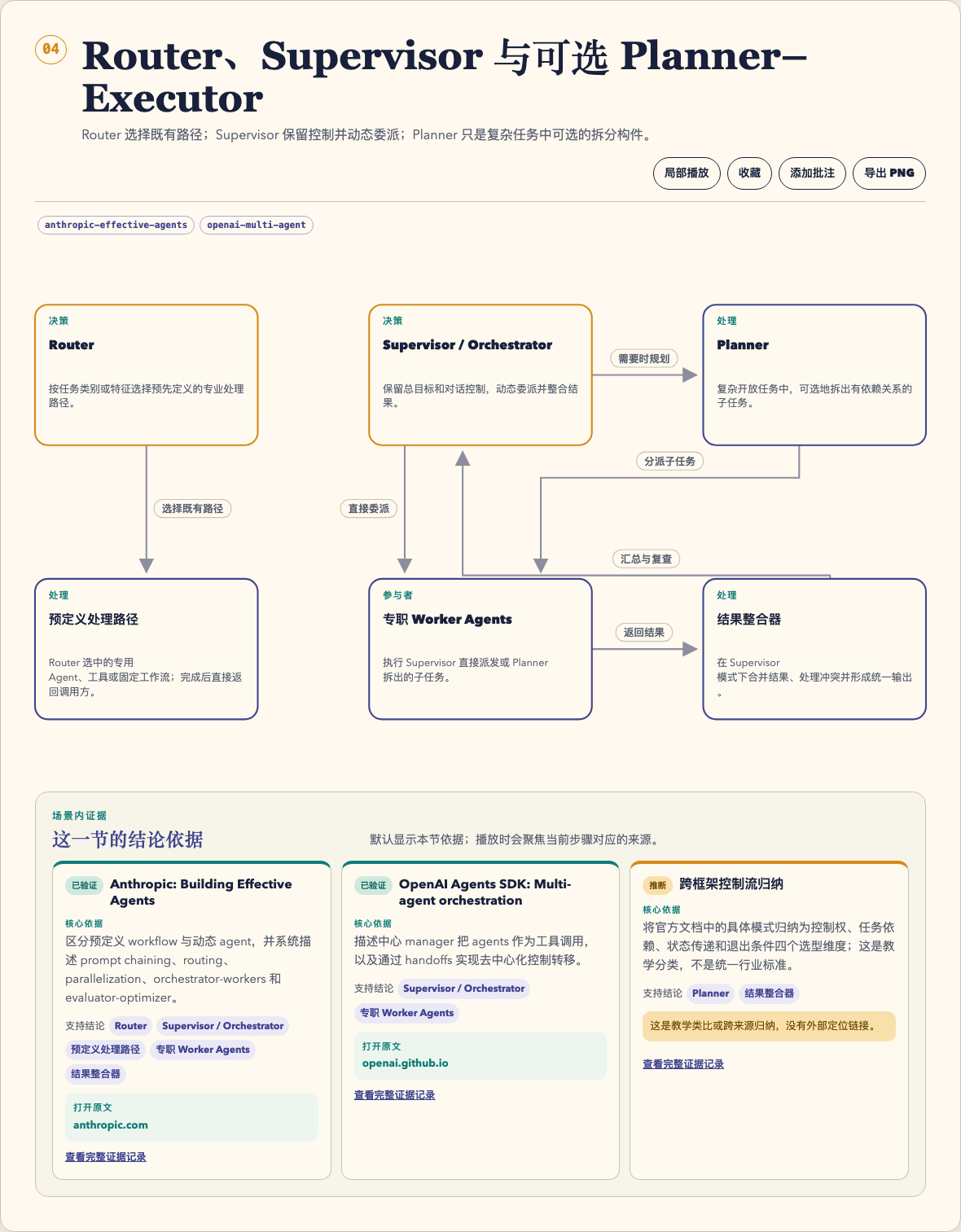
A generated Chinese scene showing the graph, local actions, and conclusion-level evidence together.
.pages conversion.npm install, Python runtime,
remote font, or remote rendering service..pages export: macOS, Apple Pages, and the bundled
loopback helper.The installer and the installed Skill have separate requirements. The
skills@1.5.23 CLI used by the release canary requires Node.js 22.20 or newer;
the installed Skill still runs on Node.js 18 or newer. Installation needs
one-time access to the public GitHub repository; the npx route also needs the
npm registry. A public install needs no GitHub account or token.
Paste one of these requests into your agent. It should inspect SKILL.md,
refuse to overwrite an existing installation without permission, and report
the final location.
Codex
Install the
fireworks-open-eli5Agent Skill globally fromhttps://github.com/yizhiyanhua-ai/fireworks-open-eli5using Codex's Skill installer. The repository root (.) is the Skill directory and its installed name must befireworks-open-eli5. ReviewSKILL.mdfirst, do not replace an existing copy without asking, verify the installed path, and tell me whether I need a new Codex task before using it.
Claude Code
Install the
fireworks-open-eli5Agent Skill globally for Claude Code fromhttps://github.com/yizhiyanhua-ai/fireworks-open-eli5. ReviewSKILL.mdfirst, use the Agent Skills CLI when available, and do not replace an existing copy without asking. If the installer requirement is not met, report it without changing my Node.js installation. Verify that Claude Code can discover the Skill and report the installed path.
npxThe open Agent Skills CLI supports both Codex and Claude Code:
# Codex
npx skills@latest add yizhiyanhua-ai/fireworks-open-eli5 -g -a codex -y

# Claude Code
npx skills@latest add yizhiyanhua-ai/fireworks-open-eli5 -g -a claude-code -y

# Both agents
npx skills@latest add yizhiyanhua-ai/fireworks-open-eli5 -g -a codex -a claude-code -y
-g installs at user scope. Remove it for a project-local installation. Check
the result with npx skills@latest list -g --json, then start a fresh agent
task so the Skill is rediscovered. Review Skills before using them: they run
with the permissions of the host agent.
node scripts/validate.mjs assets/example-spec.json
node scripts/render.mjs assets/example-spec.json example.html
node scripts/validate.mjs assets/example-spec.json example.html
The commands print compact JSON and exit nonzero on failure. Rendering is
create-only by default. Use --force only to intentionally replace a known
regular file; symbolic links are always rejected.
Run the complete contributor and distribution gate:
npm run check
This checks JavaScript syntax, focused tests, the canonical example, release package contents, and a render/validate canary from an unpacked archive.
On Node.js 22.20 or newer, also exercise an isolated Codex and Claude Code installation through the pinned Agent Skills CLI release:
npm run check:agent-install
After installation, ask for an evidence-aware visual explanation, for example:
Explain how one queued job moves through this repository. Cite real files, let me play the request path, and show what breaks when the lease expires.
Read SKILL.md for the agent workflow and references/spec-contract.md for the version 1 story spec.
question + audience + evidence
            │
            ▼
  versioned JSON story spec
            │ validate
            ▼
 deterministic HTML renderer
            │
            ├── offline interactive explainer
            ├── print / PDF
            ├── current-scene PNG
            ├── all-scene PPTX
            ├── Pages-compatible DOCX
            └── optional native Pages conversion
The JSON spec is the portable source of truth. The HTML contains its canonical SHA-256, and the validator can byte-compare a supplied spec against a fresh deterministic render.
Every explainer has a directory drawer. Favorites appear first, followed by independent tabs for the current outline, previously opened explainers, and annotation browsing. A reader can play, favorite, annotate, or export one scene without starting the global trace.
The local library is disabled until the reader selects Enable local
library. It records only explainers actually opened at the same scheme, host,
and port; it never scans the filesystem. Favorites and annotations are
browser-local, unencrypted, and removed when that origin's browser data is
cleared. They never modify the source JSON or generated HTML. file:// and
unavailable storage degrade to an in-memory session.
See references/library-and-export.md for the persistence, privacy, accessibility, playback, and export contract.
| Action | Result | Verification boundary |
|---|---|---|
| Print / PDF | Browser print dialog | The reader chooses Save as PDF when available |
| PNG | 1600×900 image of the selected scene | PNG signature, dimensions, and scene evidence footer |
| PPTX | One 16:9 slide per scene | ZIP signature and required OOXML parts |
| DOCX | One 16:9 page per scene | ZIP signature and required OOXML parts |
| Native Pages | A real .pages package saved by Apple Pages | Must contain Index/Document.iwa and reopen in Pages |
PNG, PPTX, and DOCX are built locally in the browser without third-party libraries. Native Pages conversion is never faked by renaming a DOCX. Serve a trusted explainer directory with:
node scripts/serve.mjs --root /absolute/path/to/explainers --port 8772
The helper binds only to 127.0.0.1, verifies exact origin and a rotating
process token, bounds and validates the generated DOCX/PNG structure, serializes
conversion, and cleans task-specific temporary files. These controls protect
the browser action from cross-site requests; they are not authentication
against other local processes.
The renderer reads local files and writes one local file. Generated HTML uses a
hash-whitelisted Content Security Policy, embeds no remote resources, and
contains no XHR, WebSocket, eval, or HTML-string DOM insertion. Its only
connection is a user-initiated same-origin request to the optional loopback
Pages helper. Cited HTTP(S) URLs are ordinary reader-facing links, never runtime
dependencies.
Annotations are capped and inserted as text. The validator rejects unsafe source URLs, external resources, runtime tampering, spec-hash drift, and unexpected CSP hashes. See SECURITY.md to report a vulnerability.
assets/example-spec.json — complete Chinese DNS exampleassets/explainer-shell.html — offline visual and interaction shellscripts/render.mjs — deterministic rendererscripts/validate.mjs — spec and output validatorscripts/serve.mjs — loopback-only native Pages helperreferences/ — evidence, grammar, visual, reporting, workspace, and export
contractsevals/ — task-quality and trigger evaluation promptstests/ — Node built-in tests and adversarial fixturesRead CONTRIBUTING.md, then run:
npm run check
The release package uses an explicit allowlist and keeps private: true to
prevent accidental npm publication. This repository is intended to distribute
an Agent Skill, not an npm runtime library.
Apache-2.0. See LICENSE and NOTICE.
Fireworks Open ELI5 is an independent implementation inspired by the Anthropic
community eli5 skill and is not endorsed by Anthropic.
Sign in to join the discussion.
No comments yet. Be the first to say what this is good for.
An agentic skills framework & software development methodology that works.
Turn any codebase, with its docs, SQL schemas, configs, and PDFs, into a queryable knowledge graph. A /graphify skill for Claude Code, Cursor, Codex, and Gemini CLI: local deterministic AST parsing, every edge explained, no vector store.

Topic in, narrated explainer video out. A Claude Code / Codex skill that turns any topic into a black-canvas motion-graphics explainer video with TTS voiceover, subtitles and a chapter progress bar. Chinese or English; every frame drawn in code with Remotion.
Public repository for Agent Skills
Open-source AI job search: scan job portals, evaluate listings into a structured A-H report with a global 1-5 score, tailor your CV, track applications — runs locally in your AI coding CLI (Claude Code, Codex, OpenCode, Antigravity…)
Production-grade engineering skills for AI coding agents.