

JuliusBrussee/
caveman

🪨 why use many token when few token do trick — Claude Code skill that cuts 65% of tokens by talking like caveman
105k
1 add
session-migrate is a Python tool that moves a native agent session from one harness to another, then lets you resume it in the target client. It supports many sources and targets, including Claude Code, Codex, Pi, OpenCode, Copilot CLI, Cursor, Mistral Vibe, Muse Code, Qwen Code, Kimi Code, Grok, Kilo Code, OpenHands, Hermes, MastraCode, and Devin.
Builders who want to continue the same coding session in a different agent harness.
You can carry an active agent conversation into another client and keep working from the same history.
Converts a session from one supported harness into another supported native format.
Finds older sessions by title, name, ID, format, lifecycle, and date before transferring them.
Shows native session metadata and structure without dumping the full chat.
Uses per-format readers and writers backed by tests and native corpus validation.
Produces a new target session ID so you can resume it in the destination client.
curl -LsSf https://session-migrate.github.io/install.sh | sh
uv tool install session-migrate
smigrate inspect ~/.claude/projects/-work/SESSION.jsonl
smigrate transfer SESSION_UUID --from claude --to codex --cwd "$PWD"
codex resume NEW_SESSION_UUID
smigrate catalog refresh
smigrate catalog search "oauth refresh" --format claude
smigrate transfer --title "oauth refresh" --from claude --to pi

Migrate your sessions to any harness.





Move coding agent sessions among Claude Code, Codex, Pi, Oh My Pi, OpenCode, GitHub Copilot CLI, Antigravity CLI, Cursor Agent, Mistral Vibe, Muse Code, Qwen Code, and Kimi Code, Grok, Kilo Code, OpenHands, Hermes Agent, MastraCode, and Devin.
curl -LsSf https://session-migrate.github.io/install.sh | sh
Or install with uv:
uv tool install session-migrate
pipx install session-migrate works too. Python 3.11+ and Linux are currently
supported. The full command is session-migrate; smigrate is the shorthand.
Already installed? Run uv tool upgrade session-migrate.
Inspect any native transcript without printing its conversation:
smigrate inspect ~/.claude/projects/-work/SESSION.jsonl
Move a Claude session into Codex and resume it from the same project directory:
smigrate transfer SESSION_UUID --from claude --to codex --cwd "$PWD"
codex resume NEW_SESSION_UUID
Or find an older session by its native title/name first:
smigrate catalog refresh
smigrate catalog search "oauth refresh" --format claude
smigrate transfer --title "oauth refresh" --from claude --to pi
Search is case-insensitive and every word must match, in any order. It searches native titles, names, and IDs—not conversation bodies. A few useful patterns:
# “Fix flaky PostgreSQL timeout” also matches this reversed keyword order.
smigrate catalog search "timeout postgres"

# Find a release conversation among archived Codex sessions from this month.
smigrate catalog search "release notes" --format codex \
  --lifecycle archived --since 2026-08-01T00:00:00Z

# Opt in to matching a project directory when the title is vague.
smigrate catalog search "checkout api" --include-paths
catalog refresh is exhaustive inside the default, environment-selected,
registered, and explicitly discovered roots. It does not crawl your whole disk.
Choose the route on the project website, or replace the three bracketed values yourself:
Follow https://session-migrate.github.io/llms.txt to migrate a session from
[SOURCE]to[TARGET]. Session:[UUID OR TITLE]
The linked procedure is sandbox-tested with both Claude Code and Codex. See the agent workflow and verification.
 Claude Code |  Codex |  Pi |  Oh My Pi |  OpenCode |  Copilot |
 Antigravity |  Mistral Vibe |  Muse Code |  Qwen Code |  Kimi Code |  Grok |
 Kilo Code |  OpenHands |  Hermes Agent |  MastraCode |  Devin |  Cursor* |
Every listed format can be a source or target: 324 ordered routes, including same-format portable rewrites. Cursor deliberately transfers only ordered user/assistant text and is pinned to one exact Linux build; it is not a vendor-supported import API. Same-format migration creates a new independent session—it is not a byte-for-byte clone or a live sync. The matrix is exercised from one exact native-produced source per harness.
| Session data | Result | Notes |
|---|---|---|
| User and assistant messages | ✓ | Preserved in order on every route |
| Tool calls and results | ✓ / partial | Preserved when both adapters support the native shape |
| Images | ✓ / partial | Supported image blocks move; other media is format-dependent |
| Compaction summaries | ✓ / partial | Recreated where the target has a portable equivalent |
| Readable reasoning | Vibe-only portable rewrite | Vibe keeps its explicit readable field when rewritten to Vibe; other/private/signed traces never move |
| Session name, ID, and picker entry | ✓ / partial | The target gets a new native identity; OpenHands derives its picker title from the first user turn |
| Branches, forks, and subagents | Not flattened | Cataloged separately where detectable; migrate the parent session |
| Private or signed thinking | No | Model/provider-bound traces are deliberately omitted |
| Auth, hooks, policies, MCP, and runtime config | No | These remain with the source client |
Every omission or transformation is counted in a content-free migration manifest. The source session is never modified. Cursor intentionally accepts text only. See Pi thinking traces.
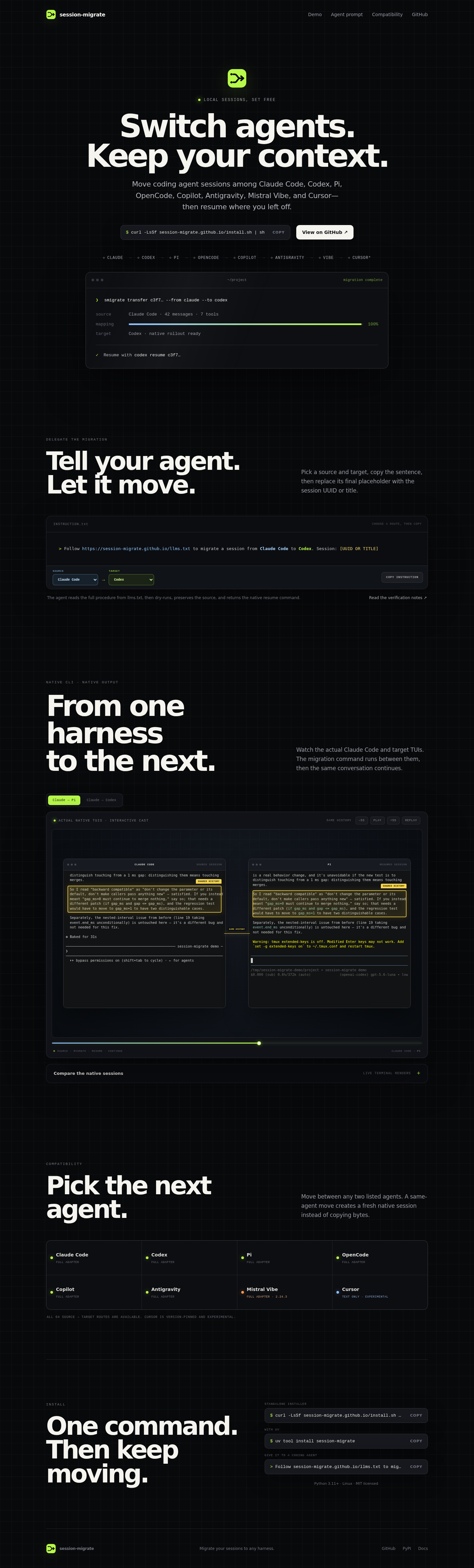
native session → validated event timeline → native target → resume
Each reader projects a versioned native transcript into a small ordered model. Each writer then emits only structures verified against the target CLI. This is session migration, not text export: the target receives a discoverable, resumable native session.
The Antigravity and Cursor adapters are clean-room, unofficial, and version-pinned. Their independently observed formats are published separately: Antigravity research and Cursor research.
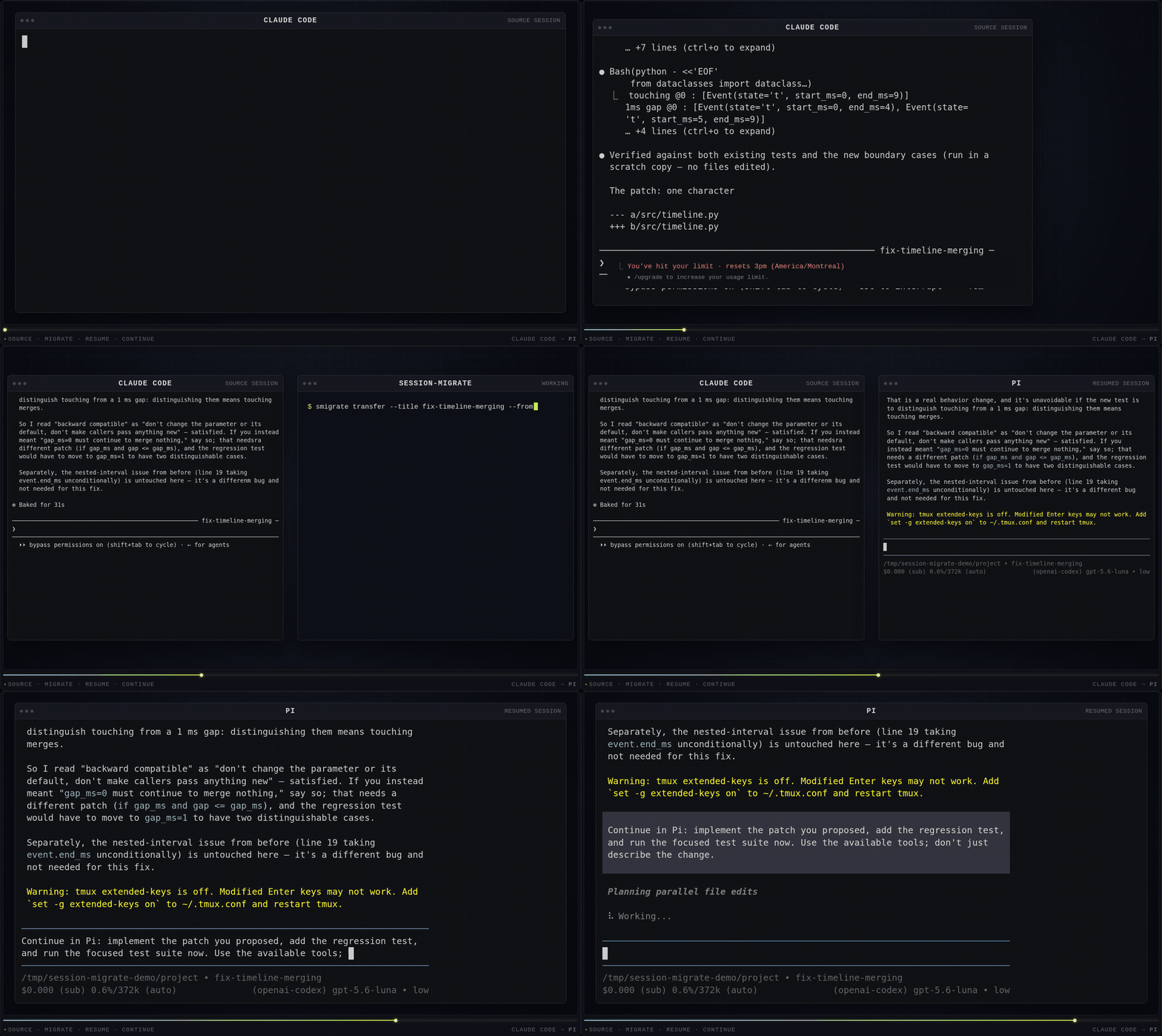
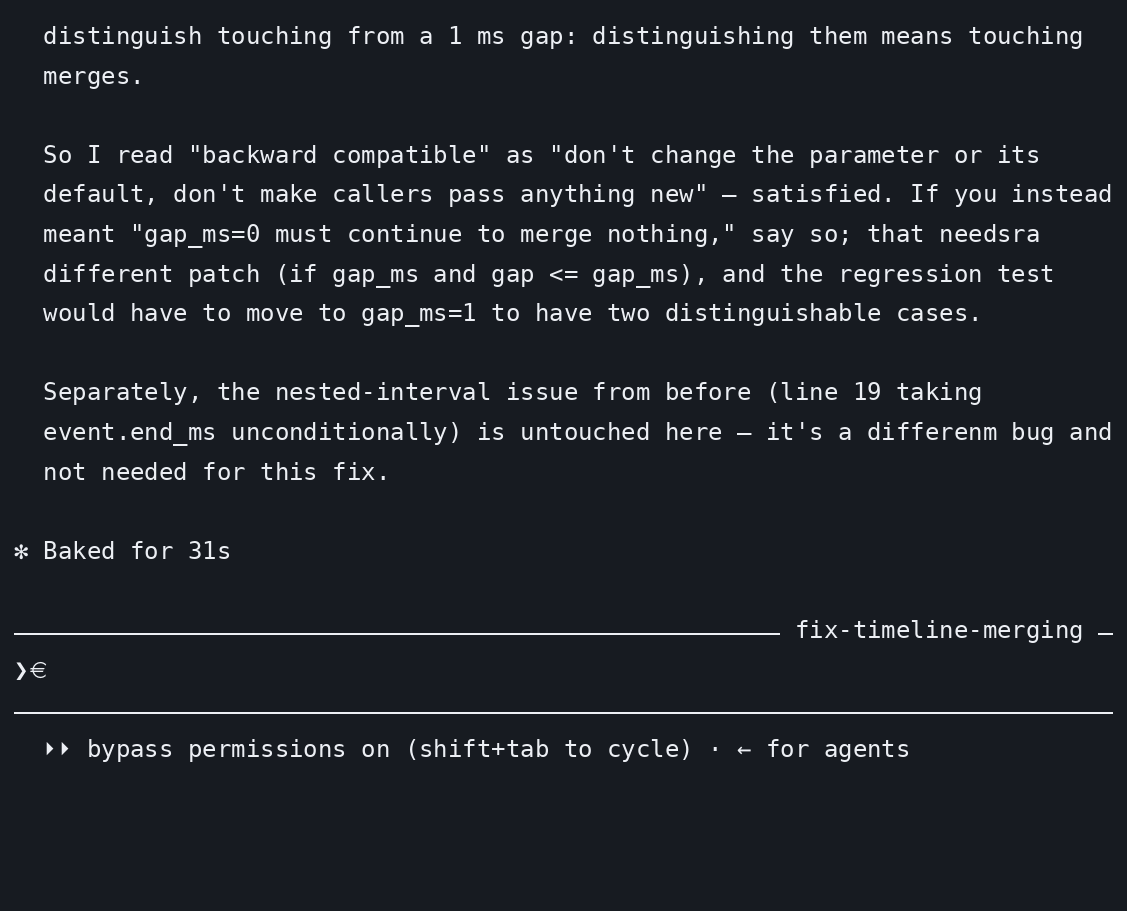
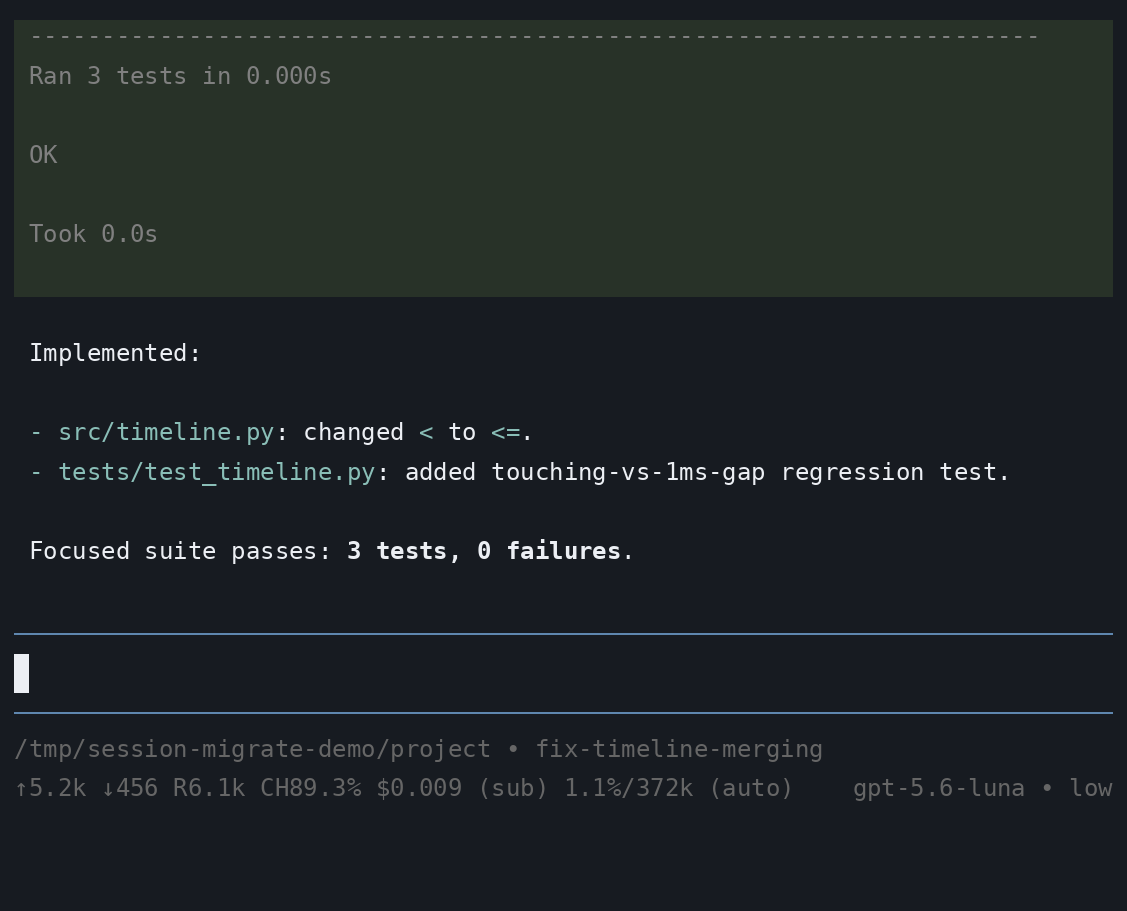
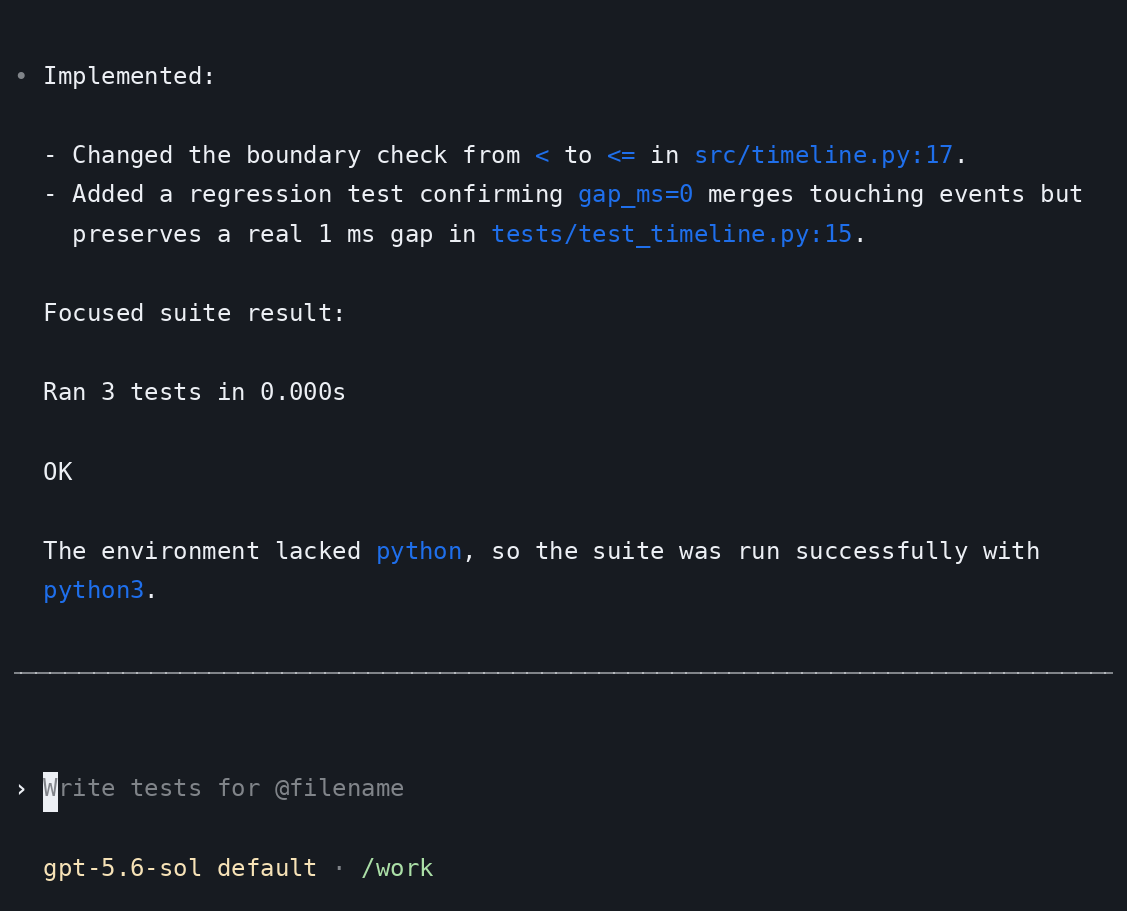
The demo above uses real native casts recorded with the same tmux + asciinema approach as agent-talk. Claude diagnoses a boundary bug in a small project; the migrated session is reopened in Pi, which applies the proposed patch and runs the regression test. It shows the source TUI, the migration command, the shared history, and the continued target session. The website plays those casts directly in JavaScript; the README animation is rendered from that same scene. The same source session is also continued in Claude → Codex. Watch the larger-text Pi video, watch the larger-text Codex video, or reproduce both. The recorder uses disposable credential copies only to drive the native clients; the published assets contain only the controlled demo project and omit account status.
| Before · Claude Code TUI | After · Pi TUI |
|---|---|
 |  |
| Before · Claude Code TUI | After · Codex TUI |
|---|---|
|  |
git clone https://github.com/xhluca/session-migrate.git
cd session-migrate
uv sync --dev
uv run pytest
See the development guide before changing a native adapter. New formats need sanitized fixtures and a real native-resume oracle.
Sign in to join the discussion.
No comments yet. Be the first to say what this is good for.
🪨 why use many token when few token do trick — Claude Code skill that cuts 65% of tokens by talking like caveman

The best-benchmarked open-source AI memory system. And it's free.

Orca is the ADE for working with a fleet of parallel agents. Run any coding agent with your own subscription. Available on desktop, mobile and remote runtime.
A cross-platform desktop All-in-One assistant for Claude Code, Codex, OpenCode, OpenClaw, Grok Build & Hermes Agent. Only official website: ccswitch.io

Never stop coding. Free MIT AI gateway: one endpoint, 352 providers (150+ free), 1200+ models Kimi, Claude, GPT, Gemini, GLM, DeepSeek, MiniMax. Works with Claude Code, Codex, Cursor, OpenCode, Cline & Copilot. Quota-aware auto-fallback, RTK+Caveman compression saves 15-95% tokens, MCP/A2A, Desktop/PWA. Built by 550+ contributors

Compress tool outputs, logs, files, and RAG chunks before they reach the LLM. 20% fewer tokens for coding agents, 60-95% fewer tokens for JSON, same answers. Library, proxy, MCP server.