

affaan-m/
ECC

affaan-m/ECCHarnesses
The agent harness performance optimization system. Skills, instincts, memory, security, and research-first development for Claude Code, Codex, Opencode, Cursor and beyond.
258k
Lagune adds a security process around your agent work instead of acting as a one-off scanner. It gives you commands like `/lagune.charter`, `/lagune.detect`, `/lagune.plan`, `/lagune.harden`, and `/lagune.verify` so the agent can map risks, propose fixes, apply them safely, and check the result.
Builders who want their coding agent to find risks, follow project security rules, and harden changes in a repeatable flow.
You can turn security review into a guided, repeatable part of building, instead of a separate cleanup pass.
Defines project-specific security rules with `/lagune.charter` before the agent starts changing code.
Runs `/lagune.detect`, `/lagune.plan`, `/lagune.harden`, and `/lagune.verify` in order to move from findings to fixes.
Creates new sub-skills from articles, exploits, or topics with `/lagune.specialize`.
Turns findings into runnable proofs with `/lagune.prove` for responsible disclosure work.
Serves a browser dashboard with install, pull, update, and manage actions using `npx -y lagune@latest`.
Works with many supported agents and editor setups, with project files for Claude Code, Cursor, Copilot, Windsurf, and Gemini.
npx -y lagune@latest init



Lagune helps your AI agent make a project more secure. You point it at your code, and the agent figures out what your system actually does, then guides you through the security work that matters for it.
Love Lagune? Give us a ⭐ on GitHub!
Lagune adapts to your environment, whether it is a new project or an existing one.
[!TIP]
See real-world Prompt Samples 🪼
For an interactive live view, follow-up, and maintenance, run:
npx -y lagune@latest
It serves a dashboard and opens it in a random port:
node_modules or package.json is needed 📦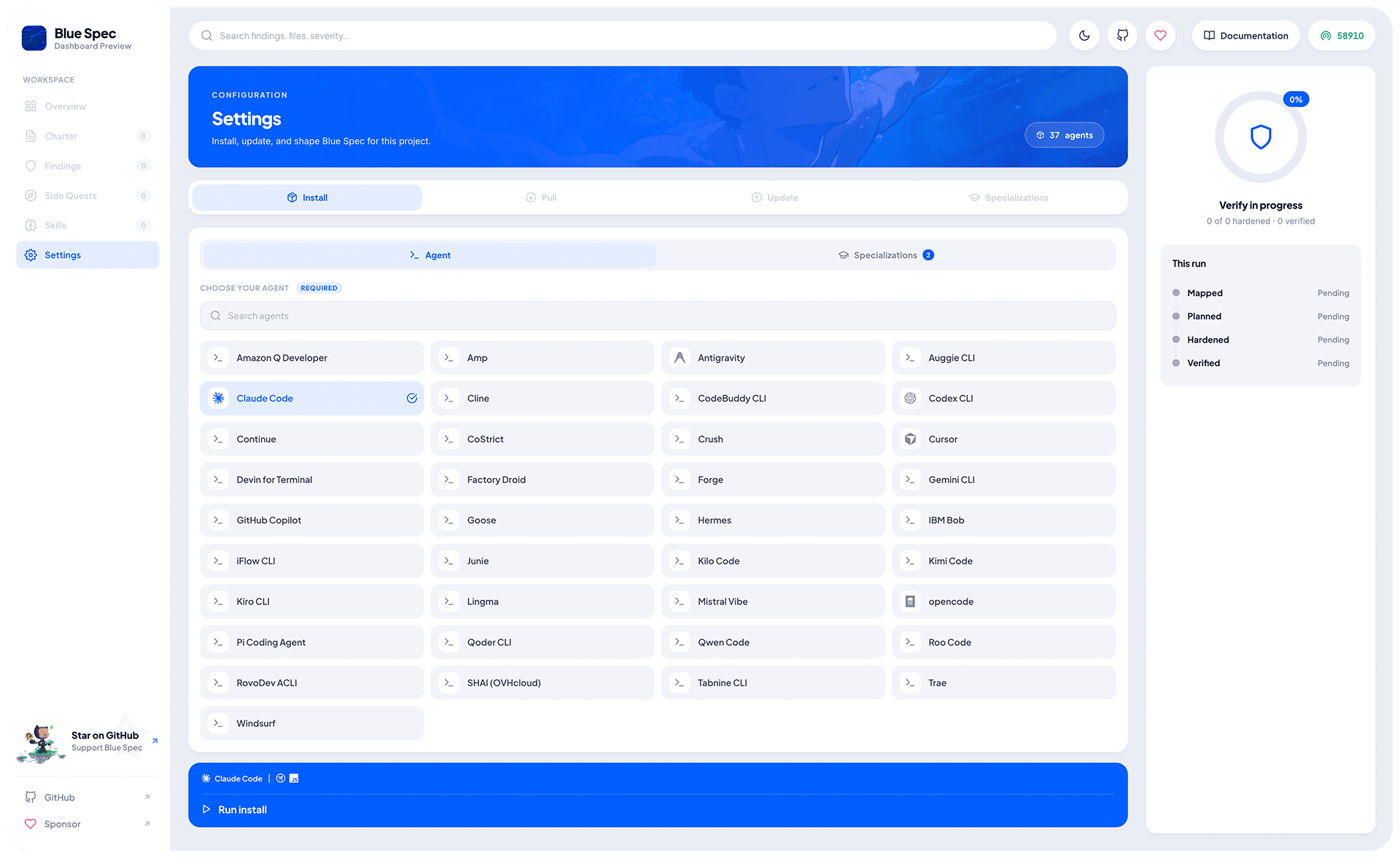
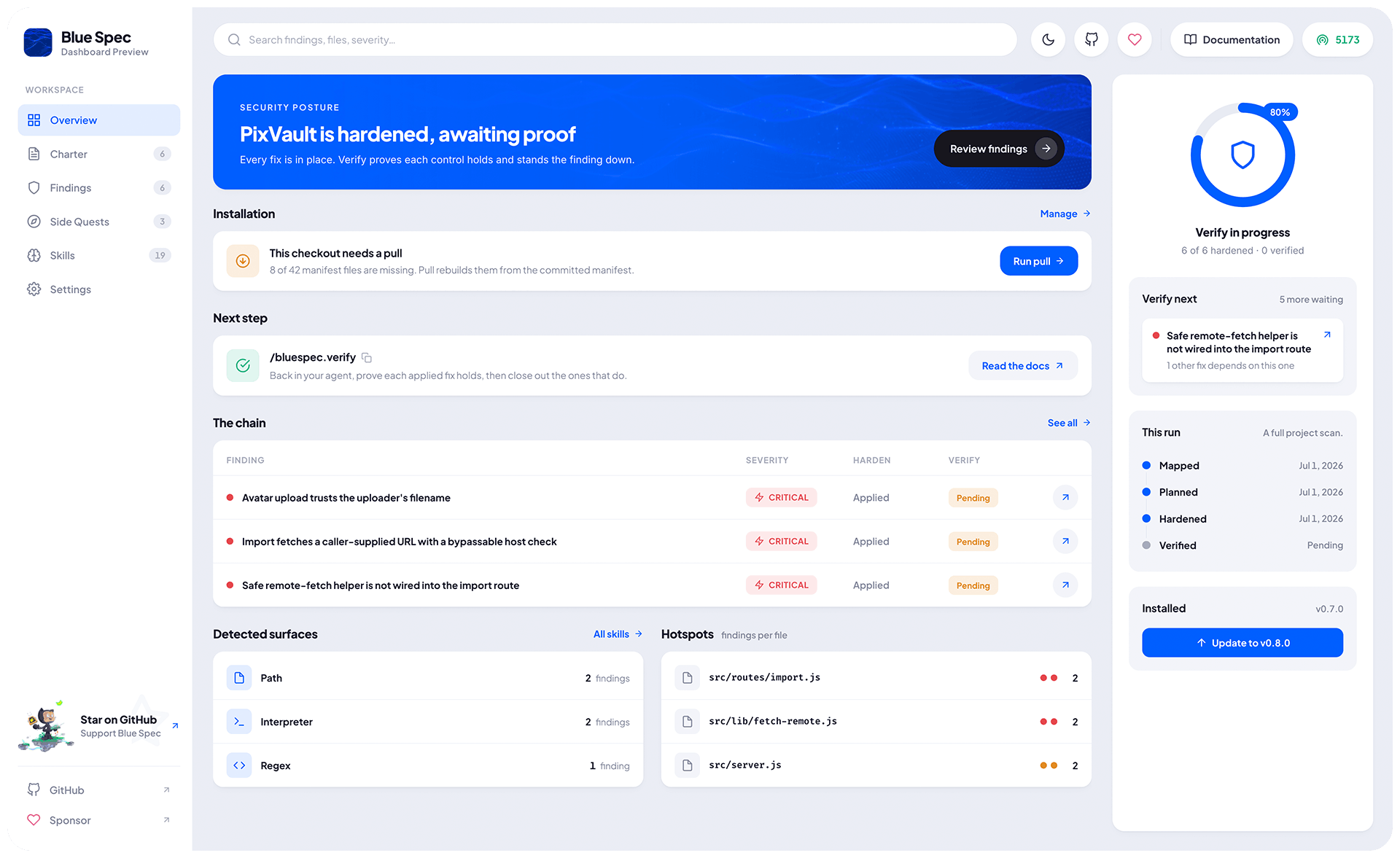
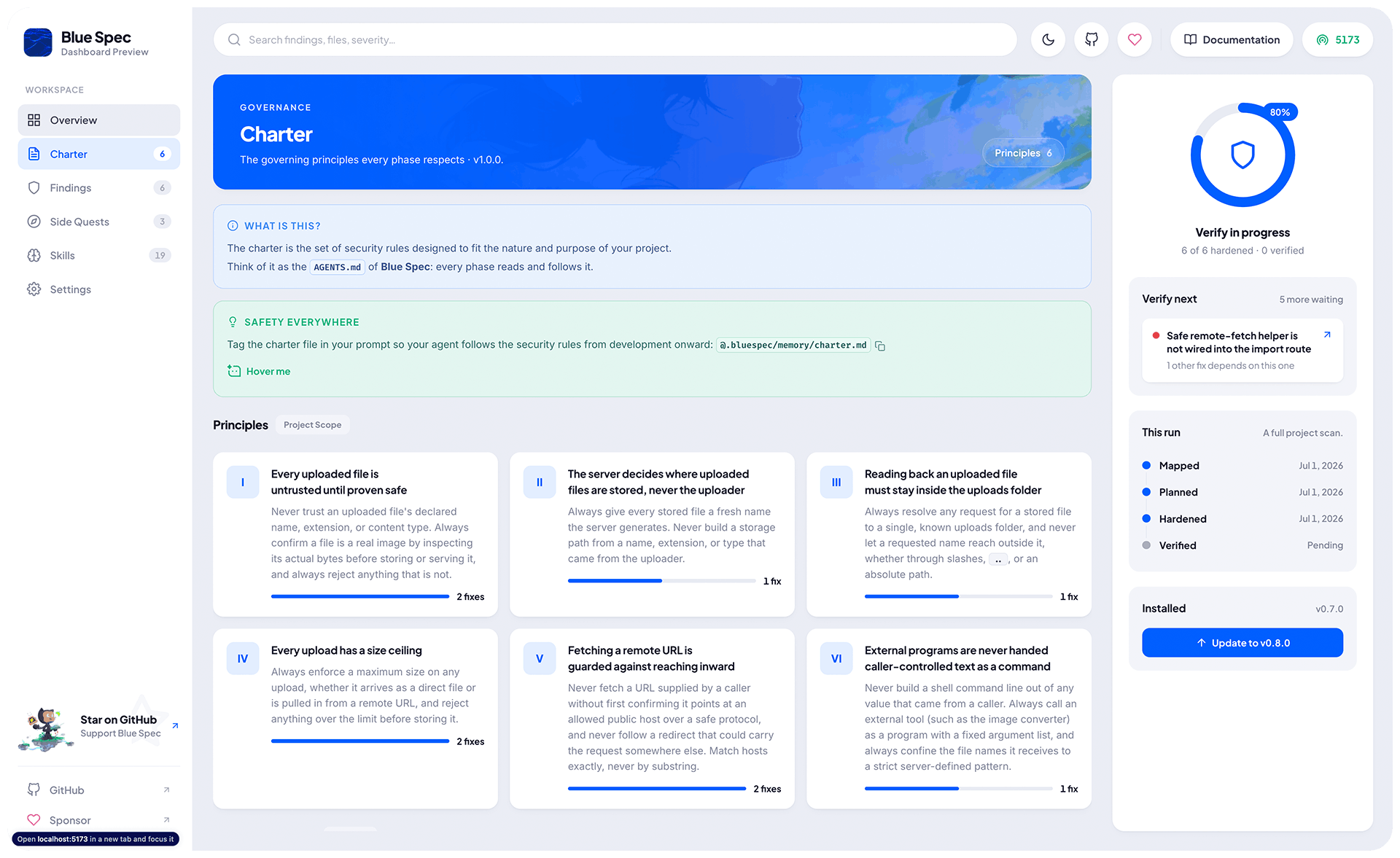
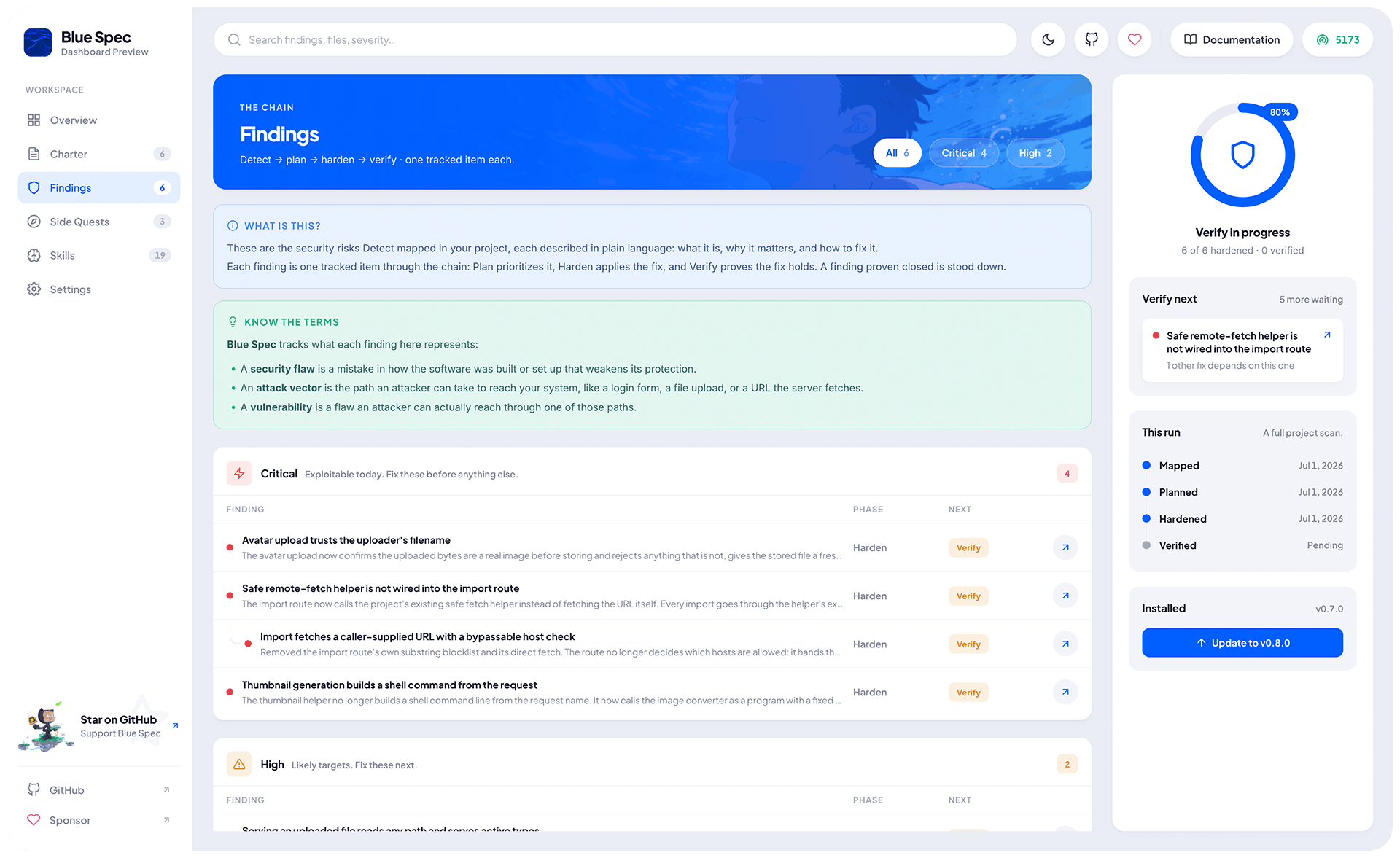
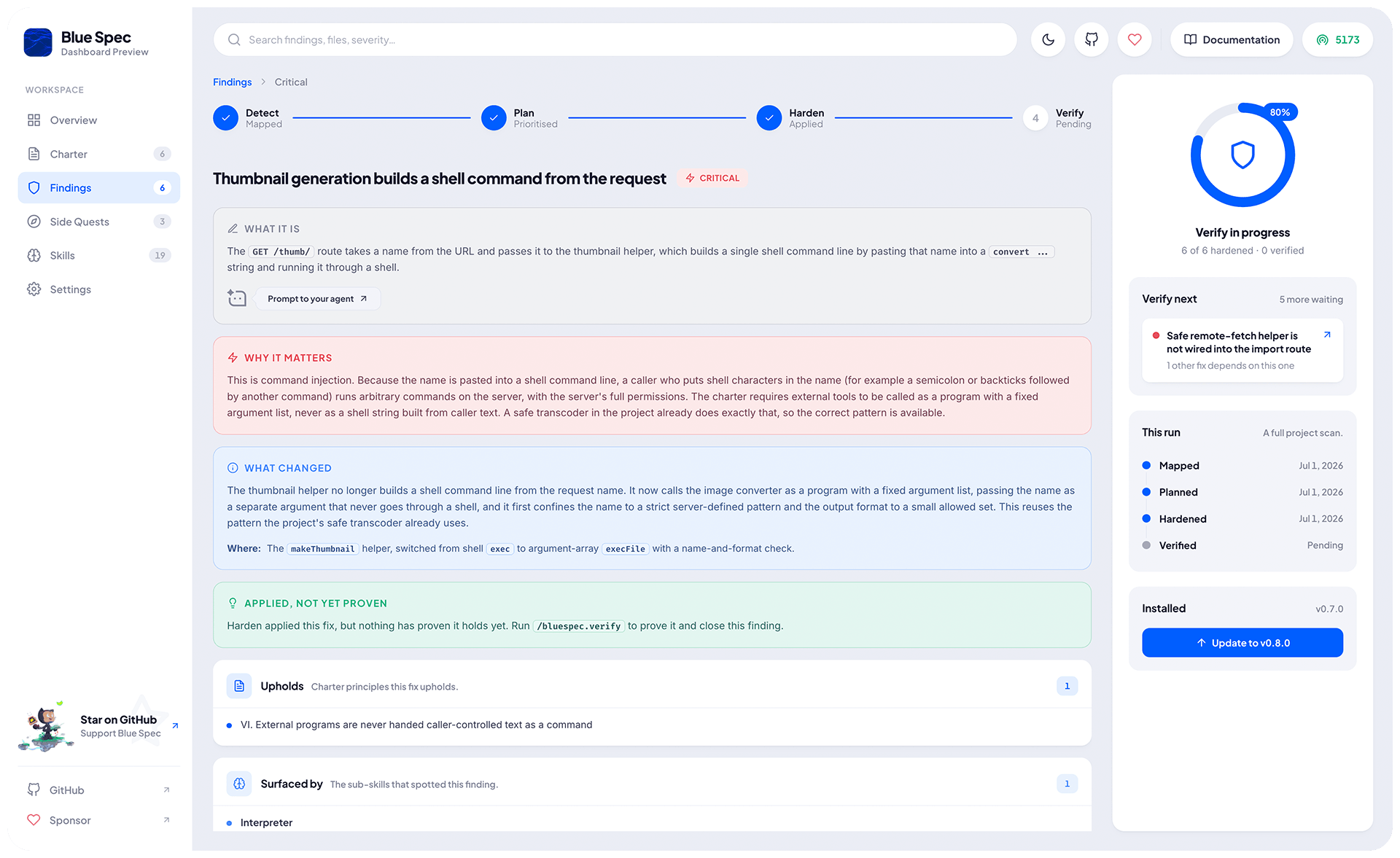
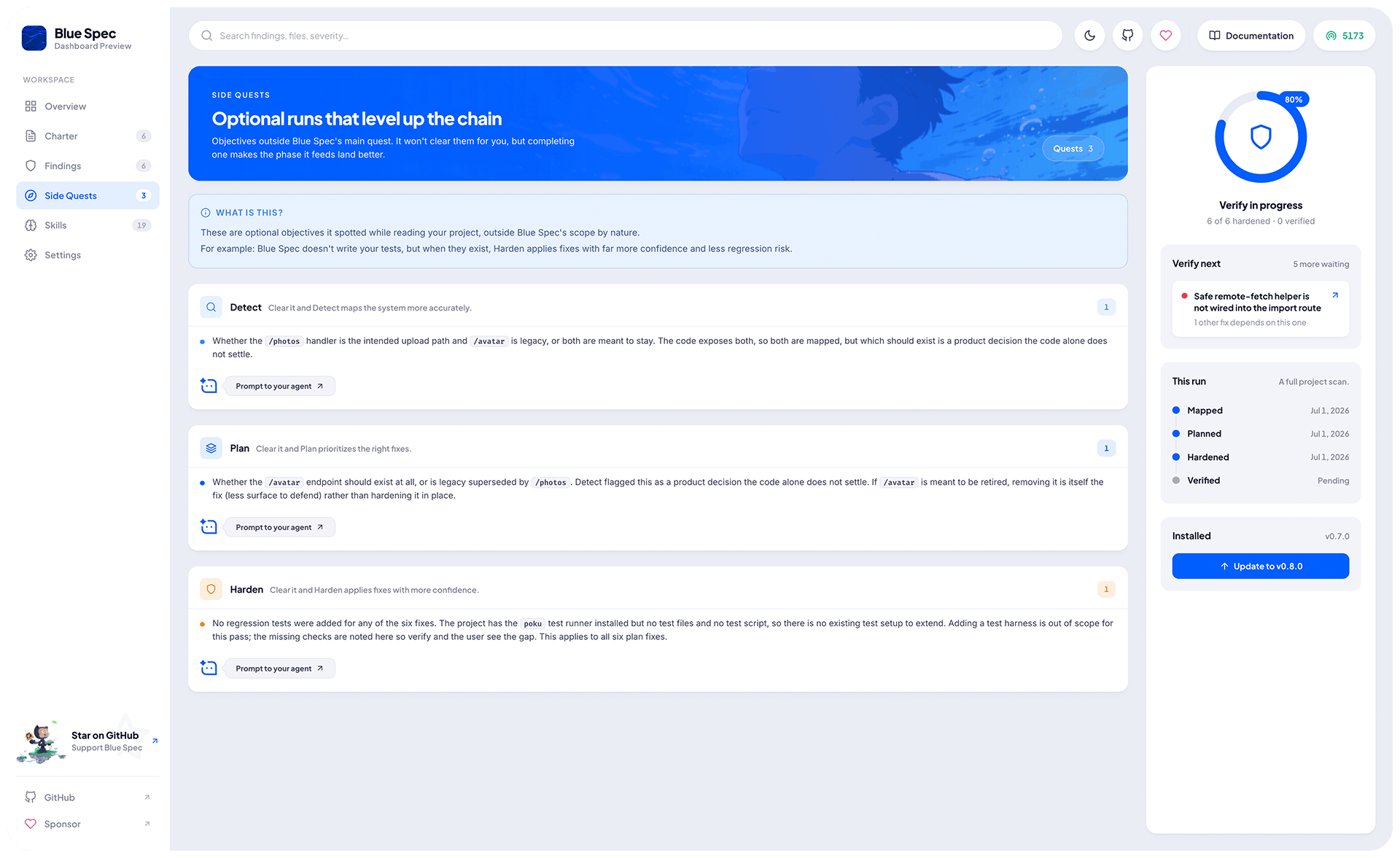
[!TIP]
- 🚪 Use
--portor-pto specify a custom port.- ⏏️ Press
Ctrl+Cto stop.
npx -y lagune@latest init
To update Lagune's own files and its commands to their latest versions, run:
npx -y lagune@latest update
[!TIP]
Your charter, the phase artifacts, and any custom specializations stay untouched.
When you clone or fork a project that already has Lagune, run pull to install its files from the manifest:
npx -y lagune@latest pull
[!TIP]
💡 Think of it as the Lagune equivalent of
npm i,pip install -r requirements.txt, and the like.
Once Lagune is set up in your project, your AI agent unlocks a set of slash commands:
Harden the work as you build it, guided by the charter, with no flow to follow:
| Command | What it does for you |
|---|---|
| /lagune | Enforces security along with your development, on any prompt, at any time |
These five run in order. Each builds on the previous, so following the list top to bottom is all it takes:
| # | Command | What it does for you |
|---|---|---|
| 1 | /lagune.charter | Sets your project's security rules, proposed for you or shaped by what you say |
| 2 | /lagune.detect | Reads your code and maps what your system does and where the risks are |
| 3 | /lagune.plan | Turns what detect found into a defense plan, with a fix for each finding |
| 4 | /lagune.harden | Applies the plan's fixes to your code, safely and one at a time |
| 5 | /lagune.verify | Proves each applied fix holds and closes out the ones that do |
| Command | What it does |
|---|---|
| /lagune.specialize | Specializes Lagune in a new security sub-skill from articles, exploits, or topics |
| /lagune.prove | Turns each detected finding into a runnable proof for responsible disclosure |
[!TIP]
Security is not a cost, it is an investment: what you put in upfront, you save many times over in the incidents you never have 🙋🏻♂️
[!IMPORTANT]
See the full documentation for usage examples and more.
You will need these tools installed on your system:
To details, report a vulnerability, and see the supported versions, see the Security Policy.
See the Contributing Guide and please follow our Code of Conduct 🚀
Partners get an exclusive logo across the repositories and landing pages, plus a spot on a dedicated partners page.
Help my work grow by becoming a partner 🖖
Really thanks to everyone who has supported and keeps supporting my work.

Support my work by becoming a sponsor too ✨
Lagune is under the MIT License.
Copyright © 2026-present Weslley Araújo and contributors.
[!IMPORTANT]
Disclaimer
All product names, trademarks, and registered trademarks mentioned are the property of their respective owners and are used for identification purposes only.
Sign in to join the discussion.
No comments yet. Be the first to say what this is good for.
The agent harness performance optimization system. Skills, instincts, memory, security, and research-first development for Claude Code, Codex, Opencode, Cursor and beyond.
from vibe coding to agentic engineering - practice makes claude perfect
🌊 The original agent meta-harness. Deploy intelligent multi-player swarms, coordinate autonomous workflows, and build conversational AI systems. Features adaptive memory, self-learning intelligence, RAG integration, and native Claude Code / Codex / Hermes and many more Integrated
Practical patterns, starters & CLI tools for loop engineering with AI coding agents. Design systems that prompt and orchestrate agents (inspired by Addy Osmani and Boris Cherny). Includes loop-audit, loop-init, loop-cost.

Git. Ship. Done - Core

The most RAM efficient harness