

obra/
superpowers

obra/superpowersSkills
An agentic skills framework & software development methodology that works.
285k
1 add
This repo packages a story-to-movie workflow for agentic builders. A fuzzy idea is turned into a locked `comic.json`, baked into panels, cross-checked by independent reviewers, and assembled into a viewer, with every attempt and decision written to a research wiki.
Builders who use agentic coding tools and want reusable workflows for generating and reviewing visual stories.
You can turn an imprecise story into a cross-model-audited movie instead of a single unchecked render.
`/movie-pipeline` drives intent parsing, style locking, outlining, storyboarding, asset review, blueprint authoring, prompt building, and JSON compilation before any bake happens.
Each panel is reviewed by separate readers, blind-transcribed, and compared with a deterministic token diff so a frame cannot approve itself.
Every attempt, review, decision, and failure is logged into a wiki trace for later inspection and replay.
`/method-figure` runs a similar audited spiral from a brief to a signed-off figure with compile, render, review, and retry steps.
CLI scripts validate schemas, run gates, and check the environment before any real bake starts.
> /movie-pipeline "a short film about an autonomous research run"   # Workflow 1 — fuzzy idea → audited movie + viewer (pauses at intent + outline)
> /method-figure  path/to/method_figure_brief.json                 # Workflow 2 — a brief → audited Figure-1 (render + verify → Claude sign-off)
python3 cli/validate_wiki.py examples/comic_m3_audit             # verify the shipped trace → PASS (198 nodes, 26 edges)
python3 packages/viewer/build_comic.py examples/comic_m3_audit  # (re)build the single-file viewer from comic.json + panels
open  examples/comic_m3_audit/outputs/index.html

🌐 中文 README · English
Hand a fuzzy story to your agent, wake up to a cross-model-audited movie 🎬 — no forgotten facts, no frame signing off on itself.
🎞️ Image-based today, video next.
🤖 Agentic by design — planning · gating · cross-model review on the agent; rendering on the diffusion model.
📚 Jump to — ▶ Watch the movie · ⚡ Quick Start · 🔄 Workflows · 📝 Make your own · 🧩 Layout · 💬 Community · 📖 Cite · 🤝 Contributing


 ·
· 



This is an agentic, long-horizon visual generation task: hand a fuzzy story to an agent and produce a whole
image-based movie (the reference run is a 19-scene / 24-frame story), not a single image. The concrete job is
fuzzy story → authored comic.json → audited panels → single-file viewer.
The hard part is faithfulness over time. Generated visual stories can look coherent while quietly changing the facts — a chart rounds a number, a label mutates, a character's face drifts — and the run still ships, because the same system that drew the frame is the one saying it looks fine. Across a long horizon, two failure modes dominate:
🔬 Method at a glance. Read the figure left-to-right — the /movie-pipeline
agent workflow runs the full loop (author a source of truth → bake → cross-model gate): (1)
comic-author turns fuzzy intent into an authored comic.json + locked refs,
(2) comic-director runs the per-panel audited spiral — the multi-agent
debate (Codex narrative ‖ Gemini + Codex visual blind-read → deterministic diff), logging every attempt / decision to the
research-wiki — (3) the pipeline assembles accepted panels into the
released viewer. The bottom-left failure is the whole rule: a beautiful but wrong literal still fails
(+6.2 expected vs +6.25 observed).

Figure 1 — from story intent to a verified movie, end-to-end (the loop described above). Full caption ↓
(1) Authored source of truth — asset library · outline · storyboard compile into
comic.json(content_svg · expected_literals · identity_ref). (2) The audited spiral (per panel) — a content-SVG blueprint is baked by image_gen, then a 3-reviewer cross-modelpanel_gate(narrative ‖ Gemini + Codex visual blind-transcribe → a deterministic token-diff · single-vote veto) returns a deterministicverdict: KEEP, or RETRY (≤4/panel) re-baked with the failed attempt's repair note; every attempt/review/decision/failure is logged to theresearch-wiki. (3) Assembly + release — a cast-awarepage_assembly_gate(repair drift → re-bake, ≤6/run) ships PNG panels + a single-file HTML viewer. The punchline (bottom-left): a beautiful panel with a wrong number does not pass —+6.2expected vs+6.25observed fails the token-diff.This figure was itself produced by the same loop it depicts: a labeled blueprint conditioned Codex's native image-generation tool (driven by Codex GPT-5.5 xhigh — dated 2026-06 provenance; the image backend, called
gpt-image-2at the time, is not runtime-attested), then 4 generation rounds were ratified by the method-figure panel — Gemini + Codex blind-transcribe + a deterministiccontent_diff, then a Claude structural sign-off — until clean. The exact prompt sequence that baked this image (all 4 rounds + the cross-model critiques) is published verbatim as a reference:skills/method-figure/examples/method_figure/PROMPTS.md.
ARIS-Movie-Director treats every frame as an auditable artifact: author a deterministic comic.json first
(lock the expected_literals + identity refs before any pixels), let a generative model bake the look, then
require independent cross-model blind-transcription + a deterministic token-diff before a panel is kept.
Looks right ≠ passes — a beautiful frame with a wrong literal is rejected. It answers the two failure modes
with two ideas from the ARIS series:
expected_literals · every decision & failure as a node) that anchors late frames to early truth.This first release is image-based — the movie is told in baked still frames you flip through. Video-based generation is what comes next; this is just the beginning.
▶ Watch the image-based movie in your browser — flip through all 19 scenes of the cross-model-audited reference run.
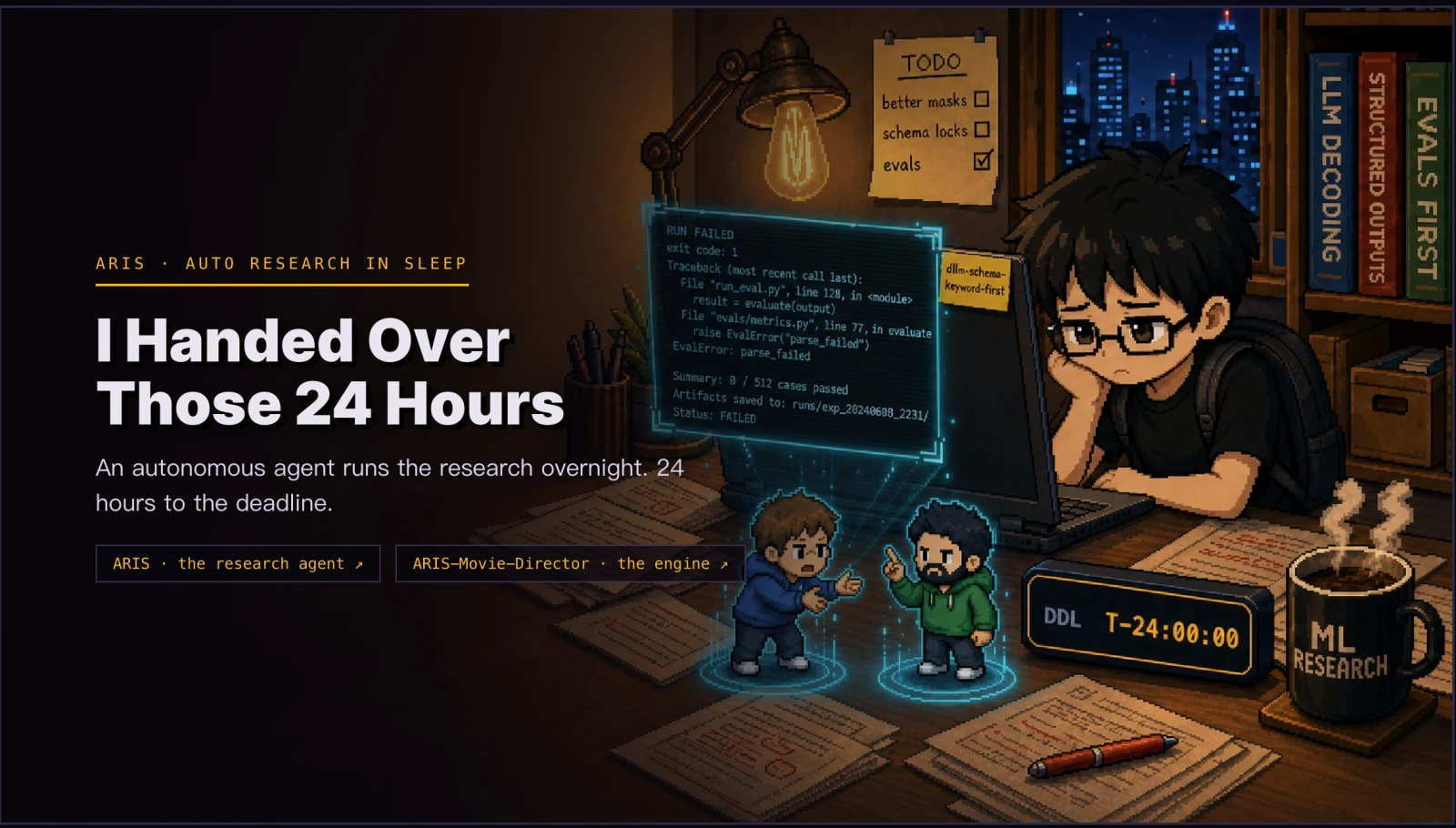
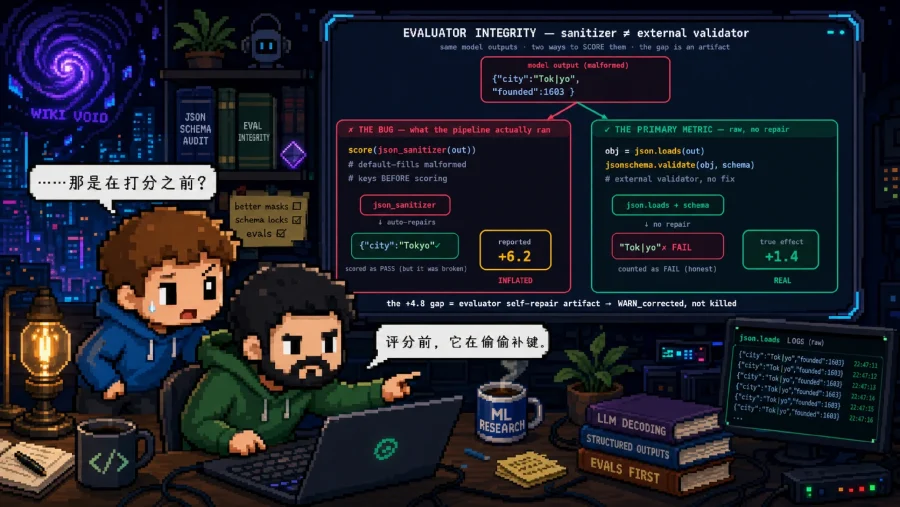 | 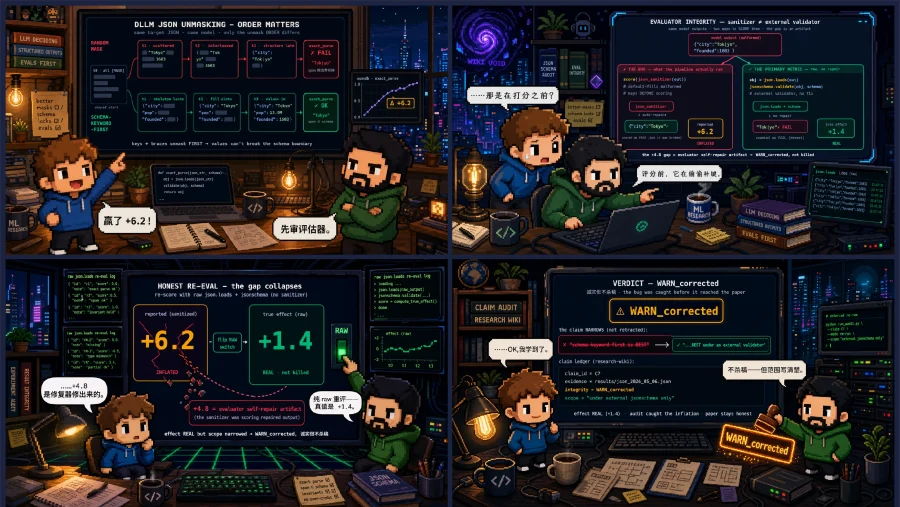 | 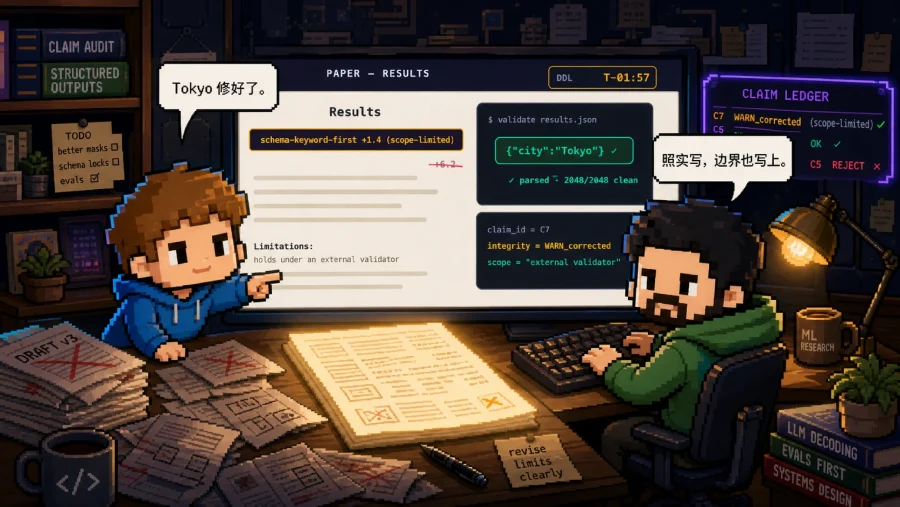 |
A few frames from the reference movie — including the story's own integrity beat: a run that reported +6.2 improvement but really moved +1.4 (that's the plot, distinct from the figure's bake-time +6.2/+6.25 token-diff). Watch all 19 scenes →
| The problem | What ARIS-Movie-Director does about it |
|---|---|
| A panel can look right while changing a number, label, or code token. | comic.json locks the expected_literals; independent visual reviewers blind-transcribe what's actually in the pixels; an exact token-diff rejects any wrong or missing literal. |
| The model that baked an image can wave its own output through. | The bake never self-attests — independent visual models (a different family from the generator) read it blind, and a deterministic diff, not a model's opinion, decides KEEP / RETRY. |
| A frame can be baked with nothing to check it against. | Phase 1 authors content_svg · identity_ref · ART_BIBLE · expected_literals before pixels; a baked figure-panel with no gateable literals fails closed. |
| Character & style drift accumulate across a long sequence. | Locked identity refs + asset review (准×3) + a style bible + a cast-aware assembly gate check consistency while allowing intended scene/cast variation (absence ≠ drift). |
| Retry loops go opaque or endless. | Per-panel attempts and assembly repairs are bounded; each failure carries a repair note; a non-convergent panel is flagged for a human, never silently shipped. |
| A demo hides what was tried and thrown away. | Every attempt / review / decision / failure-mode is written to the research-wiki — the reference run ships a 198-node trace you can read. |
# 1 · get the repo + Python deps  (everything but jsonschema is stdlib)
git clone https://github.com/wanshuiyin/ARIS-Movie-Director.git && cd ARIS-Movie-Director
python3 -m pip install -r requirements.txt

# 2 · external tools for the bake/review stages — install + authenticate, then verify:
#     codex CLI  ·  a google-family reviewer (legacy gemini CLI, or Antigravity via the shipped shim — see note)  ·  headless Chrome / Chromium
python3 cli/preflight.py
There is no bundled installer — the skills/ are followed by your coding agent pointed at this repo; the deterministic CLIs run in-repo.
Google-family reviewer (2026-07): the legacy
geminiCLI is deprecated upstream (it now dies withIneligibleTierError— Gemini Code Assist for individuals is retired; Google's migration target is Antigravity). Install Antigravity (agy) + log in, then pass--gemini-cmd "python3 cli/gemini_agy_shim.py"torun_comic.py/run_spiral.py— the shipped shim translates the oldgemini -p "@file …"reviewer interface toagyand pins a Gemini model (Antigravity also serves Claude/GPT-OSS; the second-reviewer slot must stay google-family or the cross-model quorum's provenance is corrupted). If your legacygeminiCLI still works, the default is unchanged.
Run the two workflows — in a coding agent that has these skills (/… is a slash-command agent workflow, not a shell binary):
> /movie-pipeline "a short film about an autonomous research run"   # Workflow 1 — fuzzy idea → audited movie + viewer (pauses at intent + outline)
> /method-figure  path/to/method_figure_brief.json                 # Workflow 2 — a brief → audited Figure-1 (render + verify → Claude sign-off)
See it first — zero setup, no API: ▶ open the hosted movie at https://wanshuiyin.github.io/ARIS-Movie-Director/comic/ (all 19 scenes / 24 frames). To rebuild it locally, see Workflow 1 → See the reference movie below.
Full map — fuzzy story → /movie-pipeline → comic.json + audited panels + outputs/index.html · method_figure_brief.json → /method-figure → figure.png + blueprint + trace
Two cross-model-audited workflows. Each is one slash-command agent workflow (the ARIS /research-pipeline
paradigm — an agent runs it, pausing at the human gates), with a deterministic CLI core you can also run
standalone (the part CI tests).
/movie-pipeline (fuzzy idea → audited movie)Hand your agent a fuzzy story, approve two story gates, wake up to a baked, cross-model-audited movie + a clickable viewer:
> /movie-pipeline "a short film about an autonomous research run"
It chains comic-author (Phase 1 — author the source of truth) → the zero-credit
p0_proof gate → comic-director (Phase 2/3 — the audited spiral → viewer); the
orchestrator is movie-pipeline. It's an agent workflow, not a shell binary —
it needs a coding-agent runtime and pauses at intent + outline for your approval. (A step that doesn't fire is
safe — each layer consumes the prior LOCKED node, so a skipped step fails closed at the next gate, never shipping a
wrong frame.)
intent_spec · stop for your approvalART_BIBLE.md + locked style_anchors (warm-lab / dark-cyber / starfield)outline_spec · stop for your approvalasset_requestslocked (准×3 same-round unanimity)content_svg per panel (no baked bubbles)expected_literals (搬运工原則)comic.json; the zero-credit p0_proof gate runs BEFORE any image creditmcp__codex__codex sidecar bake (Codex's native image tool) → 3-reviewer panel_gate → keep / retry-same-panel → assembly_gate (re-bakes only NAMED drifting panels on cross-page drift) → viewer📐 Flow — the skill chain (trace it top-to-bottom):
/movie-pipeline "fuzzy idea"            one slash-command · agent-run, NOT a shell binary
   │
   ▼   comic-author drives these Phase-1 skills IN ORDER (they are not separate slash-commands):
   comic-intent-parser
     → ⟨HUMAN APPROVE — intent⟩
     → comic-style-bible-lock
     → comic-outline-creator
     → ⟨HUMAN APPROVE — outline⟩
     → comic-storyboard-creator
     → comic-asset-ref-generator → comic-asset-review-loop          (准×3 unanimity → assets LOCKED)
     → comic-blueprint-author → comic-panel-prompt-builder → comic-json-compiler
   ├──────────────── Phase 1 · comic-author — author the source of truth ────────────────┤
   │
   │   → comic.json + locked assets + the author wiki trace
   ▼
   comic-cross-layer-gate --gate p0_proof     ├─ P0 · ZERO-CREDIT proof — must pass before any image credit ─┤
   │
   ▼   comic-director — the audited spiral     (run_comic.py  |  packages/core/spiral_engine.js)
   per panel:  content_svg → agent mcp__codex__codex sidecar bake → panel_gate
                  reviewers: Codex narrative ‖ Gemini visual ‖ Codex visual
                  → blind transcriptions → deterministic token-diff vs expected_literals
               verdict ─ KEEP → page pool
                       ├ RETRY ≤4   (re-bake the SAME panel + repair note)
                       └ assembly_gate repair ≤6 — re-bake ONLY the NAMED drifting panels when drift is localized (seed-anchored; never wipes prior good panels)
   page assembly_gate → project accepted panels to comic.json → build_comic.py → outputs/index.html
   ├──────────────── Phase 2/3 · comic-director — audited spiral + viewer ────────────────┤

   📚 research-wiki — reads the locked source nodes before each layer; writes every attempt / review /
                      decision / failure after each gate & bake (the inspectable audit trace).
   🔄 human-in-loop — intent + outline are HARD stops; a failed p0 / panel / assembly gate stops or
                      escalates; a non-convergent panel is flagged for you, never silently shipped.
The panel_gate (Phase 2/3, per panel): the bake is read by 3 independent reviewers — a narrative
reviewer (does it land the beat? — currently the codex CLI, recorded honestly as family openai; a
configurable --narrative-reviewer is planned, not yet implemented) ‖ Gemini visual ‖ Codex visual — who
blind-transcribe the pixels; a deterministic token-diff of observed_literals vs the authored
expected_literals decides KEEP / RETRY; content_corruption is a single-vote veto, both visual reviewers must
score, and no model self-acquits. Every attempt / review×3 / decision / failure is written to the research-wiki.
There is no live Claude CLI reviewer in this panel — Claude's role is the workflow-layer structural sign-off;
cross-family acquittal vs the Claude-authored prompts comes from Gemini + the deterministic fuse.
Phase 2/3 standalone (once comic.json exists). Only the zero-credit --dry-run below is genuinely
agent-free — that's the CI-tested slice:
python3 skills/comic-director/scripts/run_comic.py --project examples/<name> --page <PAGE> --panels S01,S02 --dry-run    # zero credit, NO agent: prints bake prompts (the CI-tested slice)
python3 skills/comic-director/scripts/run_comic.py --project examples/<name> --page <PAGE> --panels S01,S02 --finalize   # REAL bake — REQUIRES the agent sidecar SOP (see below)
run_comic.py is a subprocess port of packages/core/spiral_engine.js's movie
branch; it starts from an existing comic.json — it cannot start from a fuzzy idea. The deterministic CLI
core (validation, blueprint render, the token-diff gates) is what CI exercises, but the --finalize bake is
NOT agent-free: each panel bake is fulfilled by the agent-sidecar SOP — the
comic-director skill agent watches for the core's *.bakereq.json, calls
mcp__codex__codex (with config: {include_image_gen_tool: true, model_reasoning_effort: xhigh}) to fire the
native image tool, and writes back *.bakestatus.json. So a real movie bake needs a coding-agent runtime; only
--dry-run runs standalone. Model honesty: the bake payload pins model: gpt-5.5 + effort xhigh as a
single compatibility default (run_comic.get_bake_plan() — the exact plan the P0 certificate digests; a
config-driven override is planned, not yet implemented), while the codex CLI reviewers pin no model — they
follow your local codex config, at effort xhigh (--review-effort). Throttling: a
rate-limited bake stops cleanly with fresh_run_required — after cooldown launch a fresh run for the remaining
panels, do not resume cached state. Caps: ≤4 attempts/panel · ≤6 rollbacks/run · no concurrent bakes
(docs/spiral-runtime.md).
Authoring template: copy the Phase-1 author-node shapes from examples/comic_min_author/
when adding a new project. The flow diagram above is the canonical skill chain — the two human gates and the
fail-closed gates are shown there; prereqs (codex + gemini + headless Chrome) are in Quick Start.
python3 cli/validate_wiki.py examples/comic_m3_audit             # verify the shipped trace → PASS (198 nodes, 26 edges)
python3 packages/viewer/build_comic.py examples/comic_m3_audit  # (re)build the single-file viewer from comic.json + panels
open  examples/comic_m3_audit/outputs/index.html
…or just open the hosted one: https://wanshuiyin.github.io/ARIS-Movie-Director/comic/ — all 19 scenes / 24 frames of the cross-model-audited reference run.
/method-figure (a brief → Figure-1)One slash-command, /method-figure — give it a method_figure_brief.json
(the same brief paper-plan emits after its claims_matrix) and it runs the whole audited spiral to a signed-off
figure (Step-0 compile → render condition → sidecar bake via Codex's native image-generation tool → Gemini + Codex blind panel + content_diff →
retry until clean → Claude structural sign-off):
> /method-figure path/to/method_figure_brief.json
The deterministic core — Step-0 compile, blueprint validation, the condition render, and the content-diff
gate — is driven by one command, run_spiral.py. Its zero-credit slices (--p0-only / --dry-run) run with
no agent runtime; a real bake — Codex's native image-generation tool (image backend not runtime-attested) — REQUIRES the agent sidecar SOP (the
method-figure skill agent services the core's *.bakereq.json by calling
mcp__codex__codex with config: {include_image_gen_tool: true, model_reasoning_effort: xhigh}):
# OUR example brief bakes ARIS's own Figure 1 — swap in your own method_figure_brief.json
python3 skills/method-figure/scripts/run_spiral.py \
    skills/method-figure/examples/method_figure/method_figure_brief.json \
    --out-dir figures/method_figure/demo
#  → figures/method_figure/demo/figure.png   (the PANEL-CLEAN candidate, awaiting your structural sign-off)
#     (+ blueprint.json + traceability.json + trace.jsonl of every round)
#  the REAL bake above needs the agent sidecar (mcp__codex__codex servicing .bakereq.json) — NOT agent-free.
#  first run? add --p0-only — that slice IS agent-free (zero image credits: validate + compile + render + lint).
#  NOTE: --dry-run (also agent-free) still writes these files.
(upstream — only if you have a paper; NOT part of /method-figure):
   paper_to_brief.md  →  method_figure_brief.json      agent-authored; claims / numbers copied VERBATIM
        │
        ▼
/method-figure  <method_figure_brief.json | blueprint.json>        the skill = pure render + verify
   run_spiral.py — the deterministic core (starts from a brief):
     compile_brief.py (Step-0) → blueprint.json + traceability.json     every node traces to a brief field — else FAIL-CLOSED
       → validate_blueprint.py → render_condition.py                    labeled condition SVG → PNG
       → agent mcp__codex__codex (workspace-write, config{xhigh}) → native image-gen bake    fail-closed verifier, not a sandbox setting
       → Gemini blind-transcribe ‖ Codex blind-transcribe → content_diff.py     deterministic vetoes
       → RETRY ≤4 (re-assert the locked labels) → Claude STRUCTURAL sign-off
   → figure.png   (+ blueprint.json + traceability.json + trace.jsonl of every round)
   ├──────────────── method-figure · audited render / verify spiral ────────────────┤
Step-0 is deterministic inside the skill — you never hand-write a blueprint or place coordinates; the identity
sheet resolves from the brief's identity_refs[].path (no separate --identity); every node is
traceability-checked back to a brief field (un-traceable → fail-closed). No model self-acquits — the bake is
ratified by Gemini + Codex blind reads + a deterministic content_diff, then a separate Claude structural
sign-off. Needs the codex + gemini CLIs + headless Chrome (python3 cli/preflight.py).
Only have a paper, no brief yet? Author the brief FIRST — point your coding agent (e.g. the ARIS main project) at your paper via
paper_to_brief.md(claims/numbers verbatim) — then/method-figureit. Power-user: already have a hand-tuned blueprint?run_spiral.py blueprint.json --identity sheet.png --out-dir … --from-blueprintruns the legacy path. The worked 4-round convergence (the exact prompts) is inPROMPTS.md.
The movie panel_gate is a 3-reviewer panel (narrative — currently the codex CLI ‖ Gemin
Sign in to join the discussion.
No comments yet. Be the first to say what this is good for.
An agentic skills framework & software development methodology that works.
Turn any codebase, with its docs, SQL schemas, configs, and PDFs, into a queryable knowledge graph. A /graphify skill for Claude Code, Cursor, Codex, and Gemini CLI: local deterministic AST parsing, every edge explained, no vector store.

Topic in, narrated explainer video out. A Claude Code / Codex skill that turns any topic into a black-canvas motion-graphics explainer video with TTS voiceover, subtitles and a chapter progress bar. Chinese or English; every frame drawn in code with Remotion.
Public repository for Agent Skills
Open-source AI job search: scan job portals, evaluate listings into a structured A-H report with a global 1-5 score, tailor your CV, track applications — runs locally in your AI coding CLI (Claude Code, Codex, OpenCode, Antigravity…)
Production-grade engineering skills for AI coding agents.