



affaan-m/
ECC

affaan-m/ECCHarnesses
The agent harness performance optimization system. Skills, instincts, memory, security, and research-first development for Claude Code, Codex, Opencode, Cursor and beyond.
258k
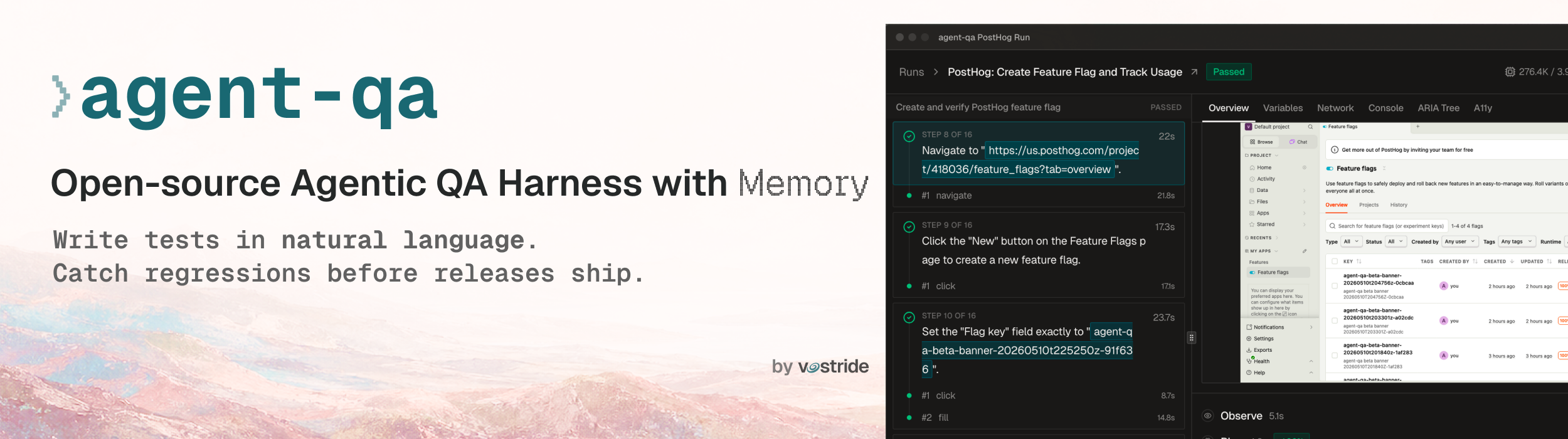
agent-qa is a test harness for writing QA steps in natural language and running them through an agent. It watches the UI, retries failed actions with a new path, and stores memory from past runs so later tests can adapt faster. It also includes a dashboard, CLI, MCP server, and skills for agent-led workflows.
Builders who want their agent to run QA tests against web and mobile interfaces.
You can keep tests in plain language while the harness adapts to UI drift and remembers what worked before.
Write actions and assertions in human language while the runner uses visible roles, labels, and screen state.
If a click, fill, or select fails, the harness re-observes the UI and tries another path in the same run.
Each run adds product, suite, and test observations to memory so future runs have more context.
Validated plans can be reused across similar runs to cut planner work, token usage, and runtime overhead.
Node, Bun, Python, and Bash hooks run in Docker containers to set up state, call APIs, seed fixtures, or tear down.
You can run tests from the command line, use the dashboard, or connect coding agents through MCP and skills.
npm install -D agent-qa
npm install -D @vostride/agent-qa-subscription-auth
npx agent-qa init
npx agent-qa install-browsers --chromium
# Mobile projects:
npx agent-qa install-mobile-drivers --all
npx agent-qa dashboard --open
The self-improving Agentic QA harness with Memory
Write tests in natural language for web and mobile. agent-qa learns from past runs, adapts to UI changes, and catches regressions before you ship.
Install the package:
npm install -D agent-qa
For Codex or Claude Code subscription auth, also install:
npm install -D @vostride/agent-qa-subscription-auth
Install Docker before using hooks. agent-qa runs hooks in a sandboxed runtime, and Docker is required for the Node, Bun, Python, and Bash hook containers.
Initialize agent-qa and install the runtime support you need:
npx agent-qa init
npx agent-qa install-browsers --chromium
# Mobile projects:
npx agent-qa install-mobile-drivers --all
Start the dashboard, complete auth, and run tests from the UI:
npx agent-qa dashboard --open
For the full setup flow, use the quickstart.
Run tests from the CLI:
npx agent-qa run tests/hacker-news-top-story.yaml
Sign in to join the discussion.
No comments yet. Be the first to say what this is good for.
The agent harness performance optimization system. Skills, instincts, memory, security, and research-first development for Claude Code, Codex, Opencode, Cursor and beyond.
from vibe coding to agentic engineering - practice makes claude perfect
🌊 The original agent meta-harness. Deploy intelligent multi-player swarms, coordinate autonomous workflows, and build conversational AI systems. Features adaptive memory, self-learning intelligence, RAG integration, and native Claude Code / Codex / Hermes and many more Integrated
Practical patterns, starters & CLI tools for loop engineering with AI coding agents. Design systems that prompt and orchestrate agents (inspired by Addy Osmani and Boris Cherny). Includes loop-audit, loop-init, loop-cost.

Git. Ship. Done - Core

The most RAM efficient harness