
JuliusBrussee/
caveman

🪨 why use many token when few token do trick — Claude Code skill that cuts 65% of tokens by talking like caveman
105k
1 add
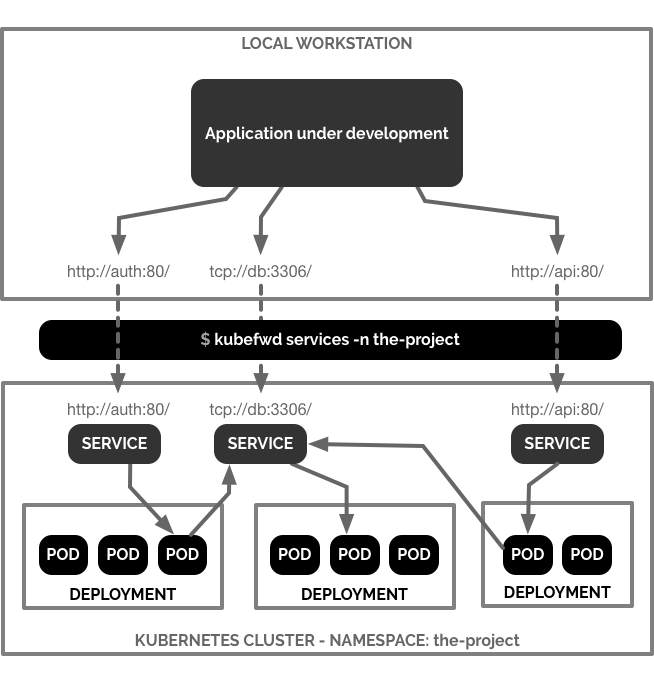
kubefwd discovers services in one or more Kubernetes namespaces, assigns each service a unique loopback IP, and writes host entries so you can reach them by service name. It manages the port forwards, reconnects when connections drop, and can show live status in a TUI or expose a REST API.
Builders who need local access to Kubernetes services without rewriting connection settings.
You can work against cluster services from your laptop using the same hostnames and ports your app already expects.
Forwards all services in a namespace with one command instead of setting up each port by hand.
Gives each service its own 127.x.x.x address to avoid port conflicts.
Updates local host resolution so you can call services by their in-cluster names.
Restarts forwards when pods restart or connections drop.
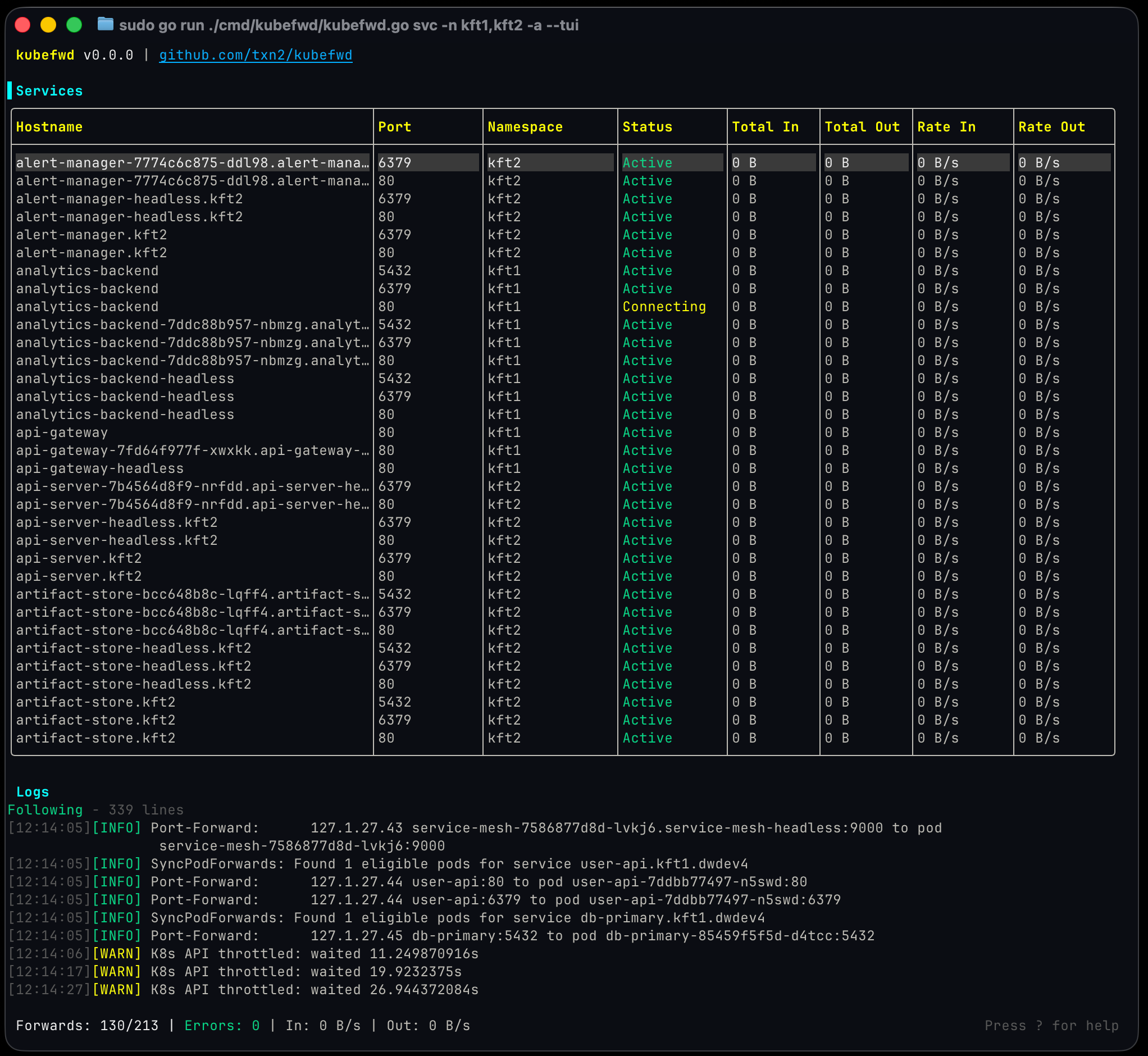
Shows service status, traffic, and logs in a terminal interface.
Exposes HTTP endpoints for programmatic control.
Lets Claude Code and Cursor connect to the forwarding workflow through MCP.
# Install (macOS)
brew install kubefwd

# Forward all services in a namespace with the interactive TUI
sudo -E kubefwd svc -n my-namespace --tui
brew install kubefwd
winget install txn2.kubefwd
# or
scoop install kubefwd
docker run -it --rm --privileged \
  -v "$HOME/.kube:/root/.kube:ro" \
  txn2/kubefwd services -n my-namespace --tui






Documentation | Getting Started | User Guide | API Reference | MCP (AI Integration)
kubefwd enables developers to work on their local machine while seamlessly accessing services running in a Kubernetes cluster. If you're building a new API that needs to connect to a database at db:5432, an auth service at auth:443, and a cache at redis:6379, all running in your development cluster, kubefwd makes them available locally by their service names, exactly as they would appear in-cluster. No environment-specific configuration, no local service setup, no Docker Compose files. Just run kubefwd and your application's existing connection strings work.
This is the essential use case: reduce or eliminate environment-specific connection setup and configurations during local development. Your code uses http://api-gateway:8080 in production? It works the same way on your laptop with kubefwd.
Bulk Kubernetes port forwarding with an interactive TUI, unique IPs per service, and automatic reconnection.
kubefwd is a command-line utility that bulk port forwards Kubernetes services to your local workstation. Each service gets its own unique loopback IP (127.x.x.x), eliminating port conflicts and enabling realistic local development with cluster services accessible by name.
# Install (macOS)
brew install kubefwd

# Forward all services in a namespace with the interactive TUI
sudo -E kubefwd svc -n my-namespace --tui
Press ? for help, q to quit. See Getting Started for detailed installation and setup.
kubefwd discovers services in your namespace, assigns each a unique loopback IP, updates /etc/hosts with service names, and establishes port forwards through the Kubernetes API. Access services by name just like in-cluster:
curl http://api-service:8080
mysql -h database -P 3306
redis-cli -h cache -p 6379
macOS:
brew install kubefwd
Linux: Download .deb, .rpm, or .tar.gz from releases
Windows:
winget install txn2.kubefwd
# or
scoop install kubefwd
Docker:
docker run -it --rm --privileged \
  -v "$HOME/.kube:/root/.kube:ro" \
  txn2/kubefwd services -n my-namespace --tui
# Interactive mode (recommended)
sudo -E kubefwd svc -n default --tui

# Multiple namespaces
sudo -E kubefwd svc -n default,staging --tui

# Filter by label
sudo -E kubefwd svc -n default -l app=api --tui

# With REST API enabled
sudo -E kubefwd svc -n default --tui --api
Unlike kubectl port-forward, kubefwd:
| Feature | kubectl port-forward | kubefwd |
|---|---|---|
| Services per command | One | All in namespace |
| IP allocation | localhost only | Unique IP per service |
| Port conflicts | Manual management | None (unique IPs) |
| Service name resolution | Not supported | Automatic (/etc/hosts) |
| Auto-reconnect | No | Yes |
| Real-time monitoring | No | TUI with metrics |
See Comparison for detailed comparisons with Telepresence, mirrord, and other tools.
Full documentation at kubefwd.com:
We welcome contributions for bug fixes, tests, and documentation. Feature development is limited to maintainers. See CONTRIBUTING.md.
Open source by Craig Johnston, sponsored by Deasil Works, Inc.
Sign in to join the discussion.
No comments yet. Be the first to say what this is good for.
🪨 why use many token when few token do trick — Claude Code skill that cuts 65% of tokens by talking like caveman

The best-benchmarked open-source AI memory system. And it's free.

Orca is the ADE for working with a fleet of parallel agents. Run any coding agent with your own subscription. Available on desktop, mobile and remote runtime.
A cross-platform desktop All-in-One assistant for Claude Code, Codex, OpenCode, OpenClaw, Grok Build & Hermes Agent. Only official website: ccswitch.io

Never stop coding. Free MIT AI gateway: one endpoint, 352 providers (150+ free), 1200+ models Kimi, Claude, GPT, Gemini, GLM, DeepSeek, MiniMax. Works with Claude Code, Codex, Cursor, OpenCode, Cline & Copilot. Quota-aware auto-fallback, RTK+Caveman compression saves 15-95% tokens, MCP/A2A, Desktop/PWA. Built by 550+ contributors

Compress tool outputs, logs, files, and RAG chunks before they reach the LLM. 20% fewer tokens for coding agents, 60-95% fewer tokens for JSON, same answers. Library, proxy, MCP server.