
JuliusBrussee/
caveman

🪨 why use many token when few token do trick — Claude Code skill that cuts 65% of tokens by talking like caveman
105k
1 add
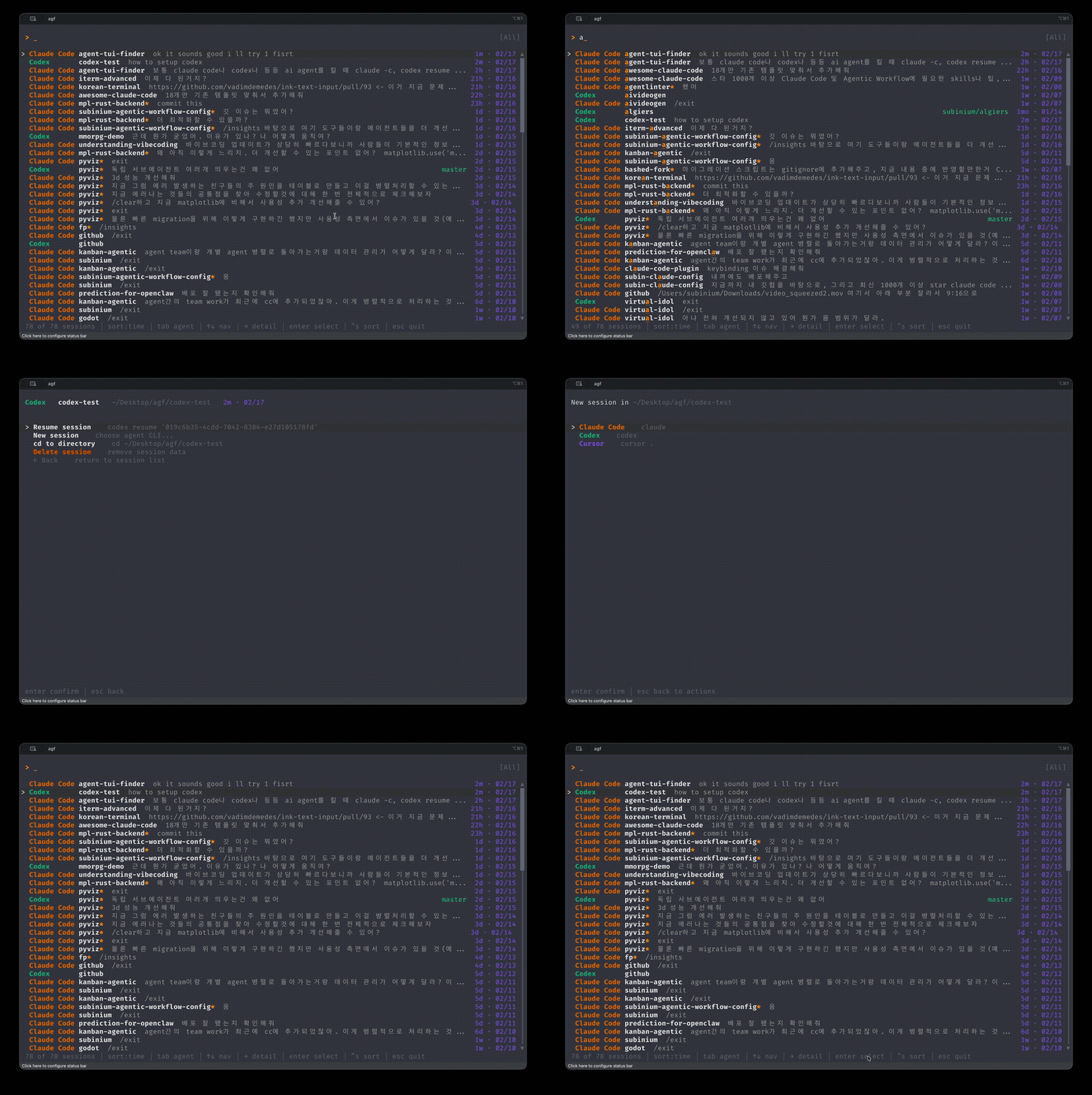
agf reads local session stores from supported agents and puts them into one searchable list. You can fuzzy-search by project, path, branch, or summary, then resume the matching agent session with the right command.
Builders who use terminal coding agents and want one place to find and resume local sessions.
You can pick up the right agent session instead of digging through history files or starting over.
Shows sessions from supported agents in one list and lets you search by project name, path, branch, or summary.
Builds the correct resume command for the chosen agent and session.
Lets you run `agf resume <query>` to skip the TUI and jump straight to a match.
Lets you select multiple stale sessions and remove them from the UI with `Ctrl+D`.
Surfaces git branches and Claude Code worktree sessions in the session list.
Provides read-only JSON commands and an MCP server for agent integrations and automation.
cargo install agf --locked
agf
brew install subinium/tap/agf
agf resume project-name # fuzzy-matches and resumes the best match directly
agf search parser --agent codex --limit 10
agf show SESSION_ID --agent codex --include-summaries
agf resume-plan SESSION_ID --agent codex
agf capabilities
agf mcp --agent codex --project /absolute/project/path
git clone https://github.com/subinium/agf.git
cd agf
cargo install --path . --locked
agf setup




Find the AI coding session you meant to resume.
agf is a local-first fuzzy finder for AI coding-agent sessions.
Search the sessions your terminal agents already keep locally, then resume the right one in a keystroke.
cargo install agf --locked
agf
Building with Cargo requires Rust 1.88 or newer and a C compiler for bundled
SQLite. --locked uses the dependency versions tested with the release.
Cargo's Adding ... (available: ...) lines are version-selection information,
not build failures; a newer dependency may require an API or Rust-version change.
Prebuilt binaries for macOS, Linux, and Windows need no Rust toolchain and are available on the Releases page. On macOS or Linux, Homebrew is another option:
brew install subinium/tap/agf
For parent-shell directory changes, run agf setup, then restart your shell or
follow its reload instruction. This optional step edits your shell profile; the
TUI, JSON commands and MCP server also work without it.
Run cargo install agf --locked again, or brew upgrade subinium/tap/agf for a
Homebrew installation. Check agf --version afterwards. If it still reports an
older version, use type -a agf (PowerShell: Get-Command agf -All) to find a
shell wrapper or an earlier Cargo/Homebrew executable on PATH.
agf resume project-name # fuzzy-matches and resumes the best match directly
agf search parser --agent codex --limit 10
agf show SESSION_ID --agent codex --include-summaries
agf resume-plan SESSION_ID --agent codex
agf capabilities
agf mcp --agent codex --project /absolute/project/path
The first four commands return versioned JSON. They do not launch agents or
modify their stores; resume-plan returns literal arguments, working directory
and scoped storage environment for review. The stdio MCP server uses the same
read-only API. See agent integration for schemas,
limits, client configuration and the portable AGF skill.
AI coding agents are great at keeping context — until you lose the terminal.
You switch projects, close a tab, forget the session ID, or resume the wrong agent. Then you either dig through history files or start over.
agf gives you one searchable list of local agent sessions and resumes the right one.
agf reads the session files each agent already stores locally. No account, no cloud sync, no extra agent process.
| Agent | Resume command | Local session source |
|---|---|---|
| Claude Code | claude --resume <id> | ~/.claude/history.jsonl + ~/.claude/projects/ |
| Codex | codex resume <id> | ~/.codex/sessions/**/*.jsonl |
| Grok Build | grok --resume <id> | $GROK_HOME/sessions/ or ~/.grok/sessions/ |
| Kimi Code | kimi --session <id> | $KIMI_CODE_HOME/sessions/ or ~/.kimi-code/sessions/ |
| Qwen Code | qwen --resume <id> | $QWEN_RUNTIME_DIR/projects/ or ~/.qwen/projects/ |
| Prime Agent | prime-agent --resume <id> | ~/.prime/agent/sessions/<id>.jsonl |
| Gemini CLI | gemini --resume <id> | ~/.gemini/tmp/<project>/chats/session-*.json or .jsonl |
| Cursor CLI | cursor-agent --resume <id> | ~/.cursor/projects/*/agent-transcripts/<id>/<id>.jsonl (Composer 2+)~/.cursor/projects/*/agent-transcripts/<id>.txt (legacy) |
| OpenCode | opencode -s <id> | ~/.local/share/opencode/opencode.db |
| Kiro | kiro-cli chat --resume-id <id> | Kiro v2 SQLite + Kiro v3 ~/.kiro/sessions/cli/ |
| pi | pi --session <id> | ~/.pi/agent/sessions/<cwd>/*.jsonl |
| Hermes | hermes --resume <id> (cwd-independent — resumes in your current shell directory) | ~/.hermes/state.db |
| Oh My Pi | omp --resume <id> | ~/.omp/agent/sessions/<cwd>/*.jsonl |
| Yolop | yolop --session <id> | Platform data directory under yolop/sessions/ |
| Agent | Format | Default Path |
|---|---|---|
| Claude Code | JSONL | ~/.claude/history.jsonl (sessions)~/.claude/projects/*/ (worktree detection) |
| Codex | JSONL | ~/.codex/sessions/YYYY/MM/DD/rollout-*.jsonl |
| Grok Build | JSON + JSONL | $GROK_HOME/sessions/<encoded-cwd>/<id>/summary.json (default ~/.grok)Activity, title, recap, branch, and worktree metadata come from the bounded summary document |
| Kimi Code | JSON + JSONL | $KIMI_CODE_HOME/sessions/<workDirKey>/<id>/state.json (default ~/.kimi-code)session_index.jsonl supplies cwd fallback for migrated legacy sessions |
| Qwen Code | JSONL | $QWEN_RUNTIME_DIR/projects/<project>/chats/<id>.jsonlDefaults to $QWEN_HOME or ~/.qwen; advanced.runtimeOutputDir and legacy tmp/<project>/chats/ are also supported |
| Prime Agent | JSONL | ~/.prime/agent/sessions/<id>.jsonl (also honors Prime Agent environment/global settings overrides) |
| OpenCode | SQLite | ~/.local/share/opencode/opencode.db |
| pi | JSONL | ~/.pi/agent/sessions/--<encoded-cwd>--/<ts>_<id>.jsonl |
| Oh My Pi | JSONL | ~/.omp/agent/sessions/<encoded-cwd>/<ts>_<id>.jsonl |
| Kiro | SQLite + JSON/JSONL | v2: macOS ~/Library/Application Support/kiro-cli/data.sqlite3, Linux ~/.local/share/kiro-cli/data.sqlite3v3: $KIRO_HOME/sessions/cli/ or ~/.kiro/sessions/cli/ |
| Cursor CLI | SQLite + JSONL/TXT | ~/.cursor/chats/<workspace>/<id>/store.db (metadata; required for .jsonl to be resumable)~/.cursor/projects/*/agent-transcripts/<id>/<id>.jsonl (Composer 2+ transcript)~/.cursor/projects/*/agent-transcripts/<id>.txt (legacy transcript) |
| Gemini | JSON + JSONL | ~/.gemini/tmp/<project>/chats/session-*.json or .jsonl<project> is a named dir or SHA-256 hash of the project pathProject paths resolved via ~/.gemini/projects.json |
| Hermes | SQLite | ~/.hermes/state.db (sessions + messages)JSON dumps in ~/.hermes/sessions/session_<id>.jsonHermes is cwd-independent — resume runs in your current shell directory |
| Yolop | JSONL + JSON | macOS: ~/Library/Application Support/yolop/sessions/<id>/Linux: $XDG_DATA_HOME/yolop/sessions/<id>/Windows: %APPDATA%\yolop\sessions\<id>\ |
| Provider | Supported settings |
|---|---|
| Codex | CODEX_HOME; user config.toml sqlite_home takes precedence over CODEX_SQLITE_HOME, then the Codex home |
| Claude Code | CLAUDE_CONFIG_DIR |
| Gemini | GEMINI_CLI_HOME selects the parent of .gemini |
| Cursor | AGF_CURSOR_CLI explicitly selects one executable path/name, including installations named agent |
| OpenCode | XDG_DATA_HOME |
| pi | PI_CODING_AGENT_DIR, PI_CODING_AGENT_SESSION_DIR |
| Hermes | HERMES_HOME; native Windows defaults to %APPDATA%/hermes |
Existing Grok, Kimi, Qwen, Kiro and Prime Agent overrides remain supported.
Resuming freezes the resolved executable and applicable storage roots before
changing directory. A generic agent found on PATH is not automatically assumed
to be Cursor. Codex project-trust/profile/managed configuration layers and Oh My
Pi profile/XDG extensions are not emulated; use the documented roots explicitly.
agf resume <query> skips the TUI entirelyCtrl+D to multi-select and clean up stale sessions--worktree sessions surface in the UIAlso supports Unicode/CJK search, mouse navigation, agent filters, permission/approval-mode picker, agent auto-detection, and shell wrappers for zsh, bash, fish, and PowerShell.
| Key | Action |
|---|---|
| Type anything | Fuzzy search |
↑ ↓ / Ctrl+K Ctrl+J | Navigate |
Enter | Open action menu |
Tab / Shift+Tab | Cycle agent filter |
→ / Ctrl+L | Preview session |
Ctrl+D | Bulk delete |
? | Help / settings |
Esc | Quit |
| Key | Action |
|---|---|
| Type anything | Fuzzy search |
↑ ↓ / Ctrl+K Ctrl+J | Navigate |
[ ] | Cycle session summary |
Enter | Open action menu |
→ / Ctrl+L | Preview session details |
Tab / Shift+Tab | Cycle agent filter |
Ctrl+S | Cycle sort (time / name / agent) |
Ctrl+D | Enter bulk delete mode |
? | Help / settings |
Esc | Quit |
Ctrl+D)| Key | Action |
|---|---|
Space | Toggle selection + move down |
↑ ↓ / Ctrl+K Ctrl+J | Navigate |
Enter | Confirm deletion (when items selected) |
Esc | Cancel and return to browse |
| Key | Action |
|---|---|
1-9 | Quick select agent |
Tab | Open permission/approval mode picker |
Enter | Launch with default mode |
Esc | Back |
Optional. AGF uses the platform configuration directory:
| Platform | Configuration file |
|---|---|
| Linux | $XDG_CONFIG_HOME/agf/config.toml, or ~/.config/agf/config.toml |
| macOS | ~/Library/Application Support/agf/config.toml |
| Windows | %APPDATA%\agf\config.toml |
Create the file at the matching location:
sort_by = "time"            # "time" | "name" | "agent"
max_sessions = 200
search_scope = "name_path"  # "name_path" (default) | "all" (include summaries)
summary_search_count = 5    # number of summaries included when search_scope = "all"
include_non_interactive = false # show Codex subagent/exec threads
You can also edit search_scope and summary_search_count interactively by pressing ? in the TUI.
agf setup uses $SHELL when available; pass --shell zsh, bash, fish,
powershell (Windows PowerShell 5.1), or pwsh (PowerShell 7) explicitly when
detection is ambiguous.
~/.zshrc.~/.bash_profile on macOS, ~/.bashrc elsewhere.fish/config.fish instead of agf/config.toml.WindowsPowerShell/profile.ps1 for powershell or PowerShell/profile.ps1
for pwsh. Elsewhere it uses the platform configuration directory with
powershell/profile.ps1.Setup infers these paths; it does not query the active PowerShell host's
$PROFILE or resolve custom zsh/fish profile locations. For a custom profile,
including PowerShell or fish on macOS, add the matching initialization line to
the profile your shell actually loads instead.
If auto-detection misses your shell, run the matching agf init form manually:
eval "$(agf init zsh)"                               # zsh
eval "$(agf init bash)"                              # bash
agf init fish | source                               # fish
agf init powershell | Out-String | Invoke-Expression # PowerShell
After upgrading, restart your shell or re-evaluate the matching initialization line to load the latest wrapper. Setup leaves an existing AGF marker unchanged. See CHANGELOG.md for release notes.
claude, codex, grok, kimi, qwen, prime-agent, opencode, pi, kiro-cli, cursor-agent, gemini, hermes, omp, yolopgit clone https://github.com/subinium/agf.git
cd agf
cargo install --path . --locked
agf setup
agf works best with agents that store resumable sessions locally.
Direct deletion is intentionally disabled for Prime Agent, Grok Build, Kimi Code, Qwen Code, and Gemini. Their native pickers coordinate active sessions, secondary indexes, or session sidecar/subagent artifacts; deleting only the visible file from AGF could leave corrupted or stale upstream state. Use the provider's native deletion workflow instead.
JSON API and MCP metadata can contain private or untrusted text. Summaries are opt-in, and project scope limits returned records rather than providing an OS sandbox. CSV preserves source values, including spreadsheet formula prefixes; import it as text when opening untrusted session data in a spreadsheet.
Providers outside the supported-agent table, including Amp and GitHub Copilot, do not currently have AGF scanners.
agf uses Rust 2024 (MSRV 1.88), SuperLightTUI 0.24,
and the official Rust MCP SDK.
The default mcp feature can be omitted with --no-default-features; the TUI and
JSON CLI remain available.
Issues and PRs are welcome. Adding support for another agent/harness is a self-contained change — see docs/adding-an-agent.md for the wiring checklist.
Unix PTY tests use Python 3 and requirements-test.txt to reconstruct terminal
screens, including incremental redraws. Install these test dependencies in a
virtual environment and set AGF_TEST_PYTHON to its Python executable when
running cargo test. They are not AGF runtime dependencies.
Sign in to join the discussion.
No comments yet. Be the first to say what this is good for.
🪨 why use many token when few token do trick — Claude Code skill that cuts 65% of tokens by talking like caveman

The best-benchmarked open-source AI memory system. And it's free.

Orca is the ADE for working with a fleet of parallel agents. Run any coding agent with your own subscription. Available on desktop, mobile and remote runtime.
A cross-platform desktop All-in-One assistant for Claude Code, Codex, OpenCode, OpenClaw, Grok Build & Hermes Agent. Only official website: ccswitch.io

Never stop coding. Free MIT AI gateway: one endpoint, 352 providers (150+ free), 1200+ models Kimi, Claude, GPT, Gemini, GLM, DeepSeek, MiniMax. Works with Claude Code, Codex, Cursor, OpenCode, Cline & Copilot. Quota-aware auto-fallback, RTK+Caveman compression saves 15-95% tokens, MCP/A2A, Desktop/PWA. Built by 550+ contributors

Compress tool outputs, logs, files, and RAG chunks before they reach the LLM. 20% fewer tokens for coding agents, 60-95% fewer tokens for JSON, same answers. Library, proxy, MCP server.