
JuliusBrussee/
caveman

🪨 why use many token when few token do trick — Claude Code skill that cuts 65% of tokens by talking like caveman
105k
1 add
Lockpaw is a macOS screen-cover app that keeps your machine awake while an agent runs. You press a hotkey to lock the screen, and Lockpaw can watch for agent hooks so the screen glows when the agent needs you.
Builders who want their Mac to stay covered while Claude Code, Codex, Cursor, Gemini CLI, or Copilot keeps running.
You can step away without exposing your screen, then uncover it with the same hotkey or Touch ID when your agent needs you.
Use a customizable hotkey, defaulting to `Cmd+Shift+L`, to cover and uncover the screen.
Unlock with an armed Touch ID prompt, with password fallback like macOS.
Listen for Claude Code, Codex, Gemini, Cursor, Copilot, or Aider hooks and glow when they need attention.
Uses an IOKit sleep assertion so the display cover does not interrupt long-running work.
Covers every connected screen and recreates the overlay when monitors change.
Provides settings for shortcuts, updates, permissions, and mascot choice in one window.
Includes `lockpaw install-hook` and `lockpaw ping` for terminal agent workflows.
brew tap sorkila/lockpaw
brew install --cask lockpaw
brew install xcodegen
git clone https://github.com/sorkila/lockpaw.git
cd lockpaw
xcodegen generate
xcodebuild -scheme Lockpaw -configuration Release build
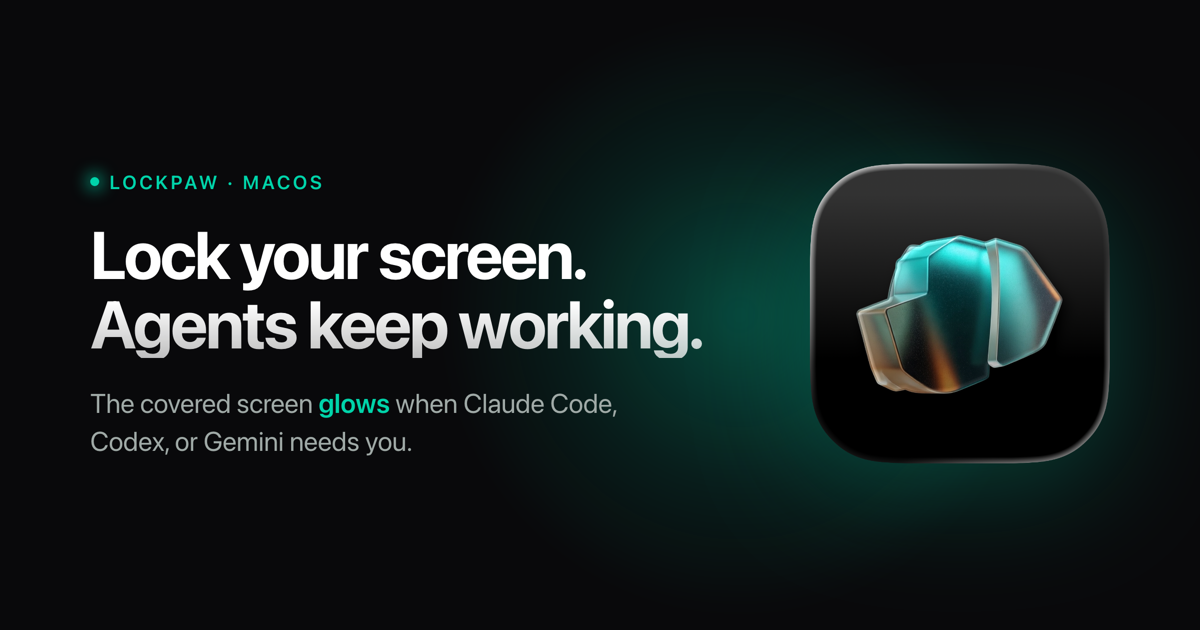
One hotkey covers your screen. One hotkey uncovers it. Everything keeps running.
No sleep. No display disconnect. No process interruption. The screen glows when your agent needs you.



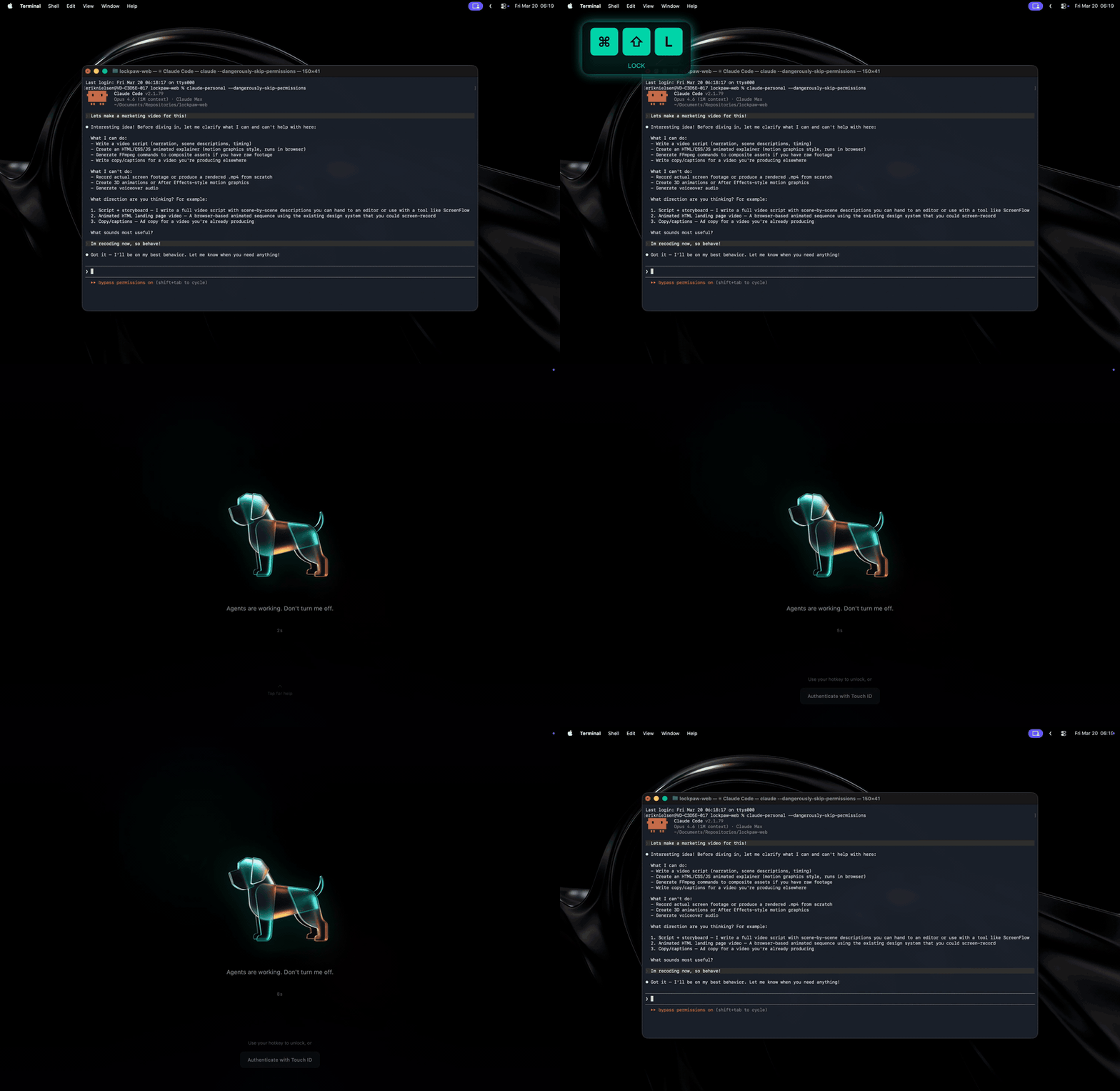
You could set up Amphetamine, configure Hot Corners, tweak energy settings, and adjust your screen saver. Or you could press ⌘⇧L.
| Action | How |
|---|---|
| Lock | Your hotkey (default Cmd+Shift+L) |
| Quick unlock | Same hotkey, or rest a finger on Touch ID |
| Fallback unlock | Click Authenticate with Touch ID at the bottom of the lock screen |
| Settings | Menu bar → Settings… |
| Change hotkey | Settings → Shortcuts → click to record |
| Change mascot (or turn it off) | Settings → Lock Screen → Mascot |
| Hide the menu bar icon | Settings → General → Show menu bar icon (open Lockpaw from Applications to bring it back) |
Lock your screen and walk away — when your AI agent pauses for permission or finishes, the locked screen glows from across the room and a notification fires. You stay covered (and private) until you unlock. The glow is always silent; turn on a sound in Settings → General if you want one (off by default for shared offices).
Easiest: open Settings → General → Connect your agent and click your agent —
done. Prefer the terminal? Lockpaw ships a tiny lockpaw command-line tool
(Lockpaw.app/Contents/SharedSupport/lockpaw); one command wires everything up,
including installing itself into ~/.local/bin (add --print to just see the snippet):
| Agent | Setup | What it hooks |
|---|---|---|
| Claude Code | lockpaw install-hook claude | Notification + Stop hooks in ~/.claude/settings.json (honors $CLAUDE_CONFIG_DIR) |
| Codex CLI | lockpaw install-hook codex | notify in ~/.codex/config.toml |
| Gemini CLI | lockpaw install-hook gemini | Notification + AfterAgent hooks in ~/.gemini/settings.json |
| Cursor | lockpaw install-hook cursor | stop hook in ~/.cursor/hooks.json |
| Copilot CLI | lockpaw install-hook copilot | agentStop + notification hooks in ~/.copilot/hooks/lockpaw.json (honors $COPILOT_HOME) |
| Aider | lockpaw install-hook aider | notifications-command in ~/.aider.conf.yml |
| Anything else | append ; lockpaw ping to your command | runs after your agent finishes |
The hooks reference ~/.local/bin/lockpaw by path, so they work no matter what's on
your PATH, and keep working when the app moves or updates. Re-running install-hook
upgrades older hook entries in place; existing foreign hooks are never clobbered, and
a .bak backup is saved next to any config it touches. lockpaw install-cli is still
there if you just want the command on your PATH.
Under the hood, lockpaw ping posts a local notification that Lockpaw listens for — it
never launches the app if it isn't already running.
Grab the latest signed & notarized DMG from getlockpaw.com or GitHub Releases.
brew tap sorkila/lockpaw
brew install --cask lockpaw
brew install xcodegen
git clone https://github.com/sorkila/lockpaw.git
cd lockpaw
xcodegen generate
xcodebuild -scheme Lockpaw -configuration Release build
On first launch, grant Accessibility when prompted. The Lockpaw icon appears in your menu bar.
The lock screen is intentionally minimal. Near-black canvas. Subtle radial glow. One element at a time.
Calm by default — the screen opens with your chosen mascot, your message, and a quiet elapsed timer; the pointer slips away after a moment of stillness. The fallback auth button waits quietly at the bottom — always there, never loud. When an agent pings, the screen breathes two slow waves of teal, then keeps a soft "your agent needs you" hint until you return.
Mascots — a metallic origami dog or cat rendered in teal and amber, floating in a pool of light. Slow 12-second breathing cycle. On successful unlock, the mascot scales up with a teal bloom and fades away.
Typography — system San Francisco throughout. Regular weight message at 55% white. Monospaced timer at 35%. The screen whispers.
Auth button — glass material effect with a subtle border. Visible enough to be tappable, quiet enough to stay out of the way.
Hotkey — CGEvent.tapCreate with .listenOnly on a dedicated background thread. Bypasses the LSUIElement activation issue that affects Carbon hotkeys in menu bar apps. Requires Accessibility permission.
Input blocking — separate CGEventTap intercepts all keyboard, scroll, and tablet events system-wide while locked. Mouse events pass through to the overlay (SwiftUI buttons need clicks). If macOS disables the tap, it re-enables synchronously in the callback.
Window level — CGShieldingWindowLevel(), the highest level in the system. Above Spotlight, Notification Center, screen savers, everything.
Multi-display — one overlay window per screen, recreated on hot-plug.
State machine — LockState enum with validated transitions. Every transitionTo() call is checked. State is verified again after async authentication returns.
Sleep prevention — IOPMAssertion keeps the Mac awake while locked.
Auth — while locked, a biometrics-only LAContext is already armed behind the overlay, so the first finger press unlocks with nothing to click. The button path uses .deviceOwnerAuthentication for Touch ID with password fallback, rate-limited to a 30s cooldown after 3 failed attempts. A rejected finger on the armed sensor costs no attempt — it may be a palm or a bag strap, and Touch ID enforces its own lockout in hardware.
Auto-updates — Sparkle framework checks for updates automatically. Appcast hosted at getlockpaw.com.
Lockpaw is a visual privacy tool, not a security boundary.
It guards against the accidental — a colleague, a cat, your own muscle memory while agents run. Not the intentional.
#if DEBUG)pkill LockpawFor real security: Ctrl+Cmd+Q.
Found a lock or auth bypass anyway? Please report it privately.
lockpaw://lock              Lock the screen
lockpaw://unlock            Unlock with Touch ID
lockpaw://unlock-password   Unlock with password
lockpaw://toggle            Toggle lock state
Lockpaw/
├─ LockpawApp                     Entry, MenuBarExtra, AppDelegate, onboarding
├─ Controllers/
│  ├─ LockController              State machine, lock/unlock orchestration
│  ├─ Authenticator               LAContext · armed Touch ID · password fallback
│  ├─ InputBlocker                CGEventTap · keyboard/scroll blocking
│  ├─ HotkeyManager               CGEventTap · global hotkey detection
│  ├─ OverlayWindowManager        NSWindow · multi-display · shielding level
│  ├─ SleepPreventer              IOKit · idle sleep assertion
│  └─ AgentNotifier               UNUserNotificationCenter · agent-ping notifications
├─ Models/
│  ├─ LockState                  .unlocked → .locking → .locked → .unlocking
│  ├─ HotkeyConfig               Centralized hotkey UserDefaults access
│  ├─ PingDecision               Pure agent-ping decision (pulse/notify/sound)
│  ├─ PassiveAuthPolicy          Pure armed-Touch-ID rules (arm/re-arm/stand down)
│  ├─ Mascot                     Dog/cat/none lock screen preference
│  └─ TerminationPolicy          Quit is refused while guarded (+ LockStatus mirror)
├─ Views/
│  ├─ LockScreenView             Dog/cat mascot · agent-ping glow · fallback auth
│  ├─ AmbientScreenView          Secondary display gradient animation
│  ├─ MenuBarView                Dropdown · lock/unlock/quit
│  ├─ SettingsView               Native tabs · hotkey recorder · updates
│  └─ OnboardingView             5-step wizard · hotkey · accessibility · agent alerts
├─ Utilities/
│  ├─ Constants                  Timing, animations, formatting
│  ├─ Notifications              All Notification.Name in one place
│  └─ AccessibilityChecker       AXIsProcessTrusted + System Settings
└─ Resources/
   └─ Assets                      App icon, mascot, menu bar icon, colors

LockpawCLI/
└─ main                           `lockpaw` CLI · ping · install-cli · install-hook
Pushes to main and PRs run build + 96 unit tests via GitHub Actions. Shipped DMGs are Developer ID-signed, notarized, and published to GitHub Releases; auto-updates are delivered through Sparkle with EdDSA-signed appcasts.
Tintpad is the other half of the loop: one hotkey opens your terminal at the right repo with Claude Code, Codex, or any agent already running. Tintpad starts your agents. Lockpaw covers for you while they run. Also free, also MIT.
Sign in to join the discussion.
No comments yet. Be the first to say what this is good for.
🪨 why use many token when few token do trick — Claude Code skill that cuts 65% of tokens by talking like caveman

The best-benchmarked open-source AI memory system. And it's free.

Orca is the ADE for working with a fleet of parallel agents. Run any coding agent with your own subscription. Available on desktop, mobile and remote runtime.
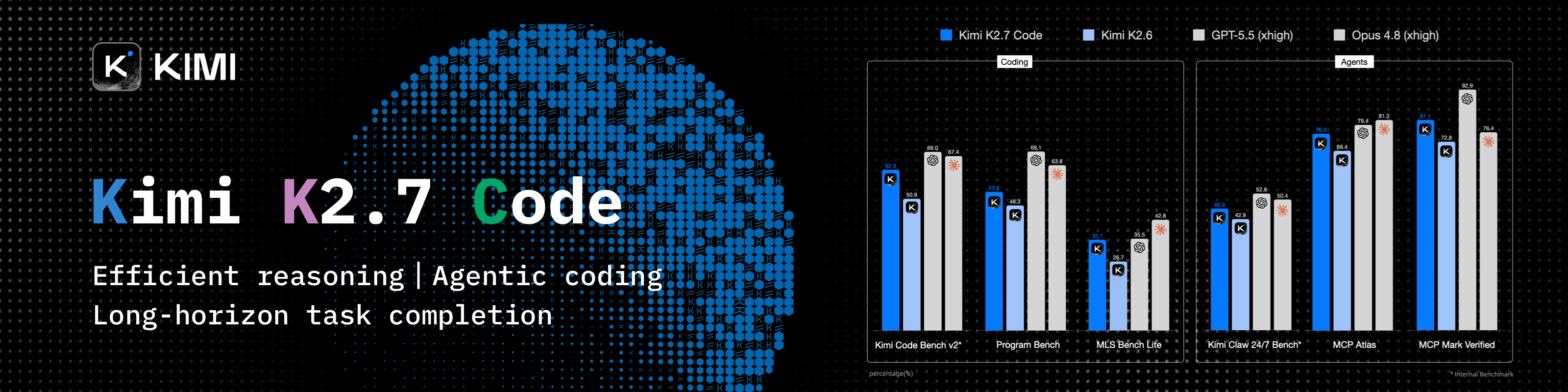
A cross-platform desktop All-in-One assistant for Claude Code, Codex, OpenCode, OpenClaw, Grok Build & Hermes Agent. Only official website: ccswitch.io

Never stop coding. Free MIT AI gateway: one endpoint, 352 providers (150+ free), 1200+ models Kimi, Claude, GPT, Gemini, GLM, DeepSeek, MiniMax. Works with Claude Code, Codex, Cursor, OpenCode, Cline & Copilot. Quota-aware auto-fallback, RTK+Caveman compression saves 15-95% tokens, MCP/A2A, Desktop/PWA. Built by 550+ contributors

Compress tool outputs, logs, files, and RAG chunks before they reach the LLM. 20% fewer tokens for coding agents, 60-95% fewer tokens for JSON, same answers. Library, proxy, MCP server.