
JuliusBrussee/
caveman

🪨 why use many token when few token do trick — Claude Code skill that cuts 65% of tokens by talking like caveman
105k
1 add
Skrun is a self-hosted runtime for agent skills, with a CLI, typed SDK, HTTP API, and operator dashboard. It packages a skill into a versioned agent you can run through `POST /run`, stream over SSE, or call from the SDK. It works with many model providers, supports tools, files, state, and verification, and keeps the skill format in your repo as the source of truth. The repo also ships demo agents and Docker-based self-hosting setup.
Builders who want to deploy agent skills, wrap existing scripts, or run them behind a stable API.
You can turn a local skill into a versioned API that others can call without re-building the agent plumbing.
Imports skills from `SKILL.md`, `AGENTS.md`, or another format and exposes them at `POST /run`.
Runs agents with Claude, GPT, Gemini, Mistral, Groq, Grok, Ollama, and other OpenAI-compatible endpoints.
The `skrun` command handles local dev, packaging, deployment, versioning, and execution.
`@skrun-dev/sdk` provides `run`, `stream`, `runAsync`, `push`, `pull`, and other methods for app integration.
Agent runs can stream SSE events in real time or finish asynchronously with webhook callbacks.
The web UI shows agents, runs, versions, costs, and interactive playgrounds.
Runs on Docker, SQLite, or Postgres, with GitHub OAuth and API keys for production.
Supports local scripts, MCP servers, file uploads, artifacts, state, and model tool choice controls.
npm install -g @skrun-dev/cli

skrun init --from-skill ./my-skill        # or: skrun init my-agent
skrun deploy -m "initial release"         # build + push + get your API URL
skrun verify dev/my-skill@1.0.0           # admin step — auto-admin in local dev
skrun run dev/my-skill -i '{"query":"analyze this"}'curl -X POST http://localhost:4000/api/agents/dev/my-skill/run \
-H "Authorization: Bearer dev-token" \
-H "Content-Type: application/json" \
-d '{"input": {"query": "analyze this"}}'
Deploy any Agent as an API via POST /run.
The open, multi-model runtime for AI agents — works with any LLM, on any infrastructure.
The open-source alternative to Claude Managed Agents (CMA) and Google's Gemini Enterprise Agent Platform (GEAP) — multi-model, self-hostable, MIT.






Why · Use Cases · Quick Start · Dashboard · SDK · Features · Docs
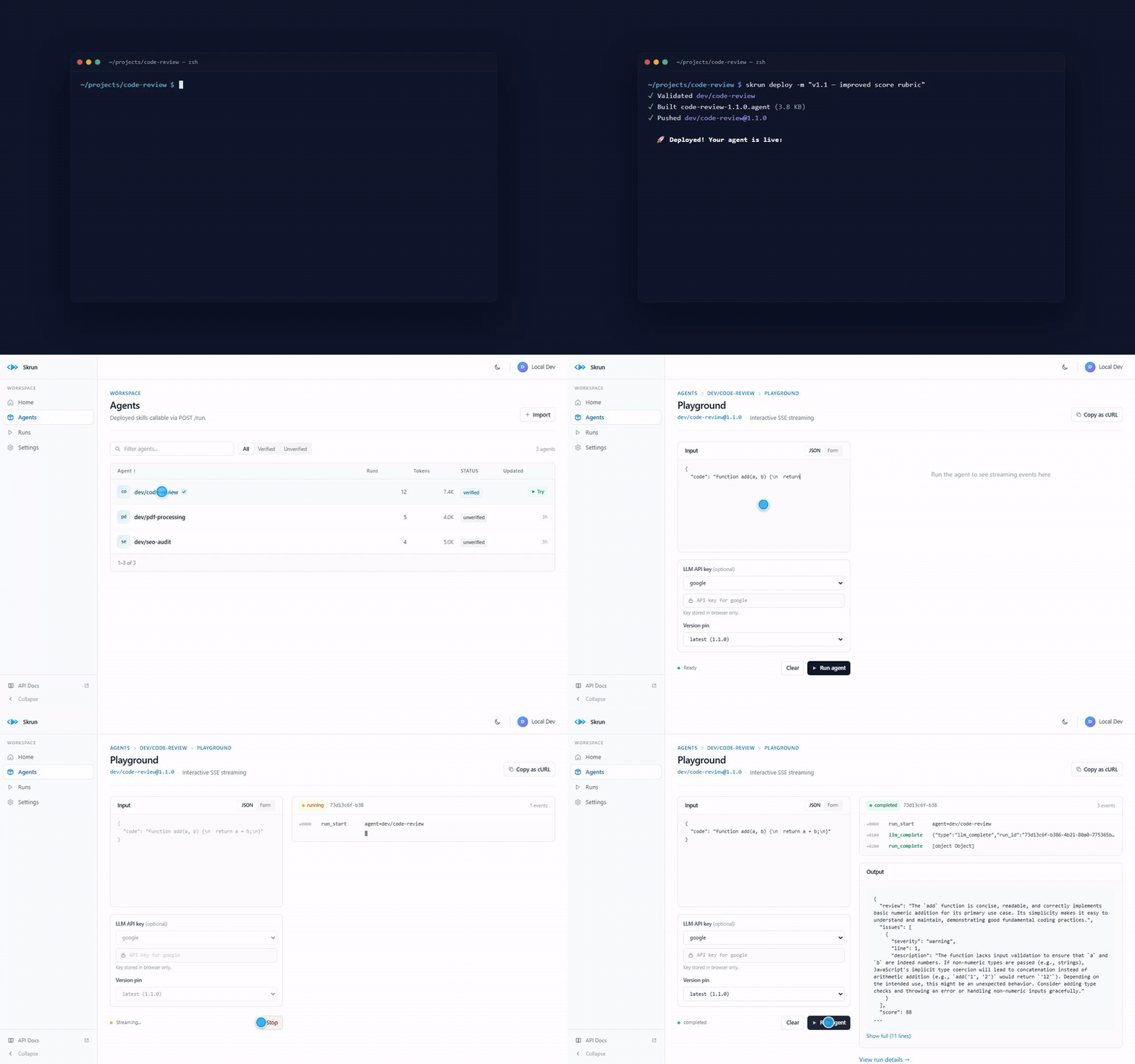
4 steps: (1) skrun deploy -m "initial release" from your terminal →
(2) the agent appears in the dashboard →
(3) open the Playground, fill the input →
(4) click Run, watch SSE events stream in real time, see the result.
You shipped an AI capability. It works on your machine. But every user, every customer, every new model brings new plumbing.
Skrun is the open agent runtime. Turn your skill — declared as SKILL.md, AGENTS.md, or your own format — into a POST /run endpoint. Without building your own agent loop. Without picking a vendor. Without locking your users behind a wall.
Any model. Any cloud. BYOK. MIT. Your skill stays portable.
SKILL.md) and AGENTS.md (Linux Foundation). Your existing skill works.| Skrun | CMA / GEAP / Vendor runtimes | |
|---|---|---|
| Models | Claude, GPT, Gemini, Mistral, Groq, Grok + any OpenAI-compatible endpoint (DeepSeek, Kimi, Qwen, Ollama, vLLM…) | One provider only |
| Deployment | Self-hosted (Node + SQLite/Postgres) or our cloud (coming soon) | Vendor cloud only |
| Format | SKILL.md (agentskills.io, 40+ platforms), AGENTS.md (Linux Foundation), or your own | Proprietary |
| Streaming | SSE + async webhooks | Varies |
| License | MIT | Closed |
| Auth | GitHub OAuth + API keys — multi-tenant namespaces | Vendor console only |
| LLM keys | Bring your own keys | Vendor billing only |
You wrote changelog-generator (or research-to-brief, or incident-postmortem). It works in Claude Code. Stars are climbing. Then someone opens issue #34: "How do I run this from a CI pipeline?" Issue #41: "Can I integrate this with Linear?" Issue #58: "My status-page automation needs this."
Today you respond: "Sorry, this is a SKILL.md — you need Claude Code installed." Half abandon.
With Skrun: skrun deploy, you reply with a curl command. Issue closed in 5 minutes instead of 3 hours of setup. The drop-off between "starred it" and "actually running it" disappears.
Your team has accumulated 12 LLM-powered scripts in 2 years. Each engineer rolled their own. One left last week — three of his scripts are crashing silently. Your LLM bill went 5x without explanation. The board asked twice "what's our AI strategy?" — you don't have one.
With Skrun: wrap existing scripts gradually as skills (or AGENTS.md, or your own format). No big-bang rewrite. One dashboard for all AI calls — cost per feature, failure modes, ownership. Your team standardizes on one declarative format. New engineers read a manifest in 30 seconds instead of reverse-engineering 800 lines.
Each new client means 2-3 weeks of build. You glue Express + Anthropic SDK + Vercel for each delivery. The plumbing is identical 70% of the time. Worse: when a client wants to switch from Anthropic to OpenAI 3 months later, you're back rewriting auth + retry + fallback logic.
With Skrun: same skill format, deploy per client. Model swap is a YAML edit. Your client gets a stable POST /run endpoint they own — they can host on their infra, swap models, take over anytime. You ship the skill, not a server you maintain.
What skill would you turn into an API tomorrow? What's missing in your current agent setup?
Tell us in Discussions — we read every post, and it shapes what we build next.
npm install -g @skrun-dev/cli
skrun init --from-skill ./my-skill # or: skrun init my-agent
skrun deploy -m "initial release" # build + push + get your API URL
skrun verify dev/my-skill@1.0.0 # admin step — auto-admin in local dev
skrun run dev/my-skill -i '{"query":"analyze this"}'
That's it. Your agent is verified, callable via the CLI, and reachable as a POST /run HTTP endpoint:
curl -X POST http://localhost:4000/api/agents/dev/my-skill/run \
  -H "Authorization: Bearer dev-token" \
  -H "Content-Type: application/json" \
  -d '{"input": {"query": "analyze this"}}'
dev-tokenis for local development. In production, authenticate via GitHub OAuth or API keys — your GitHub username becomes your namespace, andskrun verifyis governed by the operator verification policy (admin-only by default; creators can self-attest underowner).
→ 10-minute tutorial · Concepts · API reference
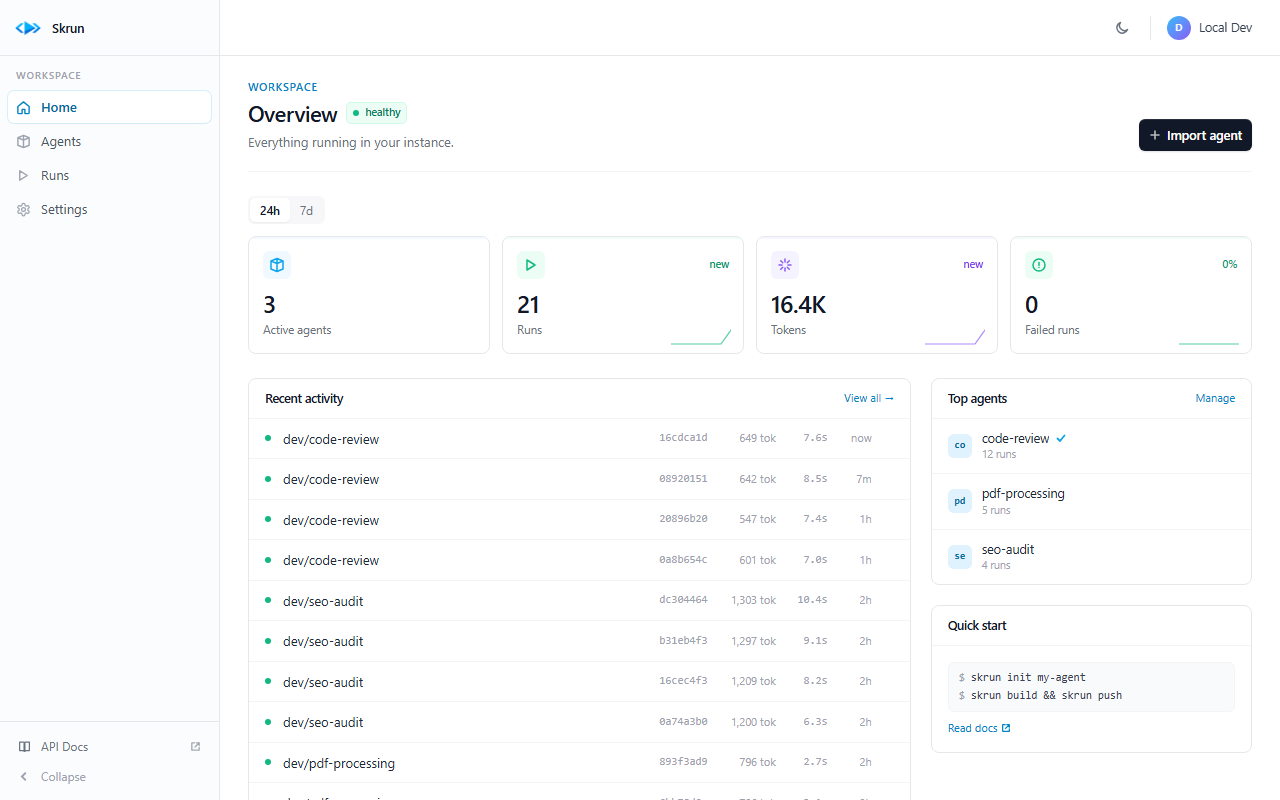
Every Skrun registry ships with a full operator dashboard at /dashboard. No separate install, no extra env var.
sk_live_*) with one-shot reveal and revocation.→ Screenshot tour of all 7 pages
npm install @skrun-dev/sdk
import { SkrunClient } from "@skrun-dev/sdk";

const client = new SkrunClient({
  baseUrl: "http://localhost:4000",
  token: "dev-token",
});

// Sync — get the result
const result = await client.run("dev/code-review", { code: "const x = 1;" });
console.log(result.output);

// Stream — real-time events
for await (const event of client.stream("dev/code-review", { code: "..." })) {
  console.log(event.type); // run_start, tool_call, llm_complete, run_complete
}

// Async — fire and forget with webhook callback
const { run_id } = await client.runAsync("dev/agent", input, "https://your-app.com/hook");

// Pin a specific agent version — reproducible, no silent drift
const pinned = await client.run("dev/code-review", input, { version: "1.2.0" });
console.log(pinned.agent_version); // "1.2.0" — always echoed back

// Push with a note (like a git commit message)
await client.push("dev/code-review", bundle, "1.3.0", { message: "Added retry logic" });
10 methods: run, stream, runAsync, push, pull, list, getAgent, getVersions, verifyVersion, setVisibility. Zero runtime dependencies, Node.js 20+.
| Feature | Description |
|---|---|
| 🤖 Multi-model | 6 built-in providers (Anthropic, OpenAI, Google, Mistral, Groq, xAI) + any OpenAI-compatible endpoint (DeepSeek, Kimi, Qwen, Ollama, vLLM…) — with automatic fallback |
| 🔧 Tool calling | Local scripts (scripts/) + MCP servers (npx) — same ecosystem as Claude Desktop |
| 💾 Stateful | Agents remember across runs via key-value state |
| 📡 Streaming | SSE real-time events (run_start → tool_call → run_complete) + async webhooks |
| 📦 Typed SDK | npm install @skrun-dev/sdk — run(), stream(), runAsync() + 7 more methods |
| 📊 Operator Dashboard | Web UI at /dashboard — agents, runs, stats, settings, integrated playground with SSE streaming |
| 📖 Interactive API docs | OpenAPI 3.1 schema + Scalar explorer at GET /docs |
| 🔐 Production auth | GitHub OAuth login + API keys (sk_live_*) + multi-tenant namespaces |
| 🗄️ Persistent storage | Pluggable database — SQLite for local dev (zero-config, file-based), any standard Postgres for production (Supabase, Neon, RDS, Fly Postgres… — no vendor lock-in) |
| 🔑 Caller keys | Users bring their own LLM keys via X-LLM-API-Key — zero cost for operators. A key only ever goes to an endpoint its owner chose: an agent may declare its own model.base_url, so running someone else's agent with your key means naming the origin you expect (X-LLM-Base-URL), and the server never pairs its own key with an agent-chosen endpoint unless the operator opts in |
| ✅ Agent verification | Verified flag controls script execution — safe for third-party agents |
| 🔒 Private by default | Every agent is private — only its owner/admin can POST /run; non-owners get an opaque 404 and can't override the agent's declared environment. Agents are private-only for now — public is a marketplace capability whose set-path ships later |
| 📌 Version pinning + notes | Pin a specific agent version per call (version: "1.2.0") or attach a note at push (-m "...") — reproducible integrations, visible changelog |
| 🌍 Environment separation | Agent behavior (model, tools) separated from runtime environment (networking, timeout, sandbox). Per-run overrides via POST /run body |
| 📁 Files API | Unified /api/files namespace for both directions — upload binary inputs (image/PDF/audio) via POST /api/files, download agent-produced artifacts via GET /api/files/:id/content |
| 🖼️ Multimodal inputs | Declare type: file inputs (image / PDF / audio) in agent.yaml. Agents read images directly via vision (no OCR upstream). 3 transports: file_id ref, base64 inline, URL. Capability check at skrun deploy/push refuses incompatible model+media. |
| 📦 Script dependencies | Drop a standard package.json (Node) or requirements.txt / pyproject.toml (Python) at the bundle root. Skrun resolves deps on first run, caches at ~/.skrun/deps/<hash>/ for instant subsequent runs. Auto-detects pnpm/yarn/npm + uv/poetry lockfiles for reproducible installs. |
| 🎯 Tool choice | Force the LLM to invoke a specific tool (top-level tool_choice: <name>), require any tool (tool_choice: required), block tool use (none), or mark per-tool invariants with required: true. Native cross-provider support (Anthropic / Gemini / OpenAI / xAI) with graceful soft-fallback when a directive isn't natively supported. |
| 💸 Native prompt caching | Automatic across 5 providers (Anthropic / OpenAI / Gemini / xAI / Groq) — 30-90% input cost savings on repeated content (system prompts + tools + reference documents). Anthropic gets explicit cache_control injection on the system + tools prefixes; OpenAI / xAI / Groq / Gemini benefit from implicit caching. Cost-tracking accuracy improves to ±5% of provider invoice via the new cache_read_tokens / cache_write_tokens fields in usage. Track dollar savings live (cost.saved) and on the dashboard. |
| 📊 Structured logs | JSON to stdout via pino — pipe to Axiom, Datadog, ELK. LOG_LEVEL env var controls verbosity |
| ☁️ Cloud deployment | SKRUN_RUNTIME=flyio spawns a dedicated ephemeral sandbox machine per run. The harness drives the LLM loop and holds every credential; the sandbox runs agent code with zero LLM/DB/S3 keys, read-only rootfs, non-root UID, iptables egress allowlist, zero capabilities. Self-host docker-compose applies the same container-level hardening (read-only rootfs, non-root, cap-drop, no-new-privileges); the per-run micro-VM + zero-credential sandbox are cloud-only (self-host runs agents in-process). |
Eight runnable demos under agents/ — each produces a real, downloadable artifact (PDF, XLSX, PPTX, ZIP, CSV, MD). All use Google Gemini Flash by default (free tier). Change the model section in agent.yaml to use any supported provider.
| Agent | What it does | Artifact |
|---|---|---|
| 📝 changelog-generator | Reads your local git log between two tags, groups commits by Conventional Commit type, drafts release notes | CHANGELOG.md + release-notes.md |
| 📐 adr-writer | Captures an architectural decision (context / options / decision / consequences) as a numbered Markdown ADR — auto-numbers from your existing adrs/ folder | NNNN-<slug>.md |
| Agent | What it does | Artifact |
|---|---|---|
| 🎯 meeting-transcript-to-action-items | Extracts decisions + action items from a Zoom/Teams transcript. Stateful — auto-resolves prior actions when next meeting mentions them as done | actions.csv + recap.md |
| 🛡️ semgrep-rule-creator | Turns a CVE description + bad-code snippet into a complete Semgrep rule bundle (rule + tests + rationale) | rule.yml + tests.md + README.md |
| Agent | What it does | Artifact |
|---|---|---|
| 📊 csv-to-executive-report | CSV → analyzed multi-page PDF with charts + narrative + summary table | report.pdf |
| 🎤 slide-deck-generator | Markdown outline → polished .pptx with brand color, title/content/closing layouts, speaker notes | deck.pptx |
| 🧾 receipts-to-expenses | Receipt photos (vision-native) + optional bank statement → categorized expense workbook + summary PDF | expenses.xlsx + monthly.pdf |
| Agent | What it does | Artifact |
|---|---|---|
| 🧠 knowledge-base-from-vault | Folder of Markdown notes (Obsidian/Notion/raw) → navigable static HTML site. Stateful — concept index densifies across runs | kb.zip (HTML+CSS) |
Shorter examples that each illustrate one primitive (model fallback, MCP, state, scripts) without producing artifacts:
code-review · pdf-processing · seo-audit · data-analyst · email-drafter · web-scraper
# 1. Start the registry (uses SQLite — data persists across restarts)
cp .env.example .env          # add your GOOGLE_API_KEY
pnpm dev:registry              # keep this terminal open

# 2. In another terminal — pick any agent (changelog-generator is the lightest)
skrun login --token dev-token
cd agents/changelog-generator
skrun build && skrun push -m "v1 — first push"
skrun verify dev/changelog-generator@1.0.0   # admin step; dev-token = auto-admin

# 3. Call it (uses the bundled fixture — no real git repo needed)
skrun run dev/changelog-generator \
  -i '{"repo_path": "./fixtures/sample-repo.git-log.txt", "project_name": "demo"}'

# Or via raw HTTP:
curl -X POST http://localhost:4000/api/agents/dev/changelog-generator/run \
  -H "Authorization: Bearer dev-token" \
  -H "Content-Type: application/json" \
  -d '{"input": {"repo_path": "./fixtures/sample-repo.git-log.txt", "project_name": "demo"}}'

# 4. Download the artifacts via the Files API (run_id from response)
curl http://localhost:4000/api/runs/<run_id>/files/CHANGELOG.md \
  -H "Authorization: Bearer dev-token" -o CHANGELOG.md
Windows (PowerShell): use
curl.exeinstead ofcurl, and pass-d "@input.json"for the body. Python demos (slide-deck-generator, csv-to-executive-report, receipts-to-expenses) and the Node demo (knowledge-base-from-vault): no manual install. Skrun's runtime auto-resolves each agent'srequirements.txt/package.jsonon first call and caches at~/.skrun/deps/<hash>/. See the Script dependencies reference.
| Command | Description |
|---|---|
skrun init [dir] | Create a new agent |
skrun init --from-skill <path> | Import existing skill |
skrun dev | Local server with POST /run (mock, free) |
skrun test | Run agent tests (real LLM) |
skrun build | Package .agent bundle |
skrun push -m "note" | Push with a version note |
skrun verify <ns>/<name>@<v> | Attest a version (authority per the verification policy — admin by default) |
skrun unverify <ns>/<name>@<v> | Revoke verification (authority per the verification policy) |
skrun run <ns>/<name>[@<v>] | Invoke an agent — -i inline, -f file, --stdin pipe |
skrun deploy -m "note" | Build + push + live URL |
skrun pull <agent> | Download agent bundle |
skrun keys create --agent <ns>/<name> --run-only | Mint a scoped/restricted API key (e.g. a run-only client key) |
skrun llm-key set <provider> --agent <ns>/<name> | Attach your LLM key so callers run the agent on your key (key from stdin / --key-env) |
skrun login / logout | Authentication (OAuth or token) |
skrun logs <agent> | Execution logs (planned) |
Skrun is MIT — deploy anywhere.
# Recommended: prod-parity docker compose stack (Postgres + MinIO + Redis + Caddy)
git clone https://github.com/skrun-dev/skrun.git && cd skrun
cp .env.example .env   # fill at least one LLM key
docker compose -f infra/docker-compose.yml up -d
curl http://localhost/health   # → {"status":"ok"}
docker compose up brings the prod-parity stack (Postgres + MinIO + Redis + Caddy) live with every sandbox hardening control on by default. See self-hosting with Docker.DATABASE_URL=postgres://…. No vendor lock-in.→ Self-hosting guide — step-by-step with env vars, reverse proxy, migrations.
git clone https://github.com/skrun-dev/skrun.git
cd skrun
pnpm install && pnpm build && pnpm test
See CONTRIBUTING.md for conventions and setup.
MIT — free to use, modify, self-host, and build on top.
Sign in to join the discussion.
No comments yet. Be the first to say what this is good for.
🪨 why use many token when few token do trick — Claude Code skill that cuts 65% of tokens by talking like caveman

The best-benchmarked open-source AI memory system. And it's free.

Orca is the ADE for working with a fleet of parallel agents. Run any coding agent with your own subscription. Available on desktop, mobile and remote runtime.
A cross-platform desktop All-in-One assistant for Claude Code, Codex, OpenCode, OpenClaw, Grok Build & Hermes Agent. Only official website: ccswitch.io

Never stop coding. Free MIT AI gateway: one endpoint, 352 providers (150+ free), 1200+ models Kimi, Claude, GPT, Gemini, GLM, DeepSeek, MiniMax. Works with Claude Code, Codex, Cursor, OpenCode, Cline & Copilot. Quota-aware auto-fallback, RTK+Caveman compression saves 15-95% tokens, MCP/A2A, Desktop/PWA. Built by 550+ contributors

Compress tool outputs, logs, files, and RAG chunks before they reach the LLM. 20% fewer tokens for coding agents, 60-95% fewer tokens for JSON, same answers. Library, proxy, MCP server.