

DietrichGebert/ponytailPlugins
Makes your AI agent think like the laziest senior dev in the room. The best code is the code you never wrote.
138k
1 add
sd0x-harness is a reference harness layer for Claude Code that combines project rules, lifecycle hooks, review agents, and skill packs. It shapes how the agent plans, edits, reviews, and stops, with hooks and state files that keep safety and completion checks in place across sessions.
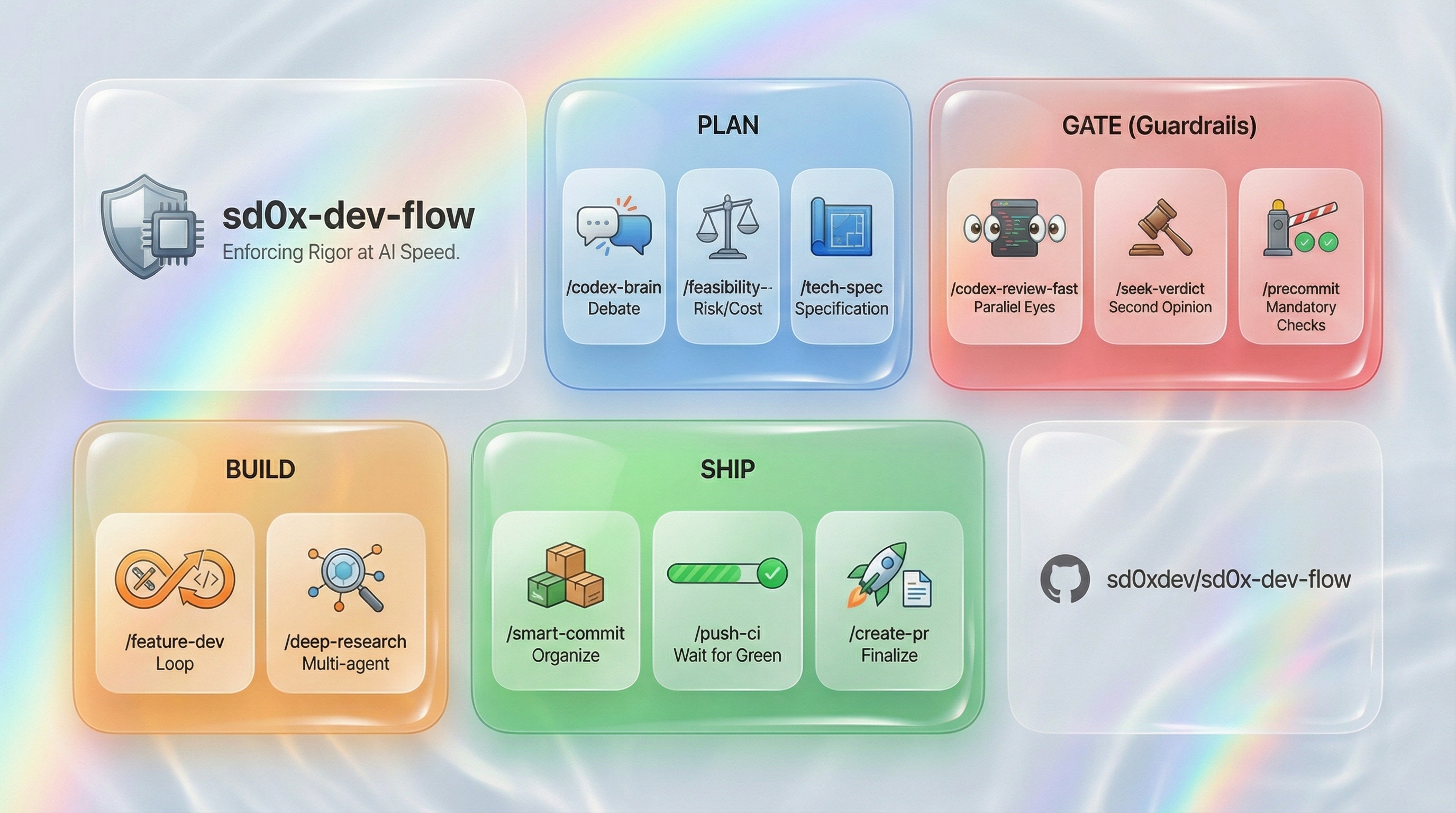
Builders who use Claude Code and want reusable gates, rules, and review workflows in their repo.
You can keep agent work inside a consistent harness so edits, reviews, and safety checks are harder to skip.
Runs reminder and guard scripts around session events such as edit, stop, compact, and user prompt submit.
Stores review verdicts in `scripts/review-state.js` so an edit reopens the related gate instead of letting old results go stale.
Uses Codex exec as an independent reviewer for Claude Code changes, with a fallback reviewer path when configured.
Ships a large catalog of skills that can be installed as skills-only for Codex CLI, Cursor, and Windsurf.
Includes named agents like reviewers, architects, analysts, and verify helpers under `agents/`.
Provides install, validation, commit-msg, pre-push, and precommit scripts that enforce the harness contract.
# Claude Code — full control plane
/plugin marketplace add sd0xdev/sd0x-harness
/plugin install sd0x-dev-flow@sd0xdev-marketplace

# Configure your project
/project-setup
# Codex CLI / Cursor / Windsurf / Aider — skills only
npx skills add sd0xdev/sd0x-harness
$codex-setup init
codex --version
/sd0x-dev-flow:install-scripts codex-exec.js
Language: English | 繁體中文 | 简体中文 | 日本語 | 한국어 | Español
The harness layer for Claude Code.
Let the model choose the path. Keep "done" verifiable.
v4 gives Claude discretion inside a closed, test-pinned anchor set; hooks are digest-bound reminders that survive compaction, and Codex reviews independently.
Full control plane on Claude Code. Skills-only distribution for Codex CLI and other compatible agents.
99 bundled · 99 public skills · 16 agents — ~4% of Claude's context window

# Claude Code — full control plane
/plugin marketplace add sd0xdev/sd0x-harness
/plugin install sd0x-dev-flow@sd0xdev-marketplace

# Configure your project
/project-setup
One command auto-detects framework, package manager, database, entrypoints, and scripts. Installs a subset of rules and hooks; the full plugin bundles 16 rules + 6 hooks. Use --lite to only configure CLAUDE.md (skip rules/hooks).
# Codex CLI / Cursor / Windsurf / Aider — skills only
npx skills add sd0xdev/sd0x-harness
Then, inside Codex CLI, generate the AGENTS.md kernel and install the commit-msg hook. The pre-push gate is opt-in — add --with-push-gate to install it too:
$codex-setup init
| Method | Tools | Coverage |
|---|---|---|
| Plugin install | Claude Code | Full (99 bundled skills, hooks, rules, auto-loop) |
npx skills add | Codex CLI, Cursor, Windsurf, Aider | Skills only (99 public skills) |
$codex-setup init | Codex CLI | AGENTS.md kernel + commit-msg hook (pre-push gate opt-in) |
Requirements: Claude Code 2.1+ | Node.js 18+ | jq (pre-edit-guard and post-edit-format parse their hook payload with it — without jq both exit 0, so the sensitive-path guard and auto-formatting are silently off) | Codex CLI (optional to install the plugin; the default reviewer for the /codex-* review gates — on codex_fail — the adapter's start or resume exiting 1, and nothing else — the gate is carried by a contract-aware fallback reviewer under the same mechanism, fail-closed per family contract with [REVIEWER_FALLBACK] recorded; a missing adapter, a configuration error, an unfinished run, or an alloc/cleanup failure dispatches no fallback, records no marker and leaves the gate open, and only when every carrier is exhausted does the review surface ⚠️ Need Human instead of a verdict)
The review loop talks to Codex through codex exec, driven by a small adapter. There is no MCP
server to register: this plugin no longer dispatches through codex mcp-server.
1. In a shell — install the Codex CLI (>= 0.149.0) and sign in:
codex --version
2. In Claude Code — install the transport adapter into this project. This is a slash command, not a shell command; typed into a terminal it would try to run an absolute path:
/sd0x-dev-flow:install-scripts codex-exec.js
Step 2 is optional: the first review that needs the adapter auto-installs it, using the same
three-level lookup precommit-fast uses for its runner. Run it explicitly when you would rather the
install not happen inside a review.
Model and reasoning effort now live in a Codex profile, not on a registration command. Name one
in rules/auto-loop-project.md:
## Codex Profile

review
That name resolves to $CODEX_HOME/<name>.config.toml — the profile-v2 form codex exec -p layers
on top of your base user config (codex exec --help: "Layer $CODEX_HOME/<name>.config.toml on top
of the base user config"). So a review profile holding model_reasoning_effort = "high" gives the
review loop the depth the old -c override gave it, and leaves your interactive Codex sessions
alone. Leaving ## Codex Profile empty is fine: the adapter then passes no -p and Codex uses its
own default configuration.
The adapter pins the sandbox and the approval policy itself for every dispatch, so neither is a
setup decision — see skills/codex-code-review/references/codex-transport.md for the full contract.
Frontier models can plan, batch, and recover from structured state — they no longer need the harness to dictate every next command. v4 moves from choreography to contracts: the harness stopped scripting the model's moves and started defining what must be true when the work is declared done, without relaxing a single safety or review anchor.
| Dimension | v3 (choreography) | v4 (contracts) |
|---|---|---|
| Hook role | Emit the next command to run | Print reminders + [AUTO_LOOP_STATE] facts — change class, per-plane verdict state |
| Completion | Scripted step sequence ("fix → immediately re-review") | Terminal completion invariant: every gate the change class requires has passed after the last edit |
| Rule force | Uniform — every rule reads as mandatory | Three tiers: Anchor (never), Default (deviate with a stated signal), Guidance (advisory) |
| Review depth | Maximum by default | Risk-scaled tiers (fast / standard / thorough); security and data integrity always escalate |
| Stall detected / round cap hit | Hand off to the human | First hit: structured self-diagnosis + one bounded adjustment, then resume — unless a human exit applies (security/data-integrity, architecture-level change, requirement ambiguity); the same change hitting the cap again after its diagnosis: always human |
The non-negotiable core lives in a closed Anchor Register (rules/discretion.md) that no project override can downgrade — resolution is Anchor-first, and a test suite fails by design if a Register entry is removed. Inside that boundary, ownership is explicit:
| Owner | Owns |
|---|---|
| Model | Batching, timing, review depth escalation, Default-tier deviations (stated, then keep working) |
| Harness | Digest-bound reminder state, git-level guards (commit-msg by default, pre-push opt-in), the closed anchor set |
| Human | Irreversible approvals (push, commit, merge) and the enumerated exit points |
The model owns the path. The harness owns the evidence and non-negotiable boundaries. The human retains irreversible authority.
If you notice review quality drop after upgrading to 4.4.0 — real defects slipping through, or reviews converging too eagerly — please open an issue. This release changes review judgment, and field reports are the only way to validate it.
The plain-language version: the auto-loop used to let reviews dig ever deeper — a reviewer would flag a weak test, the fix added a stronger guard, the next round attacked that guard, and so on. We measured a real case: 9 review rounds where 7 of 8 blocking findings were about the test guards' own strength, and none were about the delivered change. 4.4 draws a line: once a property is demonstrated in both directions on its real path, further hardening of that property is non-blocking unless an AC or security invariant requires it.
| What changed | Before | After |
|---|---|---|
| Where assurance stops | A guard could always be asked to guard the guard | A refusing test proves both directions on the actual path — that representative proof is the boundary; deeper hardening is a non-blocking Nit unless an AC or security invariant demands it |
| The "Prevention" field | Read as "every fix must add another guard artifact" — the seed of the spiral | An explanation of which existing control catches the class; usually the regression test the fix already ships |
| Review dispatch | Re-dispatches could accumulate "attack X next" directions, anchoring reviewers deeper each round | A fixed three-part contract: frozen task (task, baseline, ACs, user-supplied focus), current facts, fixed review contract — attack lists are a prohibited pattern |
| Reviewer framing | "Focus on finding issues" | "Focus on material defects" — plus an assurance boundary and a boundary check replacing the open-ended gap check |
| Design thinking | Left to review, after the code exists | Nudged at write time: when the shape is non-obvious, name the simplest design chosen and why — questions, not quotas |
Why we believe this is right (and why we still want your reports): IFScale measures model-specific adherence degradation as instruction density rises from 10 to 500 simultaneous instructions; context-rot research finds longer contexts and topically related distractors reduce reliability; and Vercel's agent evals found an always-present documentation index scored 100% where a skill with explicit trigger instructions scored 79% — instruction load and unclear contracts have measurable costs. The auto-loop core is untouched: the terminal completion invariant, edit-reopens-gate, sub-threshold discipline, stall diagnosis, and every safety anchor remain exactly as they were.
Harness engineering is the discipline of engineering everything around the LLM — tool loops, context management, hooks, state machines, safety layers — as opposed to training the model itself. Mitchell Hashimoto coined the term in Feb 2026; Anthropic engineering and Martin Fowler have published on it; arXiv 2603.05344 formalizes it.
sd0x-dev-flow is a reference implementation. Each row below maps a canonical harness sub-problem to concrete code you can study:
| # | Harness sub-problem | sd0x-dev-flow implementation | Code evidence |
|---|---|---|---|
| 1 | Tool loop control | Terminal completion invariant — every gate a change class requires must pass after the last edit; the model chooses when and how to run them | rules/auto-loop.md + scripts/review-state.js |
| 2 | Digest-bound reminder state | Verdicts are noted by the model (node scripts/review-state.js note <plane> <pass|fail>) and bound to the tree digest — an edit re-opens its plane's reminder because the digest changed; gate sentinels (✅ Ready / ## Overall: ✅ PASS) stay behaviour-layer signals | scripts/review-state.js + rules/auto-loop.md (§ Gate Sentinels, § Enforcement) |
| 3 | Context recovery across compaction | Git baseline (branch + uncommitted files) and owed-gate reminders re-injected after SessionStart(compact) | hooks/post-compact-auto-loop.sh |
| 4 | Lifecycle interceptors | 5 hook event types dispatched to 6 scripts — 4 advisory reminder hooks, an auto-formatter, and one blocking security guard (SessionStart additionally runs scripts/namespace-hint.sh): PreToolUse / PostToolUse / Stop / SessionStart / UserPromptSubmit | hooks/ (6 scripts) + .claude/settings.json |
| 5 | Capability-based tool gating | Skill frontmatter allowed-tools — e.g., /ask has no Edit/Write | 91 of 99 public skills declare allowed-tools |
| 6 | Defense-in-depth safety | Git-level guards stay hard where they are installed — commit-msg-guard always, pre-push-gate over /dev/tty when opted in; edit-time pre-edit-guard still blocks sensitive-path edits (a security guard, not workflow enforcement — it needs jq, and without it the guard does not fire); the Stop hook reminds — the layers that gate irreversible actions and secrets kept their teeth, the review layer became advisory by design | scripts/pre-push-gate.sh + scripts/commit-msg-guard.sh + hooks/stop-guard.sh |
| 7 | Generator-evaluator split | Codex reviews what Claude wrote, researching the repo independently — never handed a conclusion to confirm | rules/codex-invocation.md + rules/auto-loop.md (Review Dispatch) |
| 8 | Incremental progress tracking | Evidence-based stall discipline: three review rounds that close no findings — counted by the model from the review reports — trigger a structured classification plus one bounded adjustment. The per-tier round budget (default 6 / 15 / 30, overridable 3–50) is the runaway backstop and runs the same diagnosis on its first hit, with enumerated human exits | rules/auto-loop.md (§ Stall Detection and Diagnosis; details in skills/codex-code-review/references/loop-diagnostics.md) |
| 9 | Human-in-the-loop safety gates | AskUserQuestion approval before every /push-ci push — always required, and the authorization itself where the opt-in pre-push hook is absent; with the hook installed, /dev/tty confirmation is the terminal credential for protected-branch pushes (plus non-fast-forward detection) | scripts/pre-push-gate.sh + skills/push-ci/SKILL.md |
| 10 | Self-improvement loop | Correction → record lesson → promote to rule after 3+ recurrences | rules/self-improvement.md |
Most harness projects cover 2–4 of these. sd0x-dev-flow covers all 10 — which makes the code useful as a study target, not just a tool.
flowchart LR
    P["🎯 Plan"] --> B["🔨 Build"]
    B --> G["🛡️ Gate"]
    G --> S["🚀 Ship"]

    P -.- P1["/codex-brainstorm<br/>/feasibility-study<br/>/tech-spec"]
    B -.- B1["/feature-dev<br/>/bug-fix<br/>/codex-implement"]
    G -.- G1["/codex-review-fast<br/>/precommit<br/>/codex-test-review"]
    S -.- S1["/smart-commit<br/>/push-ci<br/>/create-pr<br/>/pr-review"]
Everything orbits one rule — the terminal completion invariant: work on a change may be declared complete only when every gate its change class requires has passed after the last edit in that class. Code edits require an independent review — Codex by default, or a validated contract-aware fallback reviewer when Codex is unavailable — then /precommit; .md docs require /codex-review-doc. When to run them, how to batch edits, and how deep to review are the model's calls — the invariant constrains the end state, not the choreography.
Hooks report facts, not orders: they print reminders and an [AUTO_LOOP_STATE] fact line (change class, per-plane verdict state) and the model owns the decision. What blocks comes from the tier (fast P0 · standard P0/P1 · thorough P0/P1/P2); findings below that line are logged and the loop proceeds rather than opening another round. A stall — three review rounds that close nothing, counted by the model — or, as a backstop, hitting the round cap triggers a structured self-diagnosis (architecture problem? doc too long? attention diffusion?) and one bounded adjustment before the loop resumes, rather than an automatic hand-off; the human exits stay in force whichever trigger fired (security and data-integrity changes skip the diagnosis entirely; a stall diagnosed as architecture-level or requirement ambiguity goes to the human).
There is no enforcement mode (hook-lightweighting, 2026-08-13): every review-layer hook is a reminder that exits 0. The reviewer's report is what establishes the verdict; the model then records it (node scripts/review-state.js note <plane> <pass|fail>, digest-bound — an edit re-opens its plane) to retire the reminder. A verdict never noted still stands — it just keeps its reminder alive — and the honest way to silence a reminder is to run the gate and note the outcome. The guards outside the review layer keep their teeth: pre-edit-guard still blocks sensitive-path edits (when jq is available; without it the guard does not fire), and the git-level guards remain hard where installed (commit-msg-guard by default, pre-push-gate opt-in).
A second reviewer is available via /codex-review-branch --dual and is off by default. See docs/hooks.md for hook and dependency details.
sequenceDiagram
    participant D as Developer
    participant C as Claude
    participant X as Codex exec
    participant H as Hooks

    D->>C: Edit code
    H->>H: Reminder state re-opens (digest changed)
    C->>X: Codex review (sandbox, researches repo itself)
    X-->>C: Findings + gate sentinel
    C->>C: note the verdict (review-state.js)
    C->>C: Gate on the tier's blocking severity

    alt Blocking findings
        C->>C: Fix them (sub-threshold: log and move on)
        alt R-a threshold (3 replies; override 2–6) or R-b context overrun
            C->>X: Fresh first dispatch on a new thread (frozen baseline rides along)
            X-->>C: Fresh report
            C->>C: Reconcile old findings onto the fresh report, re-derive the gate
            C->>C: Record [THREAD_ROTATED] (old → new threadId)
        else Under threshold
            C->>X: codex exec resume <threadId>
            X-->>C: Re-verify
        end
        Note over C,X: Rotation keeps the frozen scope baseline; stall streaks and round caps continue unreset
    end

    C->>C: /precommit (auto)
    C-->>D: ✅ All gates passed

    Note over H: Stop: owed gates re-reminded — never blocked
One reviewer — Codex — runs everywhere by default. The tier decides how much rigour a change gets, and what a reviewer finding has to be before it re-opens the loop:
| Tier | Use for | Blocks on | Round cap |
|---|---|---|---|
fast | Docs, config, small low-risk edits | P0 | 6 |
standard (default) | Ordinary features and bug fixes | P0, P1 | 15 |
thorough | Security, data integrity, releases, public API | P0, P1, P2 | 30 |
The configured tier is a baseline, not a ceiling — the model escalates when the change warrants it, and security or data-integrity changes are always reviewed at thorough whatever is configured.
80 is a passing grade. Findings below the tier's blocking severity are logged ([NIT_DEFERRED] — a reporting convention in the review report; nothing persists it) and the loop proceeds to /precommit — no extra fix pass, no extra review round. /codex-review-branch picks them up when the change is next reviewed at depth.
The round caps above are deliberately loose, because a cap cannot tell a converging loop from a churning one — it stops both at the same number. What tells them apart is the evidence: three consecutive review rounds that close no findings — counted by the model from the review reports, normally many rounds before the cap — trigger the diagnosis below. The cap is left as the runaway backstop.
The round caps above are the tier defaults — a project ## Max Rounds override (3–50) takes precedence. Hitting the cap is a diagnosis point, not an automatic hand-off: the model classifies the stall (architecture, doc too long, attention diffusion, unverified claims, tier mismatch, requirement ambiguity), makes one bounded adjustment, and resumes. The human exits stay binding whichever trigger fired: security/data-integrity changes skip the diagnosis and go straight to the human, a stall classified as architecture-level or requirement ambiguity exits to the human, and the same change hitting the cap a second time after its diagnosis always does. (Architecture-level changes, feature removal, or a user request to stop exit to the human at any point — cap or no cap.)
A second reviewer is available via /codex-review-branch --dual and is off unless the flag is passed — worth its doubled token and wall-clock cost on a release or a security review, not on a typical fix. Under --dual, findings are severity-normalized, deduplicated (file + issue key, ±5 line tolerance) and source-attributed.
Gate: ✅ Ready or ⛔ Blocked — behaviour-layer signals the model acts on; the verdict is noted into the reminder state.
| Good Fit | Not Ideal |
|---|---|
| Solo or small-team projects with Claude Code | Teams not using Claude Code |
| Projects needing automated review gates | One-off scripts with no CI |
| Codex CLI / Cursor / Windsurf users (skills subset) | Projects requiring custom LLM providers |
| Repos where quality gates prevent regressions | Repos with no test infrastructure |
| Workflow | Commands | Gate | State |
|---|---|---|---|
| Feature | /feature-dev → /verify → /codex-review-fast → /precommit | ✅/⛔ | Digest-bound reminder (noted verdicts) |
| Bug Fix | /issue-analyze → /bug-fix → /verify → /precommit | ✅/⛔ | Digest-bound reminder (noted verdicts) |
| Auto-Loop | Code edit → /codex-review-fast → /precommit | ✅/⛔ | Digest-bound reminder (noted verdicts) |
| Doc Review | .md edit → /codex-review-doc | ✅/⛔ | Digest-bound reminder (noted verdicts) |
| Planning | /codex-brainstorm → /feasibility-study → /tech-spec | — | — |
| Onboarding | /project-setup → /repo-intake | — | — |
flowchart TD
    subgraph feat ["🔨 Feature Development"]
        F1["/feature-dev"] --> F2["Code + Tests"]
        F2 --> F3["/verify"]
        F3 --> F4["/codex-review-fast"]
        F4 --> F5["/precommit"]
        F5 --> F6["/update-docs"]
    end

    subgraph fix ["🐛 Bug Fix"]
        B1["/issue-analyze"] --> B2["/bug-fix"]
        B2 --> B3["Fix + Regression test"]
        B3 --> B4["/verify"]
        B4 --> B5["/codex-review-fast"]
        B5 --> B6["/precommit"]
    end

    subgraph docs ["📝 Docs Only"]
        D1["Edit .md"] --> D2["/codex-review-doc"]
        D2 --> D3["Done"]
    end

    subgraph plan ["🎯 Planning"]
        P1["/codex-brainstorm"] --> P2["/feasibility-study"]
        P2 --> P3["/tech-spec"]
        P3 --> P4["/codex-architect"]
        P4 --> P5["Implementation ready"]
    end

    subgraph ops ["⚙️ Operations"]
        O1["/project-setup"] --> O2["/repo-intake"]
        O2 --> O3["Develop"]
        O3 --> O4["/project-audit"]
        O3 --> O7["/best-practices"]
        O3 --> O5["/risk-assess"]
        O4 --> O6["/next-step --go"]
        O5 --> O6
        O7 --> O6
    end
Real-world scenarios showing which skills to combine and in what order.
| Scenario | Flow | Docs |
|---|---|---|
| First day in a repo | /project-setup → /repo-intake → /next-step | → |
| Implement a new feature | /feature-dev → /verify → /codex-test-review → /codex-review-fast → /precommit | → |
| Resolve PR review comments | /load-pr-review → fix → /codex-review-fast → /push-ci | → |
| Security pre-merge pass | /codex-security → /dep-audit → /risk-assess → /pre-pr-audit | → |
| Showcase: Validate direction | /deep-research → /best-practices → /feasibility-study → /codex-brainstorm | [→](do |
Sign in to join the discussion.
No comments yet. Be the first to say what this is good for.
Makes your AI agent think like the laziest senior dev in the room. The best code is the code you never wrote.
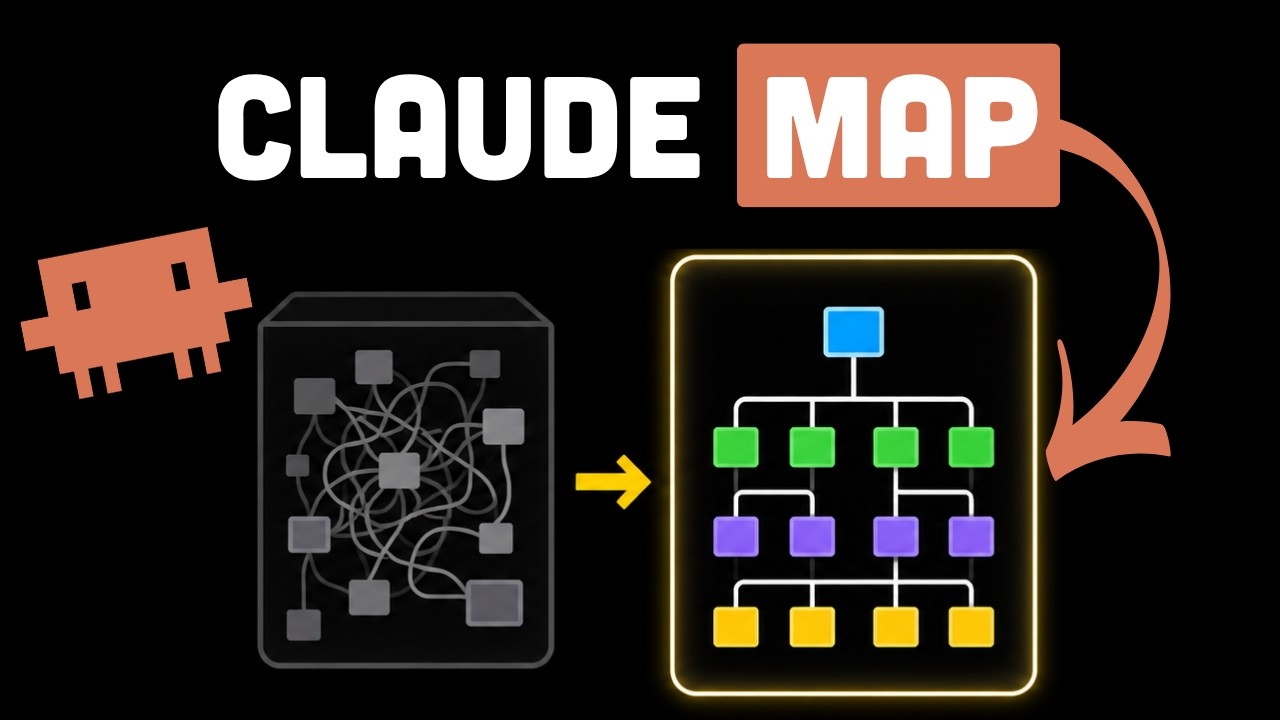
Graphs that teach > graphs that impress. Turn any code into an interactive knowledge graph you can explore, search, and ask questions about. Works with Claude Code, Codex, Cursor, Copilot, Gemini CLI, and more.

OmO: Just type "mass ulw" keyword with your prompt. Now you are the master of graph engineering.
Persistent Context Across Sessions for Every Agent – Captures everything your agent does during sessions, compresses it with AI, and injects relevant context back into future sessions. Works with Claude Code, OpenClaw, Codex, Gemini, Hermes, Copilot, OpenCode + More
Opinionated Oxlint rules for rejecting low-evidence TypeScript and JavaScript patterns
Teams-first Multi-agent orchestration for Claude Code