
JuliusBrussee/
caveman

🪨 why use many token when few token do trick — Claude Code skill that cuts 65% of tokens by talking like caveman
105k
1 add
Repowise builds a local index from your repository’s code, dependencies, git history, tests, documentation, and decisions. The index powers cited chat, code-health scoring, dead-code detection, change-risk analysis, generated docs, and MCP tools that agents can call while working in your repo.
Builders who want their agent to answer repository questions, assess change impact, and surface risky code from a local index.
You can ask an agent for repository-aware answers and change plans instead of making it rediscover the codebase from scratch.
Exposes task-shaped MCP tools for graph, git, docs, decisions, risk, health, and test impact so agents can query the index directly.
Scores files with deterministic detectors for defect risk, maintainability, and performance, then suggests concrete refactorings.
Finds dead code, bug magnets, blast radius, missing companion files, and likely tests for a diff or commit range.
Builds a structural wiki and decision pages from the indexed repository so answers stay tied to evidence.
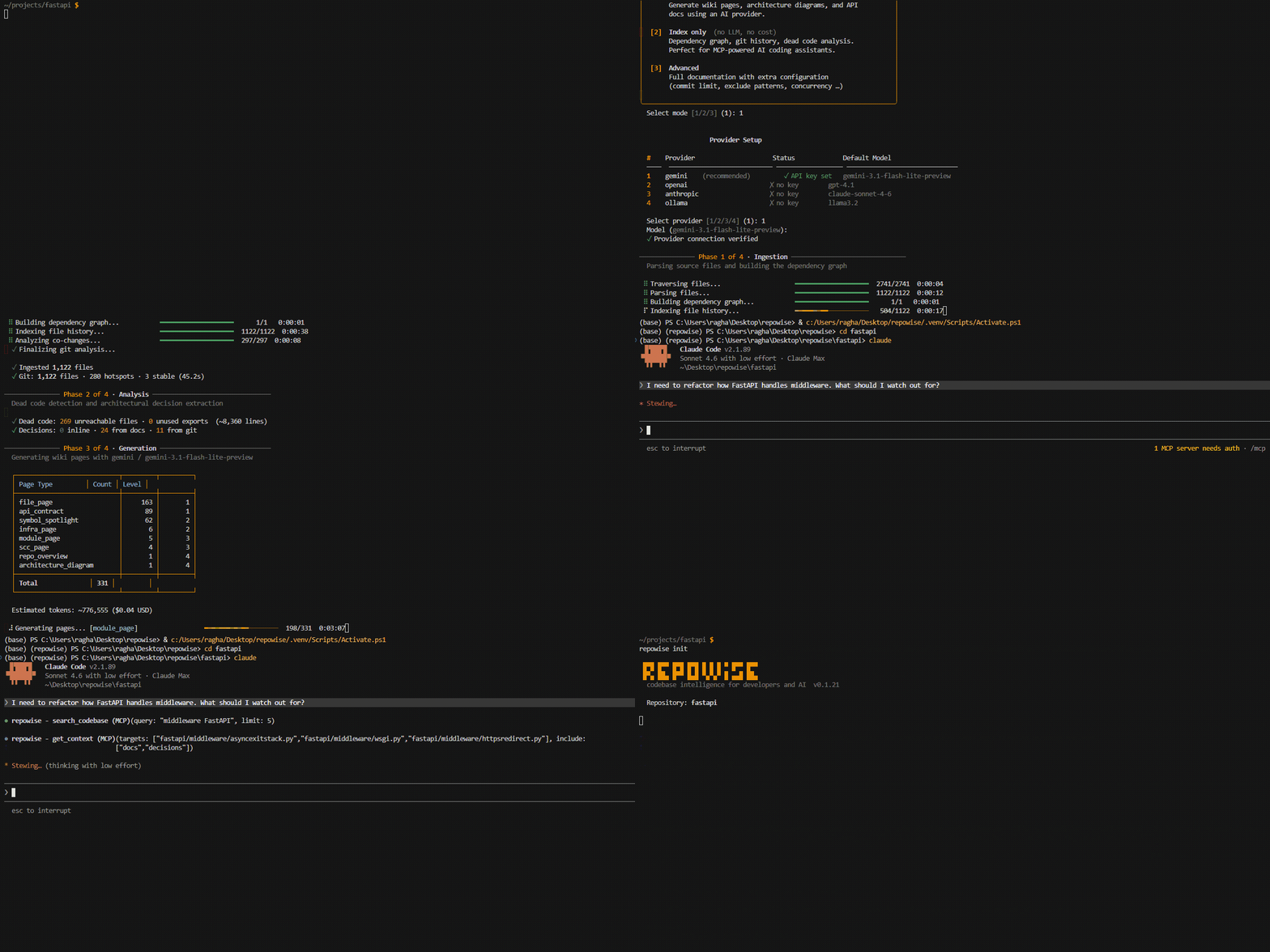
Uses git history, co-change, ownership, and cross-repo contract mapping to show how changes move through an estate.
Includes Claude Code and Codex plugins, a VS Code package, and web/dashboard views for working with the same index.
pip install repowise
cd /path/to/your/repo
repowise init --no-prose -y
repowise serve
repowise distill pytest          # 61% fewer tokens, all 11 failure lines kept
repowise distill git log -50     # 89% fewer tokens
repowise saved                   # what distillation saved you, in tokens and dollars
repowise impacted-tests main..HEAD   # only the tests this diff actually exercises
repowise health                      # untested hotspots, now graph-aware
repowise health                        # KPIs and lowest-scoring files
repowise health --refactoring-targets  # ranked, concrete plans
repowise health --trend                # snapshots plus declining-health alerts
pip install repowise          # Windows: python -m pip install repowise
repowise --version
cd /path/to/your/repo
repowise init
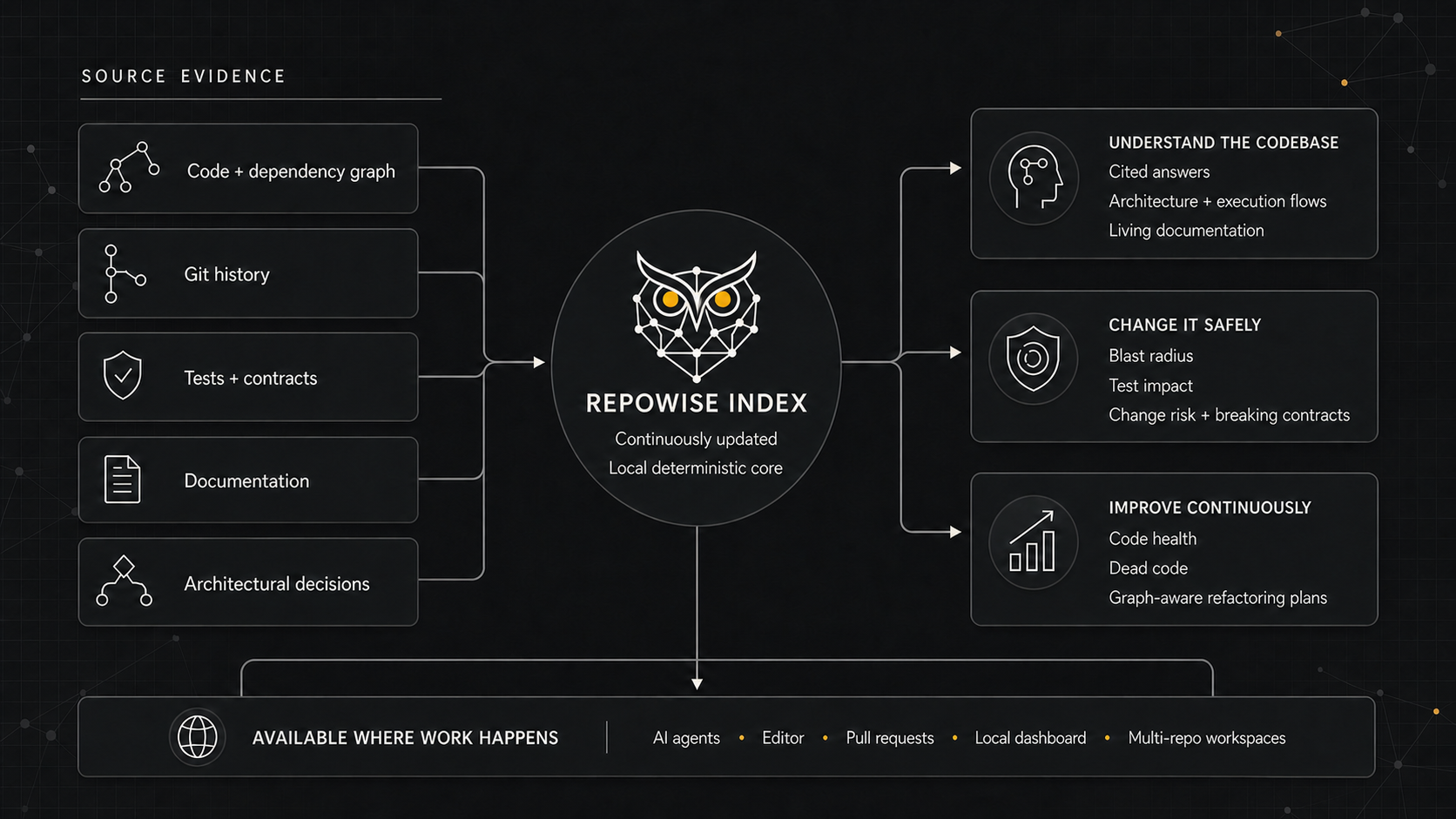
Repowise indexes your code, dependency graph, git history, tests,
documentation, and decisions once, then gives agents and developers cited answers,
change impact, and concrete code-health fixes.

−31.6% | 97.2% | 2.3× |
| less agent output 3.8 vs 7.2 tool calls n=43 · p<0.0001 | smaller context payload 393 vs 13,984 tokens 30 Flask commits | more defects surfaced same 20%-of-lines budget 2,770 files · p=0.003 |
Graph accuracy leader at matched coverage.
No tool finding as much was more precise in all 7 compiler-graded cells.
5 tools · 37,853 oracle edges
Zero LLM calls for graph, risk, health, tests, dead code, and PR review. Generated prose is optional. Every benchmark publishes its sample, method, limitations, and losing rows.
Free and self-hosted · core analysis stays on your infrastructure · no API key needed · AGPL-3.0 or commercial




Why Repowise · Agents · Changes · Code health · Workspaces · Evidence · Enterprise · Docs
| Understand the code | Change it safely | Improve it continuously |
|---|---|---|
| Ask cited questions · explore architecture and execution flows · read always-current docs · recover the decisions behind the code | See symbol-level blast radius · run only the tests a diff exercises · catch missing companion files · detect breaking contracts before merge | Find defect-prone files · separate maintainability from performance risk · remove dead code · hand concrete, graph-aware refactoring plans to an agent |
These are not disconnected scanners. The graph locates what git history flags; code health measures it; tests show what guards it; decisions explain why it exists; and the same evidence reaches your agent, editor, pull request, local dashboard, and cross-repository system map.
A dashboard tour recorded on this repository. The same local index powers the UI, MCP tools, editor views, and PR analysis. No API key and nothing uploaded.
| If you care about… | Start here |
|---|---|
| A coding agent that understands the repository | Repowise finds the right files, returns task-shaped context in fewer calls, and proactively supplies decisions and risk. For agents ↓ |
| Safer pull requests and faster test feedback | Get change risk, symbol-level callers, co-change partners, and a measured or graph-inferred test run list before merge. Change intelligence ↓ |
| Finding and fixing the code most likely to hurt you | A defect-validated 1–10 health score across defect risk, maintainability, and performance, followed by the concrete refactoring plan. Code health ↓ |
| Understanding an estate, not one repository | Match backend and frontend contracts, catch breaking providers, map downstream services, enforce architecture rules, and query every repo through one MCP endpoint. Workspaces ↓ |
| Rolling this out across an engineering organization | Keep analysis on your infrastructure, give agents and reviewers the same evidence, and add commercial licensing, security controls, custom extensions, and SLA-backed support. Teams and enterprise ↓ |
pip install repowise
cd /path/to/your/repo
repowise init --no-prose -y
repowise serve
That builds the graph, git, decisions, health, dead-code and structural-wiki layers
locally. Connect Claude Code, Codex, Cursor or any MCP host, or open the dashboard.
init wires Claude Code automatically. Then ask your agent: "Use Repowise
get_overview to summarize this repository" or "What breaks if I change
src/auth.py?"
Full setup, every agent, and optional model-written prose →
Every question your agent asks about a repository has an answer that could have been computed ahead of time. Who calls this function? What breaks if I change it? Why is it written this way? Which files are actually dangerous? Without an index, the agent rediscovers that answer on every task: grep, read, re-read, forget.
Repowise exposes ten task-shaped MCP tools to Claude Code, Codex, Cursor, VS Code and anything else that speaks MCP: graph, git, docs, decisions, and ten MCP tools behind one index. See the canonical surface. Most tools are built around data entities (one file, one symbol), which forces agents into long chains of sequential calls. These are built around tasks: pass several targets in one call, get complete context back.
Because the exploration work is already done, that phase mostly disappears. In a
measured agent loop across 43 questions on django/django, Repowise cut the agent's
own output by 31.6% (p<0.0001) and reached the answer in 3.8 tool calls
instead of 7.2. That is the end-to-end result.
One mechanism is much larger but narrower: loading a commit's context through
get_context costs 393 tokens instead of 13,984, or 97.2% less. That is one
retrieval payload, not a claim of 97.2% total agent savings. Both measurements and
every competitor row are published in the benchmark report.
And it arrives without being asked. Optional hooks push
context into the session at the moment it matters: the governing architectural
decision when your agent edits a file that decision covers, a warning when it touches
a file with a run of recent bug fixes, a compact briefing at session start. Repowise
also generates your CLAUDE.md and AGENTS.md from the real index, so even an agent
with no MCP support starts informed.
It learns from how you actually work. Repowise reads your own agent transcripts for the corrections you keep making ("use the shared HTTP client, not raw requests") and turns the durable ones into tracked decisions it delivers back later. The wiki generation budget tilts toward the modules you and your agent ask about most. All local, all deterministic, no extra LLM calls.
| Foundation | What it contributes |
|---|---|
| Graph | File + symbol dependencies across 25 AST-parsed languages, confidence-stamped call resolution, communities, centrality, cycles, and execution flows |
| Git | Hotspots, ownership, co-change, bus factor, and bug-fix history: behavioral signals static analysis cannot see |
| Docs | A wiki for every module and file, rebuilt incrementally with freshness and confidence scoring plus hybrid search |
| Decisions | Architectural rationale mined from five index-time sources plus human and agent capture, each claim traced to evidence |
| Code health | 49 deterministic detectors across defect risk, maintainability, and performance, followed by concrete refactoring plans |
The structural wiki needs no model. Model-written prose is an optional upgrade, one page or directory at a time. Six of the seven decision sources are deterministic too; only comment archaeology needs a provider.
Most of what an agent reads back from a shell command is noise: 300 lines of passing
tests wrapped around 4 failures, full commit bodies when it asked "what changed
recently". repowise distill <cmd> compresses command output before the agent reads
it, errors first, exit code preserved.
repowise distill pytest          # 61% fewer tokens, all 11 failure lines kept
repowise distill git log -50     # 89% fewer tokens
repowise saved                   # what distillation saved you, in tokens and dollars
Nothing is lost. Every omission leaves an inline [repowise#<ref>] marker that
repowise expand <ref> reverses in full, so the agent can always pull the detail back
without re-running the command. Small outputs pass through untouched. An opt-in hook
rewrites noisy commands automatically, shown to you for approval first.
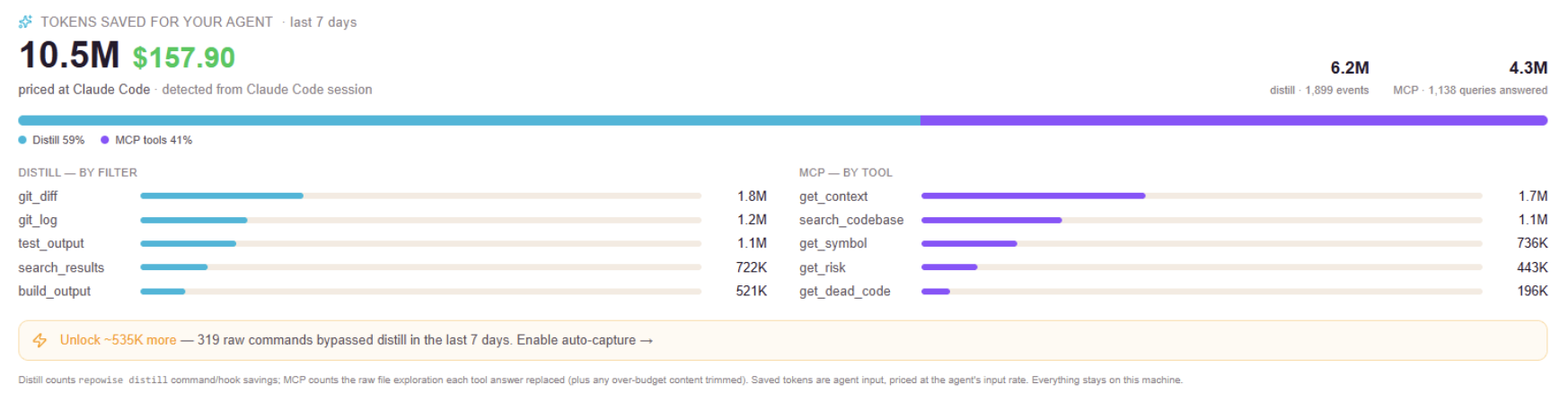
The Costs dashboard tallies both savings surfaces, priced at your own agent's model. Example from a week of heavy local use.
Full guide: docs/agent/DISTILL.md →
Four deterministic signals, all computed from the graph and git history, no LLM:
base..HEAD range 0-10 from the shape of
the diff, ranked against your repo's own recent commits. PR mode returns directives
rather than vibes: may_break, missing_cochanges, missing_tests, tests_to_run.
One command: repowise risk main..HEAD. (reference →)same file, or a co-change pair with the commit
counts behind it), and whether the diff in front of you is one change or several
groups the index links nothing between. Both stay quiet when there is nothing to
report. repowise overlap and repowise risk.
(reference →)Plus the free Repowise PR Bot, which puts all of it on every pull request. Zero LLM calls.
Ingest LCOV, Cobertura or Clover and you get the measured answer. Most repositories never produce one, so the graph answers instead: a test file that imports a source file reaches it, which is a recorded edge rather than the name-shaped guess everything else falls back to.
That fallback fails in both directions, and this repo is the proof. Five of its six worst bug-magnet files have no test named for them and read as untested while the graph names 3 to 23 test files each. The sixth is worse: matching on basename paired the health engine with the distill engine's tests and called it tested.
repowise impacted-tests main..HEAD   # only the tests this diff actually exercises
repowise health                      # untested hotspots, now graph-aware
Dogfooded against a real coverage run --contexts=test:
95.7% precision on what reaches a file and 97.5% on the
run list, at a 100% hit rate, against 72.1% and 94.8% for the one-hop
import walk this replaced. The two tiers are never averaged: rows are stamped
basis: "measured" or "inferred", measured wins outright
where both can answer, and the inferred tier may never produce a percentage.
Sound as a floor, unsound as a quantity, and labelled so.
Test intelligence →
Install the GitHub App and the index shows up where the decision actually gets made. One comment per pull request, edited in place on every push rather than reposted, and a green PR gets no comment at all.
See a real comment on a real PR, not a mockup: repowise-dev/repowise#1204.
What decides a review is inline. What is context sits behind one fold, so the comment stays about seventeen rows whatever it finds.
Markdown runs out. The comment shows three callers and says "+6 more"; the page shows all nine. Public, no sign-in, on a repository the reader has never seen.
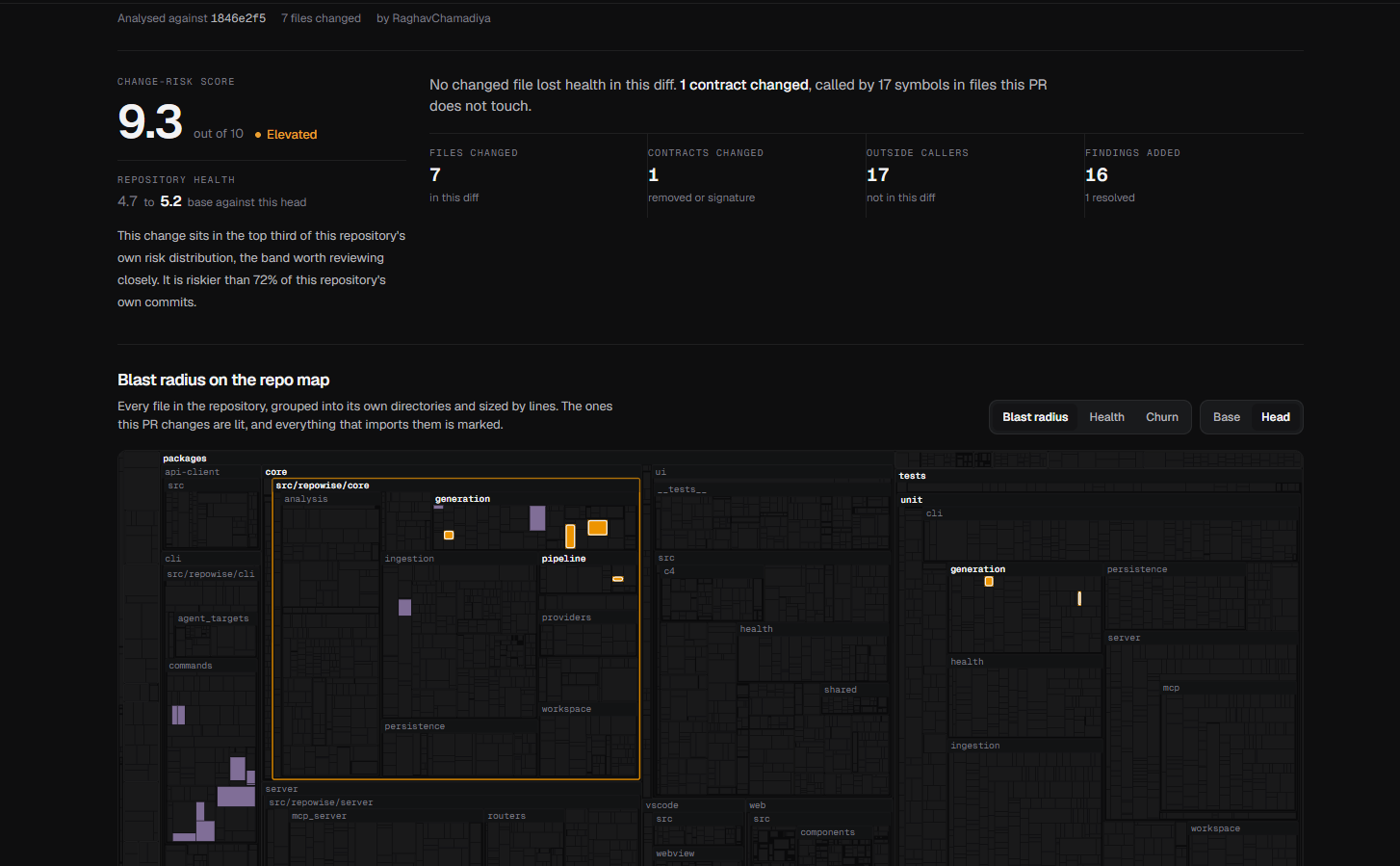
The page leads with change risk and newly introduced findings, then maps every changed file and outside caller across the repository. See it live →
Install the PR bot → · how it works →
A score that says "this file is risky" is where most tools stop. Repowise scores every file, locates where the risk concentrates, and then names the specific fix.
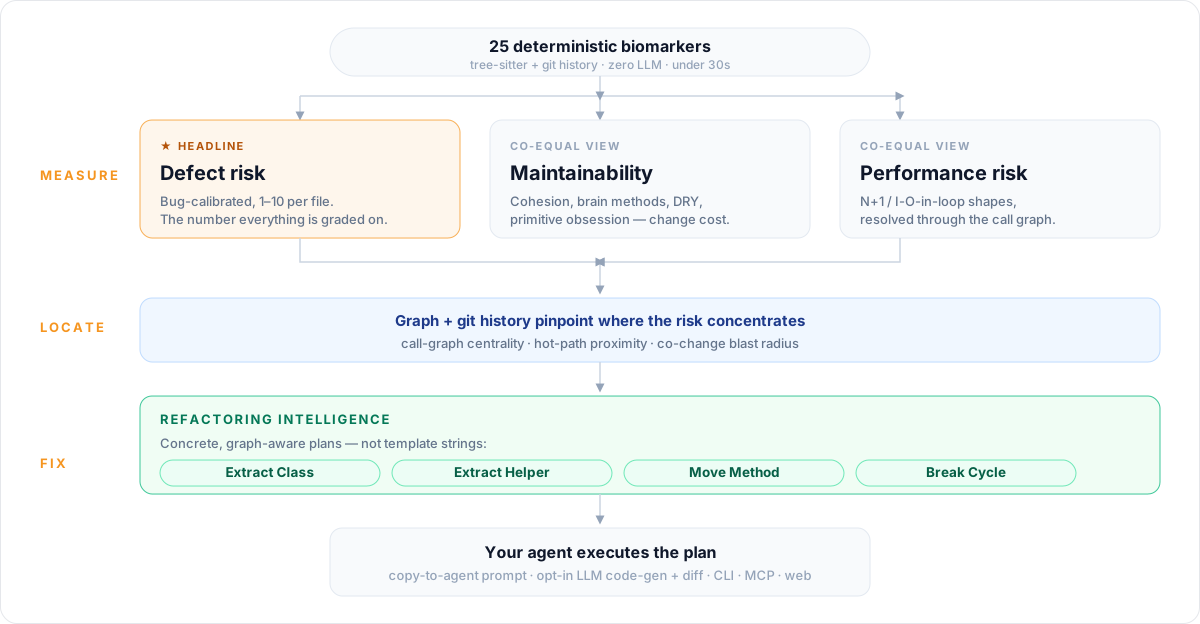
Every file is scored 1-10 by 49 deterministic detectors (McCabe complexity, brain methods, LCOM4 cohesion, god classes, native Rabin-Karp clone detection, untested hotspots, change entropy, prior-defect history and more), split into three lenses: defect risk, maintainability, and performance: static N+1 and I/O-in-loop risk traced across files through the call graph, where file-local linters found 0 of the cross-function cases and repowise surfaced ~90. Only 26 of the 49 are permitted to move the defect number, because that is the number carrying published accuracy claims.
Zero LLM calls, zero cloud, zero new runtime dependencies. Pure Python over tree-sitter and git data, under 30 seconds on a 3,000-file repo, a budget enforced by a CI test, not an estimate. Marker weights are calibrated against a real defect corpus, not hand-tuned: every file scored at a commit preceding the bug window so nothing leaks backward, and an L2-logistic fit with file size as an explicit control, so a marker only earns weight for defect lift beyond being big. Only the learned constants ship.
It proves itself on your repo, not just on a benchmark. After every index, Repowise checks its own flags against your git history and reports what it found: "16 of the 20 lowest-health files had a bug fix in the last 6 months, 3.3x the 24% baseline." If that number is bad on your codebase, you will see it. (It is an association on your indexed history, not a forward prediction, the leakage-free version is in the benchmarks.)
Then it names the fix. Not "this class is too big", but Extract Class, Extract Helper, Move Method, Break Cycle, Split File, or Extract Method, with the exact methods, edges and symbols that move, the blast radius of callers and co-changing files that have to move with them, and a graph-aware ranking so a fix on a central hub outranks the same fix on a leaf. Extract Method goes down to an intra-procedural dataflow pass that lifts the exact span and infers a behavior-preserving signature.
repowise health                        # KPIs and lowest-scoring files
repowise health --refactoring-targets  # ranked, concrete plans
repowise health --trend                # snapshots plus declining-health alerts
The dashboard renders each plan as a card with a copy-to-agent button. An optional LLM step, never in the indexing path and only on request, expands any plan into generated code and a unified diff.
Validated on 21 open-source repos across 9 languages (2,826 files, scored at a fixed point and checked against the following 6 months of bug fixes, keyword-labelled): ROC AUC 0.737 [0.683, 0.787]. The signal is correlated with file size and weakens sharply within a fixed size band, which we report rather than bury. Independently recomputed from the raw data.
Against CodeScene, the leading commercial code-health tool, on the same 2,770 files and the same defect labels, ranking by repowise health surfaces 2.3x the defects under a fixed review budget (paired, p = 0.003). Full head-to-head, methodology and limitations →
Guides: code health · refactoring
repowise serve starts the full web dashboard next to the MCP server. No separate
setup, all local.
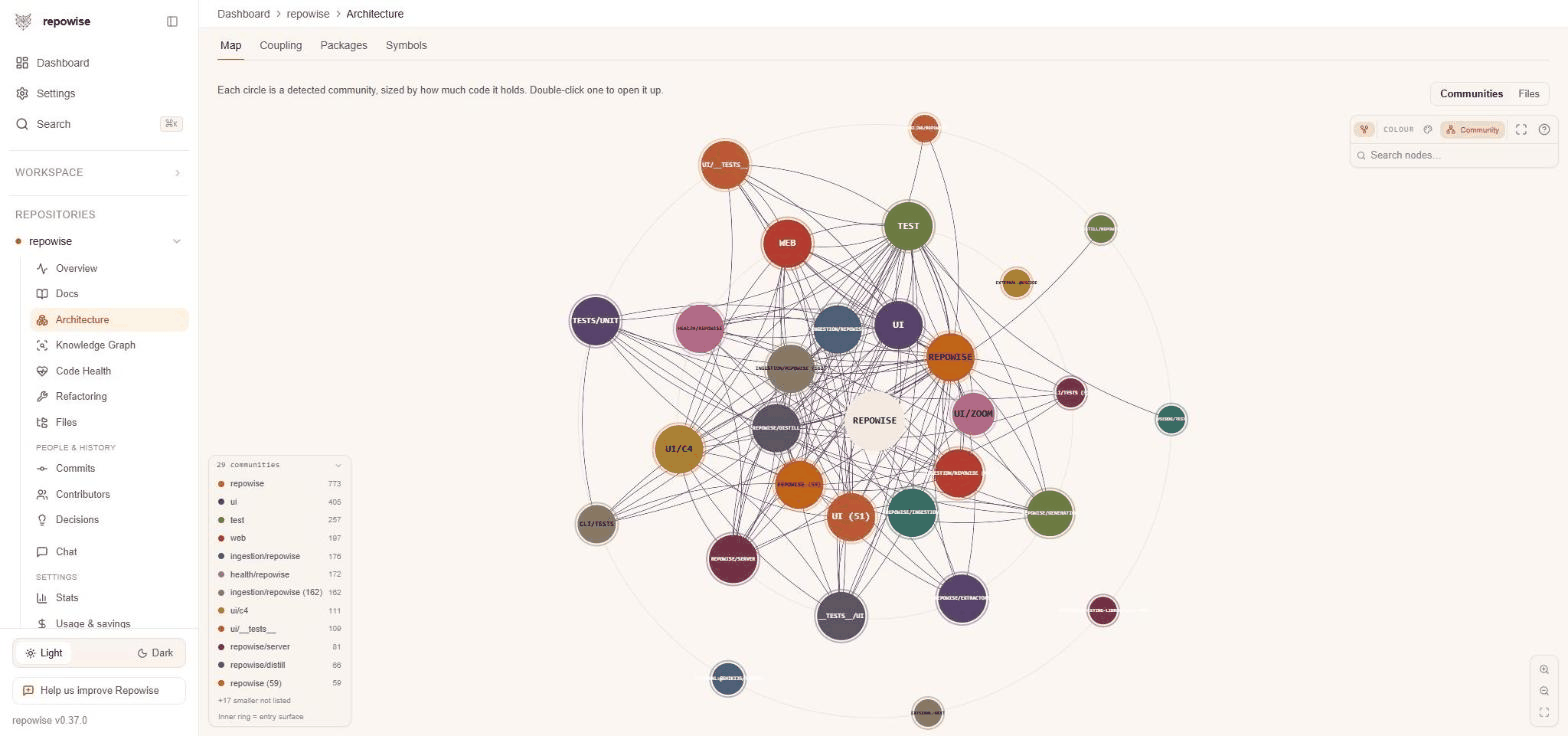 Architecture · the dependency graph, laid out and explorable, with per-node context and change coupling | 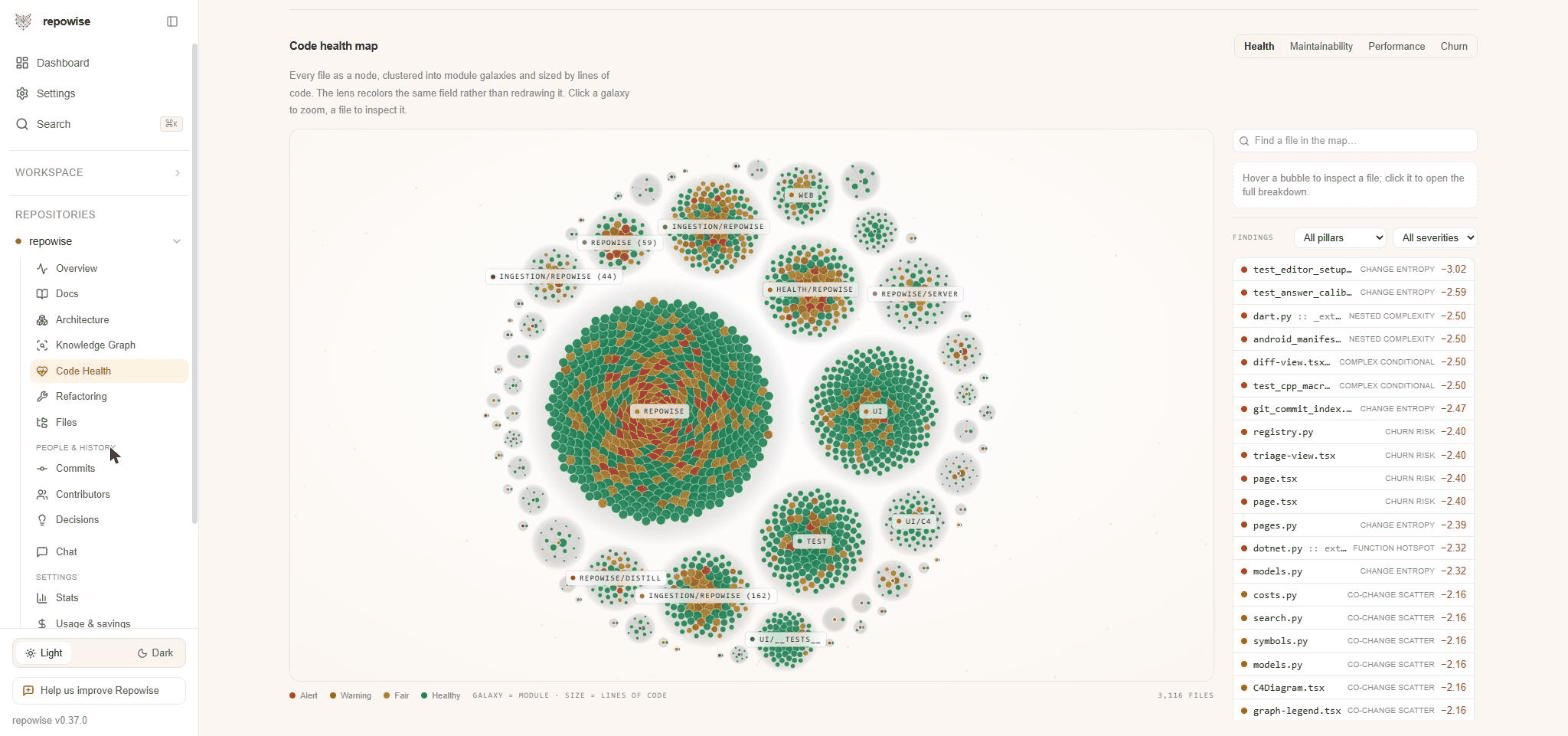 Code Health · every file as a bubble, hover any one to inspect its score, size, coverage and findings |
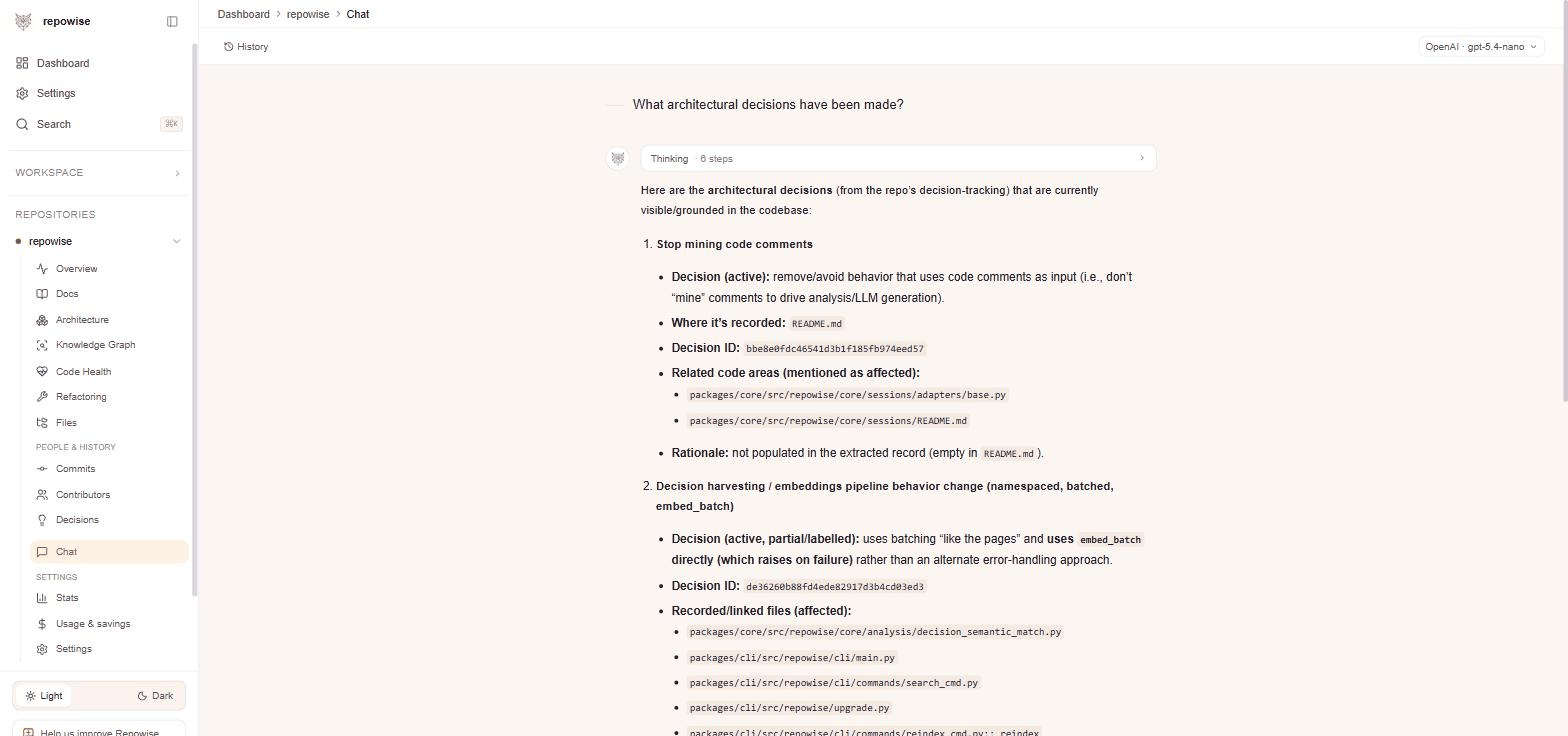 Chat · ask the codebase a question, answers cite the files and pages they came from | 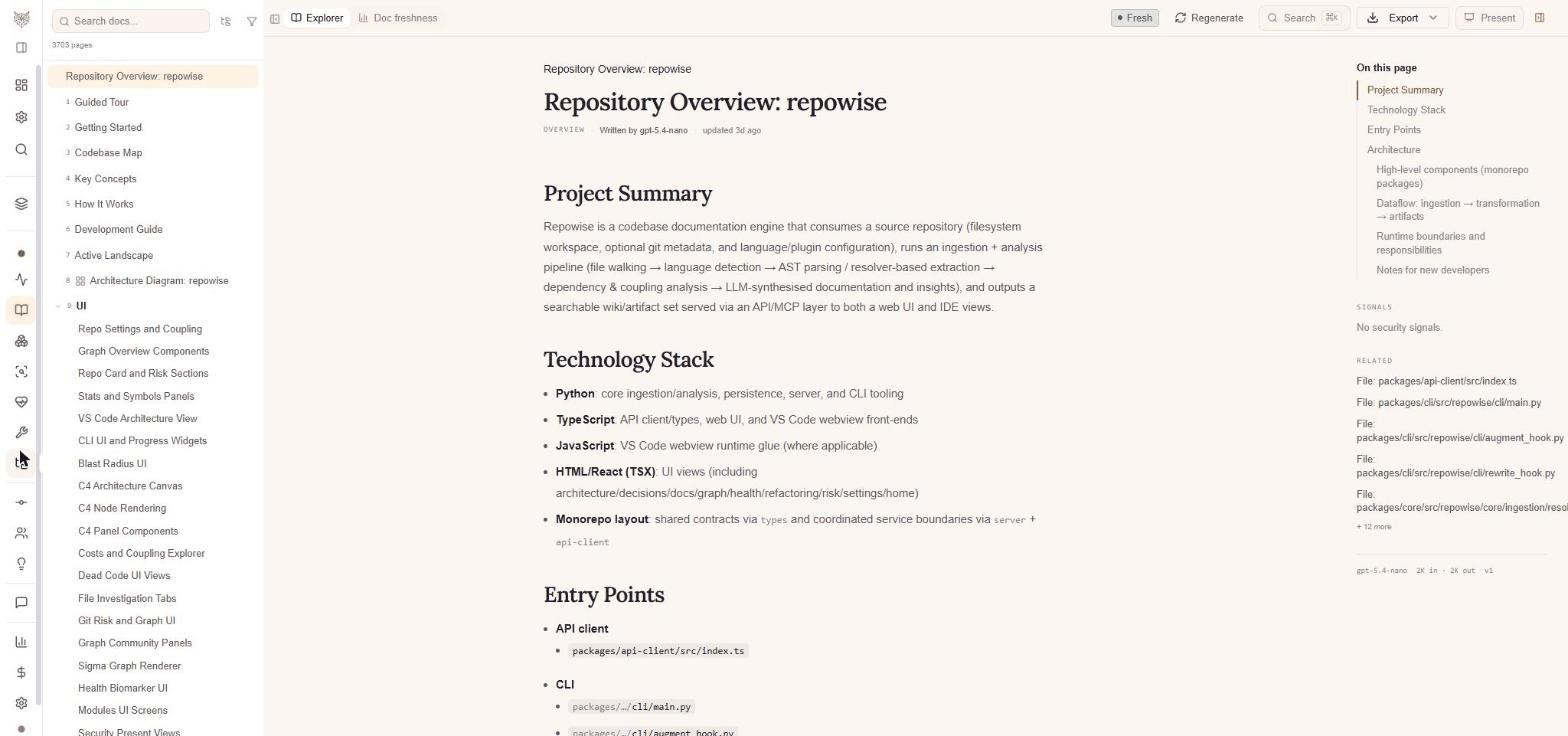 Docs · auto-generated wiki pages for the whole codebase, with confidence and freshness badges |
Also in there: Chat (ask the codebase in natural language) · Docs (the generated wiki, with Mermaid and a graph sidebar) · Architecture and C4 (Context → Containers → Components) · Knowledge Graph plus a zoomable canvas map · Risk, Hotspots, Coupling and Blast radius · Contributors · Decisions (evidence drawer and evolution timeline) · Symbols · Security · Dead code · Stats · Costs · Workspace.
Every view and what each one answers: docs/start/DASHBOARD.md →
Real systems are not one repository, and the expensive failures live in the gaps between them. Change a backend contract and Repowise can name the frontend calls that consume it, the services downstream, the historical companion files missing from the change, and the architecture rule the new dependency violates before it ships.
| Workspace intelligence | What it answers |
|---|---|
| Contract map | Which services provide and consume each HTTP, gRPC, event, socket, and data contract? Links retain exact/candidate confidence and the source evidence. |
| Cross-repo blast radius | If this provider changes, which downstream services will break through structural dependencies, and which ones may drift through historical co-change? |
| Breaking-change guard | Was an endpoint removed or a typed contract changed incompatibly, and which exact consumer files call it? |
| Test impact | Which tests in the consumer repos should run for this provider change, measured from coverage or inferred from the |
Sign in to join the discussion.
No comments yet. Be the first to say what this is good for.
🪨 why use many token when few token do trick — Claude Code skill that cuts 65% of tokens by talking like caveman

The best-benchmarked open-source AI memory system. And it's free.

Orca is the ADE for working with a fleet of parallel agents. Run any coding agent with your own subscription. Available on desktop, mobile and remote runtime.
A cross-platform desktop All-in-One assistant for Claude Code, Codex, OpenCode, OpenClaw, Grok Build & Hermes Agent. Only official website: ccswitch.io

Never stop coding. Free MIT AI gateway: one endpoint, 352 providers (150+ free), 1200+ models Kimi, Claude, GPT, Gemini, GLM, DeepSeek, MiniMax. Works with Claude Code, Codex, Cursor, OpenCode, Cline & Copilot. Quota-aware auto-fallback, RTK+Caveman compression saves 15-95% tokens, MCP/A2A, Desktop/PWA. Built by 550+ contributors

Compress tool outputs, logs, files, and RAG chunks before they reach the LLM. 20% fewer tokens for coding agents, 60-95% fewer tokens for JSON, same answers. Library, proxy, MCP server.