

affaan-m/
ECC

affaan-m/ECCHarnesses
The agent harness performance optimization system. Skills, instincts, memory, security, and research-first development for Claude Code, Codex, Opencode, Cursor and beyond.
258k
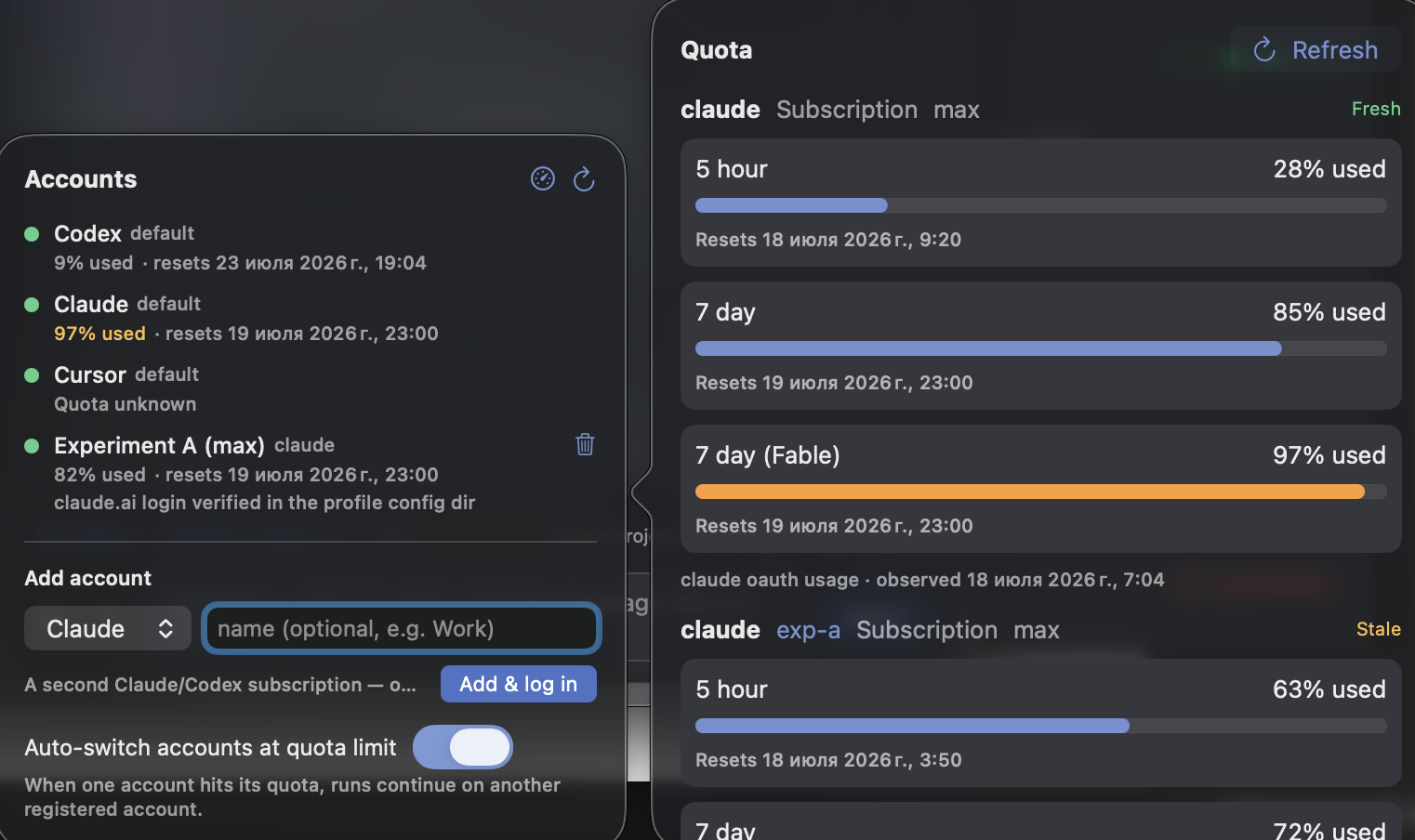
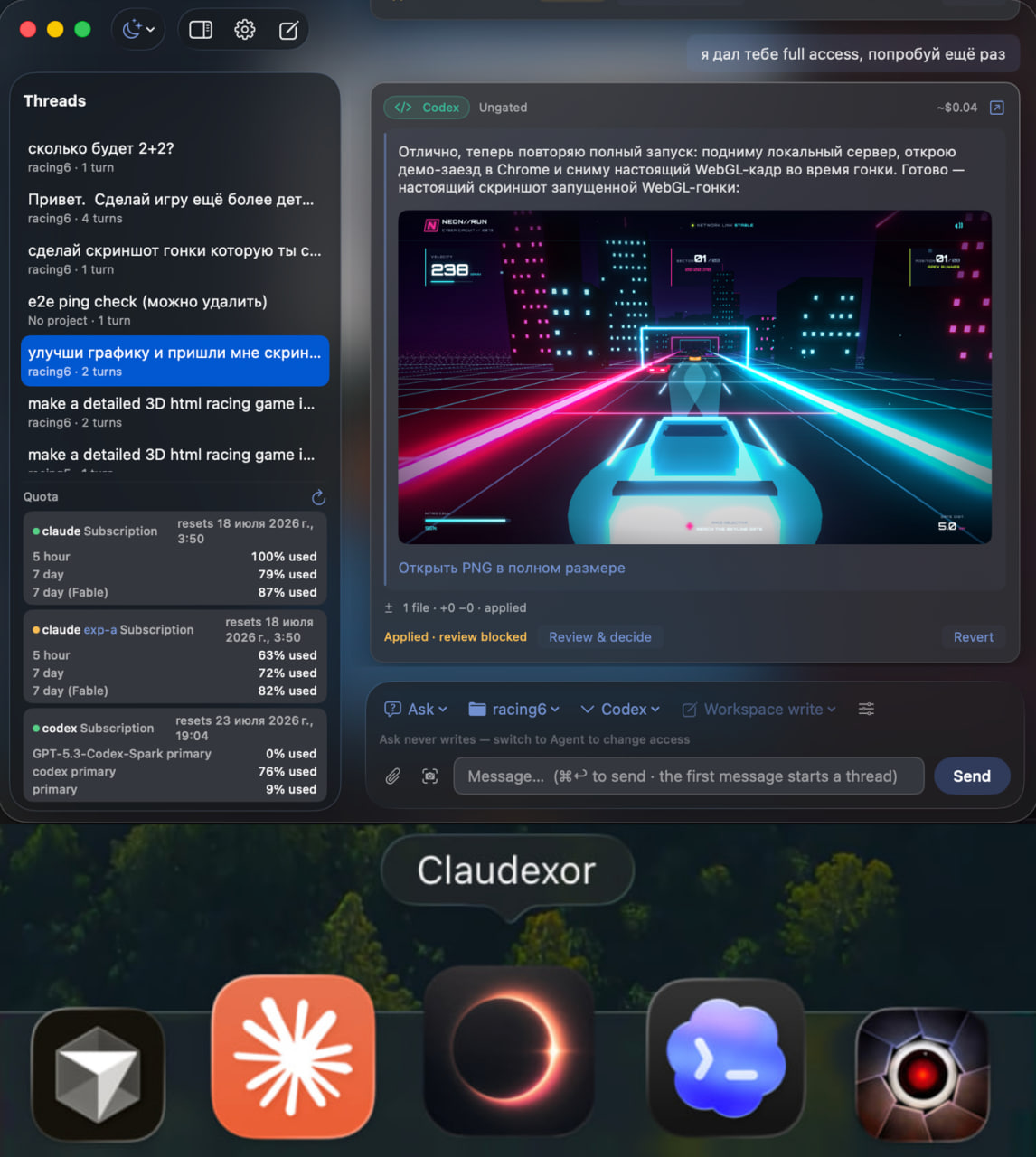
Claudexor routes agent turns through multiple harnesses, keeps thread context across sessions, and can switch accounts when a quota is spent. It also supports best-of-N runs, review panels, and audit-friendly run artifacts so you can compare model output and apply changes with more control.
Builders who want their agent work spread across Claude Code, Codex, and Cursor with shared context and quota-aware rotation.
You can keep working across multiple agents without re-explaining context or manually juggling subscriptions.
Tracks live subscription usage and can move work away from a spent account when vendor limits are hit.
Keeps a thread of turns and hydrates later runs with the prior context for the same lane or account.
Runs review panels across different harnesses so one model can critique another model’s patch.
Runs multiple candidates in parallel, then reviews, synthesizes, and arbitrates the result.
Injects a scoped MCP belt so a harness can spawn bounded sub-runs without gaining apply or settings control.
Stores typed facts, patches, and evidence on disk so runs are inspectable and auditable.
npm install -g claudexor
claudexor doctor






Claudexor is a local-first control plane for the AI coding agents you already pay for. It runs Codex CLI, Claude Code, Cursor CLI, OpenCode, Antigravity CLI, and raw API adapters behind one typed interface: a chat of turns where read-only questions resume the vendor's own native session, write turns land as inspectable patches, races pit harnesses against each other with cross-family review, and every claim — cost, quota, web evidence, auth route — is a typed fact you can audit, never a vibe.
Compared to driving a bare Codex or Claude Code session, Claudexor adds the
layer the vendors do not ship: best-of-N races with independent reviewers and
arbitration; honest budget/quota accounting (unknown cost is never $0);
deterministic gates and protected paths; and — since 2.1 — credential
profiles: named Antigravity/Claude/Codex/Cursor subscription bindings side
by side, each with Claudexor-scoped state and platform-declared credential
custody. Live subscription-quota tracking — and the opt-in policy that rotates
a spent account out of the way on typed vendor limits — covers the harnesses
with a vendor usage source (Antigravity, Claude, and Codex); Cursor has none
yet. Everything runs on your machine, files are the source of truth, and there
is no telemetry.
Current status: v3.10.2. See "Stability at 2.0" below for what is a stable contract and what remains experimental; retired verbs and mode ids hard-error with the new spelling instead of silently aliasing.
Claudexor also runs as the exact-pinned delegated execution layer inside Ouroboros, a persistent self-developing agent. Ouroboros owns its tasks, memory, review, and final integration. Claudexor runs the connected coding harnesses and returns durable execution evidence. See Ouroboros in action.
Embedding callers can also make a single model request through a managed Codex subscription, using the same account as Agents. The caller supplies its own system prompt and tools and executes those tools itself. This is a typed engine operation, not a public OpenAI-compatible server or a second agent loop. Model catalogs and context limits are account-specific; subscription access does not guarantee zero incremental charges or enable provider-paid credits. See model operations for the transport, retention and unsupported-parameter contract.
Thanks to Praxis Relay and CLIProxyAPI for prior work exploring subscription-backed model transports. They informed this design; neither runs as an embedded relay or owns credentials in this integration.
If you use Claudexor — or you are an agent whose human does — a star is the one-click way to say it works.
corepack enable pnpm)codex, claude, cursor-agent,
opencode, or agy (Antigravity, for a Gemini subscription) — OR a
provider API key (adapters accept OPENAI_API_KEY,
ANTHROPIC_API_KEY, ... as fallbacks; the raw-API route needs only a key).
Log in through Claudexor, not the bare vendor CLI — see
Install And LoginCLI + daemon from npm (installs the claudexor and claudexord bins):
npm install -g claudexor
claudexor doctor
You can also build from source — see Quickstart below.
On a Mac, the app is the easiest way in — it ships as a signed and notarized DMG, so it installs like any ordinary Mac app, with no Gatekeeper warnings:
Claudexor-<version>.dmg from
Releases.Claudexor.app into Applications.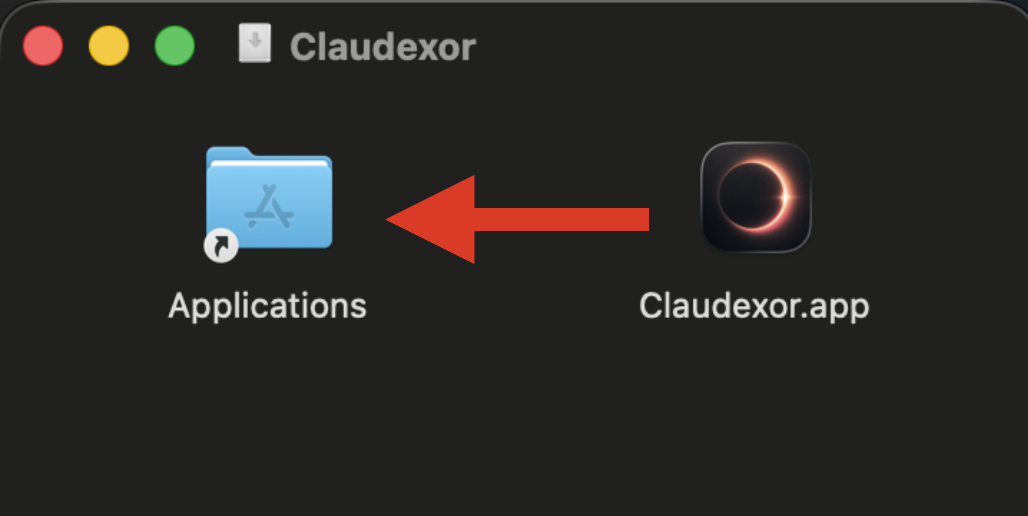
The app bundles its own daemon runtime and starts it on launch; installing the Claudexor CLI is only needed for terminal use. Git and vendor harnesses remain separate capabilities checked before a run starts. (The v1.0.0 DMG was unsigned — if you kept it, either upgrade or approve it via System Settings → Privacy & Security → Open Anyway.)
Host integrations may install one vendor CLI into Claudexor's managed local
toolchain with
claudexor harness install <harness> --target local --yes --json; a host may
bind that explicit unattended authorization to the user's Connect action.
Exact npm pins install under ~/.claudexor/node; Cursor remains unpinned, so
the JSON receipt records the downloaded installer's SHA-256 and byte length.
Every successful executed receipt also records the absolute installed launcher
and its verified version; a zero-exit installer without that postcondition is a
typed failure.
Omitting --target preserves the disclosed remote-host flow, its prefix and
its exit-code contract; the install lease and the post-install proof are part
of the unattended local contract and do not apply there.
The macOS app can run a thread on a Linux or macOS SSH host while keeping the
UI local. In Settings → Connections, pick a concrete alias from
~/.ssh/config or create one in-app — the form appends a plain Host block
to ~/.ssh/config (after a timestamped backup), never a key or password.
Connect it, then choose a saved folder or Browse on <host>… from the
project picker. The thread is permanently bound to that
host and folder; changing either creates a new draft.
Claudexor uses the system /usr/bin/ssh, so existing keys, ssh-agent,
known_hosts, MFA and ProxyJump remain OpenSSH's responsibility. On first
connection the app verifies and installs a signed, no-sudo runtime under
~/.claudexor/remote/, then reaches its loopback-only control API through an
SSH local forward. Vendor CLIs and their credentials remain on the server and
with the vendors. Claudexor can install a harness CLI on the host for you
through a disclosed, exact-pinned flow — claudexor harness install, or
Settings → Harnesses for a connected host: Claude, Codex, and OpenCode
install one exact pinned npm version, while the Cursor and Antigravity vendor
scripts are downloaded in full and run in the visible terminal where you watch
them; nothing executes before the exact package/version/destination install
recipe is disclosed and confirmed. An embedding host may instead pass
--target local --yes, which installs into the managed toolchain root and
must prove the launcher it installed before reporting success.
(Installing them on the host yourself works too.) Then sign in from the app,
which runs each vendor's own login in an embedded SSH terminal (Codex uses
device auth). Remote threads include an embedded SSH terminal and an
explicit-port preview tunnel.
v3.8.0, v3.9.0 and v3.9.7 release exceptions. These owner-authorized releases omit the three custom Ed25519 documents rather than publishing unsigned substitutes. Existing app installs therefore cannot take the in-place engine update to those versions, and the app cannot perform a first-time remote bootstrap from those releases. A fresh signed/notarized DMG, npm packages, and reviewed exact-pin embedders remain usable; normal releases keep the signed-manifest path below fail-closed (the client verifiers themselves stay fail-closed for the waived versions too).
claudexor-runtime-<version>.tar.gz
closure (the bundled daemon and CLI, setup-login runner, Browser MCP, and native
process-identity helper; Node, UI, and icons stay outside it) plus a signed
runtime-manifest.json describing it. On foreground and from the bottom-left
update chip / Check for Updates, the app reads that manifest and, if a
newer runtime is offered, surfaces "Update available → vX.Y.Z". One click
installs it in place, no new DMG: the app downloads the closure, verifies
its SHA-256 against the signed manifest, unpacks it under
~/.claudexor/runtime/versions/<version>/, probe-starts it, waits until the
engine is idle (it never interrupts running jobs), stops the daemon, swaps the
active pointer atomically, relaunches, and re-checks the version — rolling back
to the last-known-good runtime on any failure. The manifest is signed by a
dedicated offline key the app pins; an unsigned, unknown-key, tampered, or
downgraded manifest is refused. Node stays app-owned, so a Node bump still
ships a new signed DMG. There is no background update timer; the check runs
only when you open the app or click Check for Updates. The manifest's
minAppVersion floor means an app that is too old is told to update the app
itself rather than offered an incompatible engine.claudexord.bundle.cjs, invokes operational commands through the adjacent
claudexor.bundle.cjs, verifies --probe against the pinned
{version,buildSha}, and uses
--stop <observed-version> <observed-buildSha> before replacing a live
closure. This is an extraction/daemon-bootstrap contract, not a claim that
every harness or interactive login path has feature parity on Windows. The
signed manifest is the upstream publication authority used to form that pin;
a host may verify it live or rely on its reviewed exact
URL/buildSha/SHA-256/size pin.
minAppVersion remains the macOS app's compatibility field; embedders keep
protocol, one tested Node toolchain, and separate daemon/CLI entrypoint bounds in their pin instead
of creating a second Claudexor manifest or trust root. Start and stop must use
the same CLAUDEXOR_CONFIG_DIR and, when overridden,
CLAUDEXOR_DAEMON_SOCK, or the lifecycle command may address another daemon.
A Windows consumer still owns a native
extract/--probe/handshake/--stop smoke before claiming Windows support.
The local harness installer is intentionally typed-unsupported on Windows in
this release. On POSIX, npm-backed local installation additionally requires
<node-root>/lib/node_modules/npm/bin/npm-cli.js; Claudexor never falls back
to a npm found on ambient PATH.npm install -g claudexor@latest. claudexor release check reports whether a
newer engine runtime is published, verifying the same signed manifest
fail-closed (npm users update via npm).pnpm install --frozen-lockfile
pnpm build
# Run the CLI from the repo (or add an alias/PATH entry for it):
node packages/cli/dist/cli.js doctor
alias claudexor="node $(pwd)/packages/cli/dist/cli.js"
claudexor ask "2+2?"
claudexor ask "google the latest release notes" --web auto
claudexor ask --deep-scan "map this repo's auth and run storage"
claudexor agent "fix the failing auth refresh test" --harness codex
claudexor best-of "fix add() and keep the patch minimal" --harness codex,claude --n 2
claudexor inspect <run_id>
claudexor follow <run_id> # live event tail of a daemon run; answers questions in the TTY
claudexor apply <run_id> --dry-run
claudexor doctor
claudexor secrets list
claudexor daemon start
apply --dry-run checks final/patch.diff with git apply --check and does
not mutate the repo. Unknown flags and invalid --access/--web/--effort
values fail loudly with exit code 2 — a typo never silently runs with defaults.
When deterministic gates protect existing test/package surfaces and the task is
explicitly test-authoring work, use --allow-protected-path <glob[,glob...]> to
record typed per-run approval for those protected gate/test path changes. This
does not bypass built-in critical/security human gates.
Ordinary Agent runs skip internal model review by default, whether the executor is pinned or selected automatically. Completed changes remain normally applicable and show Not reviewed; required checks and patch-integrity checks still apply. Ask and Plan reject these Agent-only controls; Council is Plan's critique path:
Review — --review enables automatic panel selection. Best-of and
--until-clean include review. Explicit --attempts N keeps its review-based
repair default; --no-review --attempts N repairs against configured checks
and work completion without model reviewers.
Reviewers — pick exactly who reviews a change. Pass --reviewer-panel a
comma-separated list of unpinned harness=model:effort entries (model and
effort are optional); repeat a harness to review through several models. For
a deterministic account per slot, use the round-trippable
--reviewer-panel-json '<array>' form with credentialProfileId. Example:
--reviewer-panel-json '[{"harness":"claude","model":"claude-fable-5-1","credentialProfileId":"review-claude"}]'.
An omitted profile uses the canonical account pool; a named profile is strict
and never silently falls back. An explicit panel or reviewer model/effort
override enables review without another flag. With --review and no panel,
the engine chooses a cross-family panel and discloses families it skips.
Approvals — mark paths that must clear a human before a change touching
them can be applied. Set canonical repo-relative globs in the versioned
.claudexor/config.yaml (empty by default):
version: 1
constraints:
  protected_paths:
    - migrations/**
    - "**/*.env"
Creating, modifying, deleting, or renaming a matching path completes the run
but pauses apply for a human decision. --allow-protected-path applies only
to engine-derived gate/test paths and cannot suppress these project rules.
Before a mutating turn starts, a live project thread with configured project
protected paths is promoted one-way to its persistent isolated worktree. The
run and patch therefore complete without touching the project tree; only the
existing typed thread Apply decision can deliver the accumulated change.
Direct one-shot --in-place agent runs refuse and name the isolation remedy.
Canonical mode ids (engine strategies are FLAGS, not modes):
ask - read-only answer/explanation route. --deep-scan widens it into
the bounded multi-scout research sweep with synthesis (per-scout findings,
omissions, follow-up questions). Also the macOS composer's no-project
fallback intent (Agent is the default on a project thread).plan - read-only planning; the plan lifecycle surfaces typed open questions
and Implement freezes the plan as a content-hashed contract. Solo is the
default; --council (optionally --n 2..4) drafts plans across N harnesses in
parallel, then the primary merges them into ONE unified plan whose open
questions reach you as a single set (see below).agent - default claudexor agent route. Strategy flags: --n N (best-of-N
race with isolated candidates, review, synthesis, arbitration),
--attempts N (repair loop with a hard cap), --until-clean (repair loop
until gates/review converge, budget/quota exhausts, cancellation happens, or
the run stalls), --create (create-from-scratch intent), --delegate (the
delegation belt — see below).agent --delegate)--delegate (agent-only) injects a SCOPED Claudexor MCP belt into the harness
sandbox so the harness itself decides when to spawn bounded, isolated sub-runs
(the industry pattern: Claude Code's Task tool, Cursor subagents, Codex spawn).
The belt exposes only claudexor_ask / claudexor_plan / claudexor_run
(isolated sub-run) / claudexor_best_of / claudexor_run_status /
claudexor_run_result — there is NO apply/decision/thread/settings tool, so the
PARENT integrates results in its own workspace. Policy is enforced server-side
at the tool boundary: nesting depth is 1 (a sub-run cannot itself delegate),
sub-runs are capped per parent (default 8), and each sub-run draws from the
same live daemon-owned paid-budget authority as its parent. Reservations and
settlements are enforced across the whole family; each child reports its own
spend while the parent reports the aggregate. Only harnesses whose adapter declares
capability_profile.mcp_injection (claude, codex, cursor) can host the belt. The flag is
permission, not a requirement to create a child. Readiness and the final
requested/effective/used outcome are engine-projected: a known pre-start
incompatibility may continue as an ordinary Agent run only with a durable
warning and typed remediation, while failure after belt injection is terminal
on adapters with a startup receipt (claude, codex) — cursor hosting is
pre-spawn injection with typed pre-spawn refusals, its live E2E and
startup-status mapping gated as recorded in docs/FEATURES.md. Claudexor children
carry a typed parent link; native vendor subagents never count as belt use. This
replaces the former orchestrate mode (retired in v3): "suggest"-style planning
is ordinary claudexor plan.
plan --council)--council (plan-only) runs the Council plan strategy: N harnesses each draft a
plan in parallel (round 1, harness-native read-only planner transport, each in
its own lane on a thread turn; Cursor uses native Ask so its final WorkReport
remains available), the drafts land as file-backed run artifacts
(council/draft-<harness>.md), and then an admitted member runs one merge iteration that
points at the draft and attempt evidence files by absolute path (never embedding their full text) and
synthesizes ONE unified plan. The tagged ## Open Questions parser runs on the
MERGE output only, so you always answer a single question set — the downstream
readiness/freeze/Implement flow is byte-for-byte identical to a solo plan.
--n 2..4 sets the member count (default: distinct available harnesses, up to 3,
primary first); --n on a plan is legal ONLY with --council. Degradation is
honest: a failed member is disclosed (event + council/membership.yaml) and the
merge proceeds with the usable inputs (one input still merges). A useful draft
with a contradictory completed plus required_inputs report is retained as
explicitly unverified input, while its original attempt remains failed. The
merger prefers an accepted draft's lane, then an eligible unverified lane; no
eligible input is a typed failure. The final plan must still pass its own checks. Run
detail carries a council projection (membership + per-member status + who
merged). Council is the plan critique path — the standalone "plan review" entity
was retired in v3.
Unknown modes fail loudly. The retired mode ids (audit, best_of_n,
max_attempts, until_clean, explore, create, readonly_audit, daily,
until_convergence, readonly_swarm) are NOT aliases, and the retired
audit/map/explore verbs hard-error pointing at claudexor ask --deep-scan. The retired orchestrate verb hard-errors pointing at claudexor agent --delegate. claudexor create remains a CLI convenience VERB mapping
onto agent --create; old WIRE mode ids hard-error at every API/DTO boundary.
Chat is the normal loop: claudexor with no arguments opens a REPL over a
thread. Read-only ask/plan turns RESUME the routed harness's own native CLI
session (codex exec resume, claude --resume) — plan first, then keep
asking, in ONE conversation. Each such turn runs in a DURABLE per-lane scoped
home (a lane is a thread + harness + credential profile), so the native
session it records survives the run and the next lane turn actually reaches
it; a one-shot ask/plan with no thread keeps a disposable throwaway home.
Write (agent) turns run
IN-PLACE: a single-candidate turn mutates the thread's live execution tree
directly (the project for an in_place thread, or the thread's persistent git
worktree for an isolated thread) and resumes the native vendor session, so
the next turn sees the work. A race (--n N > 1) runs its candidates in
isolated throwaway envelopes and AUTO-ADOPTS the winner's patch into the live
tree.
When a turn runs on a lane that has NOT seen the whole conversation — a lane
switch (a different harness or account) or a gap (A→B→A) — the engine hydrates
it with a bounded continuation packet: the delta turns since that lane's
checkpoint, verbatim (past a byte budget the oldest turns are condensed — into a
cached LLM summary when one is available, else mechanical one-liners), plus the
active plan pointer and a workspace anchor. The packet is written as a file
(context/THREAD.md in the run's artifact tree) and the prompt only points at
its absolute path — the packet body never rides the prompt. Every hydrated
turn DISCLOSES it (INV-137): a typed session.continuity event carries the
stats, the turn record stamps a continuity field (native_resume | packet
| fresh), and the CLI prints one line (e.g. continued with thread context · 3 turns). Returning to a previously used lane resumes i
Sign in to join the discussion.
No comments yet. Be the first to say what this is good for.
The agent harness performance optimization system. Skills, instincts, memory, security, and research-first development for Claude Code, Codex, Opencode, Cursor and beyond.
from vibe coding to agentic engineering - practice makes claude perfect
🌊 The original agent meta-harness. Deploy intelligent multi-player swarms, coordinate autonomous workflows, and build conversational AI systems. Features adaptive memory, self-learning intelligence, RAG integration, and native Claude Code / Codex / Hermes and many more Integrated
Practical patterns, starters & CLI tools for loop engineering with AI coding agents. Design systems that prompt and orchestrate agents (inspired by Addy Osmani and Boris Cherny). Includes loop-audit, loop-init, loop-cost.

Git. Ship. Done - Core

The most RAM efficient harness