
JuliusBrussee/
caveman

🪨 why use many token when few token do trick — Claude Code skill that cuts 65% of tokens by talking like caveman
105k
1 add
Factory Factory gives each task its own git worktree and branch so multiple agent sessions can run in parallel. It brings chat, diffs, files, terminals, issues, and pull request state into one local command center. It connects to Claude Code and Codex through ACP and supports repeatable workflows like quick actions, periodic tasks, and follow-up agents for PRs.
Builders who want a local command center for parallel Claude Code and Codex sessions.
You can run separate agent sessions on isolated workspaces and keep changes, terminals, and PRs organized in one place.
Creates a separate git worktree and branch for each task so agents do not overwrite each other.
Connects to Claude Code and Codex through ACP and lets you resume sessions with model options.
Starts work from GitHub or Linear issues, links them to a workspace, and follows the changes through review and merge.
Shows chat, diffs, files, terminals, issues, and pull request status together in one UI.
Watches pull requests and can dispatch follow-up agents for failing CI or review feedback.
Supports quick actions, periodic tasks, and child workspaces for common agent workflows.
npx factory-factory@latest serve
npm install -g factory-factory
ff serve
ff serve --help     # Ports, database path, host, and other options
ff proxy --private  # Share the app through a password-protected Cloudflare tunnel
ff db:studio        # Inspect the local database with Prisma Studio
Run Claude Code and Codex in parallel, each in an isolated git workspace.
Turn issues into branches, steer multiple agents, review changes, and keep pull requests moving from one local command center.



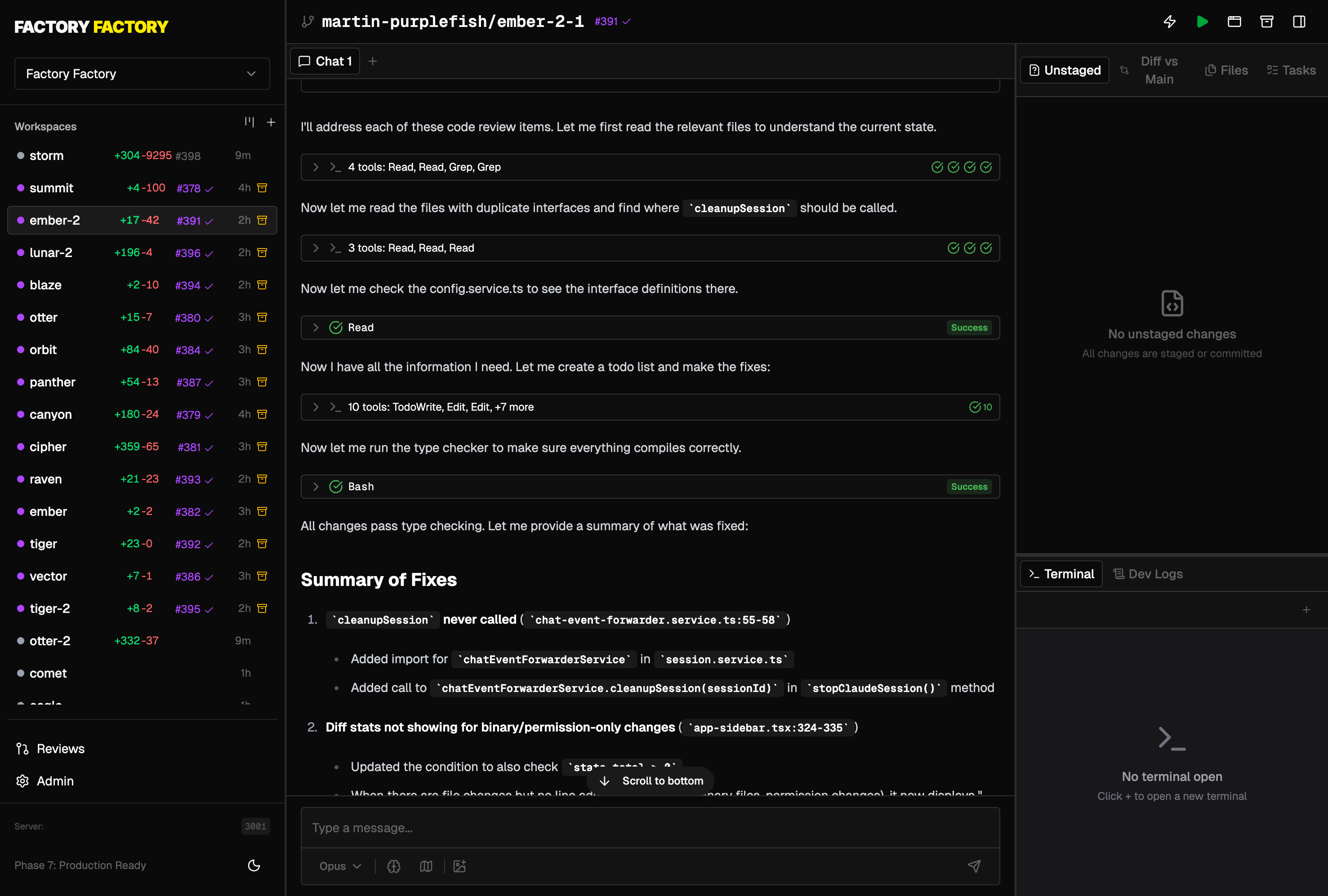
Factory Factory is a local workspace manager for AI coding agents. Every workspace gets its own git worktree and branch, so agents can work on separate tasks without stepping on each other. The UI brings chat, diffs, files, terminals, issues, and pull request status together in one place.
You will need:
.node-version); the desktop app uses Electron's bundled Node.js runtimeclaude loginStart Factory Factory without installing it:
npx factory-factory@latest serve
Factory Factory opens in your browser and stores its database in ~/factory-factory/ by default.
See Settings for IDE commands, default chat models, and project configuration.
Then:
The core model is intentionally small:
Project (a local git repository)
└── Workspace (an isolated worktree and branch)
    ├── Agent sessions (Claude or Codex over ACP)
    └── Terminal, files, changes, and pull request state
For regular use, install the CLI globally:
npm install -g factory-factory
ff serve
Useful commands:
ff serve --help     # Ports, database path, host, and other options
ff proxy --private  # Share the app through a password-protected Cloudflare tunnel
ff db:studio        # Inspect the local database with Prisma Studio
ff proxy requires cloudflared on your PATH. Factory Factory automatically runs database migrations, finds an available port, and opens the browser when the server is ready.
To serve Factory Factory from your own domain (e.g. https://ff.example.com) via nginx, Caddy, or another reverse proxy:
CORS_ALLOWED_ORIGINS to the exact public origin(s), comma-separated: CORS_ALLOWED_ORIGINS=https://ff.example.com. This gates both HTTP CORS and WebSocket upgrades; non-loopback origins must match exactly (scheme + host + non-default port, no trailing slash).BACKEND_HOST bound to localhost/127.0.0.1 so only your proxy can reach the server.By default the server rejects WebSocket upgrades that carry client-address headers (x-forwarded-for, cf-connecting-ip, etc.), because it expects to sit behind an authenticated proxy that strips them. If your reverse proxy adds these headers, either strip them before forwarding, or set TRUST_PROXY_HEADERS=true to accept them. Only enable TRUST_PROXY_HEADERS when the backend is reachable solely through your trusted proxy (i.e. bound to loopback) — otherwise clients could spoof address headers. The remote-address trust check (loopback / TRUSTED_LOCAL_CIDRS) still applies.
[!WARNING] Factory Factory runs coding agents that can execute commands and modify files without manual confirmation. Workspaces isolate git branches; they are not containers or security sandboxes.
Use Factory Factory only with repositories and agent instructions you trust. Review changes before merging, protect your GitHub and Linear credentials, and consider a VM or container when working with untrusted code.
Use pnpm 12.3.4, pinned in package.json. Dependency build permissions live in
pnpm-workspace.yaml under allowBuilds; review new build scripts with
pnpm approve-builds when adding or updating dependencies.
Development requires Git 2.32 or newer for lint-staged. Builds and typechecks use
TypeScript 7 through the @typescript/native package alias. The typescript
alias provides Microsoft's TypeScript 6 compatibility API for guardrail scripts
and tools that parse source files; tsc runs version 7 and tsc6 runs version 6.
git clone https://github.com/purplefish-ai/factory-factory.git
cd factory-factory
pnpm install
pnpm dev
Before opening a pull request, run the standard checks:
pnpm test
pnpm typecheck
pnpm check
See CONTRIBUTING.md for project structure, conventions, and the full contributor workflow.
Factory Factory was inspired by Conductor, VibeKanban, Gastown, and Multiclaude.
Sign in to join the discussion.
No comments yet. Be the first to say what this is good for.
🪨 why use many token when few token do trick — Claude Code skill that cuts 65% of tokens by talking like caveman

The best-benchmarked open-source AI memory system. And it's free.

Orca is the ADE for working with a fleet of parallel agents. Run any coding agent with your own subscription. Available on desktop, mobile and remote runtime.
A cross-platform desktop All-in-One assistant for Claude Code, Codex, OpenCode, OpenClaw, Grok Build & Hermes Agent. Only official website: ccswitch.io

Never stop coding. Free MIT AI gateway: one endpoint, 352 providers (150+ free), 1200+ models Kimi, Claude, GPT, Gemini, GLM, DeepSeek, MiniMax. Works with Claude Code, Codex, Cursor, OpenCode, Cline & Copilot. Quota-aware auto-fallback, RTK+Caveman compression saves 15-95% tokens, MCP/A2A, Desktop/PWA. Built by 550+ contributors

Compress tool outputs, logs, files, and RAG chunks before they reach the LLM. 20% fewer tokens for coding agents, 60-95% fewer tokens for JSON, same answers. Library, proxy, MCP server.