
affaan-m/
ECC

affaan-m/ECCHarnesses
The agent harness performance optimization system. Skills, instincts, memory, security, and research-first development for Claude Code, Codex, Opencode, Cursor and beyond.
258k
Machinist maps named commands to fixed executables, sends prompts on standard input, and tracks each run from request to handoff. It is built to keep repository access, credentials, and execution rules local while letting you invoke Codex, Claude Code, or another agent CLI through the same entrypoint.
Builders who want reusable, controlled workflows for agent-led coding on local repositories.
You can run agent work through one approved entrypoint instead of letting it use arbitrary shell access.
Maps each command name to a fixed executable and runs it against an approved repository path.
Renders a prompt and sends it to the executor on standard input.
Keeps repositories, credentials, model aliases, and executor settings on the worker.
Streams stdout and stderr and records events, artifacts, exit status, duration, and reported token use.
Returns a pull request instead of deciding what ships.
Supports scripts and workflow examples that live with the repository.
git clone https://github.com/owainlewis/machinist.git
cd machinist
mkdir -p ./bin && go build -o ./bin/machinist ./cmd/machinist
./bin/machinist init
./bin/machinist run --command=foreman --repo=/path/to/repo --prompt="Implement issue 42"

The open source AI software factory for agentic coders.
Machinist is an open source software factory for repeatable and scalable AI coding workflows.
Website · Documentation · Configuration · Workflow examples
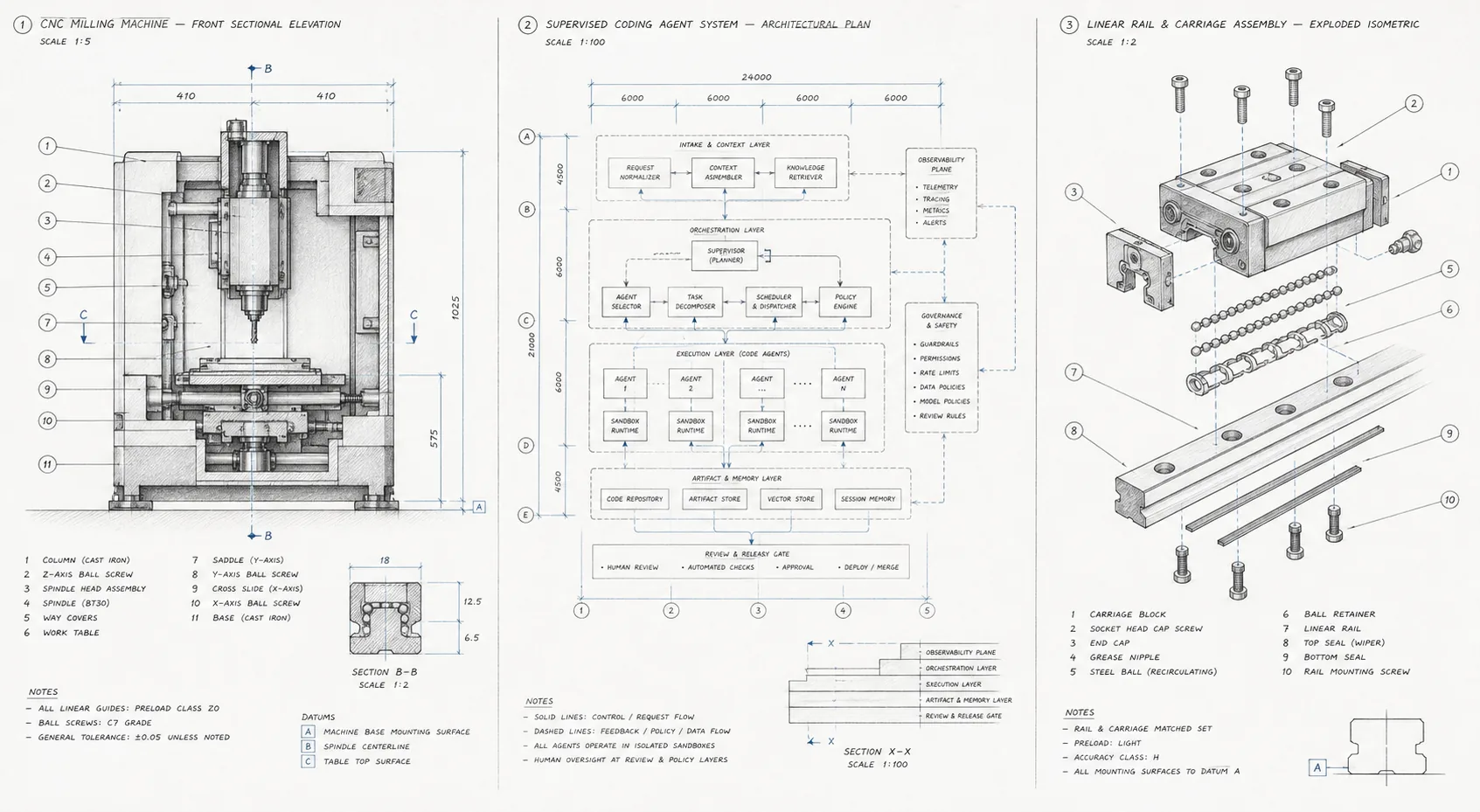
Machine section · supervised agent system · exploded assembly
Machinist is an open-source software factory implementation. It runs on your machine, keeps repository access and credentials local, and records the work from request to handoff. Commands can invoke Codex, Claude Code, another agent CLI, a test runner, a shell script, or repository-owned orchestration.
Please note: this is early access software and subject to change.
Build and initialize Machinist:
git clone https://github.com/owainlewis/machinist.git
cd machinist
mkdir -p ./bin && go build -o ./bin/machinist ./cmd/machinist
./bin/machinist init
Configure an approved command:
# ~/.machinist/config.toml
[commands.foreman]
executor = "codex"
prompt_file = "prompts/foreman.md" # optional
timeout = "45m"
Run it directly:
./bin/machinist run --command=foreman --repo=/path/to/repo --prompt="Implement issue 42"
For a direct run, Machinist maps the configured command name to a fixed executable and uses the path supplied with --repo as the working directory. Managed submissions instead resolve an approved repository name from the worker configuration. In both cases, Machinist renders the prompt, sends it on standard input, streams stdout and stderr, and applies one overall timeout and cancellation. Exit code 0 succeeds; every non-zero exit code fails.
Scripts are intentionally opaque. Their internal stages appear in logs, but Machinist does not invent child runs, graphs, checkpoints, or resumable stages. A killed script restarts from the beginning unless the script owns checkpointing.
| Guide | What it covers |
|---|---|
| Documentation | Choose the right setup and operations guide |
| Configuration | Commands, executors, workers, models, and repositories |
| Development | Build, test, and work on Machinist locally |
| VM deployment | Run the control plane and worker as services |
| Workflow examples | Repository-owned multi-step orchestration |
Read CONTRIBUTING.md for development setup and pull-request expectations. Security issues should follow SECURITY.md.
Machinist is released under the MIT License.
Sign in to join the discussion.
No comments yet. Be the first to say what this is good for.
The agent harness performance optimization system. Skills, instincts, memory, security, and research-first development for Claude Code, Codex, Opencode, Cursor and beyond.
from vibe coding to agentic engineering - practice makes claude perfect
🌊 The original agent meta-harness. Deploy intelligent multi-player swarms, coordinate autonomous workflows, and build conversational AI systems. Features adaptive memory, self-learning intelligence, RAG integration, and native Claude Code / Codex / Hermes and many more Integrated
Practical patterns, starters & CLI tools for loop engineering with AI coding agents. Design systems that prompt and orchestrate agents (inspired by Addy Osmani and Boris Cherny). Includes loop-audit, loop-init, loop-cost.

Git. Ship. Done - Core

The most RAM efficient harness