

affaan-m/
ECC

affaan-m/ECCHarnesses
The agent harness performance optimization system. Skills, instincts, memory, security, and research-first development for Claude Code, Codex, Opencode, Cursor and beyond.
258k
HAR turns a repo into a machine-readable harness for coding agents. It isolates each run in its own worktree, then uses the same launch, verify, and teardown flow so results are consistent and easy to check. The repo also includes MCP tools, agent files, and project contracts in `.har/` so different agents read the same setup.
Builders who want their coding agents to work in isolated copies of a repo and leave proof of what was checked.
You can run one agent or a fleet on the same repo without collisions, then verify the exact code that passed.
Creates a separate worktree, branch, ports, and database per agent slot so runs do not collide.
Runs the project’s checks through the same verify stage every time and records what passed.
Ships as both a `har` CLI and an MCP server for agent discovery, session control, and evidence.
Uses `.har/` as a machine-readable contract that Claude Code, Cursor, Codex, and other MCP clients can read.
Keeps logs, artifacts, and validated tree hashes so reviewers can see what was run.
Includes a local dashboard for tracking repositories, worktrees, runs, validations, and artifacts.
Provides `har env maintain` to compare the installed harness with current templates and catch drift.
npm install -g @osfactory/har




HAR is an open-source agent harness for AI coding workflows you can trust and verify. It runs every coding agent in its own isolated, consistent worktree, with deterministic validation, verifiable proof, and full observability. Run one agent or a whole fleet, with the same quality and control. It wraps the tools, tests, and CI you already use, and stays yours to customize.
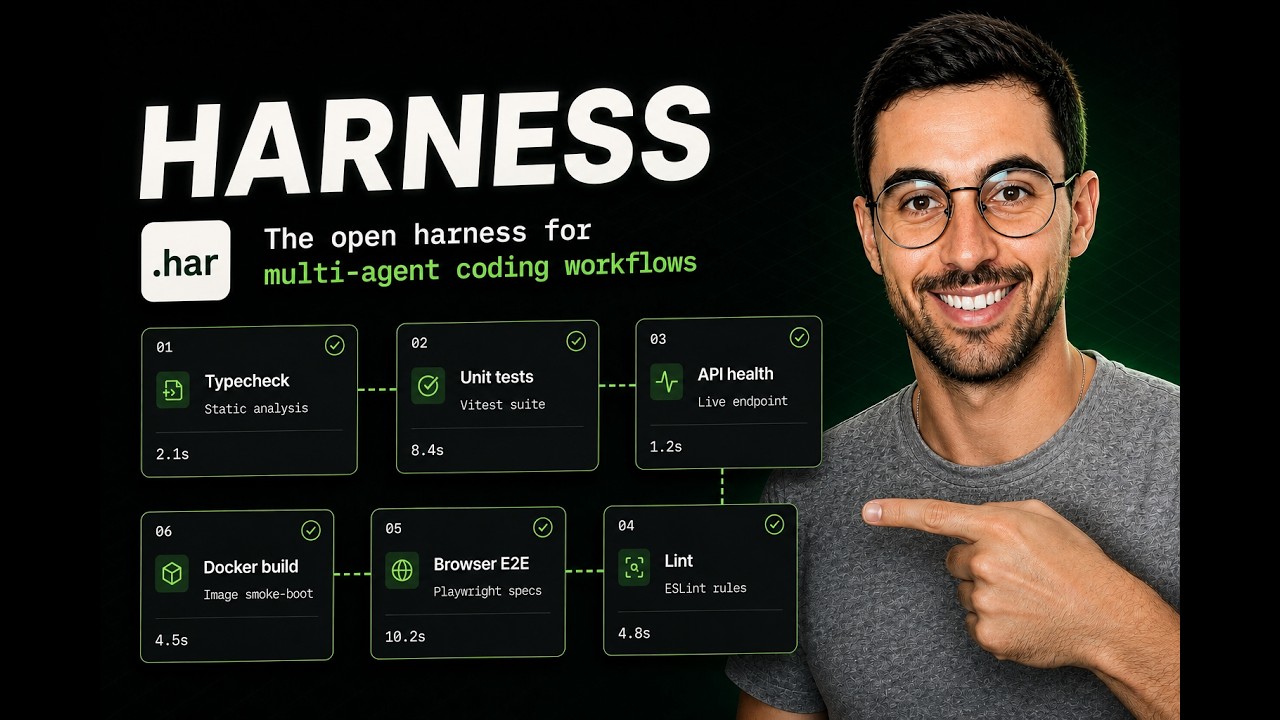
|
| ▶ Introduction demo, click the thumbnail to watch on YouTube |
Works with Claude Code · Cursor · Codex · any MCP agent.
npm install -g @osfactory/har
cd my-app
har onboard               # scaffold .har/ and print a prompt for your coding agent
har env launch 1          # isolated worktree + running stack for agent slot 1
har env verify 1 --full   # run the project's real checks, record what passed
Full walkthrough: Quickstart.
Running a coding agent is easy. Trusting what it produced, without re-checking every change by hand, is the hard part, and it only gets harder as tasks grow more complex and you run more agents at once. HAR was built to close those gaps:
No standard way to run or verify a repo. That knowledge is scattered across a README, a CLAUDE.md, Cursor rules, and CI yaml today, drifting out of sync with each other and the actual codebase. HAR replaces all of that with one machine-readable contract (.har/) that Claude Code, Cursor, Codex, or any MCP agent reads the same way.
Multiple agents on one repo collide. Shared dev server, shared database, shared ports, conflicting git state. HAR gives each agent its own worktree, ports, and database per slot, so a fleet can genuinely run concurrently.
Trusting an agent's change means re-verifying it yourself. Every task runs the same deterministic verify step and leaves an evidence trail, logs, artifacts, a validated tree hash, so a reviewer can check proof of what ran instead of relying on the agent's self-report.
One platform's sandbox locks you in. If the contract lives inside a vendor's hosted dashboard, switching coding agents later means rebuilding the whole verification setup. HAR's contract is an open standard living in the repo itself, portable across whichever agent or tool you adopt.
Hand-rolled scripts rot as the stack changes. A new dependency, a new service, a new env var, and nobody updates the script until an agent's run fails for a confusing reason. har env maintain diffs your installed harness against current templates and flags drift before it causes a silent failure.
HAR coordinates the work around the model, so agents can focus on the code and reviewers can trust the result.
flowchart LR
    D["Discover<br/>reads the harness contract"] --> I["Isolate<br/>one slot per agent"]

    I --> A1["Agent 1<br/>own worktree, branch, ports, DB"] --> B1["Build"] --> V1["Verify"]
    I --> A2["Agent 2<br/>own worktree, branch, ports, DB"] --> B2["Build"] --> V2["Verify"]

    V1 --> H["Hand off<br/>branch + evidence"]
    V2 --> H
Discover. The agent asks the harness what this project looks like, including its stack, its scripts, and what checks are available.
Isolate. Every task gets its own slot. That means a fresh copy of the repo on its own branch, with its own ports and, where the project needs it, its own database. Nothing is shared with the main checkout or with any other agent's slot.
Build. The agent edits and tests its work entirely inside that isolated copy. The main checkout stays untouched the whole time.
Verify. The project's own checks, whatever they are, run through the same pipeline every time and produce a consistent result. A full verification goes further and captures the state of the entire codebase at that moment, so a pass is tied to the exact code that was checked.
Hand off. Once verification passes, the session is torn down, but the branch and the proof of what ran are kept. A reviewer gets the code plus the evidence that it was checked.
Everything beyond install and first commands lives at harproject.dev.
har executable exposes.See CONTRIBUTING.md for local setup, the dogfood harness loop, and architecture. Coding agents working on this repo should start with AGENTS.md. Maintainer release process: RELEASING.md.
HAR is sponsored by Kerno, runtime code and security tester for coding agents.


Licensed under the Apache License 2.0.
Report vulnerabilities via SECURITY.md.
Sign in to join the discussion.
No comments yet. Be the first to say what this is good for.
The agent harness performance optimization system. Skills, instincts, memory, security, and research-first development for Claude Code, Codex, Opencode, Cursor and beyond.
from vibe coding to agentic engineering - practice makes claude perfect
🌊 The original agent meta-harness. Deploy intelligent multi-player swarms, coordinate autonomous workflows, and build conversational AI systems. Features adaptive memory, self-learning intelligence, RAG integration, and native Claude Code / Codex / Hermes and many more Integrated
Practical patterns, starters & CLI tools for loop engineering with AI coding agents. Design systems that prompt and orchestrate agents (inspired by Addy Osmani and Boris Cherny). Includes loop-audit, loop-init, loop-cost.

Git. Ship. Done - Core

The most RAM efficient harness