
JuliusBrussee/
caveman

🪨 why use many token when few token do trick — Claude Code skill that cuts 65% of tokens by talking like caveman
105k
1 add
Token Proxy runs on your machine and forwards requests to OpenAI, Gemini, Anthropic, Kiro, Codex, and xAI providers. It can balance upstreams by priority, convert between API formats, and store request and token stats in SQLite for later review. It also includes one-click setup for Claude Code and Codex, plus a Tauri dashboard for upstreams, logs, and usage. The CLI and app share a workspace so you can run it locally or manage it through the desktop UI.
Builders who want Claude Code, Codex, or other agent clients to use a local proxy with routing and token tracking.
You can point your agent at one local endpoint and get routing, logging, format conversion, and setup in one place.
Routes requests across OpenAI, Gemini, Anthropic, Kiro, Codex, and xAI upstreams by priority and strategy.
Converts between OpenAI Chat, OpenAI Responses, Anthropic Messages, and Gemini formats, including SSE, tools, and images.
Stores per-request usage, cached tokens, latency, model, and upstream in `data.db`.
Shows usage totals, trends, top models, upstream probes, and recent requests in the app UI.
Writes config for Claude Code in `~/.claude/settings.json` and Codex in `~/.codex/config.toml` and `~/.codex/auth.json`.
Supports a local access key plus upstream credential injection through `credential.api_keys` or account-backed credentials.
curl -X POST \
  -H "Authorization: Bearer YOUR_LOCAL_KEY" \
  -H "Content-Type: application/json" \
  http://127.0.0.1:9208/v1/chat/completions \
-d '{"model":"gpt-4.1-mini","messages":[{"role":"user","content":"hi"}]}'curl -X POST \
-H "x-api-key: YOUR_LOCAL_KEY" \
-H "Content-Type: application/json" \
http://127.0.0.1:9208/v1/messages \
-d '{"model":"claude-3-5-sonnet-20241022","max_tokens":256,"messages":[{"role":"user","content":[{"type":"text","text":"hi"}]}]}'English | 中文
Local AI API gateway for OpenAI / Gemini / Anthropic. Runs on your machine, keeps tokens counted (SQLite), offers priority-based load balancing, optional API format conversion (OpenAI Chat/Responses ↔ Anthropic Messages, plus Gemini ↔ OpenAI/Anthropic, including SSE/tools/images), and one-click setup for Claude Code / Codex.
Default listen port: 9208 (release) / 19208 (debug builds).
openai, openai-response, anthropic, gemini, kiro, codex, xaicredential.api_keys or request-header fallback when local auth is off)Dashboard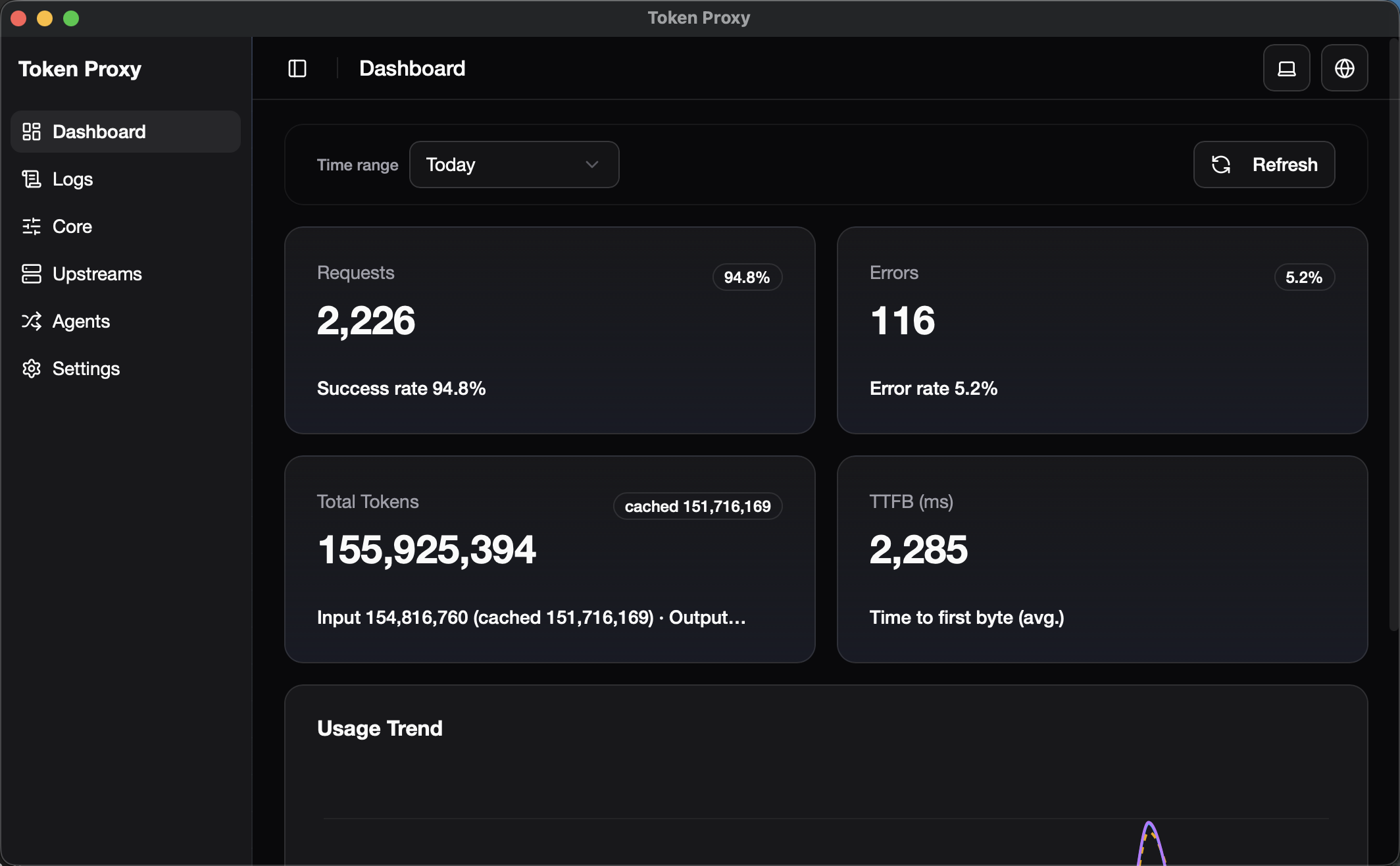 | Core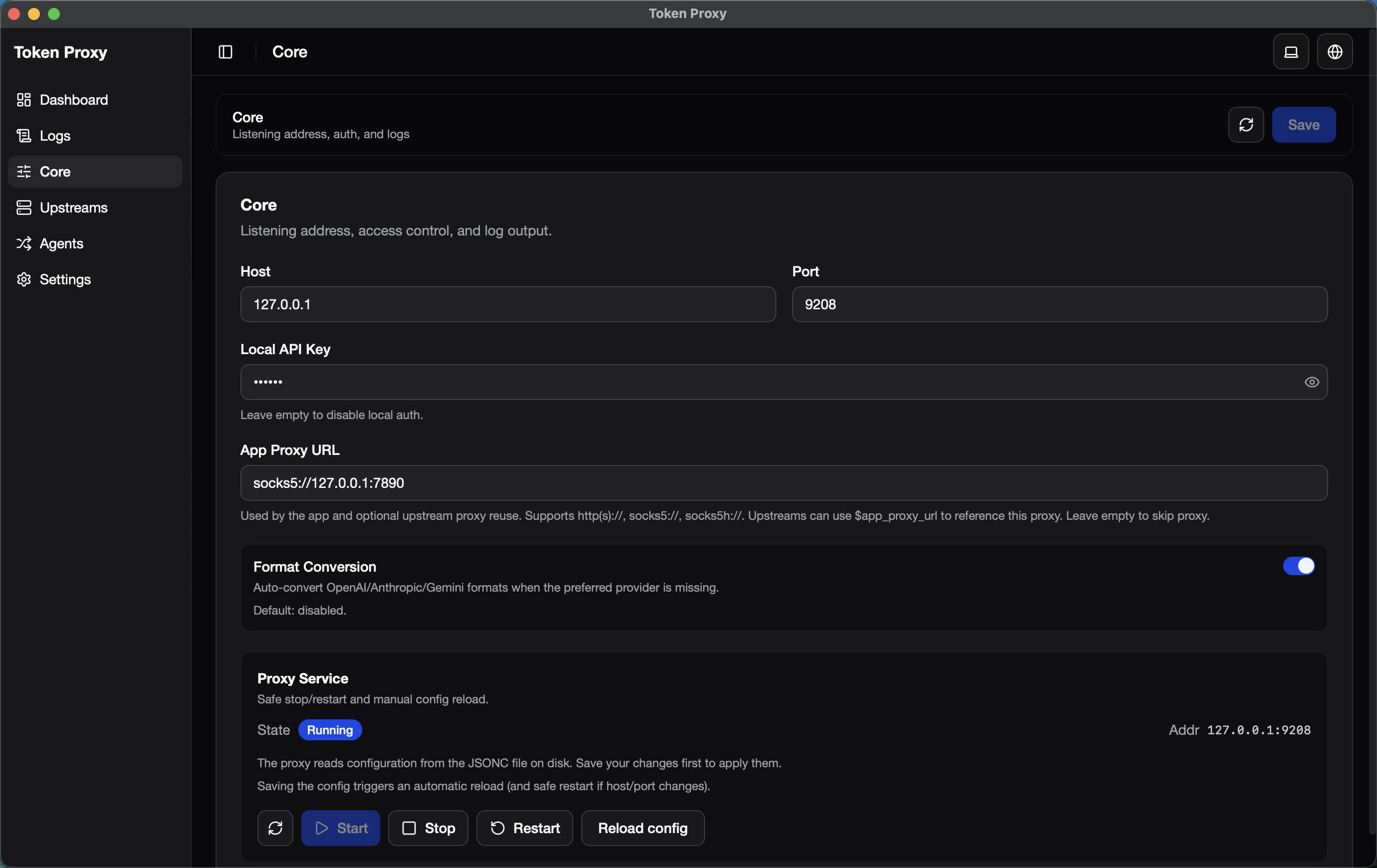 |
Upstreams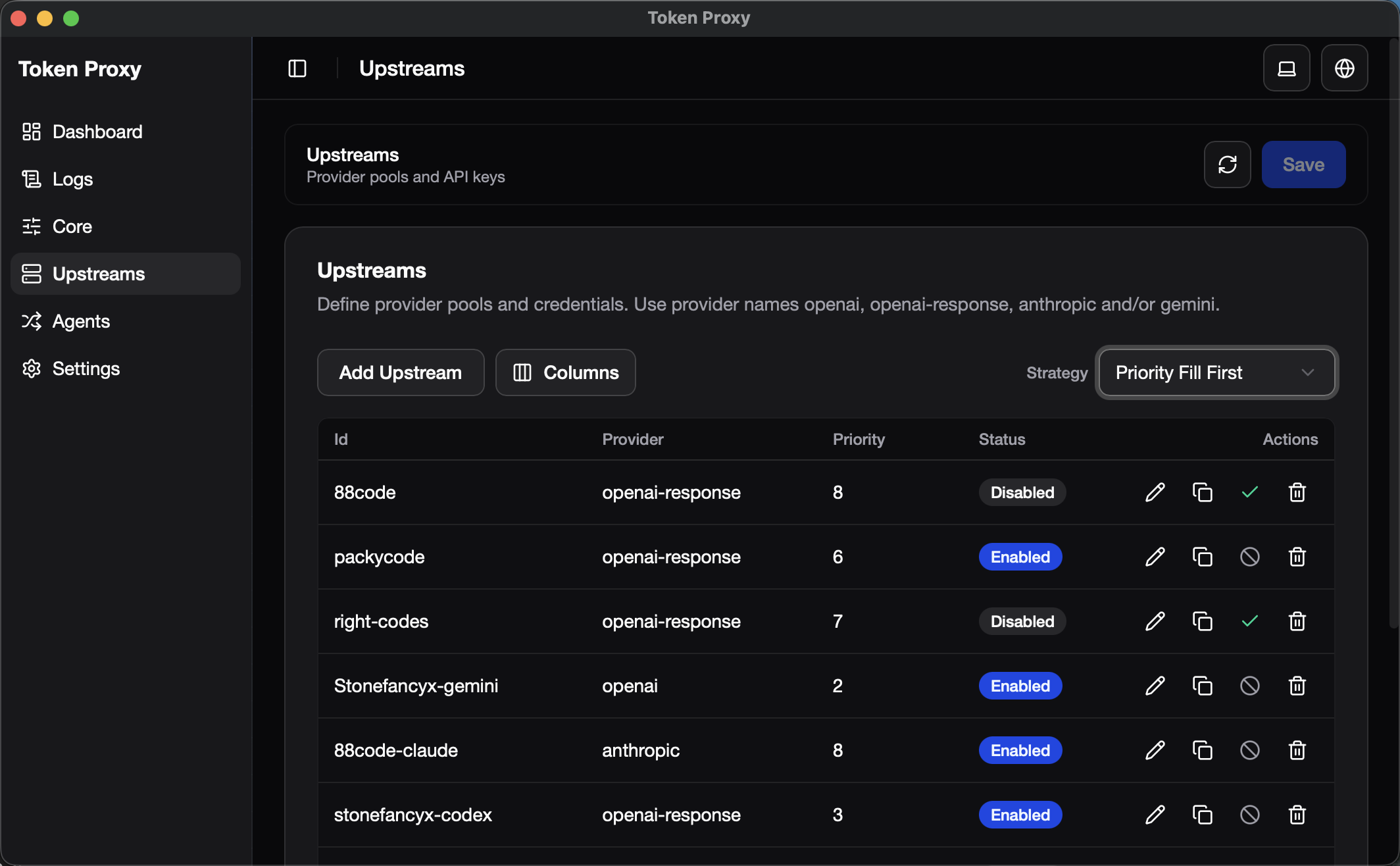 | Add upstream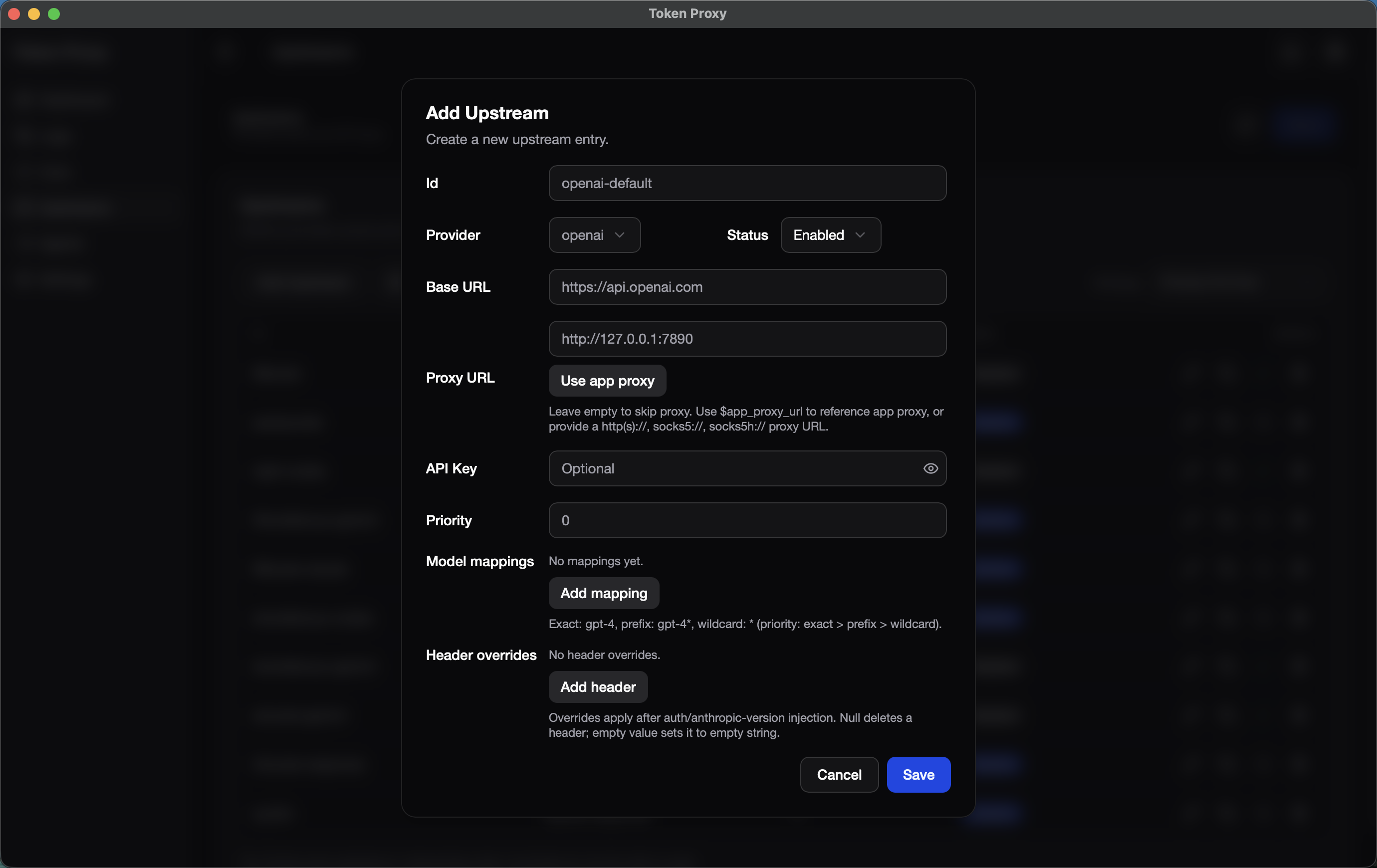 |
Token Proxy.app to /Applications. If blocked: xattr -cr /Applications/Token\ Proxy.app.config.jsonc in the Tauri config dir). Defaults are usable; just paste your upstream API keys. Running proxies auto-apply the new config via reload or restart when needed.curl -X POST \
-H "Authorization: Bearer YOUR_LOCAL_KEY" \
-H "Content-Type: application/json" \
http://127.0.0.1:9208/v1/chat/completions \
-d '{"model":"gpt-4.1-mini","messages":[{"role":"user","content":"hi"}]}'
You can also call using the Anthropic Messages format (useful for Claude Code clients):
curl -X POST \
  -H "x-api-key: YOUR_LOCAL_KEY" \
  -H "Content-Type: application/json" \
  http://127.0.0.1:9208/v1/messages \
  -d '{"model":"claude-3-5-sonnet-20241022","max_tokens":256,"messages":[{"role":"user","content":[{"type":"text","text":"hi"}]}]}'
src-tauri/.crates/token_proxy_cli (binary token-proxy)../config.jsonc (override with --config).token-proxy_cli_<version>_<target>.tar.gztoken-proxy_cli_<version>_<target>.zip# start proxy
cargo run -p token_proxy_cli -- serve
# start with custom config path
cargo run -p token_proxy_cli -- --config ./config.jsonc serve
# config helpers
cargo run -p token_proxy_cli -- config init
cargo run -p token_proxy_cli -- --config ./config.jsonc config path
# watch mode
pnpm test

# run once (CI-friendly)
pnpm test:run

# coverage (optional)
pnpm test:coverage

# TypeScript typecheck
pnpm exec tsc --noEmit
Notes:
src/**/*.test.{ts,tsx}.src/test/setup.ts.vitest.config.ts.config.jsonc (comments + trailing commas allowed)--config (default: ./config.jsonc)| Field | Default | Notes |
|---|---|---|
host | 127.0.0.1 | Listen address (IPv6 allowed; will be bracketed in URLs) |
port | 9208 release / 19208 debug | Change if the port is taken |
local_api_key | null | When set: local auth uses format-specific headers (see Auth rules); local auth inputs are not forwarded upstream. |
app_proxy_url | null | Proxy for app updater & as placeholder for upstreams ("$app_proxy_url"). Supports http/https/socks5/socks5h. |
log_level | silent | `silent |
max_request_body_bytes | 104857600 (100 MiB) | 0 = fallback to default. Shared inbound, JSON filter, and format-conversion ceiling. |
retryable_failure_cooldown_secs | 15 | Cooldown window after retryable failures that should temporarily sideline an upstream. 0 disables cooldown. Reloading or restarting the running proxy resets current cooldown state. |
same_upstream_retry_count | 1 | Extra same-upstream retries after a retryable failure (excluding the first attempt). 0 disables same-upstream retry; max 5. |
codex_session_scoped_cooldown_enabled | false | Only applies to Codex account-backed OpenAI Responses requests. When enabled, cooldown is isolated by session_id; final success clears that session, and requests without session_id do not share cooldown. |
tray_token_rate.enabled | true | macOS tray live rate; harmless elsewhere. |
tray_token_rate.format | split | combined (total), split (↑in ↓out), both (`total |
upstream_strategy | { "order": "fill_first", "dispatch": { "type": "serial" } } | Structured strategy object. order controls candidate ordering inside one priority group; dispatch controls serial / hedged / race execution. |
upstreams[])| Field | Default | Notes |
|---|---|---|
id | required | Unique per upstream. |
providers | required | One upstream can serve multiple providers. Account-based providers kiro / codex / xai must be alone (cannot mix with each other or with API-key providers). |
base_url | required | Full base; overlapping path parts are de-duplicated. (providers=["kiro"] / ["codex"] can be empty; xai account-backed uses the fixed CLI gateway base.) |
credential | { "type": "passthrough" } | Discriminated union — the only credential shape. See below. |
preferred_endpoint | null | kiro only: ide or cli. |
proxy_url | null | Per-upstream proxy (not an account field); supports http/https/socks5/socks5h; default is no system proxy. $app_proxy_url placeholder allowed. |
priority | 0 | Per-upstream scheduling weight (not an account field). Higher = tried earlier. |
enabled | true | Per-upstream toggle (not an account field). Disabled upstreams are skipped. |
available_models | [] | Inbound model allowlist; empty = no restriction. |
model_mappings | {} | Exact / prefix* / *. Priority: exact > longest prefix > wildcard. Response echoes original alias. |
convert_from_map | {} | Explicitly allow inbound format conversion per provider. Example: { "openai-response": ["openai_chat", "anthropic_messages"] }. |
overrides.header | {} | Set/remove headers (null removes). Hop-by-hop/Host/Content-Length are always ignored. |
credential (required shape)type | Shape | Notes |
|---|---|---|
passthrough | { "type": "passthrough" } | No static upstream key; may rely on request-header fallback when local_api_key is unset. Not allowed for kiro / codex / xai. |
api_keys | { "type": "api_keys", "api_keys": ["key-a", "key-b"] } | Static keys; empty list behaves like passthrough after normalize. Not allowed for account-based providers. |
account | { "type": "account", "provider": "kiro"|"codex"|"xai", "account_id": "..." } | Binds one Provider Account. provider must match the sole account-based entry in providers[]. One (provider, account_id) may bind only one upstream. |
Kiro / Codex / xAI must use credential.type = "account". Account login/import creates a stable binding via app lifecycle; do not invent frontend-only ids such as kiro-default / codex-default / xai-default. Deleting an account-backed upstream cascades deletion of that account credential; copy is forbidden.
Legacy flat fields (api_key, api_keys, kiro_account_id, codex_account_id, xai_account_id) are not part of the documented schema. On load they are migrated once into credential and written back (no dual-format docs).
/v1beta/models/* (including :generateContent, :streamGenerateContent, :countTokens, :embedContent, :batchEmbedContents), model catalog/detail, /v1beta/files*, /upload/v1beta/files*, /v1beta/cachedContents*, /v1beta/tunedModels* → gemini./v1/messages (and subpaths) and /v1/complete → anthropic (Kiro shares the same format)./v1/chat/completions → openai; /v1/responses → openai-response.anthropic: chat/completions/*, responses/*, assistants*, threads*, conversations*, chatkit*, containers*, evals*, files*, uploads*, batches*, vector_stores*, images/*, audio/*, embeddings, moderations, completions, fine_tuning/*, realtime/*, skills*, videos*.responses/* resources, provider preference is openai-response → openai; for other OpenAI native resources, provider preference is openai → openai-response.openai > openai-response > anthropic.upstreams[].convert_from_map (no global switch). If a provider has no eligible upstream for the inbound format, it won't be selected.openai is missing for /v1/chat/completions: fallback can be openai-response, anthropic, or gemini (priority-based; tie-break prefers openai-response)./v1/messages: choose between anthropic and kiro by priority; tie-break uses upstream id. If the chosen provider returns a retryable error, the proxy will fall back to the other native provider (Anthropic ↔ Kiro) when configured.anthropic nor kiro exists for /v1/messages: other providers can be selected only when allowed for anthropic_messages via convert_from_map (e.g. openai-response, openai, gemini).openai-response is missing for /v1/responses: fallback can be openai, anthropic, or gemini (priority-based; tie-break prefers openai).gemini is missing for /v1beta/models/*:generateContent or *:streamGenerateContent: fallback can be openai-response, openai, or anthropic (priority-based; tie-break prefers openai-response).gemini upstream.local_api_key enabled → require format-specific key. Local auth inputs are reserved for gateway access and not used as upstream credentials.
GET / HEAD /v1/models and /v1beta/openai/models do not require local key.Authorization: Bearer <key>/v1/messages: x-api-key or x-anthropic-api-keyx-goog-api-key or ?key=...local_api_key is enabled, inbound request auth headers are not collected for upstream; configure credential.api_keys (or an account credential) on the upstream instead.credential.api_keys into the attempt key):
credential.api_keys → request x-openai-api-key / Authorization only when local_api_key is unset → no key.credential.api_keys → request x-api-key / x-anthropic-api-key / bearer fallback only when local_api_key is unset → no key. Missing anthropic-version is auto-filled with 2023-06-01.credential.api_keys → request x-goog-api-key → query ?key=... (query/header fallback only when local_api_key is unset) → skip attempt.kiro / codex / xai): uses the bound Provider Account identity (OAuth / Agent Assertion); not api_keys.priority groups first.upstream_strategy.order controls selection inside the same priority group:
fill_first: keep the configured list order.round_robin: rotate the starting point across requests.upstream_strategy.dispatch controls how requests are launched inside one priority group:
{"type":"serial"}: try one candidate at a time.{"type":"hedged","delay_ms":2000,"max_parallel":2}: launch the first candidate immediately, then add one more attempt after delay_ms if the prior attempt is still unresolved, up to max_parallel.{"type":"race","max_parallel":3}: launch up to max_parallel candidates immediately and take the first successful result.same_upstream_retry_count, and the repaired body is retained for later attempts.same_upstream_retry_count extra times (default 1, excluding the first attempt) before failing over. After the first client-visible stream output, the proxy does not replay the same attempt.401/403/408/429/5xx will temporarily move the failed upstream behind ready peers for retryable_failure_cooldown_secs (default 15); 400/404/422/307 stay retryable but do not trigger cross-request cooldown. With codex_session_scoped_cooldown_enabled=true, Codex account-backed OpenAI Responses cooldown is isolated by session_id; final successful requests do not keep same-session cooldown, and requests without session_id do not share cooldown./v1/messages only: after the chosen native provider is exhausted (retryable errors), the proxy can fall back to the other native provider (anthropic ↔ kiro) if it is configured.data.db in config dir. Stores per-request stats (tokens, cached tokens, latency, model, upstream).tray_token_rate).~/.claude/settings.json env (ANTHROPIC_BASE_URL, ANTHROPIC_MODEL=claude-sonnet-4-6, ANTHROPIC_AUTH_TOKEN when local key is set).~/.codex/config.toml model="gpt-5.5", model_provider="token_proxy", and [model_providers.token_proxy].base_url → http://127.0.0.1:<port>/v1; writes ~/.codex/auth.json OPENAI_API_KEY..token_proxy.bak file is created before overwriting; restart the CLI to apply.port in config.jsonc; remember to update your client base URL.local_api_key is set, you must send the format-specific local key (OpenAI/Responses: Authorization, Anthropic: x-api-key, Gemini: x-goog-api-key or ?key=). With local auth enabled, configure upstream keys in upstreams[].credential (api_keys or account).max_request_body_bytes (default 100 MiB) or the transform limit for format-conversion requests.reqwest is built with .no_proxy(); set per-upstream proxy_url if needed.Sign in to join the discussion.
No comments yet. Be the first to say what this is good for.
🪨 why use many token when few token do trick — Claude Code skill that cuts 65% of tokens by talking like caveman

The best-benchmarked open-source AI memory system. And it's free.

Orca is the ADE for working with a fleet of parallel agents. Run any coding agent with your own subscription. Available on desktop, mobile and remote runtime.
A cross-platform desktop All-in-One assistant for Claude Code, Codex, OpenCode, OpenClaw, Grok Build & Hermes Agent. Only official website: ccswitch.io

Never stop coding. Free MIT AI gateway: one endpoint, 352 providers (150+ free), 1200+ models Kimi, Claude, GPT, Gemini, GLM, DeepSeek, MiniMax. Works with Claude Code, Codex, Cursor, OpenCode, Cline & Copilot. Quota-aware auto-fallback, RTK+Caveman compression saves 15-95% tokens, MCP/A2A, Desktop/PWA. Built by 550+ contributors

Compress tool outputs, logs, files, and RAG chunks before they reach the LLM. 20% fewer tokens for coding agents, 60-95% fewer tokens for JSON, same answers. Library, proxy, MCP server.