

JuliusBrussee/
caveman

🪨 why use many token when few token do trick — Claude Code skill that cuts 65% of tokens by talking like caveman
105k
1 add
Kaydet stores your notes as plain text day files and keeps a local SQLite FTS index for full-text search. It also exposes an MCP server so Claude Desktop, Cursor, and other MCP clients can search, add, edit, and summarize your history. You can use it as a work log, developer diary, todo list, or personal journal without leaving the terminal. The storage files stay readable and syncable, while the index is rebuilt locally on each device.
Builders who want a terminal note system their agent can read and write through MCP.
You can keep one searchable record of your work and let your agent answer from it instead of from memory.
Stores entries in one `.txt` file per day with timestamps, IDs, tags, and `key:value` metadata.
Indexes notes with FTS5 so you can search text, tags, dates, and numeric metadata quickly.
Adds and completes todos from the command line with `--todo` and `--done`.
Supports `--init`, `--sync`, and `--status`, and also works with synced folders like Dropbox or iCloud.
Provides tools like `add_entry`, `search_entries`, `list_todos`, `get_stats`, and `suggest_kaydet_tags` for MCP clients.
Lets you attach files, grab files into entries, edit by ID, and delete by ID.
pipx install kaydet
pipx install kaydet[mcp]
uv tool install kaydet # uv
14:25 [42]: Fixed auth bug commit:abc123 time:2h status:done #work #urgent
~/Documents/Kaydet/          → Synced (storage)
├── 2025-10-26.txt
├── 2025-10-27.txt
├── 2025-10-28.txt
└── ...

~/.local/share/kaydet/       → Local only (index)
  └── index.db
Kaydet (pronounced "kai-det", Turkish for "record") is a terminal note-taking application for developers. Capture work logs, ideas, daily notes, and structured metadata in plain text. Instantly search everything with SQLite FTS, and let your AI search your history too.


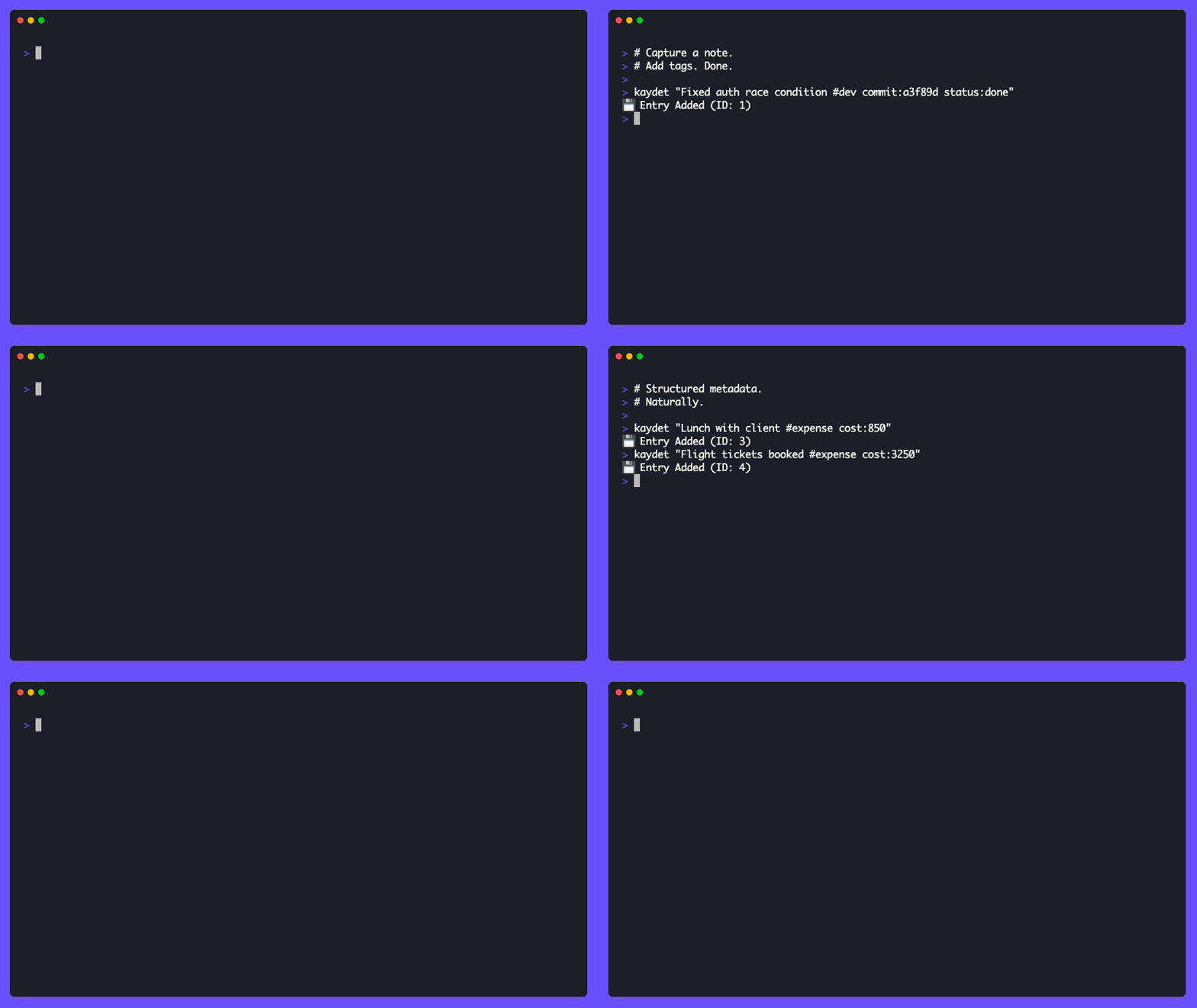
pipx install kaydet
With AI (MCP) support:
pipx install kaydet[mcp]
Also available via:
uv tool install kaydet # uv
# Capture a solution (terminal notes, instantly)
kaydet "Fixed auth race condition commit:abc123 issue:312"

# Pipe command output into a new entry
ls -lah | kaydet
git log -5 --oneline | kaydet #git

# 6 months later — find it
kaydet --filter auth

# Log what you worked on (work log / developer diary)
kaydet "Deep work on ETL pipeline #work time:3h focus:high"

# Todo from the command line (CLI notes + tasks)
kaydet --todo "Write unit tests priority:high"
kaydet --done 42

# Search by metadata
kaydet --filter "status:done"
kaydet --filter "time:>2"

# Open today's entry in your editor
kaydet --today

# See your stats (plain text notes, searchable)
kaydet --stats
Powered by MCP (Model Context Protocol). Connect Claude Desktop, Cursor, or any MCP-compatible tool:
// claude_desktop_config.json
{
  "mcpServers": {
    "kaydet": {
      "command": "kaydet-mcp"
    }
  }
}
Then ask your AI:
#expense since:2026-07-01 --sum)search_entries + since:)#expense since:2026-03-01 cost:>1000)list_todos status:pending filter:#work)Your AI grounded in your own data. Not generic knowledge — your knowledge.
Built-in MCP server with 14 tools:
| Tool | What it does |
|---|---|
add_entry | Create a new diary entry with text, tags, metadata |
search_entries | Full FTS5 search with tag, metadata, date filters |
summarize_entries | Sum numeric metadata across matching entries (supports since:, tags) |
list_recent_entries | Browse recent entries |
entries_by_tag | Filter entries by a specific tag |
get_entry | Fetch a single entry by ID |
update_entry | Edit entry text, tags, or metadata |
delete_entry | Remove an entry by ID |
create_todo | Create a todo with optional metadata |
mark_todo_done | Mark a todo as completed |
list_todos | List todos by status (pending/done/all) with optional filter |
list_tags | Show all tags with entry counts |
get_stats | Get entry counts for a given month |
suggest_kaydet_tags | Suggest tags based on current project directory |
┌─────────────────────┐
│   Claude Desktop    │
│  or any MCP client  │
└────────┬────────────┘
         │ MCP protocol
┌────────▼────────────┐
│     kaydet-mcp      │
└────────┬────────────┘
         │
     ┌───┴───┐
┌────▼───┐ ┌─▼────────────┐
│ daily  │ │ SQLite index │
│ .txt   │ │ (FTS5 full-  │
│ files  │ │  text search)│
└────┬───┘ └──────────────┘
     │
     ▼
Google Drive / iCloud / Dropbox
Never lose a solution twice. How many times have you fixed a bug, then six months later faced the same problem with no memory of how you solved it? Kaydet is your external memory — a searchable notes database that lives in your terminal.
Zero friction. One command from your terminal. No app windows, no context switching, no loading screens. The fastest CLI notes workflow you'll find.
Plain text ownership. Daily .txt files you can grep, version with git, sync however you like. Your data outlives any app. True plain text notes with no lock-in.
Queryable database. SQLite FTS5 index with full-text search, structured metadata (time:>2, status:done), and numeric comparisons. Real SQLite FTS search across thousands of entries.
AI-native. Your AI can read and write your notes. It's not a chatbot with generic knowledge — it's an AI that knows your work history. Built from day one with AI integration.
| kaydet | jrnl | nb | Toney | |
|---|---|---|---|---|
| Terminal notes | ✅ | ✅ | ✅ | ✅ |
| Developer diary | ✅ | ❌ notebook | ❌ notebook | ❌ |
| Work log | ✅ daily files | ❌ | ❌ | ❌ |
| SQLite FTS search | ✅ FTS5 | ❌ | ❌ grep | ❌ |
| Structured metadata | ✅ time:>2 | ❌ | ❌ | ❌ |
| AI/MCP server | ✅ | ❌ | ❌ | ❌ |
| Plain text files | ✅ | ✅ | ✅ | ❌ |
| Todo management | ✅ | ❌ | ✅ | ❌ |
| Edit/delete by ID | ✅ | ❌ | ❌ | ❌ |
| Git sync | ✅ --init --sync | ❌ | ✅ (automatic) | ❌ |
| Language | Python | Python | Shell | Go |
| kaydet | Obsidian | Notion | |
|---|---|---|---|
| Terminal-native | ✅ | ❌ | ❌ |
| Offline first | ✅ | ✅ | ❌ |
| Plain text | ✅ | ✅ | ❌ |
| Git-friendly | ✅ | ❌ | ❌ |
| AI access (MCP) | ✅ | partial | partial |
| Structured metadata queries | ✅ | ❌ | ❌ |
| Zero friction capture | ✅ | ❌ | ❌ |
--todo and --donekey:value syntax with numeric comparisons (time:>2, status:done, priority:high)#work, #bug) and metadata in one natural string--attach or move with --grab.txt files, one per day--init, --sync, and --status commands# Add an entry
kaydet "Morning standup went well #work"
# Add with metadata
kaydet "Deep work session #focus time:3h intensity:high project:kaydet"
# Attach files
kaydet "Meeting notes" --attach notes.pdf
kaydet "Screenshot" --grab screen.png # copies + removes original
# Search & Filter
kaydet --filter "#work"
kaydet --filter "project:kaydet status:done"
kaydet --filter "time:>2"
kaydet --list # list today's entries
kaydet --today # open today's file in editor
kaydet --get 42 # show entry by ID
# Todo Management
kaydet --todo "Write unit tests priority:high"
kaydet --done 42 # Mark todo as done
kaydet --todo # List pending todos
# View
kaydet --tags # List all tags with counts
kaydet --stats # Show calendar and stats
kaydet --folder # Open log directory
kaydet --format json --filter "#work" # JSON output
# Edit & Delete
kaydet --edit 42 # Open in editor
kaydet --edit 42 "Updated message" # Inline update
kaydet --delete 42 # Delete by ID
kaydet --delete 42 --yes # Skip confirmation
# Sync (Git)
kaydet --init "https://github.com/you/notes.git" # Init repo + set remote
kaydet --sync # Commit + push + pull
kaydet --status # Show working tree status
# Management
kaydet --doctor # Rebuild search index
kaydet --config # Edit config file
kaydet --reminder # Show writing reminder
kaydet --at "2024-01-15:14:30" "Note" # Backdated entry
# Version
kaydet --version
Need a literal
#in your note? Escape it as\#(e.g.,kaydet "Budget was \#1").
Entries are stored as plain text with this format:
14:25 [42]: Fixed auth bug commit:abc123 time:2h status:done #work #urgent
key:value pairs)~/Documents/Kaydet/ → Synced (storage)
├── 2025-10-26.txt
├── 2025-10-27.txt
├── 2025-10-28.txt
└── ...
~/.local/share/kaydet/ → Local only (index)
└── index.db
Kaydet parses key:value pairs and supports:
status:done, project:kaydettime:>2, time:>=1.5, time:<5time:1..3 (between 1 and 3 hours)2h → 2.0, 90m → 1.5, 2.5h → 2.5Settings are in ~/.config/kaydet/config.ini:
[SETTINGS]
DAY_FILE_PATTERN = %Y-%m-%d.txt
DAY_TITLE_PATTERN = %Y/%m/%d - %A
STORAGE_DIR = ~/Documents/Kaydet
EDITOR = nvim
REMIND_AFTER_HOURS = 4
COLOR_HEADER = bold cyan
COLOR_TAG = bold magenta
COLOR_DATE = green
COLOR_ID = yellow
If STORAGE_DIR is omitted, Kaydet picks a sensible default on first run:
~/Documents/Kaydet~/KaydetPrefer hidden/XDG dirs? Change STORAGE_DIR (e.g., ~/.local/share/kaydet) in
config.ini and rerun kaydet --config; the CLI offers to move files for you.
You can customize output colors by adding these to [SETTINGS] in config.ini:
COLOR_HEADER = bold cyan
COLOR_TAG = bold magenta
COLOR_DATE = green
COLOR_ID = yellow
Any Rich color string works (e.g., red, bold green, rgb(255,100,0)).
Work Logging / Developer Diary
kaydet "Shipped analytics feature #work commit:a3f89d pr:142 status:done time:4h"
kaydet "Investigating prod timeout #oncall status:wip time:1.5h"
Debug History (never lose a solution twice)
kaydet "Auth race condition fixed — was missing mutex on token refresh commit:abc123"
Time Tracking
kaydet "Deep work on ETL pipeline #work time:3h focus:high"
kaydet --filter "time:>2"  # Find long sessions
Personal Journaling
kaydet "Morning run felt amazing #fitness time:30m distance:5k"
kaydet "Read Atomic Habits chapter 3 #reading"
Expense Tracking
kaydet "Lunch with client #expense amount:850 currency:TRY billable:yes"
kaydet --filter "billable:yes"  # Generate invoice data
Kaydet separates storage (plain text files) from index (SQLite database). Only the plain text files are synced — each device builds its own search index locally. Minimal sync conflicts, no infrastructure cost.
kaydet --init "https://github.com/you/notes.git"   # one-time setup
kaydet --sync                                        # commit + push + pull
Runs git in your storage directory. Your diary files, attachments, and metadata are all versioned.
Works with Google Drive, iCloud, Dropbox, Syncthing, or any folder sync tool. Just point STORAGE_DIR to your synced folder.
See docs/sync.md for details.
git clone https://github.com/miratcan/kaydet.git
cd kaydet
pip install -e .[dev]
pytest
ruff check src
Bug reports, feature ideas, and pull requests welcome. See docs/CONTRIBUTING.md for guidelines.
MIT License. See LICENSE for details.
Built by Mirat Can Bayrak
Sign in to join the discussion.
No comments yet. Be the first to say what this is good for.
🪨 why use many token when few token do trick — Claude Code skill that cuts 65% of tokens by talking like caveman

The best-benchmarked open-source AI memory system. And it's free.

Orca is the ADE for working with a fleet of parallel agents. Run any coding agent with your own subscription. Available on desktop, mobile and remote runtime.
A cross-platform desktop All-in-One assistant for Claude Code, Codex, OpenCode, OpenClaw, Grok Build & Hermes Agent. Only official website: ccswitch.io

Never stop coding. Free MIT AI gateway: one endpoint, 352 providers (150+ free), 1200+ models Kimi, Claude, GPT, Gemini, GLM, DeepSeek, MiniMax. Works with Claude Code, Codex, Cursor, OpenCode, Cline & Copilot. Quota-aware auto-fallback, RTK+Caveman compression saves 15-95% tokens, MCP/A2A, Desktop/PWA. Built by 550+ contributors

Compress tool outputs, logs, files, and RAG chunks before they reach the LLM. 20% fewer tokens for coding agents, 60-95% fewer tokens for JSON, same answers. Library, proxy, MCP server.