


affaan-m/
ECC

affaan-m/ECCHarnesses
The agent harness performance optimization system. Skills, instincts, memory, security, and research-first development for Claude Code, Codex, Opencode, Cursor and beyond.
258k
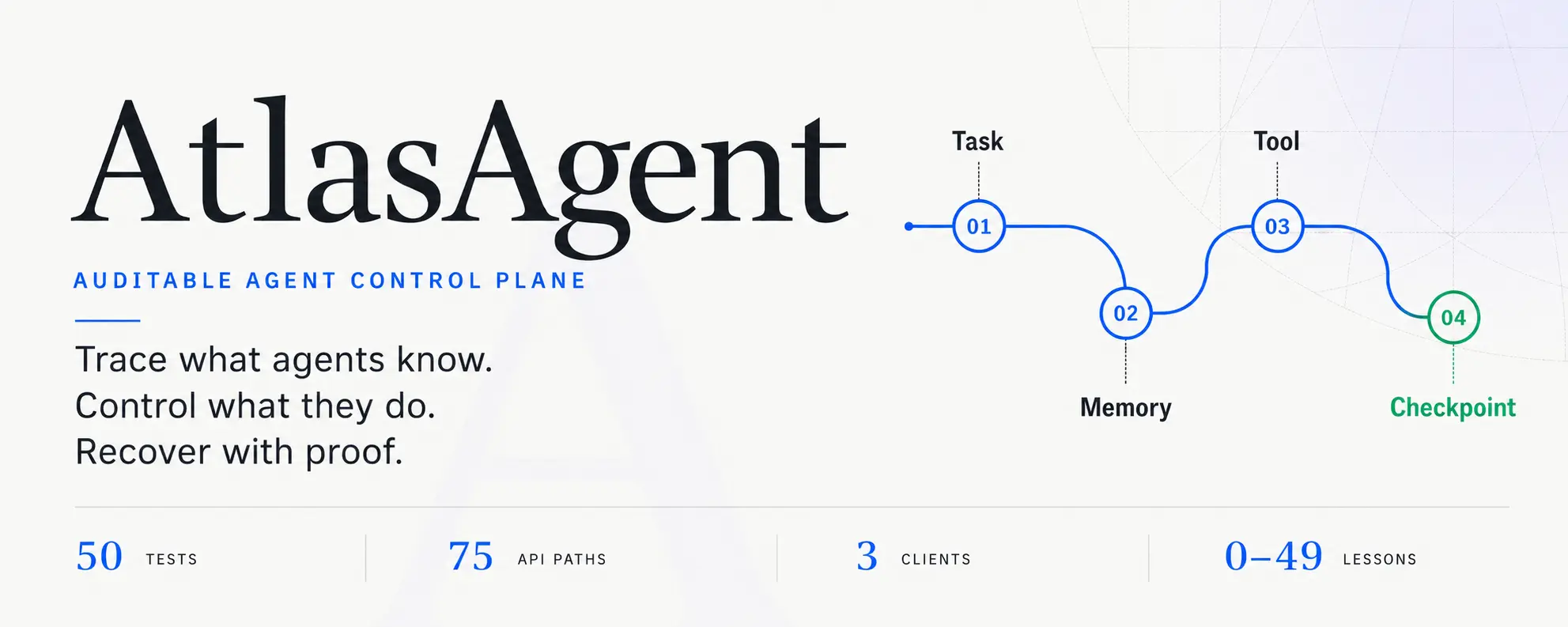
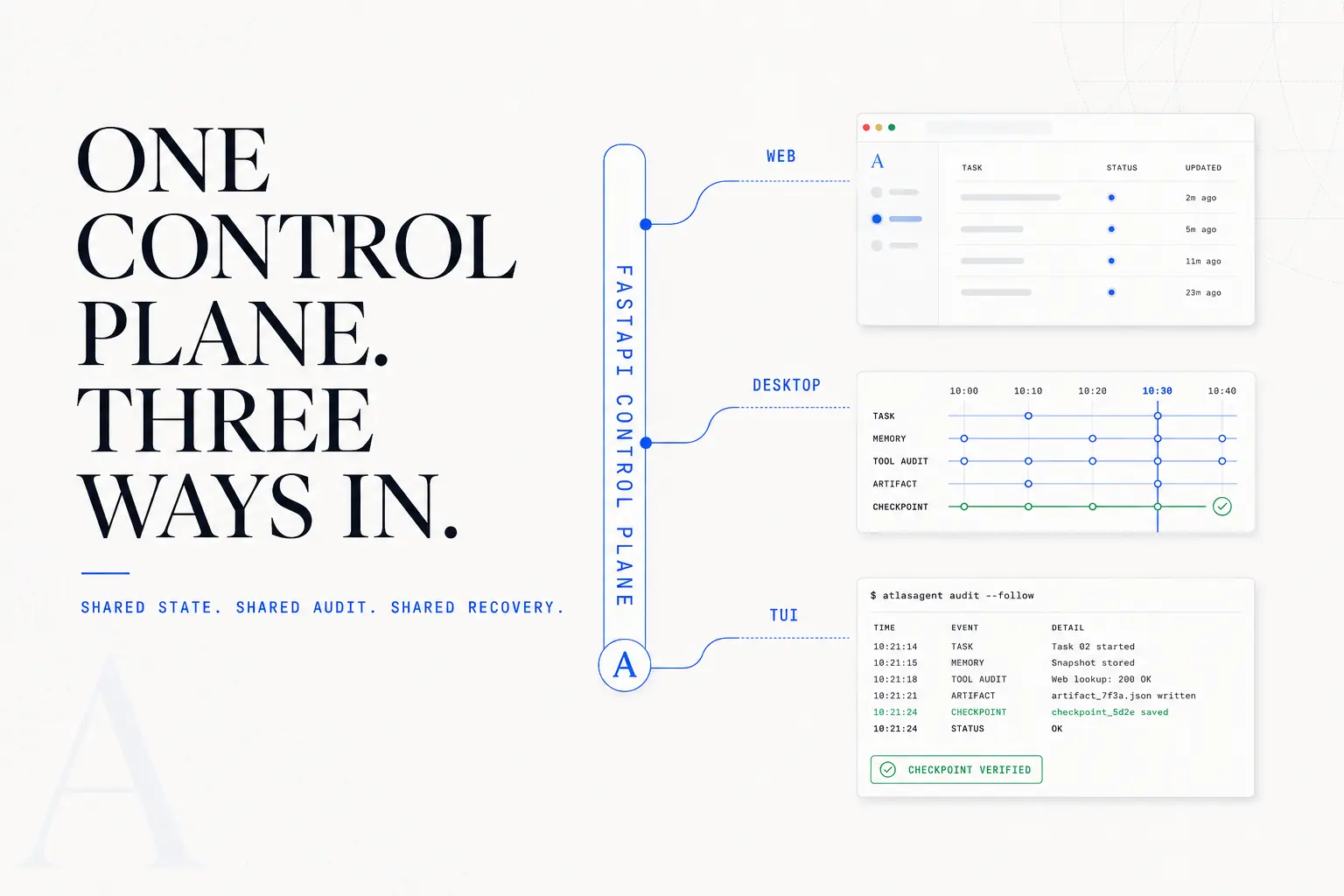
AtlasAgent is a control plane for agent work that records evidence, gates tool calls, and stores checkpoints for recovery. It pairs a FastAPI backend with a Next.js web app, a Textual TUI, a sandbox, and docs for memory, RAG, and skill handling.
Builders who want an agent system that can justify its answers, control its tools, and recover long jobs.
You can run longer agent tasks with evidence, approvals, and recovery points instead of loose chat history.
Facts pass a write gate with source, scope, and expiry before they reach the model, then flow through decay, consolidation, conflict handling, and a typed memory graph.
RAG includes query rewriting, multi-query RRF fusion, parent-document retrieval, reranking, and retrieval traces with confidence scores.
Tool calls go through risk tiering, approval, idempotency, timeout, redaction, and artifact handling before the handler runs.
A task is not marked done until the acceptance command passes, the scope audit matches the plan, and coverage review approves the tests.
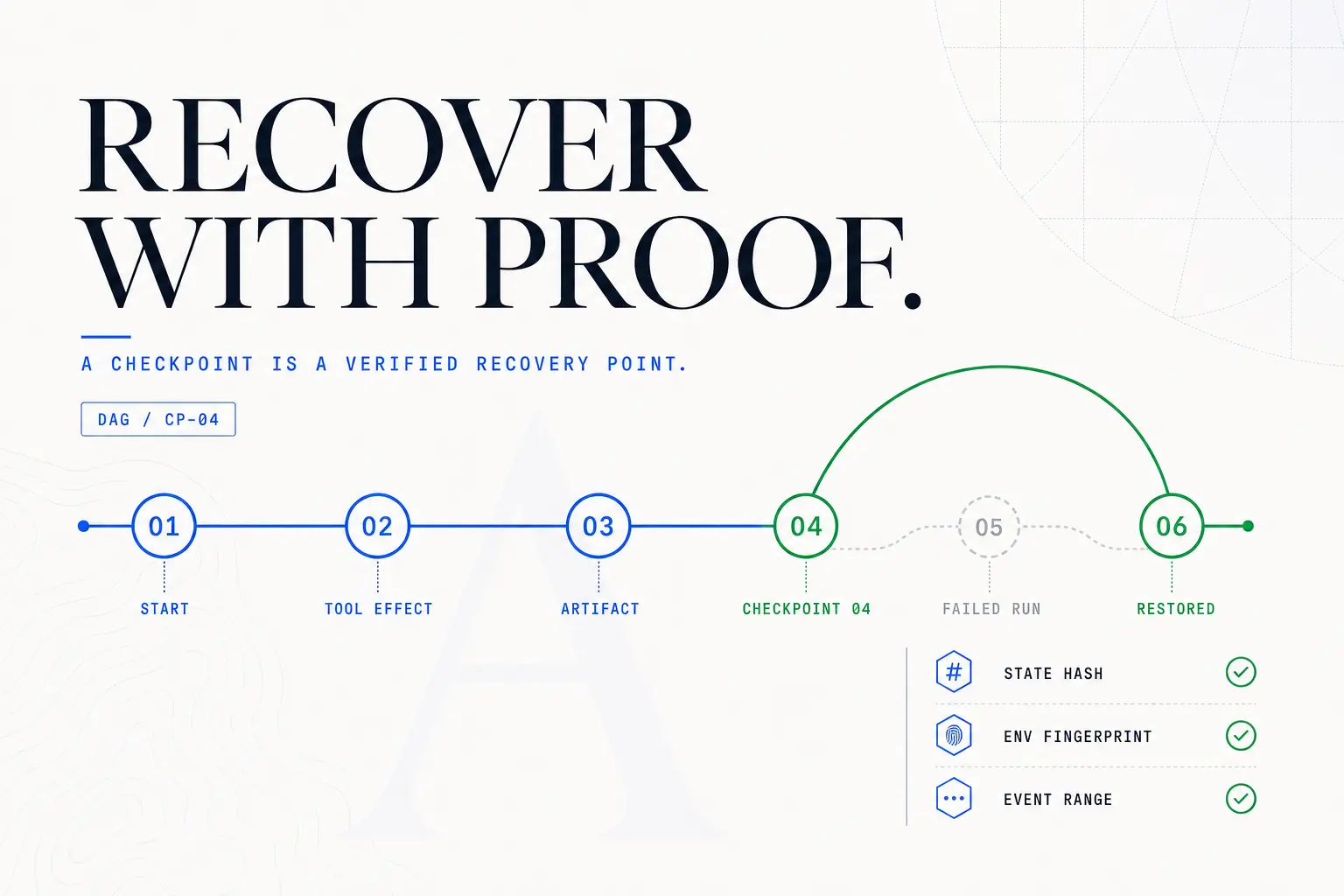
Tasks save state hashes and environment fingerprints so interrupted runs can resume from a verified checkpoint.
Every task action is stored as a queryable event record, making the system state rebuildable from logs.
git clone https://github.com/malevrigns/atlas-agent-control-plane.git
cd atlas-agent-control-plane
python scripts/quickstart.py
cp .env.example .env
BUILD=true ./scripts/start.sh
When I deployed OpenClaw for the first time, the experience was unlike anything before. But a question followed me for weeks: these general agents are already this strong — is there any point in building another one?
The answer I settled on: a general agent is a good knife; a vertical agent is a machine assembled for one workflow. They don't compete. So this project is my attempt to build the machine — not a chat shell wired to an LLM, but a system that plans a task, executes it step by step, calls tools, observes results, and answers with evidence it can point to.
Along the way I kept running into the same wall: the demos were impressive, but the moment you ask "where did this fact come from?" or "what did the agent do while I was asleep?" — nothing holds up. AtlasAgent is what that wall looks like when you take it seriously. Every fact carries its source. Every tool call passes a gate before it runs. Every long task leaves behind checkpoints you can resume from. And when a task claims it's done, an acceptance command has to exit 0 before the system believes it.
One more thing: the whole system is paired with a 64-chapter tutorial that rebuilds it from an empty directory — because reading source code tells you what, but rarely why. The trade-offs, the dead ends, the reasons things are the way they are: that's what the tutorial keeps. 写在前面 has the full story, in my own words.
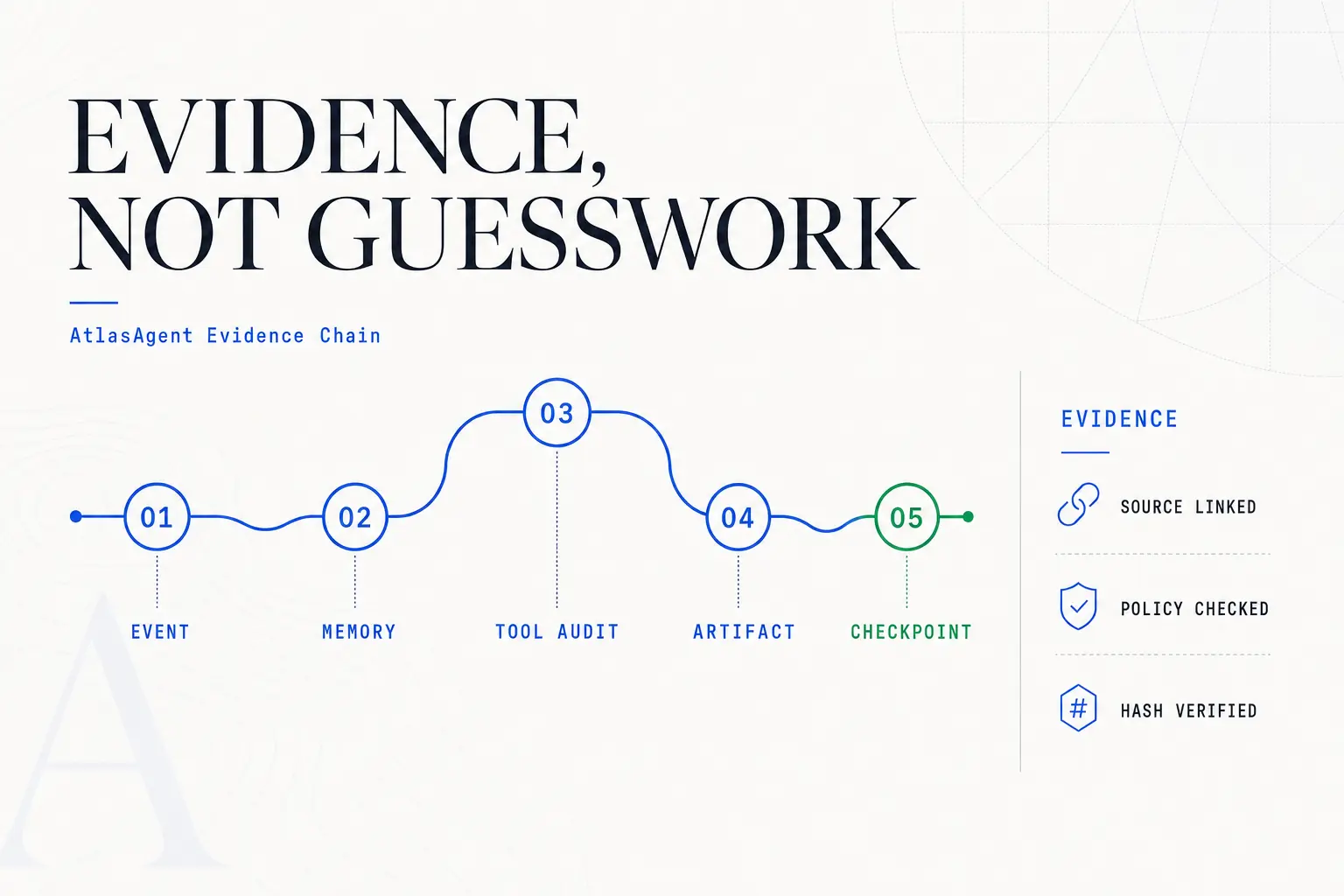
| Memory with provenance | Facts pass a write gate before they reach the model — source, scope, expiry. Then Ebbinghaus decay, consolidation, conflict resolution, and a typed memory graph. A memory should be able to forget. |
| RAG that cites its work | Query rewriting, multi-query RRF fusion, parent-document retrieval, LLM reranking with a lexical fallback. Every citation carries a confidence score; every query leaves a retrieval trace. |
| A tool runtime with a gate | Risk tier → approval → idempotency → timeout → redaction → artifact. The handler runs only after the gate says yes. Add result caching, dependency-aware batching, retries with fallback, per-step budgets. |
| A task must earn "done" | Before a task completes, three gates run in order: the acceptance command (exit 0 or it isn't done), a scope audit (only files the plan declared), and an LLM coverage review of the tests. Three gates, one shared retry budget — no infinite arguing with the model. |
| Checkpoints over restarts | State hashes and environment fingerprints. A task that dies at step 38 resumes from step 17. |
| Events are the only truth | Task state is a rebuildable view; checkpoints are verified recovery points. Everything the agent ever did is a queryable record. |
Just Python 3.11+ — no Docker, no PostgreSQL, no Redis:
git clone https://github.com/malevrigns/atlas-agent-control-plane.git
cd atlas-agent-control-plane
python scripts/quickstart.py
That's SQLite plus an in-process queue, swapped in through two environment variables. Same application, same models, same routes, same migration chain as production. Open http://localhost:8000/docs.
For the full stack — Web workbench, Postgres, Redis, Nginx, sandbox container — you need Git, Docker and Docker Compose v2:
cp .env.example .env
BUILD=true ./scripts/start.sh
Open http://localhost:8088 — the Web workbench. The start script prints the API key you'll log in with. No LLM key? Everything still boots; a local hash embedding powers offline mode, and any OpenAI-compatible endpoint (DeepSeek, Qwen, DashScope, Ollama…) plugs in via one line in backend/api/config/llm.yaml.
ATLAS_KEY="$(sed -n 's/^ATLAS_API_KEY=//p' .env)"

# a structured task, with its acceptance command declared up front
curl -X POST http://localhost:8088/api/control-plane/tasks \
  -H "X-Atlas-API-Key: ${ATLAS_KEY}" -H "Content-Type: application/json" \
  -d '{"title": "Upgrade deps", "goal": "A verifiable upgrade",
       "acceptance_criteria": ["pytest exits 0"], "project_id": "atlas"}'

# a tool call — risk, approval and idempotency are checked before the handler runs
curl -X POST http://localhost:8088/api/agent-core/tools/draft_plan/invoke \
  -H "X-Atlas-API-Key: ${ATLAS_KEY}" -H "Content-Type: application/json" \
  -d '{"arguments": {"task": "Check delivery quality"}, "project_id": "atlas",
       "idempotency_key": "demo-001"}'

# every invocation left a record you can query
curl -H "X-Atlas-API-Key: ${ATLAS_KEY}" \
  "http://localhost:8088/api/control-plane/tool-invocations?project_id=atlas"
More: Memory & Tool Control Plane · RAG & Skills · Architecture
Key settings (see .env.example for the rest): LLM_API_KEY (optional), ATLAS_API_KEY (auto-generated), RAG_VECTOR_BACKEND=pgvector|qdrant, RAG_EMBEDDING_PROVIDER=auto|local_hash, NGINX_PORT (default 8088). The built-in key is a single-tenant boundary; internet-facing deployments need TLS, OIDC/RBAC and rate limiting in front. MCP and A2A transports are off or allowlist-only by default.
Development, after docker compose up -d postgres redis:
| Module | Command |
|---|---|
| API | cd backend/api && uv sync && uv run uvicorn app.main:app --reload |
| Web | cd frontend/web && pnpm install && pnpm dev |
| TUI | cd frontend/tui && uv sync && ATLAS_API_URL=http://localhost:8000 uv run atlas-tui |
| Sandbox | cd backend/sandbox && docker build -t atlas-sandbox . && docker run -d -p 8100:8100 atlas-sandbox |
Tests: cd backend/api && uv run python -m unittest discover -s tests (499 passing).
atlas-agent-control-plane/
├── frontend/
│   ├── web/        Next.js client (PWA)
│   └── tui/        Textual terminal client
├── backend/
│   ├── api/        FastAPI control plane · migrations · 456 tests
│   └── sandbox/    Isolated files / shell / browser / VNC
├── docs/           Deep-dive documentation
├── tutorial/       64-chapter engineering tutorial (62,000+ lines)
├── scripts/        start.sh / stop.sh
└── docker-compose.yml
Issues and PRs are welcome — CONTRIBUTING.md has the setup, commit conventions, and PR flow.
第一次部署 OpenClaw 的时候,体验是前所未有的。但随之而来的问题困扰了我很久:这些通用 Agent 已经这么强了,还有必要从零做一个新的吗?
后来我想明白了:通用 Agent 像一把好刀,垂类 Agent 更像一台按业务流程装配好的机器。两者并不冲突。所以这个项目就是我去造那台机器的尝试——不是一个接了 LLM 接口的聊天壳,而是一个能围绕任务做规划、逐步执行、调用工具、观察结果、最后用可指认的证据回答的系统。
做的过程中反复撞到同一堵墙:演示都很惊艳,但只要你问一句「这条事实从哪来的」「我睡着的时候 Agent 到底干了什么」,就没有一样东西站得住。AtlasAgent 就是把这堵墙当真之后的样子:每条事实带来源,每个工具调用先过门禁,每个长任务留下可以恢复的 Checkpoint,任务说自己完成了,验收命令必须 exit 0,系统才信它。
还有一件事:整个系统配了一套 64 章的教程,从空目录开始把它重新造一遍。因为读源码能知道「是什么」,很难知道「为什么」——那些取舍、死路、和「为什么它是现在这个样子」,教程里都留着。写在前面 里有完整的来龙去脉。
| 带来源的记忆 | 事实先过写入门禁才到模型——来源、作用域、有效期,一个都不能少。再往上叠艾宾浩斯衰减、自动巩固、冲突消解、类型化记忆图谱。记忆应该会遗忘。 |
| 会引用出处的 RAG | 查询改写、多查询 RRF 融合、父文档检索、LLM 重排(词法降级兜底)。每条引用带置信度,每次检索落审计。 |
| 有门禁的工具运行时 | 风险分级 → 审批 → 幂等 → 超时 → 脱敏 → 制品化。门禁说可以,handler 才执行。另有结果缓存、依赖分批、重试降级、步骤预算。 |
| 「完成」要挣来的 | 任务完成前,三道关依次跑:验收命令(exit 0 才算完)、范围审计(只改计划声明的文件)、LLM 覆盖度评审。三关共享重试额度——不和模型无限拉扯。 |
| Checkpoint 优先于重启 | 状态哈希 + 环境指纹。第 38 步挂了,从第 17 步恢复。 |
| 事件是唯一事实源 | 任务状态只是可重建的视图,Checkpoint 是验证过的恢复点。Agent 干过的每件事都是一条可查询的记录。 |
只要 Python 3.11+,不用 Docker、不用 PostgreSQL、不用 Redis:
git clone https://github.com/malevrigns/atlas-agent-control-plane.git
cd atlas-agent-control-plane
python scripts/quickstart.py
数据库换成 SQLite、队列换成进程内实现,靠两个环境变量切过去——应用、模型、路由、迁移链和生产完全是同一套。打开 http://localhost:8000/docs 就能调。
要完整形态(Web 工作台、Postgres、Redis、Nginx、沙箱容器),才需要 Git、Docker、Docker Compose v2:
cp .env.example .env
BUILD=true ./scripts/start.sh
打开 http://localhost:8088 就是 Web 工作台,启动脚本会打印登录用的 API Key。没配模型密钥也能跑——本地哈希 embedding 撑起离线模式;要接模型的话,DeepSeek、Qwen、DashScope、Ollama,任何 OpenAI 兼容接口在 backend/api/config/llm.yaml 里改一行就行。
ATLAS_KEY="$(sed -n 's/^ATLAS_API_KEY=//p' .env)"

# 一个结构化任务,验收命令一开始就声明好
curl -X POST http://localhost:8088/api/control-plane/tasks \
  -H "X-Atlas-API-Key: ${ATLAS_KEY}" -H "Content-Type: application/json" \
  -d '{"title": "升级依赖", "goal": "可验证升级",
       "acceptance_criteria": ["pytest 退出码 0"], "project_id": "atlas"}'

# 一次工具调用——handler 执行前先过风险、审批、幂等检查
curl -X POST http://localhost:8088/api/agent-core/tools/draft_plan/invoke \
  -H "X-Atlas-API-Key: ${ATLAS_KEY}" -H "Content-Type: application/json" \
  -d '{"arguments": {"task": "检查交付质量"}, "project_id": "atlas",
       "idempotency_key": "demo-001"}'

# 每次调用都留了记录,随时可以查
curl -H "X-Atlas-API-Key: ${ATLAS_KEY}" \
  "http://localhost:8088/api/control-plane/tool-invocations?project_id=atlas"
常用配置(其余见 .env.example):LLM_API_KEY(可选)、ATLAS_API_KEY(自动生成)、RAG_VECTOR_BACKEND=pgvector|qdrant、RAG_EMBEDDING_PROVIDER=auto|local_hash、NGINX_PORT(默认 8088)。内置 API Key 是单租户边界;公网多用户部署需要 TLS、OIDC/RBAC 和限流。MCP 与 A2A 传输默认关闭或仅白名单。
本地开发,先 docker compose up -d postgres redis:
| 模块 | 命令 |
|---|---|
| API | cd backend/api && uv sync && uv run uvicorn app.main:app --reload |
| Web | cd frontend/web && pnpm install && pnpm dev |
| TUI | cd frontend/tui && uv sync && ATLAS_API_URL=http://localhost:8000 uv run atlas-tui |
| Sandbox | cd backend/sandbox && docker build -t atlas-sandbox . && docker run -d -p 8100:8100 atlas-sandbox |
测试:cd backend/api && uv run python -m unittest discover -s tests(499 个通过)。
atlas-agent-control-plane/
├── frontend/
│   ├── web/        Next.js 客户端(PWA)
│   └── tui/        Textual 终端客户端
├── backend/
│   ├── api/        FastAPI 控制平面 · 迁移 · 456 个测试
│   └── sandbox/    文件 / Shell / 浏览器 / VNC 隔离执行
├── docs/           专题深潜文档
├── tutorial/       64 章中文工程教程(62000+ 行)
├── scripts/        start.sh / stop.sh
└── docker-compose.yml
欢迎 Issue 与 PR——流程见 CONTRIBUTING.md。
Sign in to join the discussion.
No comments yet. Be the first to say what this is good for.
The agent harness performance optimization system. Skills, instincts, memory, security, and research-first development for Claude Code, Codex, Opencode, Cursor and beyond.
The job search that runs on your machine. AI job application framework built on Claude Code: evaluate postings, tailor CVs, write cover letters, prep interviews. Fork it and own it.
from vibe coding to agentic engineering - practice makes claude perfect
🌊 The original agent meta-harness. Deploy intelligent multi-player swarms, coordinate autonomous workflows, and build conversational AI systems. Features adaptive memory, self-learning intelligence, RAG integration, and native Claude Code / Codex / Hermes and many more Integrated
Practical patterns, starters & CLI tools for loop engineering with AI coding agents. Design systems that prompt and orchestrate agents (inspired by Addy Osmani and Boris Cherny). Includes loop-audit, loop-init, loop-cost.

Git. Ship. Done - Core