
JuliusBrussee/
caveman

🪨 why use many token when few token do trick — Claude Code skill that cuts 65% of tokens by talking like caveman
105k
1 add
sheal is a command-line tool that analyzes coding sessions, extracts patterns, and writes useful learnings back into agent config files like `CLAUDE.md` and `AGENTS.md`. It also checks project health, audits settings, searches past sessions, and shows digests and cost reports.
Builders who want their coding agent to remember lessons from past sessions and apply them next time.
You can turn repeated session mistakes into saved learnings and better agent behavior on the next run.
`sheal retro` analyzes the latest session for failure loops, wasted effort, and learnings, with optional agent-assisted enrichment.
`sheal learn` adds, reviews, promotes, syncs, and lints learnings stored as markdown files with frontmatter.
`sheal ask` searches across transcripts, and `sheal browse` gives a TUI for sessions, retrospectives, learnings, and digests.
`sheal check`, `sheal guard`, and `sheal drift` look for setup problems, empty PRs, and learnings that are not being applied.
`sheal init` writes sheal instructions into project agent files such as `CLAUDE.md` and `.cursorrules`.
`sheal digest`, `sheal cost`, and `sheal weekly` summarize what happened, where tokens went, and what changed over time.
`sheal sessions import`, `sheal pull`, and `sheal export` move transcripts and metadata into the local registry for later analysis.
npm install -g @liwala/sheal
git clone https://github.com/liwala/sheal
cd sheal
npm install
npx tsc
npm link

your ai agent keeps making the same mistakes. sheal fixes that.



Install • Quick Start • Commands • How It Works • Agents
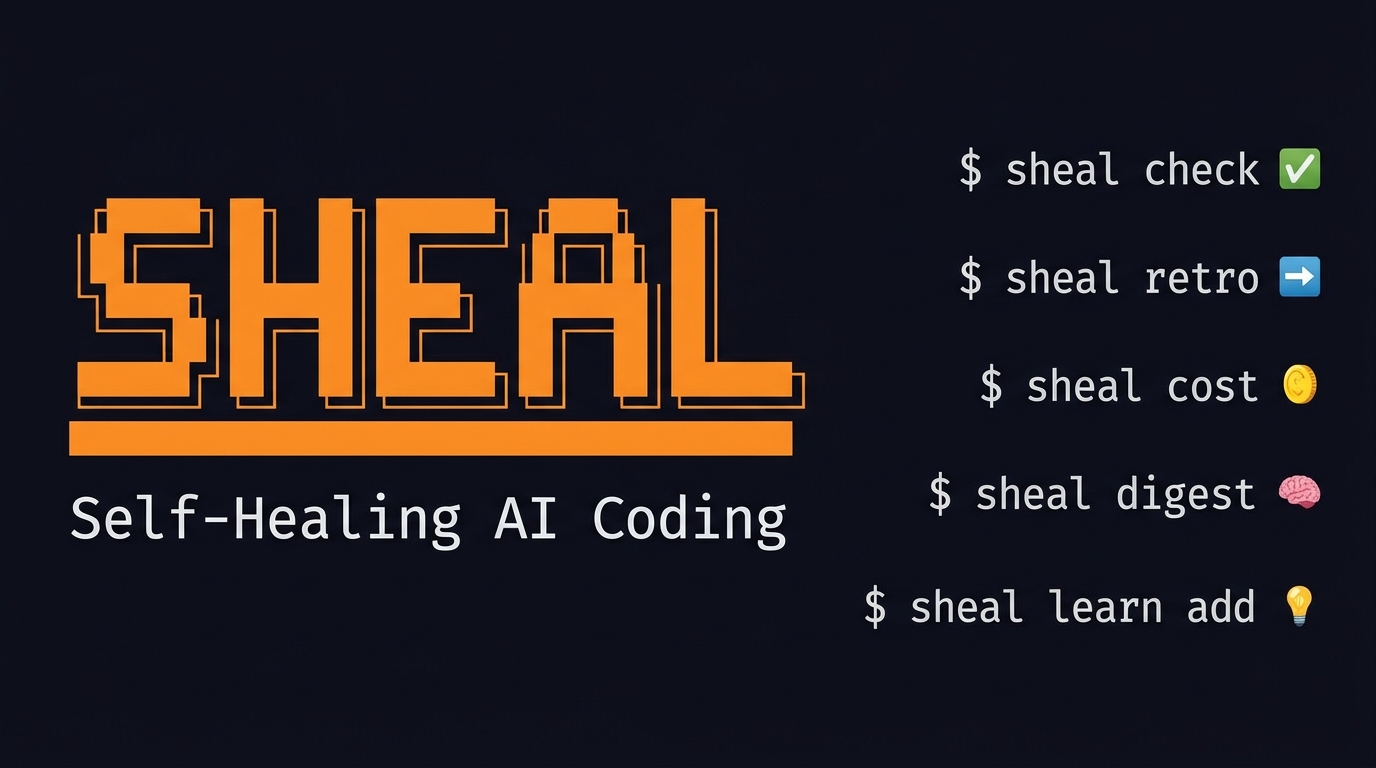
A CLI toolkit that analyzes AI coding sessions to extract learnings, detect failure patterns, and continuously improve agent behavior.
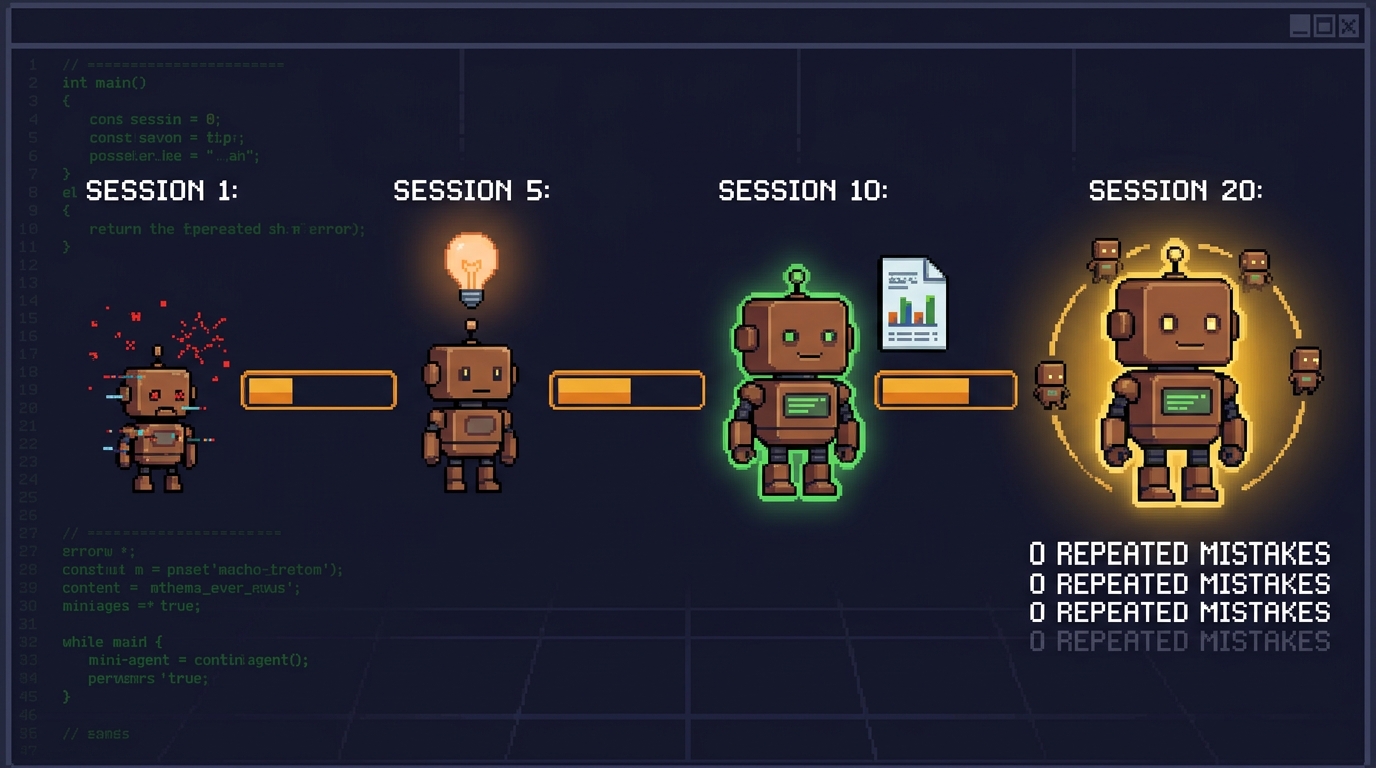
Your AI agent has amnesia. Every session it repeats the same mistakes, burns the same tokens, forgets the same rules. sheal closes the loop — it reads your sessions, extracts the patterns, writes rules back to your agent config, and makes the next session smarter. It compounds.
npm install -g @liwala/sheal
Or from source:
git clone https://github.com/liwala/sheal
cd sheal
npm install
npx tsc
npm link
# Health check your project setup
sheal check

# Audit your Claude Code settings (permissions, hooks, MCPs)
sheal audit

# Run a retrospective on your latest session
sheal retro

# See your token spend per project
sheal cost

# Get a categorized digest of what you worked on
sheal digest --since "7 days"

# Ask a question across all your sessions
sheal ask "what went wrong with beads?" --agent claude

# Add a learning from experience
sheal learn add "Always inspect real data before writing parsers" --tags=parsing
sheal checkPre-session health check. Detects environment issues before you start coding.
sheal check                    # Pretty output
sheal check --format json      # JSON output
sheal check --skip performance # Skip specific checkers
sheal check --strict           # Warnings are blockers: exit non-zero on any warning
Checkers: git status, dependencies, tests, environment, session learnings, performance & efficiency, Claude Code settings.
sheal guardPoint-in-time gates compiled from learnings, designed for hooks and CI.
sheal guard pr                 # Pre-PR gate: branch must be ahead of base, exit 1 otherwise
sheal guard pr --base develop  # Non-main base branch
guard pr verifies HEAD is a working branch (not the base itself), that
git rev-list base..HEAD is non-empty (an empty PR is always a mistake), and
warns on uncommitted changes. Wire it into a PreToolUse hook on gh pr create
or a CI step.
The performance checker detects your AI agent (Claude Code, Cursor, Gemini, Copilot, Amp), checks for RTK token compression, and config file sizes. The claude-settings checker audits permissions, hooks, MCP servers, env vars, and plugins across all settings scopes.
sheal auditAudit Claude Code settings across all scopes — permissions, hooks, MCP servers, environment variables, and plugins.
sheal audit                    # Pretty output
sheal audit --format json      # JSON output
sheal audit -p /path/to/project  # Different project root
Reads from all four settings files (global, global-local, project, project-local) and shows a merged view of what's configured where.
sheal retroSession retrospective. Analyzes the most recent AI coding session for failure loops, wasted effort, and learnings.
sheal retro                        # Static analysis (latest session)
sheal retro --checkpoint <id>      # Specific session
sheal retro --enrich               # LLM-enriched deep analysis
sheal retro --enrich --agent amp   # Use a specific agent CLI
sheal retro --prompt               # Output raw prompt (pipe to any LLM)
sheal retro --format json          # JSON output
The --enrich flag invokes an agent CLI to perform deep analysis on top of the static retro. The agent extracts rules and offers to save them as learnings. Results are cached at .sheal/retros/.
sheal ask <question>Query across your session transcripts using natural language. Uses a 3-phase pipeline:
# Search current project's sessions
sheal ask "what went wrong with beads?"

# Use a specific agent for analysis
sheal ask "how did we handle the auth migration?" --agent codex

# Search ALL projects globally
sheal ask --global "what patterns keep causing test failures?"

# Search a different project
sheal ask -p /path/to/other-project "what happened with the auth migration?"

# Search more sessions
sheal ask "show me all test failures" -n 20
Options:
--agent <name> — Agent CLI to use: claude, gemini, codex, amp-n, --limit <count> — Max sessions to search (default: 10)--global — Search across ALL projects in ~/.claude/projects/-p, --project <path> — Project root to search (default: current directory)Previously saved results can be browsed:
sheal ask-list              # List saved results
sheal ask-list --global     # List global results
sheal ask-show "beads"      # Show a specific saved result
sheal browseInteractive TUI to explore sessions, retrospectives, and learnings across all your projects.
sheal browse                       # Full TUI (project list)
sheal browse sessions              # Jump to sessions view
sheal browse retros                # Jump to retros view
sheal browse learnings             # Jump to learnings view
sheal browse digests               # Browse digest reports
sheal browse -p myproject          # Pre-filter by project name
sheal browse --agent codex         # Pre-filter by agent
Supports Claude Code, Codex, Amp, and Entire.io sessions. Claude and Codex
sessions that are visible in the live home directories but not yet present in
.sheal/sessions/raw/ are marked as not backed up, and the sessions view offers
to add them to the registry.
sheal sessions importImport Claude Code and Codex transcripts from live home directories, or from an explicit source root, into the current project's raw session registry.
sheal sessions import              # Import from ~/.claude and ~/.codex
sheal sessions import --source /tmp/agent-home
sheal sessions import --format json
Imported sessions are written to
.sheal/sessions/raw/<stable-session-id>/ with manifest.json,
transcript.raw.jsonl, and normalized.json. Live-home and explicit-source
imports do not create pull staging ingested.json markers.
sheal exportExport session data as JSON for scripting and piping.
sheal export                       # List sessions (current project)
sheal export --checkpoint <id>     # Export a specific checkpoint
sheal export --global              # Export all projects and sessions
sheal pullAcquire local sandbox changes into sheal's staging area. The shipped local path
supports sbx sandboxes and Docker containers, capturing git diff, agent
artifacts, and transcripts from runtime home directories when present. Missing
agent-specific transcript paths are reported as gaps in the pull output and
provenance.
Agent home artifacts are discovered by probing supported agent directories under
the sandbox user's home directory ($HOME/.claude, $HOME/.codex,
$HOME/.copilot, $HOME/.cursor, $HOME/.docker-agent, $HOME/.droid,
$HOME/.gemini, $HOME/.kiro, and $HOME/.opencode). Missing home probes are
ignored. Transcripts are pulled from known agent home paths such as
$HOME/.claude/sessions.jsonl, $HOME/.claude/history.jsonl,
$HOME/.claude/projects/<project-slug>/, and $HOME/.codex/sessions/ when
present. Workspace files such as AGENTS.md, MEMORY.md, and
.sheal/session.jsonl are not part of the pull capture contract.
sheal pull --list                  # List available sbx sandboxes and Docker containers
sheal pull sbx <name>              # Pull one sbx sandbox to ~/.sheal/pulls/
sheal pull sbx <name> --checkpoint # Write a checkpoint stage without registry import
sheal pull --checkpoint-run        # Run configured checkpoint targets once
sheal pull sbx --all               # Pull every sbx sandbox with a workspace
sheal pull docker <name>           # Pull one Docker container selected from --list
Use sheal pull --list first to copy the exact sandbox or container name.
Docker selection is intentionally human-driven, so sheal pull docker --all is
not supported. Pull acquisition output lands under
~/.sheal/pulls/<backend>/<name>/<timestamp>/ unless pull.stagingDir
overrides it. Pulled Claude and Codex transcripts are normalized into the
project-local raw registry at .sheal/sessions/raw/<stable-session-id>/; the
pull staging directory gets an ingested.json marker pointing at the raw
session IDs.
Use --checkpoint with sheal pull <backend> <name> for a manual mid-session
capture before teardown. Checkpoint mode uses the same local adapter capture set
and staging root, writes checkpoint.json, stamps provenance with
captureKind: "checkpoint", and does not normalize transcripts into the raw
registry or write an ingested.json marker. Long-running daemon scheduling is a
future layer over this manual checkpoint primitive.
Use --checkpoint-run to run a one-shot checkpoint pass over explicitly
configured local targets:
{
  "pull": {
    "checkpointTargets": [
      { "backend": "sbx", "name": "codex-before-teardown" }
    ]
  }
}
The runner never implies --all: only pull.checkpointTargets are
checkpointed, unconfigured sandboxes are ignored, and checkpoint stages still do
not import into the raw registry.
sheal initBootstrap sheal awareness into your project's agent configuration files (CLAUDE.md, .cursorrules, etc.).
sheal init                         # Add sheal instructions to agent configs
sheal init --dry-run               # Preview changes without writing
sheal graphCross-session knowledge graph showing file hotspots, agent activity, and patterns.
sheal graph                        # Pretty-print graph summary
sheal graph --file src/index.ts    # History for a specific file
sheal graph --agent claude         # Details for a specific agent
sheal graph --json                 # JSON output
sheal digestCategorized digest of all your prompts across agents. See what you actually worked on.
sheal digest                           # Last 7 days, pretty output
sheal digest --since "1 month"         # Custom window
sheal digest --enrich                  # LLM-powered categorization (Haiku)
sheal digest --compare                 # Diff against previous digest
sheal digest -p myproject              # Filter to one project
sheal digest -f markdown -o report.md  # Export as markdown
The --enrich flag uses Haiku to smart-categorize prompts that rule-based matching missed. The --compare flag finds the previous digest for the same scope and shows what changed.
sheal costToken cost dashboard — see exactly where your Claude budget goes.
sheal cost                             # Last 7 days
sheal cost --since "1 month"           # Custom window
sheal cost -p myproject                # Single project
sheal cost --plan "Max 5x"            # Compare against your plan
sheal cost --format json               # JSON output for scripting
Shows per-model breakdown, per-project spend, project-by-model matrix, cost type split (input/output/cache-read/cache-write), and subscription savings vs Pro / Max 5x / Max 20x plans.
sheal weeklyFull weekly report — runs digest + cost together, optionally with deep Claude analysis and Slack delivery.
sheal weekly                           # Digest + cost for last 7 days
sheal weekly --agent                   # Add deep LLM analysis
sheal weekly --slack                   # Post summary to Slack
sheal weekly --plan "Max 20x"          # Include plan savings
Reports are saved to ~/.sheal/weekly-digests/ for historical tracking.
sheal driftDetect when learnings aren't being applied in recent sessions. Compares your active learnings (both global and project-scoped) against session data to find patterns that should have been prevented but weren't.
sheal drift                        # Check learnings against last 10 sessions
sheal drift -n 20                  # Check against more sessions
sheal drift -p /path/to/project    # Different project root
sheal drift --json                 # JSON output
Each drifted learning is labeled [global] or [project] so you can see where the violation originated. Severity dots indicate how often the learning was violated (● once, ●● twice, ●●● three or more times).
Detection methods:
Recurring sections from LLM-enriched retrossheal learnManage ADR-style session learnings. Learnings are stored as individual markdown files with frontmatter metadata.
# Add a learning (saves to project by default)
sheal learn add "Always check bd --help before guessing flags" \
  --tags=beads,cli --category=workflow --severity=high
sheal learn add --global "..."  # Save directly to global store

# List learnings
sheal learn list              # Project learnings (.sheal/learnings/)
sheal learn list --global     # Global learnings (~/.sheal/learnings/)
sheal learn list --tag=beads  # Filter by tag

# Review & curate learnings interactively
sheal learn review              # Project learnings (drafts shown first)
sheal learn review --global     # Global learnings

# Promote curated project learnings to global
sheal learn promote

# Pull global learnings into project (by tag match)
sheal learn sync

# Corpus hygiene: duplicate IDs, near-duplicate rules, missing triggers
sheal learn lint                # Exit 1 on findings (CI-usable)
sheal learn lint --format json

# Consolidation pass: emit a reviewable change set (never mutates the store)
sheal consolidate               # Writes .sheal/consolidation/<date>-change-set.md
sheal consolidate --format json # Mechanical change set to stdout
sheal consolidate --prompt      # LLM judgment-stage prompt — pipe to any agent CLI
Back up ~/.sheal/ to a git repo for cross-machine sync and team sharing. By default backs up learnings, digests, and config. Optionally includes retros from all projects.
# Connect to a remote repo (initializes git in ~/.sheal/)
sheal backup remote add git@github.com:you/sheal-data.git

# Push (learnings + digests + config)
sheal backup push

# Also gather retros from all projects
sheal backup push --include retros

# Pull from remote
sheal backup pull

# Show or disconnect
sheal backup remote show
sheal backup remote remove

# learn push/pull are aliases for backup push/pull
sheal learn push
sheal learn pull
Learnings are never auto-accepted. Every learning goes through human review before it can influence agent behavior:
sheal retro --enrich — the LLM extracts candidate rules from the session.sheal/learnings/ with status: draftstatus: active and show up in sheal learn listsheal learn promote — lift project learnings to your global store (~/.sheal/learnings/)sheal learn sync — pull relevant global learnings back into other projectssheal rules — inject active learnings into agent config files (AGENTS.md, .cursorrules)You can also add learnings manually (sheal learn add "...") or review remaining drafts later (sheal learn review).
The full lifecycle:
retro → project drafts → review → active → promote → global ─┐
             ▲               │                       digests ──┤
             │          human accepts                 config  ──┼─ backup push → remote
        learn add       edits, or rejects             retros  ──┘  backup pull ← remote
                                                      global ──── sync → project
Learning format (~/.sheal/learnings/LEARN-001-inspect-real-data.md):
---
id: LEARN-001
title: Inspect real data before writing parsers
date: 2026-03-13
tags: [parsing, external-data, general]
category: missing-context
severity: high
status: active
---

Before writing parsers for external data formats, always inspect 2-3 real
samples first. Don't rely solely on documentation or type definitions.
Categories: missing-context, failure-loop, wasted-effort, environment, workflow
sheal supports two session data sources with automatic fallback:
~/.claude/projects/ (default)entire/checkpoints/v1 git branch (rich metadata, AI summaries, attribution)For --enrich and ask commands, sheal can invoke these agent CLIs:
| Agent | CLI Command | Invocation |
|---|---|---|
| Claude Code | claude | claude -p --output-format text (stdin) |
| Codex | codex | codex exec - (stdin) |
| Amp | amp | amp -x (stdin) |
| Gemini CLI | gemini | stdin pipe |
Use --agent claude, --agent codex, --agent amp, or --agent gemini to pick one. Auto-detection tries the session's own agent first, then falls back to any available CLI.
Session Capture (Entire.io / Claude Code native)
    |  session transcripts, diffs, metadata
    v
Self-Healing Engine (sheal)
    |  failure patterns, learnings, rules
    v
Agent Configuration (CLAUDE.md, .cursorrules, etc.)
    |  improved behavior
    v
Next Session (fewer mistakes)
sheal reads an optional .self-heal.json from the project root (or the nearest
ancestor directory). It configures checkers and pull staging, e.g.:
{
  "checkers": {
    "tests": { "timeoutMs": 30000 },
    "environment": {
      "requiredVars": ["DATABASE_URL"],
      "requiredServices": [{ "name": "postgres", "check": "pg_isready -p 5432" }]
    }
  }
}
A .self-heal.local.json next to it (gitignored) is merged over the shared
config field by field — use it for machine-local checks and private tooling
that don't belong in the repo.
npx tsc          # Build
npx vitest run   # Test
sheal check      # Dogfood
MIT
Sign in to join the discussion.
No comments yet. Be the first to say what this is good for.
🪨 why use many token when few token do trick — Claude Code skill that cuts 65% of tokens by talking like caveman

The best-benchmarked open-source AI memory system. And it's free.

Orca is the ADE for working with a fleet of parallel agents. Run any coding agent with your own subscription. Available on desktop, mobile and remote runtime.
A cross-platform desktop All-in-One assistant for Claude Code, Codex, OpenCode, OpenClaw, Grok Build & Hermes Agent. Only official website: ccswitch.io

Never stop coding. Free MIT AI gateway: one endpoint, 352 providers (150+ free), 1200+ models Kimi, Claude, GPT, Gemini, GLM, DeepSeek, MiniMax. Works with Claude Code, Codex, Cursor, OpenCode, Cline & Copilot. Quota-aware auto-fallback, RTK+Caveman compression saves 15-95% tokens, MCP/A2A, Desktop/PWA. Built by 550+ contributors

Compress tool outputs, logs, files, and RAG chunks before they reach the LLM. 20% fewer tokens for coding agents, 60-95% fewer tokens for JSON, same answers. Library, proxy, MCP server.