
obra/
superpowers

obra/superpowersSkills
An agentic skills framework & software development methodology that works.
285k
1 add
This repository packages a skill that profiles data, checks readiness, routes a question to the right kind of analysis, and generates a source-backed report. It keeps the original source, contract, and provenance visible, and only adds a decision brief when the evidence supports one.
Builders who want their agent to handle high-stakes analysis with explicit data gates, provenance, and bounded outputs.
You can move from an ambiguous question to a reproducible evidence report without turning weak data into a stronger claim.
Preserves the original source, checks grain, keys, schema, quality, and privacy, and stops when a transformation needs approval.
Chooses descriptive, diagnostic, predictive, or prescriptive work only when the evidence supports that route.
Produces an Evidence Intelligence Report with linked figures, JSON results, hashes, and rerunnable code.
Adds a Decision Intelligence Brief only when a separate action decision is justified.
Includes tests, rebuild scripts, and verification guides so the portfolio can be reproduced from the repo.
npx skills add limingrui679-design/high-stakes-analytics-decision-lab -g
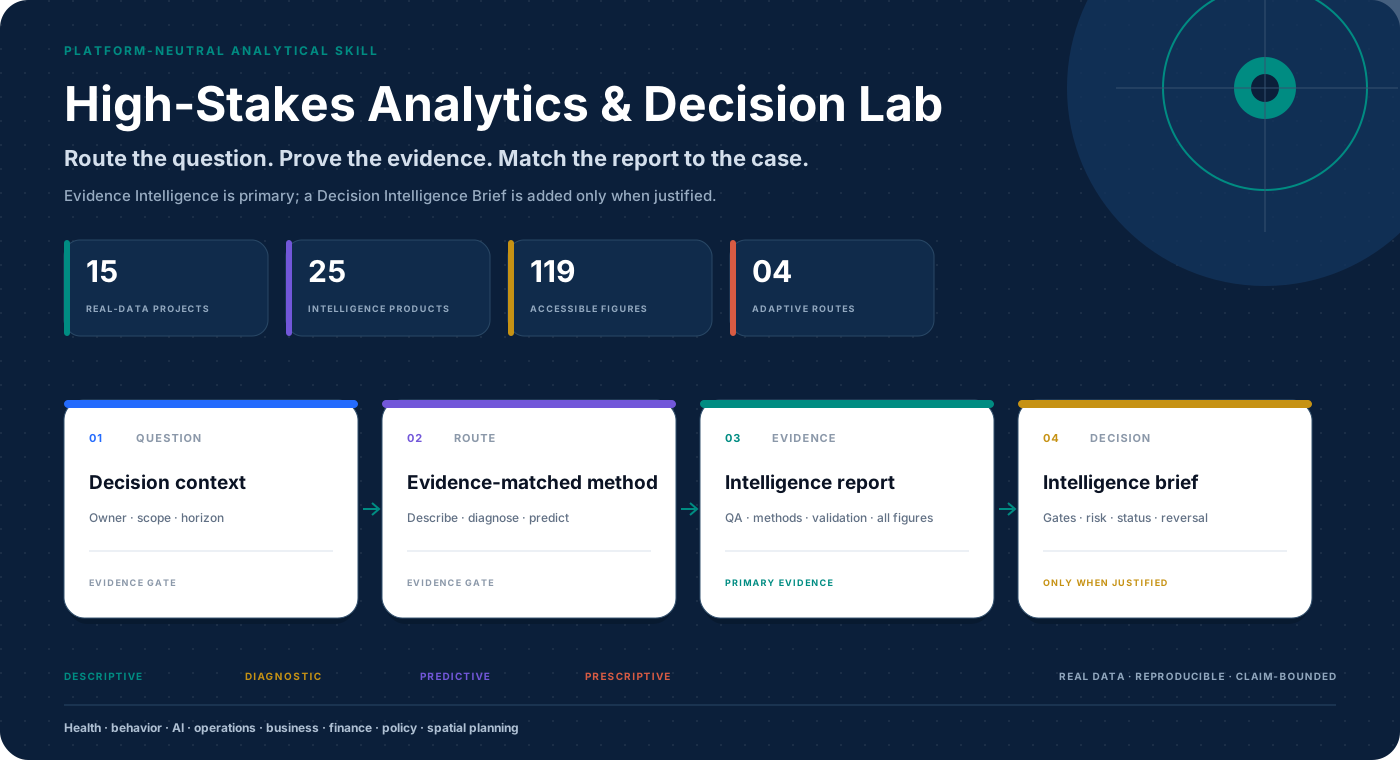
Evidence-gated analytics for consequential questions.
Move from an ambiguous decision to reproducible evidence—and only then, when justified, to bounded action.


Quick start · Architecture · Live explorer · Portfolio · Documentation · Contributing
High-stakes analysis often fails before the model: the question is underspecified, the data contract is implicit, cleaning choices are hidden, uncertainty is treated as independent, or a recommendation is written because the template expects one.
This repository is a platform-neutral Agent Skill and reproducible research portfolio built around a stricter sequence:
| Principle | System behavior |
|---|---|
| Evidence before method | Declare the question, population, grain, target quantity, horizon, lineage, and claim boundary first |
| Readiness before analysis | Preserve the source, profile quality and privacy, and pause on material transformations |
| Adaptive routes | Add descriptive, diagnostic, predictive, or prescriptive work only when justified |
| Honest endpoints | Accept an evidence request, negative validation, do_not_deploy, or no recommendation |
| Dependent uncertainty | Retain shared time, market, participant, campaign, operational, and spatial shocks |
| Traceable communication | Link claims and accessible figures to JSON, CSV, hashes, and rerunnable code |
The result is not a fixed report generator. It is an evidence-gated orchestration system that can stop, ask for a named decision, or produce a bounded analytical product without upgrading weak evidence into a stronger claim.
npx skills add limingrui679-design/high-stakes-analytics-decision-lab -g
The Agent Skills installer discovers the compact package under
skills/high-stakes-analytics-decision-lab/:
39 files and about 472 KiB, rather than the full research portfolio. Its
machine-readable file and hash contract is in
bundle-manifest.json.
Use docs/getting-started.md for Codex-specific,
no-install, and direct repository options.
$high-stakes-analytics-decision-lab
Run the data-readiness gate on this source, preserve the original file, and
select only the analytical routes the evidence supports. Produce an Evidence
Intelligence Report. Add a Decision Intelligence Brief only if the evidence
and decision context justify one.
Start with the decision or evidence question—not a preferred model. A valid
result may be a bounded action, a pilot requirement, targeted diligence, an
evidence request, negative validation, or do_not_deploy.
Every complete project keeps the narrative, machine result, visual evidence, and source lineage together:
report.md                    # primary Evidence Intelligence Report
results.json                 # machine-readable analytical result
chart-map.json               # figure-to-question and source contract
figures/*.svg                # accessible analytical visuals
A justified decision layer adds decision-report.md,
decision-results.json, and its own figure contract. It never replaces the
primary evidence product.
| Starting point | Command or guide | Outcome |
|---|---|---|
| Environment audit | python3 scripts/hsadl.py doctor | Python, runtime, template, write-access, and Skill-footprint checks |
| Safe 60-second walkthrough | python3 scripts/hsadl.py demo --output-dir build/demo | Synthetic source preservation, contract, quality gate, route, and accessible SVGs; no model or recommendation |
| Question only | python3 scripts/hsadl.py route "<question>" --scope full --output-dir <path> | Evidence and method blueprint; no invented result |
| Question plus data | python3 scripts/hsadl.py start <data.csv> --question "<question>" --output-dir <path> | Preserved source, draft contract, readiness profile, and unresolved decisions |
| Existing decision case | python3 scripts/hsadl.py validate <case.json> then python3 scripts/hsadl.py run <case.json> --output-dir <path> | Validated expected, tail, sensitivity, provenance, and group-impact outputs |
| Worked precedents | Fifteen-project portfolio | Complete source-to-report evidence paths |
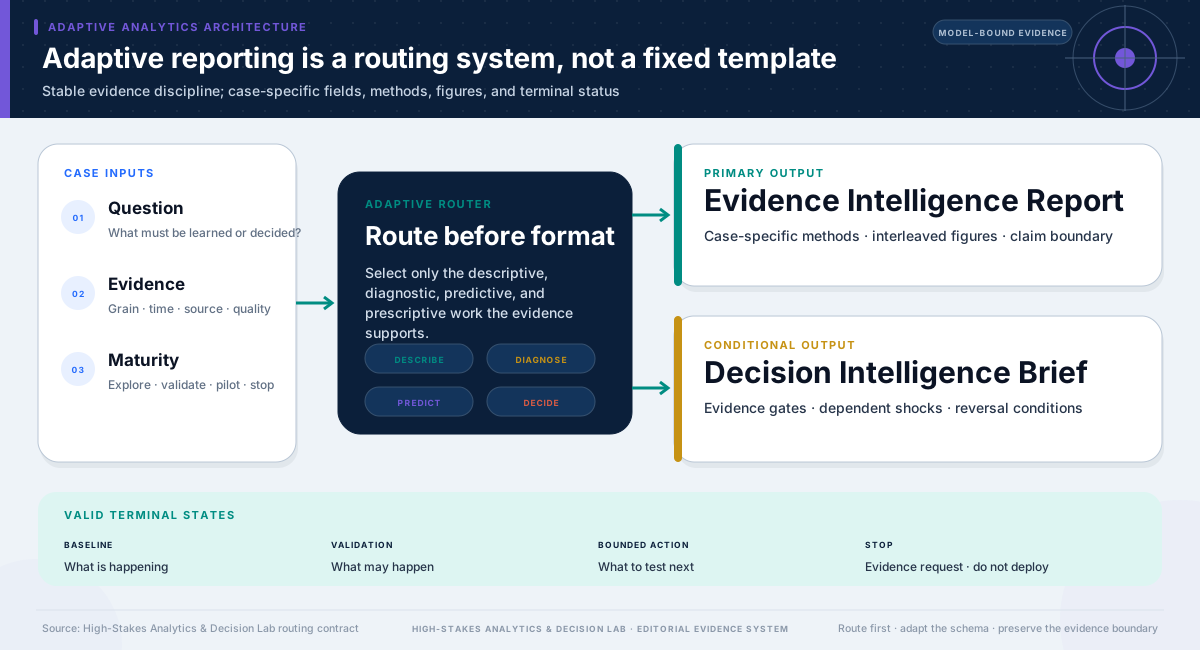
The fixed evidence spine remains stable while the case-specific analytical layer changes.
| Fixed evidence spine | Adaptive case layer |
|---|---|
| Question, population, unit, target quantity, and horizon | Route, fields, methods, and validation |
| Source lineage, quality status, and reproducibility | Figures, report sections, and decision criteria |
| Uncertainty, limitations, and claim boundary | Bounded action, evidence request, or stopping status |
Uploaded row-level data do not go directly into a model. The system preserves the original, establishes a contract, checks grain and keys, profiles quality and privacy, and produces a dry-run remediation plan.
| Gate status | Meaning | Permitted next step |
|---|---|---|
ready | No material failure under the declared contract | Continue |
ready_with_documented_limitations | Localized issues remain | Continue with visible limits |
needs_user_confirmation | A substantive transformation, privacy, or intended-use choice remains | Pause for a named approval or clarification |
blocked | Grain, key, schema, leakage, or another critical failure invalidates the route | Stop and request corrected evidence |
Only safe normalization can run without approval. Deletion, imputation, outlier treatment, category merging, unit conversion, target correction, and grain changes require explicit action IDs. The processed copy never overwrites the source.
| Route | Question | Required discipline | Valid endpoint |
|---|---|---|---|
| Descriptive | What is happening? | Denominators, coverage, trends, segments, and missingness | Baseline report or evidence request |
| Diagnostic | Why might it be happening? | Contributions, competing explanations, hypotheses, and a visible causal boundary | Prioritized explanations to test |
| Predictive | What is likely next? | Target, horizon, baseline, held-out validation, calibration, subgroup error, and drift | Validated prediction, negative validation, or do_not_deploy |
| Prescriptive | What should be done, if justified? | Owner, alternatives, constraints, dependence, tail risk, sensitivity, and reversal conditions | Bounded action or no decision-ready recommendation |
Routes may compose, but a later route cannot erase the quality and evidence
requirements of an earlier stage. Read the full system design in
docs/architecture.md.
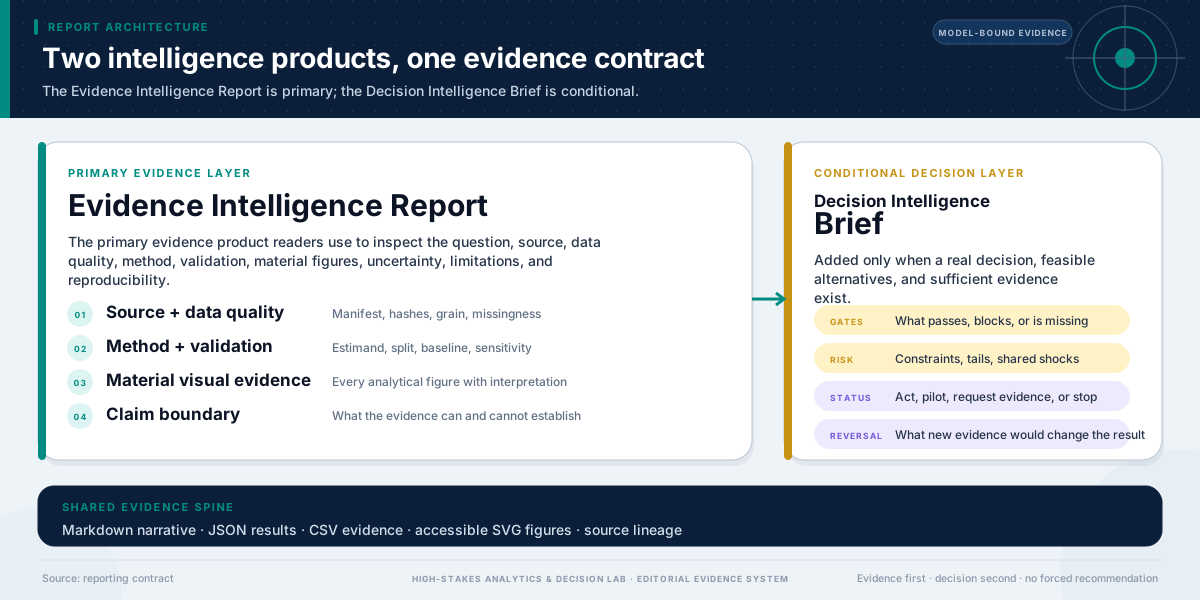
| Product | Main question | Contents | Existence rule |
|---|---|---|---|
| Evidence Intelligence Report | What does the evidence establish? | Source and QA contract, methods, validation, figures, uncertainty, limitations, lineage, and reproducibility | Primary record for every complete project |
| Decision Intelligence Brief | What action, pilot, diligence, evidence request, or stop follows? | Decision status, alternatives, constraints, shared shocks, tail risk, sensitivity, and reversal conditions | Conditional; only when a separate decision layer is justified |
Every material figure is generated from the shared editorial evidence system, includes a title and description, and is paired with its analytical question, supported interpretation, and claim boundary. The visual system is part of the evidence contract, not decorative reporting.
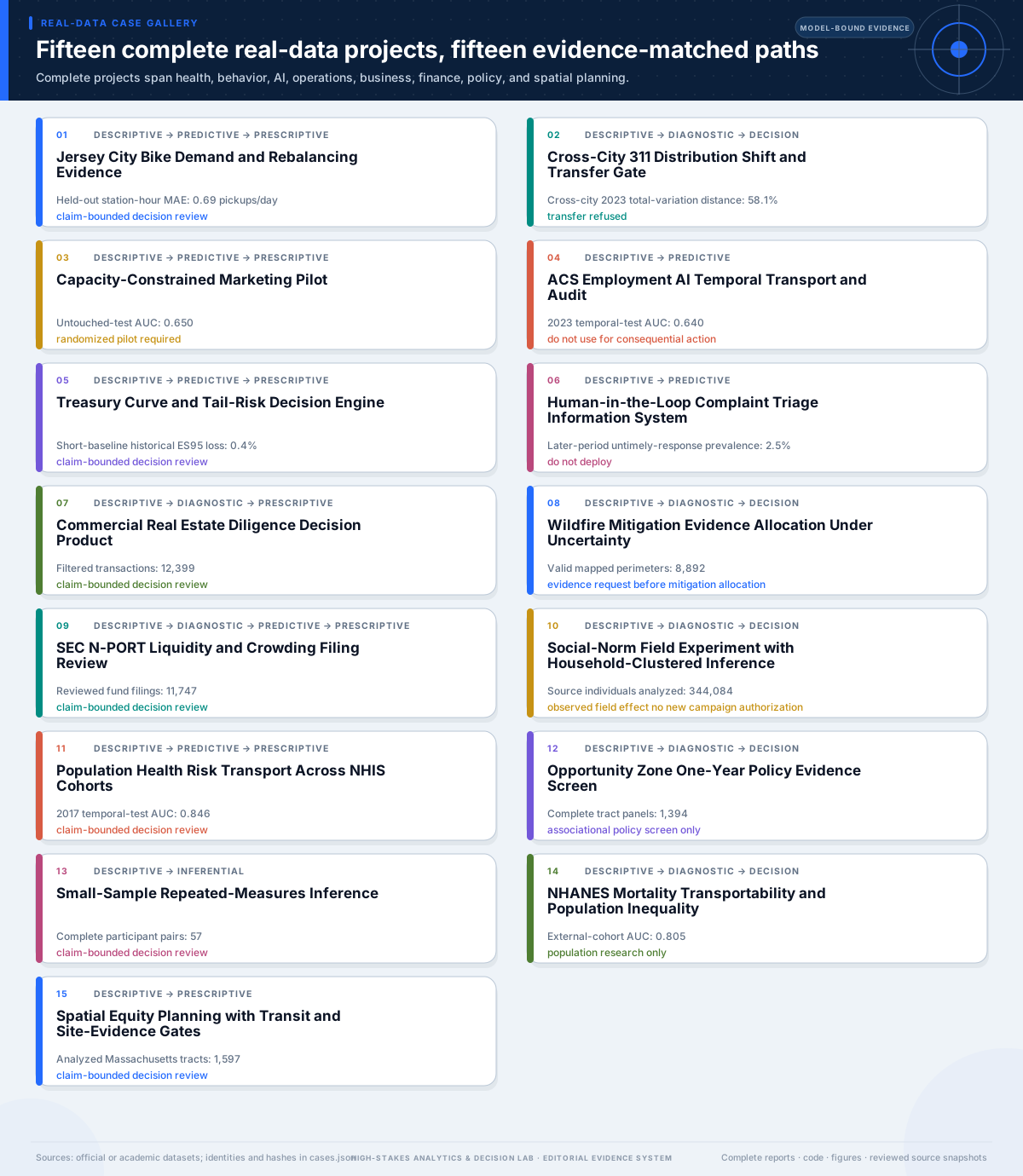
The public portfolio contains 15 primary reports and 10 conditional briefs—25 intelligence products in total—plus 119 canonical accessible figures: 50 evidence figures and 69 decision figures.
The cases span operational demand, distribution shift, scarce-capacity pilots, temporal model transport, tail-risk decisions, human-in-the-loop triage, commercial diligence, mitigation allocation, filing review, clustered field experiments, survival evidence, policy evaluation, repeated-measures inference, population transportability, and spatial equity.
They intentionally end differently: some support a bounded decision, some
require a pilot or targeted review, and some stop at an evidence request or
do_not_deploy.
| Explore | Open |
|---|---|
| Searchable route and capability explorer | Live case atlas · local source |
| Visual case gallery | Portfolio overview |
| Machine-readable catalog | cases.json |
| School-neutral capability paths | capability-map.json |
| Rebuild and comparison contract | Verification guide |
| Method and domain routing | method-domain-map.json |
The current stable release is
v1.1.2.
Its versioned source package and SHA-256 checksum are published together; the
release identity is also recorded in CITATION.cff,
CHANGELOG.md, and RELEASE-MANIFEST.json.
make verify
This runs the standalone regression suite and rebuilds all fifteen projects in
an isolated verified-file copy. Use make quality for the tracked-secret scan,
Ruff, mypy, and codespell; use docs/verification.md
for direct commands, static security gates, and no-Git release verification.
The 106 public tests cover data readiness, adaptive routing, numerical behavior, source and artifact identity, package integrity, local links, accessible SVGs, generator idempotence, compact installation, quickstart safety, interactive explorer synchronization, no-Git releases, DNS and SSRF boundaries, and source parser security. The complete 106-test standalone regression suite and the fifteen-project rebuild are separate gates: successful reproduction establishes the reviewed workflow and declared numerical tolerance, not empirical validity, external adoption, or real-world impact.
CI exercises Python 3.11, 3.12, 3.13, and 3.14. Security checks include the tracked-secret gate, Bandit, dependency auditing, hardened source-builder tests, targeted branch coverage, and CodeQL.
high-stakes-analytics-decision-lab/
├── skills/high-stakes-analytics-decision-lab/
│   └── SKILL.md                 # compact, installable Agent Skill package
├── demo/                        # dependency-free interactive case explorer
├── docs/                        # onboarding, architecture, layout, verification
├── references/                  # enforceable method and evidence contracts
├── assets/                      # templates and canonical README visuals
├── scripts/                     # profiling, routing, analysis, generation, checks
├── examples/real-data-cases/    # fifteen reproducible evidence projects
├── tests/                       # standalone contract and regression suite
└── .github/                     # CI, security, issue, and PR workflows
The nested Skill package prevents compatible installers from copying the full
portfolio. It is generated from the canonical root scripts, references, and
templates by scripts/build_skill_bundle.py; the full cases remain in
examples/. Human guides live in docs/; precise runtime rules live in
references/; generated evidence stays beside the project that produced it.
See docs/repository-layout.md before moving or
regenerating files.
| Guide | Use it for |
|---|---|
| Documentation home | Choose a user, reviewer, or maintainer path |
| Getting started | Install, route a question, profile data, and run a case |
| Architecture | Understand gates, routes, products, the decision engine, and visual evidence |
| Repository layout | Distinguish runtime contracts, human guides, canonical sources, and generated files |
| Verification | Reproduce tests, portfolio outputs, quality checks, and release gates |
| Contributing | Change code, documentation, sources, or cases without breaking evidence boundaries |
| Security | Report a vulnerability privately |
This is a public, tested research and portfolio prototype. It does not establish production readiness, institutional adoption, medical advice, investment advice, a regulatory finding, an assurance opinion, or achieved real-world impact. A reproducible result can still be decision-inappropriate; domain review remains mandatory before operational use.
Cite the version reviewed using CITATION.cff. Public release
history is in CHANGELOG.md, and component-version boundaries
are in VERSIONING.md.
Licensed under the MIT License.
Sign in to join the discussion.
No comments yet. Be the first to say what this is good for.
An agentic skills framework & software development methodology that works.
Turn any codebase, with its docs, SQL schemas, configs, and PDFs, into a queryable knowledge graph. A /graphify skill for Claude Code, Cursor, Codex, and Gemini CLI: local deterministic AST parsing, every edge explained, no vector store.

Topic in, narrated explainer video out. A Claude Code / Codex skill that turns any topic into a black-canvas motion-graphics explainer video with TTS voiceover, subtitles and a chapter progress bar. Chinese or English; every frame drawn in code with Remotion.
Public repository for Agent Skills
Open-source AI job search: scan job portals, evaluate listings into a structured A-H report with a global 1-5 score, tailor your CV, track applications — runs locally in your AI coding CLI (Claude Code, Codex, OpenCode, Antigravity…)
Production-grade engineering skills for AI coding agents.