

JuliusBrussee/
caveman

🪨 why use many token when few token do trick — Claude Code skill that cuts 65% of tokens by talking like caveman
105k
1 add
agent-computer-use gives agents a command line for working with desktop apps through accessibility trees and, for Electron apps, CDP. You can inspect running apps, find elements, click by reference, type into fields, and verify the result with a fresh snapshot.
Builders who want their agent to operate desktop apps instead of only editing files.
You can have an agent open, inspect, and use desktop apps with deterministic commands instead of screenshots and manual steps.
Lists apps, windows, visible text, and accessibility trees with commands like `apps`, `snapshot`, `tree`, and `text`.
Clicks, types, presses keys, scrolls, drags, and moves windows using refs like `@e5` or selector strings.
Supports `wait-for`, `ensure-text`, and the snapshot → act → re-snapshot workflow for checking results.
Detects Electron apps, relaunches them with a debug port, and connects over WebSocket for DOM-based interaction.
Ships as a skills.sh skill so Claude Code, Cursor, Codex, Copilot, and other supported agents can use it directly.
npm install -g agent-cu       # npm
pnpm add -g agent-cu          # pnpm
yarn global add agent-cu      # yarn
bun add -g agent-cu           # bun
agent-cu check-permissions
npm uninstall -g agent-cu     # npm
pnpm remove -g agent-cu       # pnpm
yarn global remove agent-cu   # yarn
bun remove -g agent-cu        # bun
git clone https://github.com/kortix-ai/agent-computer-use
cd agent-computer-use
./scripts/setup.sh
cargo install --git https://github.com/kortix-ai/agent-computer-use --path cli
agent-cu setup # interactive wizard — writes the allow rule for you


One CLI. Any desktop app. Like a human would. Click buttons, type text, read screens on macOS / Linux / Windows / Electron — no vision tokens, no screenshots, deterministic. For AI agents (Claude, Cursor, Codex, local models) and humans alike.
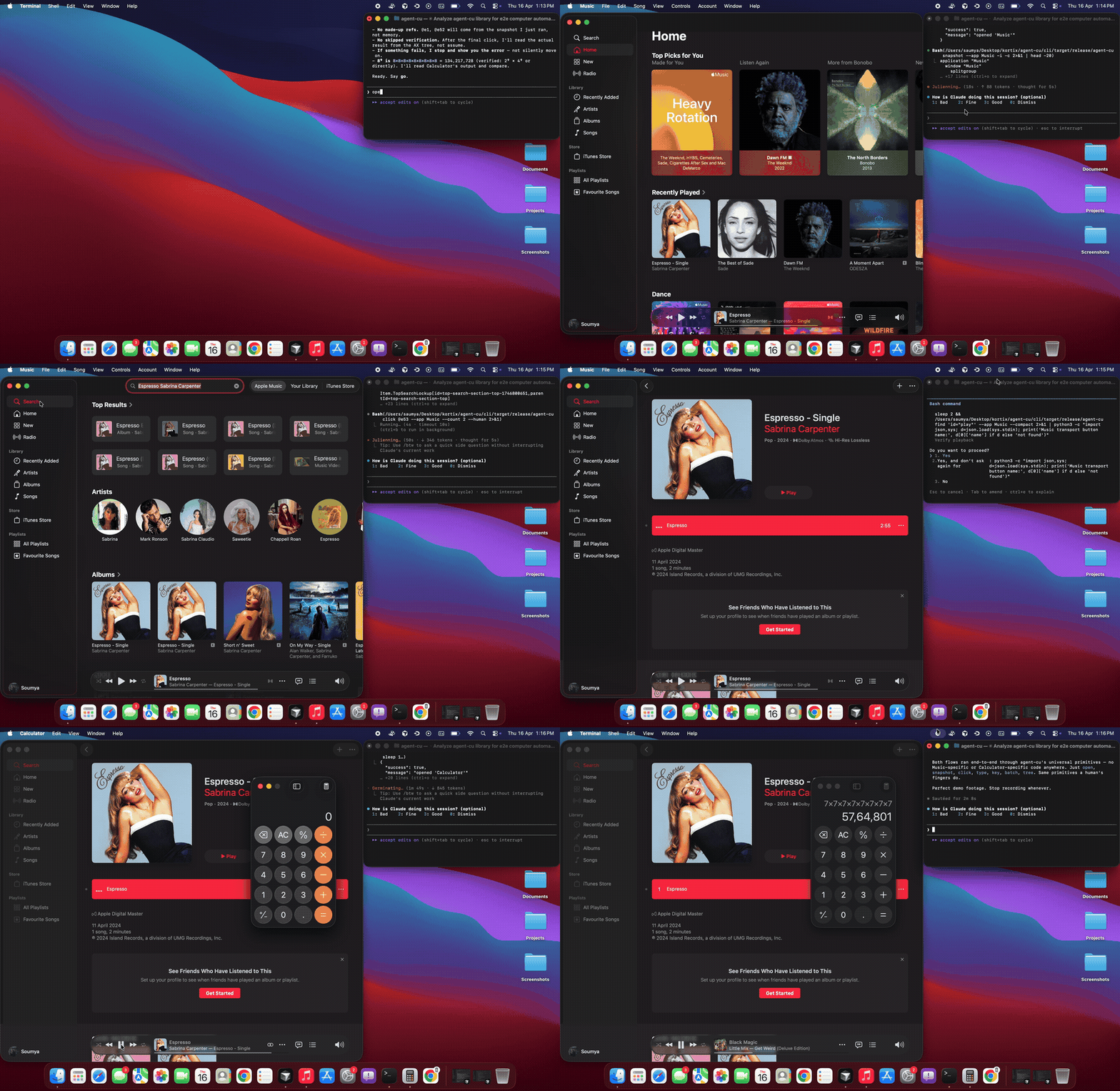
# One prompt: "open Music, play Espresso by Sabrina Carpenter, then open Calculator and compute 7^8"
# Claude drives agent-cu end-to-end — no app-specific code, no vision, just a11y primitives
| agent-cu | Anthropic Computer Use | OpenAI CUA | pyautogui | |
|---|---|---|---|---|
| Approach | accessibility | vision | vision | pixels |
| Tokens per click | 0 | ~1500 | ~1200 | 0 |
| Deterministic | ✅ | ❌ | ❌ | ✅ |
| Reads element state | ✅ | limited | limited | ❌ |
| Works on any app | ✅ (a11y) | ✅ | ✅ | ✅ |
| Open source, local | ✅ | ❌ | ❌ | ✅ |
Built in Rust. Runs locally. Zero per-action cost.
npm install -g agent-cu       # npm
pnpm add -g agent-cu          # pnpm
yarn global add agent-cu      # yarn
bun add -g agent-cu           # bun
Ships with precompiled binaries for macOS (Apple Silicon / Intel), Linux, and Windows. No Rust toolchain required.
After install, grant accessibility permissions:
agent-cu check-permissions
npm uninstall -g agent-cu     # npm
pnpm remove -g agent-cu       # pnpm
yarn global remove agent-cu   # yarn
bun remove -g agent-cu        # bun
git clone https://github.com/kortix-ai/agent-computer-use
cd agent-computer-use
./scripts/setup.sh
The setup script installs Rust (if needed), builds the CLI, installs it to ~/.cargo/bin/agent-cu, and prompts for accessibility permissions.
cargo install --git https://github.com/kortix-ai/agent-computer-use --path cli
agent-cu ships as a skill on skills.sh. Install it and your AI agent will drive agent-cu directly whenever you ask it to operate a desktop app.
npx skills add kortix-ai/agent-computer-use -a claude-code -g
The -a claude-code flag installs for Claude Code; drop it to pick interactively from 40+ supported agents (Cursor, Codex, Copilot, OpenCode, Cline, VS Code, etc.). -g installs globally — available in every project.
By default, Claude Code asks approval on every agent-cu command. To run without prompts, pick one of:
agent-cu setup # interactive wizard — writes the allow rule for you
Add to ~/.claude/settings.json:
{
  "permissions": {
    "allow": ["Bash(agent-cu *)"]
  }
}
Or, in the first approval prompt, pick "Yes, and don't ask again for: agent-cu *" — covers that specific subcommand.
agent-cu apps                              # what's running?
agent-cu snapshot -a Calculator -i -c      # see interactive elements
agent-cu click @e5                         # click by ref
agent-cu type "hello" -s @e3               # type into a field
agent-cu text -a Music                     # read all visible text
The workflow: snapshot → identify refs → act → re-snapshot to verify.
agent-cu apps                              # list all running apps
agent-cu snapshot -a Music -i -c           # interactive elements, compact
agent-cu snapshot -a Safari -d 8           # deeper tree
agent-cu tree -a Finder                    # raw accessibility tree (JSON)
agent-cu find 'role=button' -a Calculator  # find matching elements
agent-cu find 'id="play"' -a Music        # find by id
agent-cu find 'name~="Submit"' -a Safari  # find by partial name
agent-cu get-value @e5                     # read element value/state
agent-cu text -a Calculator                # all visible text
agent-cu focused                           # currently focused element
agent-cu windows -a Finder                 # list windows with positions
agent-cu click @e5                         # click by ref (AXPress, no focus steal)
agent-cu click 'name="Login"' -a Safari   # click by selector
agent-cu click 'id~="track-123"' -a Music # partial id match
agent-cu click @e5 --count 2              # double-click
agent-cu click @e5 --button right         # right-click
agent-cu click --x 500 --y 300 -a Finder  # coordinate click (last resort)
agent-cu click @e5 --expect 'name="Done"' # click then verify element appeared
agent-cu type "hello" -s @e3               # type into element (AXSetValue)
agent-cu type "hello" -a Safari            # type into focused field (keyboard sim)
agent-cu type "hello" -s @e3 --append      # append without clearing
agent-cu type "hello" -s @e3 --submit      # type then press Return
agent-cu key Return -a Calculator          # press a key
agent-cu key cmd+c -a TextEdit             # key combo
agent-cu key cmd+shift+p -a "VS Code"      # complex combo
agent-cu key Escape -a Slack               # escape
agent-cu key space -a Music                # play/pause
agent-cu scroll down -a Music              # scroll the main content area
agent-cu scroll down --amount 10 -a Music  # scroll more
agent-cu scroll-to @e42                    # scroll element into view
agent-cu drag @e5 @e10 -a Finder                           # drag by refs
agent-cu drag 'name="file.txt"' 'name="Desktop"' -a Finder # drag by name
agent-cu drag --from-x 200 --from-y 55 --to-x 900 --to-y 300 -a Finder  # by coordinates
Drag uses smooth 20-step interpolation with easing — mimics natural mouse movement.
agent-cu move-window -a Notes --x 100 --y 100    # move window (instant)
agent-cu resize-window -a Notes --width 800 --height 600  # resize (instant)
agent-cu open Calculator --wait                   # launch and wait for ready
agent-cu screenshot -a Music --path shot.png      # screenshot an app
agent-cu screenshot --path full.png               # full screen
agent-cu wait-for 'name="Dashboard"'              # poll until element appears
agent-cu wait-for 'role=button' --timeout 15      # custom timeout
agent-cu ensure-text @e3 "hello"                  # only types if value differs
echo '[["click","@e5"],["key","Return","-a","Music"]]' | agent-cu batch
echo '[["click","@e5"]]' | agent-cu batch --bail  # stop on first error
agent-cu run workflow.yaml                         # execute YAML workflow
agent-cu check-permissions                 # verify accessibility access
agent-cu observe -a Calculator             # interactive TUI explorer
@e1, @e2, @e3
'role=button'                          # by role
'name="Login"'                         # exact name
'name~="Log"'                          # name contains (case-insensitive)
'id="submit-btn"'                      # exact id
'id~="track-123"'                      # id contains
'button "Submit"'                      # shorthand: role name
'"Login"'                              # shorthand: just name
'role=button index=2'                  # 3rd button (0-based)
'css=".my-button"'                     # CSS selector (CDP only)
'id=sidebar >> role=button index=0'    # first button inside sidebar
'name="Form" >> button "Submit"'       # submit inside form
Electron apps (Slack, Cursor, VS Code, Postman, Discord, Notion) get automatic CDP support. agent-cu detects Electron apps, auto-relaunches them with a debug port, and connects via WebSocket.
agent-cu text -a Slack                     # just works — auto-detects Electron
agent-cu snapshot -a Slack -i -c           # DOM tree merged with native shell
agent-cu click @e5                         # JS element.click() via CDP
agent-cu key cmd+k -a Slack                # CDP Input.dispatchKeyEvent
agent-cu type "hello" -a Slack             # CDP Input.insertText
agent-cu scroll down -a Slack              # JS scrollBy()
First run auto-relaunches the Electron app with CDP (~5s). Every subsequent run uses cached connection (~15ms).
Override auto-detection:
agent-cu snapshot -a MyApp --cdp --cdp-port 9222   # force CDP with specific port
agent-cu snapshot -a Slack --no-cdp                 # disable CDP, use native only
All output is JSON by default.
agent-cu click @e5                         # {"success": true, "message": "pressed ..."}
agent-cu click @e5 --human                 # human-readable output
agent-cu click @e5 --compact               # single-line JSON
agent-computer-use/
├── cli/                    Rust CLI
│   ├── src/                Binary, handlers, actions, snapshot, wait, DSL parser
│   └── crates/
│       ├── agent-computer-use-core/      Platform trait, AccessibilityNode, Selector, element utils
│       ├── agent-computer-use-macos/     macOS backend (AXUIElement, CGEvent, batch attribute fetch)
│       ├── agent-computer-use-cdp/       CDP bridge (WebSocket, DOM walker, JS interaction)
│       ├── agent-computer-use-linux/     Linux backend (AT-SPI2)
│       └── agent-computer-use-windows/   Windows backend (UIAutomation)
├── docs/                   Next.js docs site
├── benchmark/              E2E benchmarks, stress tests, comparison tools
├── docker/                 Cross-compilation Dockerfiles
└── scripts/                Setup, build, bench
pnpm build          # build CLI (release)
pnpm test           # run tests
pnpm lint           # cargo fmt --check + clippy
pnpm format         # auto-format everything
pnpm bench          # criterion micro-benchmarks
pnpm bench:e2e      # real-world app benchmarks
pnpm bench:stress   # reliability stress test
pnpm bench:diff     # compare benchmark runs
| Platform | Status |
|---|---|
| macOS (Apple Silicon) | Preview |
| macOS (Intel) | Preview |
| Electron apps (CDP) | Preview |
| Windows (UIAutomation) | Preview |
| Linux (AT-SPI2) | Preview |
MIT
Sign in to join the discussion.
No comments yet. Be the first to say what this is good for.
🪨 why use many token when few token do trick — Claude Code skill that cuts 65% of tokens by talking like caveman

The best-benchmarked open-source AI memory system. And it's free.

Orca is the ADE for working with a fleet of parallel agents. Run any coding agent with your own subscription. Available on desktop, mobile and remote runtime.
A cross-platform desktop All-in-One assistant for Claude Code, Codex, OpenCode, OpenClaw, Grok Build & Hermes Agent. Only official website: ccswitch.io

Never stop coding. Free MIT AI gateway: one endpoint, 352 providers (150+ free), 1200+ models Kimi, Claude, GPT, Gemini, GLM, DeepSeek, MiniMax. Works with Claude Code, Codex, Cursor, OpenCode, Cline & Copilot. Quota-aware auto-fallback, RTK+Caveman compression saves 15-95% tokens, MCP/A2A, Desktop/PWA. Built by 550+ contributors

Compress tool outputs, logs, files, and RAG chunks before they reach the LLM. 20% fewer tokens for coding agents, 60-95% fewer tokens for JSON, same answers. Library, proxy, MCP server.