
obra/
superpowers

obra/superpowersSkills
An agentic skills framework & software development methodology that works.
285k
1 add
This skill guides an agent through optical schematic reconstruction with evidence checks at each step. It links schematic roles, CAD assets, beam paths, support paths, and render proof into one ordered workflow with explicit pass, blocked, or unverified states.
Builders who want their agent to rebuild optics setups in Blender with auditable evidence.
You can turn a 2D photonics schematic into a Blender scene that is checked against physical and provenance rules before it is trusted.
Runs reconstruction as a sequence of gates for topology, provenance, assembly, propagation, reopen checks, auditing, rendering, and sanitization.
Verifies centered apertures, splitter planes, branch continuity, beam clearance, fiber bend limits, post placement, and load paths.
Tracks run ID, revision, scene lineage, hashes, manifests, and acceptance states so claims can be traced back to evidence.
Includes deterministic replay examples and fresh design guidance so an agent can repeat a known run or start a new one from an empty scene.
Checks skill metadata, link integrity, file-size limits, privacy leaks, CAD binaries, PNG metadata, hashes, and acceptance-state consistency.
npx skills add k-telux/OpticalModeler
Use $thorlabs-blender-optical-path to reconstruct this 2D schematic in Blender.
Audit this optical table for real post/load paths, centered apertures, beam clearance, fiber bend radius, and stale evidence.
From 2D photonics schematics to physically auditable Blender optical tables.




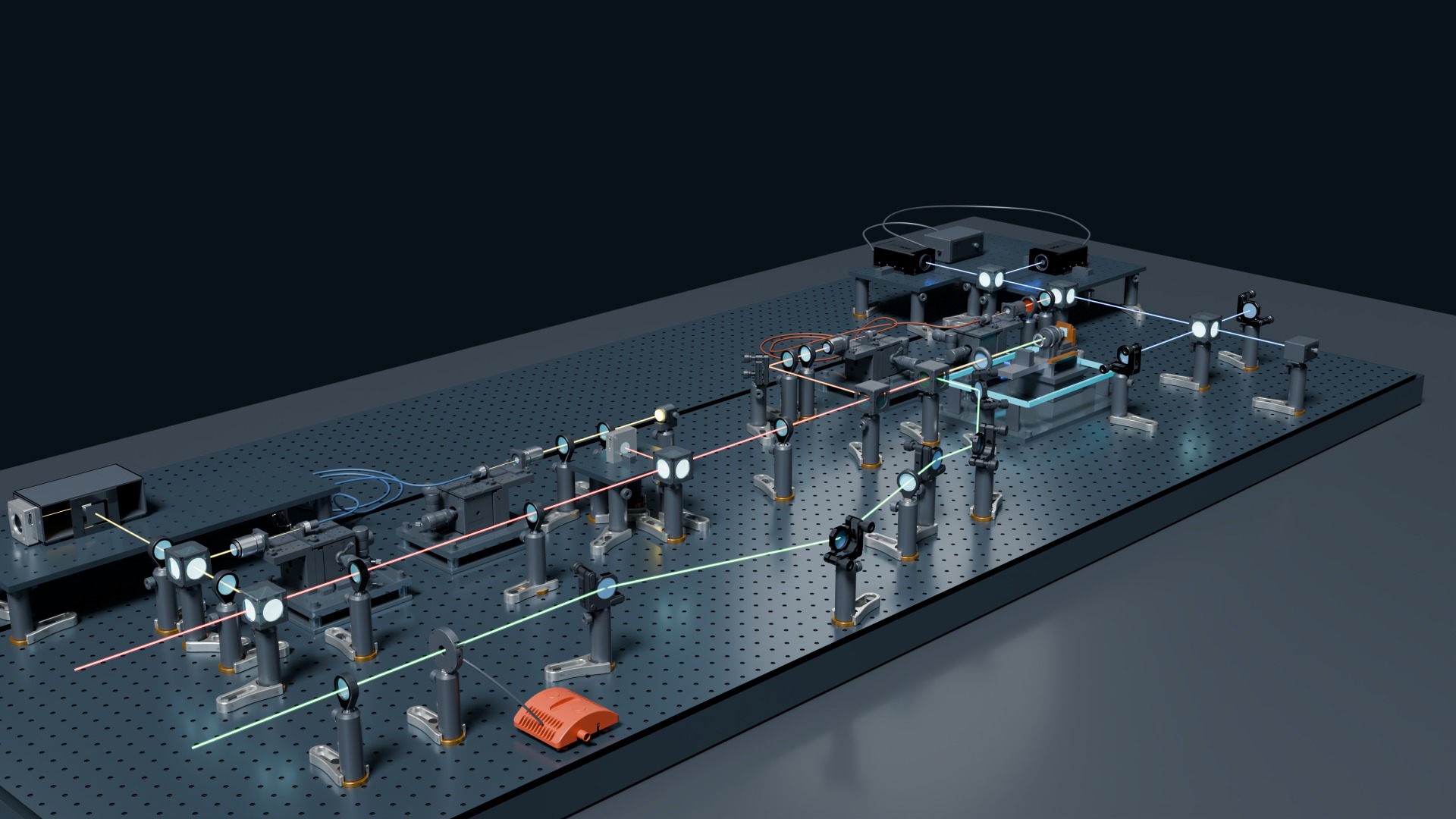
OpticalModeler is an evidence-first Agent Skill for reconstructing laboratory optical paths in Blender. It treats optical topology, real apertures, manufacturer CAD, fasteners, load paths, fiber routing, and artifact lineage as hard acceptance gates—not decorative details.
Independent community project. Not affiliated with or endorsed by Thorlabs, Inc. Product names identify compatible hardware only. A rendered CAD assembly is not a mechanical, spectral, laser-safety, or experimental certification.
| Physical assembly | Optical truth | Fail-closed evidence |
|---|---|---|
| Post-first placement, real table holes, fasteners, load paths, and supported hardware. | Centered apertures, splitter planes, branch continuity, internal fine beams, and fiber bend constraints. | Reopened-scene audits, ray/BVH checks, hashes, manifests, annotated renders, and explicit PASS / BLOCKED / UNVERIFIED states. |
| Original schematic | Annotated 3D reconstruction |
|---|---|
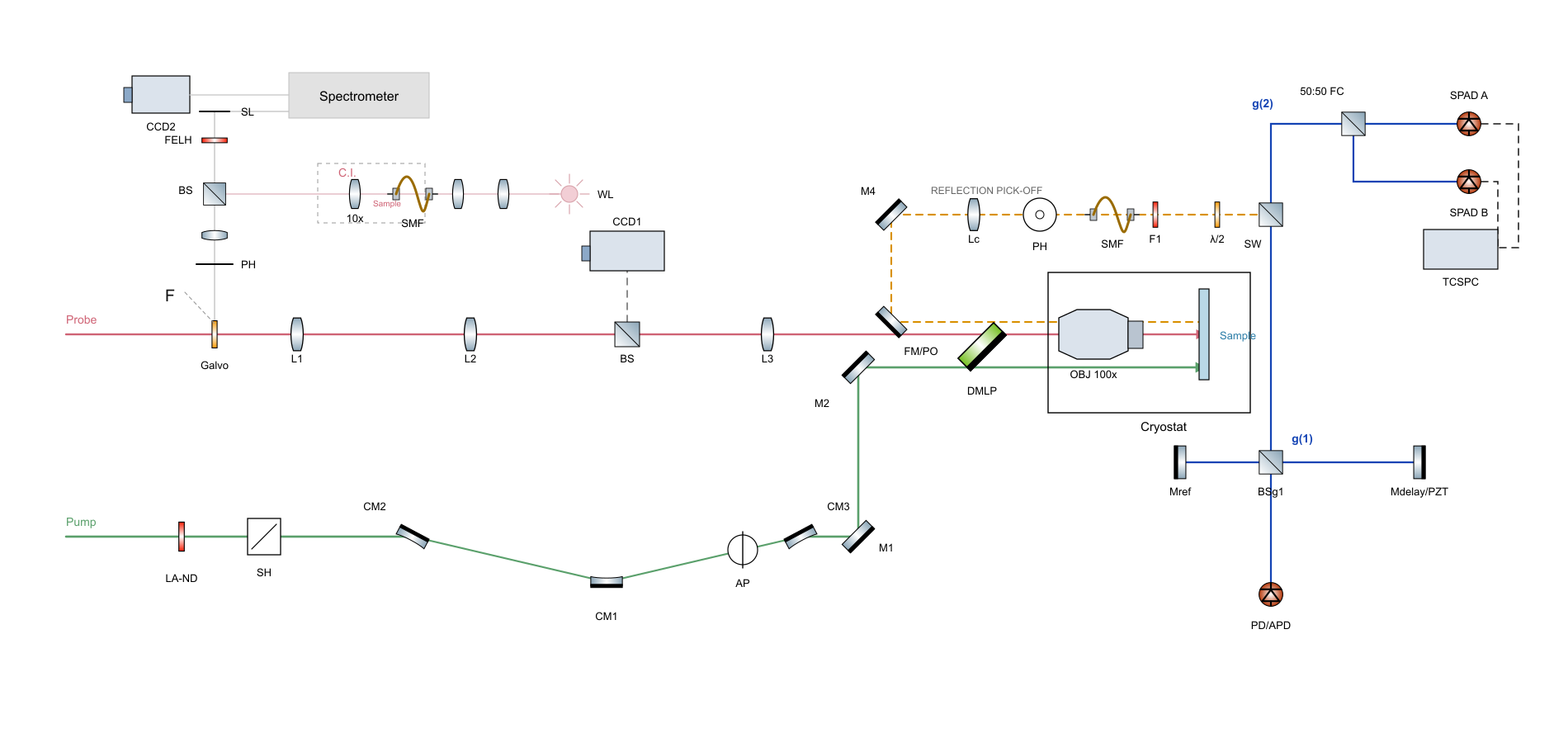 | 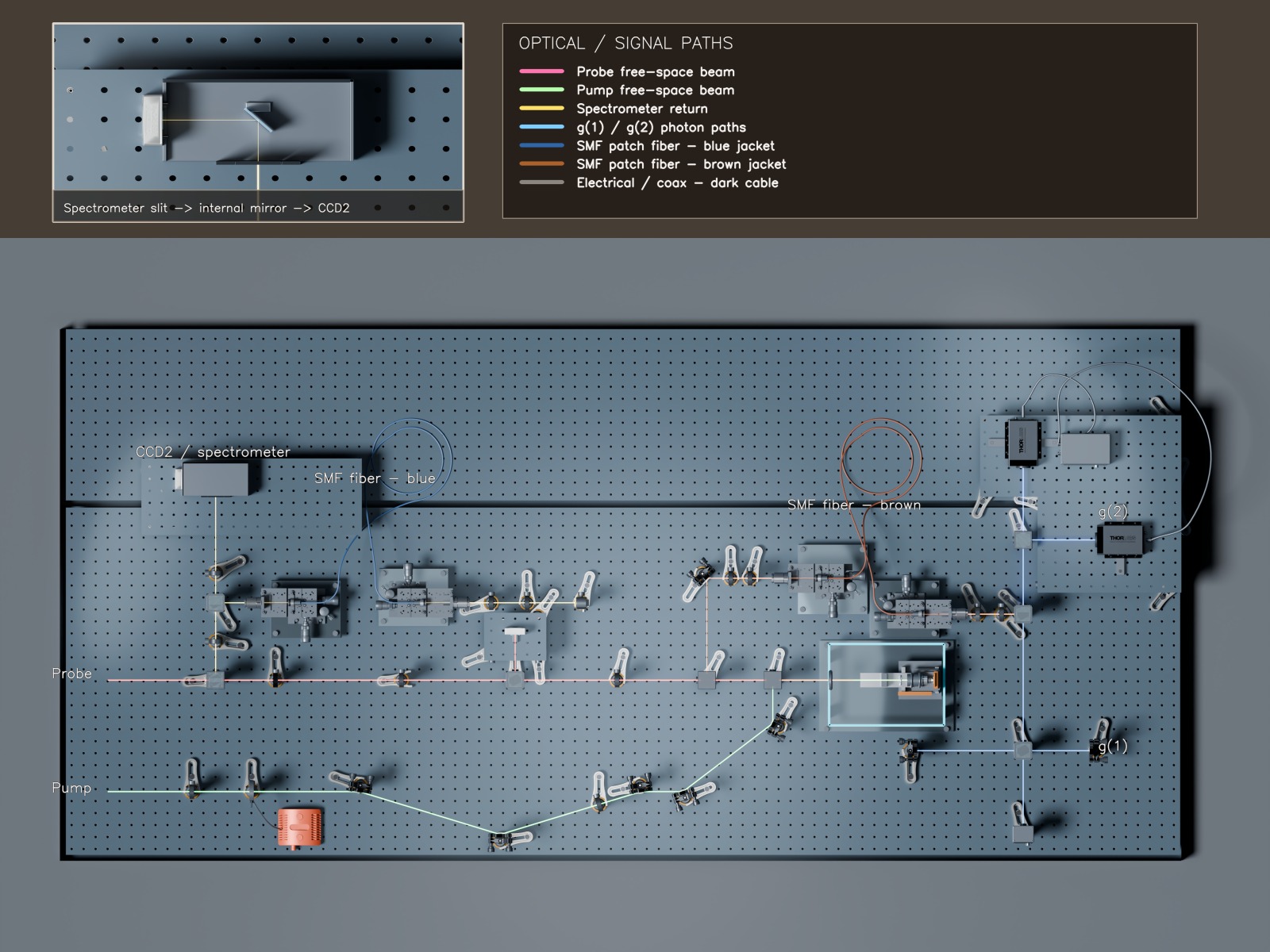 |
The sanitized G1/G2 case study includes the original 2D input, editorial 3D renders, and a machine-readable acceptance record. Vendor STEP/CAD files and the large laboratory .blend are intentionally excluded.
The primary workflow is now one ordered run with one run ID, one revision, one writer, one generator lineage, one Blender-scene lineage, and one append-only evidence ledger. Source locking, topology, CAD provenance, representative smoke, full-scene propagation, saved-scene reopen, optomechanical audit, rendering, and sanitization are gates in that same run—not independently authored modules that can be stitched together later.
Start with the end-to-end workflow contract, the single-run N04 deterministic replay, and its fresh whole-system runbook. The static replay intentionally stops at UNVERIFIED because the repository excludes vendor CAD and the saved representative .blend; downstream gates remain pending instead of inheriting a partial PASS. A fresh private revision can execute the included fetch, build, reopen, audit, and sanitization scripts end to end.
Ask for a new measurement path at the quality of an existing example, and the Skill now explicitly starts from a new topology and empty scene. It distinguishes reusable component assets from a complete prior apparatus and respects optics-only scope, including optical detectors and supports while excluding circuit/data visualization.
The fresh-design guide covers component fidelity, visible branches, measured ports, preview/final rendering, runtime isolation, and a practical completion cutoff. The MZI preview limitation case explains why expected-family ray hits, constant zero endpoint errors, whole-frame image scores, and 2048-wide previews cannot establish full physical or 4K acceptance.
This release updates the Skill and its evidence contract; it does not certify a new optical instrument. The historical examples below retain their original verdicts. See the changelog for the complete update.
Use $thorlabs-blender-optical-path to design a new optics-only measurement
system. Use the G1/G2 example only as a modeling and rendering quality reference.
Derive a new topology, build from an empty scene with provenance-bound component
assets, verify the physical paths, and deliver the declared final-resolution views.
The v1.1.0 qualification package compares 64-, 96-, and 128-node N04 scale runs with an independent 40-node stateful interferometer test. The verdict is deliberately mixed: PARTIAL_SCOPED, strict-BVH BLOCKED, scale-only PASS_SCOPED, and topology UNVERIFIED. No track supplies a whole-system or physical-release PASS.
The repeated tests hardened atomic source acquisition, live-versus-pinned CAD identity, exact cache aliases, canonical ledger replay, execution-versus-claim status, representative spacing/load evidence, strict collision classification, stateful topology expansion, and public-package sanitization. See CHANGELOG.md for the versioned changes.
Four isolated tests started from the published v1.0.0 tag and used no private Optical Path guidance. They cover a 32-node light-sheet path, a 40-node multi-state interferometer, an OCT representative smoke, and a Thorlabs CAD conversion benchmark.
| Track | Accepted verdict | Reproduced failure |
|---|---|---|
| Light-sheet / N04 | Propagation PASS, model PARTIAL_SCOPED, release BLOCKED | Public lock replay drifted from the saved scene until semantic replay and explicit overrides were added. |
| Interferometer | PARTIAL_SCOPED, release BLOCKED | README/GATE duplicated stale ray and port counts instead of deriving them from reopen evidence. |
| OCT | UNVERIFIED, propagation blocked | Package integrity passed while first-hit and load-path evidence remained incomplete. |
| CAD conversion | BLOCKED | PNG metadata leaked local paths; after sanitization, a separate CAD meshing blocker correctly remained. |
The forward-test matrix remains a historical defect-discovery record. Its four packages are not inputs that may be combined into one whole-system result.
With a compatible Agent Skills installer:
npx skills add k-telux/OpticalModeler
Or copy skills/thorlabs-blender-optical-path into your agent's skills directory.
Send message below to your agent:
Use $thorlabs-blender-optical-path to reconstruct this 2D schematic in Blender.
Audit this optical table for real post/load paths, centered apertures, beam clearance, fiber bend radius, and stale evidence.
The skill guides the agent to:
PARTIAL/SCOPED.See CHANGELOG.md for releases, CONTRIBUTING.md for rule proposals and case-study submissions, THIRD_PARTY_NOTICES.md for retained literature licensing, and SECURITY.md for responsible disclosure.
Maintained by telux. Released under the MIT License.
Sign in to join the discussion.
No comments yet. Be the first to say what this is good for.
An agentic skills framework & software development methodology that works.
Turn any codebase, with its docs, SQL schemas, configs, and PDFs, into a queryable knowledge graph. A /graphify skill for Claude Code, Cursor, Codex, and Gemini CLI: local deterministic AST parsing, every edge explained, no vector store.

Topic in, narrated explainer video out. A Claude Code / Codex skill that turns any topic into a black-canvas motion-graphics explainer video with TTS voiceover, subtitles and a chapter progress bar. Chinese or English; every frame drawn in code with Remotion.
Public repository for Agent Skills
Open-source AI job search: scan job portals, evaluate listings into a structured A-H report with a global 1-5 score, tailor your CV, track applications — runs locally in your AI coding CLI (Claude Code, Codex, OpenCode, Antigravity…)
Production-grade engineering skills for AI coding agents.