
affaan-m/
ECC

affaan-m/ECCHarnesses
The agent harness performance optimization system. Skills, instincts, memory, security, and research-first development for Claude Code, Codex, Opencode, Cursor and beyond.
258k
Jixu gives one agent a durable thread model, explicit tool effects, and replayable event history. Its core API is small: `createHarness`, `createThread`, and `thread.send`. The runtime keeps state from recorded events, so a thread can recover after interruption, replay without live driver calls, or fork from a past point. It also includes a native TUI and separate packages for stores, model drivers, and tools.
Builders who want a single TypeScript agent to keep context and work history across sessions.
You can resume the same agent work later instead of re-explaining the task after every stop.
Records each turn as events so the same thread can continue later, even after a pause or process stop.
Rebuilds thread state from stored events with no live model calls, or forks a new child thread from a chosen event.
Separates event reduction from external work, then records tool or model results back into the thread history.
Assembles model context from instructions, relevant events, plans, skills, tools, and recent work, with a continuity handoff when older work is compacted.
Provides a terminal interface through the `jixu` package so you can use the same harness interactively.
Splits the system into core, LLM drivers, event stores, and tool packages for local or embedded use.
npm install -g jixu-ai
jixu
npx jixu-ai
# pnpm dlx jixu-ai
# yarn dlx jixu-ai
# bunx jixu-ai
npm install jixu-core jixu-llm jixu-store-sqlite
durable Event -> pure Reducer -> explicit Effect -> Driver -> durable Event

Jixu means continue in Chinese.
A small single-Agent Harness for TypeScript. Define one Agent, give it Tools and Skills, and continue its work in a durable Thread.
The core API stays small: createHarness, createThread, and thread.send.
Underneath it, Jixu records execution, context decisions, and external work so
the same Thread can recover, Replay, or Fork without a second runtime.
Jixu is pre-1.0. The public API may change before 1.0.
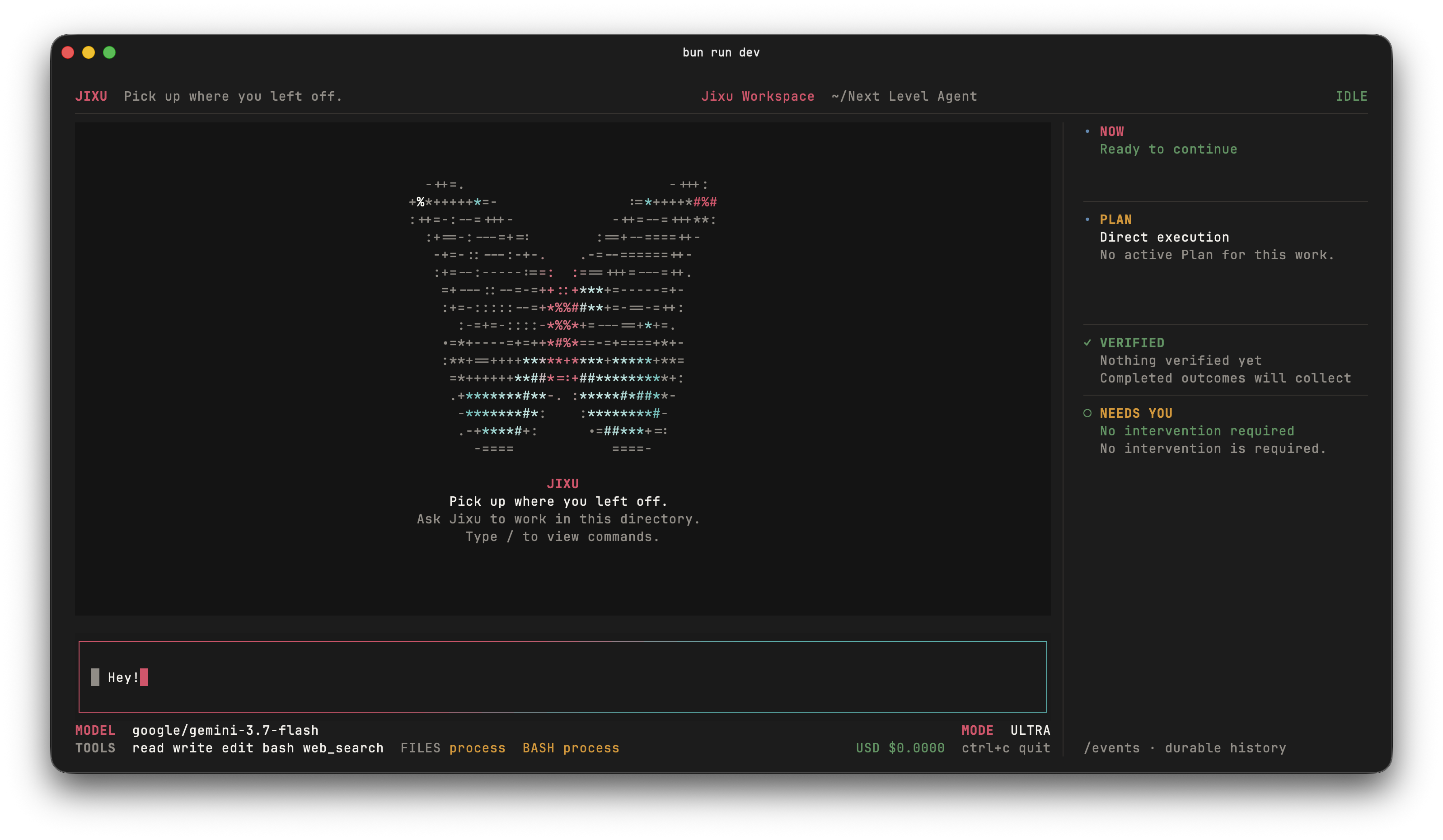
Agent loops are easy to start. Resuming one safely is harder: a Tool call may be in flight, the process may stop between writes, or the model may run out of context.
Jixu records the work as ordered Events. State is derived from them, and external work is recorded before it is dispatched. That is what lets a Thread recover, Replay, Fork, or continue later.
Each Harness has one immutable Agent definition. Its Threads hold that Agent's durable history. There is no workflow graph or second execution engine.
Install and open the reference TUI:
npm install -g jixu-ai
jixu
Global installation also works with pnpm add -g jixu-ai and
bun add -g jixu-ai. Or run Jixu without installing it:
npx jixu-ai
# pnpm dlx jixu-ai
# yarn dlx jixu-ai
# bunx jixu-ai
The package launcher requires Node.js 22.19.0 or newer. The native TUI supports macOS arm64 and Linux x64 with glibc; Intel macOS is not supported. Bun is not required at runtime.
The TUI uses the same public Agent, Harness, Thread, Store, and Driver APIs as any other Jixu application.
npm install jixu-core jixu-llm jixu-store-sqlite
import { createHarness, defineAgent } from "jixu-core";
import {
  createLLMModelDriver,
  resolveLLMModelCapabilities,
} from "jixu-llm";
import { SqliteEventStore } from "jixu-store-sqlite";

const connection = {
  api: "openai-chat-completions" as const,
  apiKey: process.env.MODEL_API_KEY,
  baseURL: "https://api.openai.com/v1",
  model: "gpt-5.6-sol",
};

const modelCapabilities = await resolveLLMModelCapabilities(connection);
const agent = defineAgent({
  instructions: "Be precise and verify your work.",
  model: { provider: "model", model: connection.model },
  modelCapabilities,
  tools: [],
});

const harness = createHarness({
  agent,
  modelDrivers: {
    model: createLLMModelDriver({
      api: connection.api,
      apiKey: connection.apiKey,
      baseURL: connection.baseURL,
      maxOutputTokens: modelCapabilities.maxOutputTokens,
    }),
  },
  store: new SqliteEventStore("./jixu.db"),
});

const thread = await harness.createThread();
const state = await thread.send("Review this design and identify its main risk.");

console.log(state.result);
The Agent definition is immutable. Each send continues the same durable
Thread.
The public Harness creates, opens, and lists Threads. A Thread exposes one coherent surface for ordinary work and continuity operations:
| Operation | Meaning |
|---|---|
send(input) | Durably accepts ordered text and image input. Input received while work is running is queued in Event order. |
state() | Returns the current deterministic projection of the Thread's Events. |
events() | Reads the immutable durable facts behind that State. |
stream() | Observes committed Events and transient Signals through one ordered surface. |
wait() | Waits until the Thread is no longer running. |
pause() | Records pause intent and settles at a safe append/dispatch boundary. |
continue() | Durably continues a paused Thread before dispatch resumes. |
interrupt() | Stops the current turn without turning it into resumable paused work. |
resolveToolOutcome({ effectId, resolution }) | Records an operator fact for one retained unknown Tool outcome. Resolution is occurred, not_occurred, or abandoned_unknown. |
clear() | Advances the model-visible context boundary while retaining the Thread and its durable history. |
replay() | Rebuilds State from Events with zero live Driver calls. |
fork({ at, input }) | Creates a new child Thread from the exact State at one selected Event. |
setMode(mode) | Durably selects standard or the strongest compatible ultra reasoning effort without changing the Agent or model. |
durable Event -> pure Reducer -> explicit Effect -> Driver -> durable Event
The Kernel reduces Events into State and Effects without performing I/O. Drivers execute external work and append the result as another Event. Replay only reduces recorded Events; it never calls a live model or Tool.
Jixu retries only when the Effect's delivery contract makes that safe:
waiting rather
than being silently repeated;allow, ask, and deny Tool policy decisions are resolved before Driver
dispatch, and approvals are durable decisions for one exact pending Effect.Jixu does not claim generic exactly-once execution. That guarantee requires an enforceable idempotency contract in the downstream system.
Each model request is assembled from the Thread's durable material: Agent instructions, relevant Events, the active Plan, Skills, Tool schemas, Artifacts, and recent work. A redacted Context Manifest records what was selected and why.
Jixu resolves the model's context window and output limit before Agent creation. If capacity is unknown, it stops instead of guessing. When older work must be compacted, Jixu writes a source-linked Continuity Handoff and keeps a bounded tail of complete recent operations. The underlying Events are not rewritten.
A Plan is optional Event-backed coordination data. It can record acceptance criteria, steps, evidence, blockers, and the next safe action, but it cannot dispatch Effects, approve a Tool call, or widen user scope.
A Thread has at most one Plan and one active step. Changes are validated and committed before related Effects can dispatch; rejected changes remain visible in Event history. The Plan is a current hypothesis rather than a fixed schedule: completed work and the current step stay protected, while pending steps may be rewritten as evidence changes. If a model returns only Plan or progress control, Jixu durably gives it one execution-only continuation with ordinary Tools and no reserved controls; the control plane cannot loop indefinitely or permanently block the requested work.
Jixu keeps operational facts inside the same durable model:
| Package | Purpose |
|---|---|
jixu-ai | Framework entry point and installable reference TUI. |
jixu-core | The single-Agent Harness, Thread API, deterministic Kernel, and public ports. |
jixu-llm | Provider-neutral model Drivers for OpenAI Chat Completions and Anthropic Messages. |
jixu-store-jsonl | Inspectable local JSONL Event Store. |
jixu-store-sqlite | Local SQLite Event Store. |
jixu-tools-node | Opt-in Node file and unsandboxed local shell Tools. |
jixu-tools-jina | Opt-in Jina-backed Web Search and URL Reader Tools. |
jixu-testkit | Deterministic fixtures and shared Store contracts for adapter authors. |
[!WARNING] Jixu's Bash Tool is not OS-sandboxed and runs with the permissions of the Jixu process. Permission controls approve Tool calls, not individual shell operations. Keep Bash on
ASKand use a backed-up or disposable workspace.
Model providers, Tools, Stores, and UIs use the runtime's public ports. Thread state still belongs to the core runtime.
Jixu is not a multi-Agent orchestrator, workflow engine, or hosted control plane. It does not add Agent graphs, supervisors, queues, schedulers, or a generic exactly-once guarantee. External systems remain ordinary Tools and do not change the single-Agent model.
MIT
Sign in to join the discussion.
No comments yet. Be the first to say what this is good for.
The agent harness performance optimization system. Skills, instincts, memory, security, and research-first development for Claude Code, Codex, Opencode, Cursor and beyond.
The job search that runs on your machine. AI job application framework built on Claude Code: evaluate postings, tailor CVs, write cover letters, prep interviews. Fork it and own it.
from vibe coding to agentic engineering - practice makes claude perfect
🌊 The original agent meta-harness. Deploy intelligent multi-player swarms, coordinate autonomous workflows, and build conversational AI systems. Features adaptive memory, self-learning intelligence, RAG integration, and native Claude Code / Codex / Hermes and many more Integrated
Practical patterns, starters & CLI tools for loop engineering with AI coding agents. Design systems that prompt and orchestrate agents (inspired by Addy Osmani and Boris Cherny). Includes loop-audit, loop-init, loop-cost.

Git. Ship. Done - Core