

JuliusBrussee/
caveman

🪨 why use many token when few token do trick — Claude Code skill that cuts 65% of tokens by talking like caveman
105k
1 add
Boost wraps shell commands so agents see compact, structured summaries instead of full scrollback. It is built for command loops in tools like Claude Code, Cursor, Codex CLI, and Copilot, and it keeps failures, summaries, timings, and cache signals that matter for reasoning.
Builders who run coding agents through lots of shell commands and want their context to stay lean.
You can keep agent sessions readable and token-light without losing the signal needed to continue work.
Wraps commands like `npm ci`, `pytest`, `docker build`, and `git` so the agent sees a shorter result.
Keeps errors, test failures, timings, cache hits, and changed counts instead of raw scrollback.
Connects Boost into Cursor, Claude Code, GitHub Copilot, and Codex CLI with `boost init`.
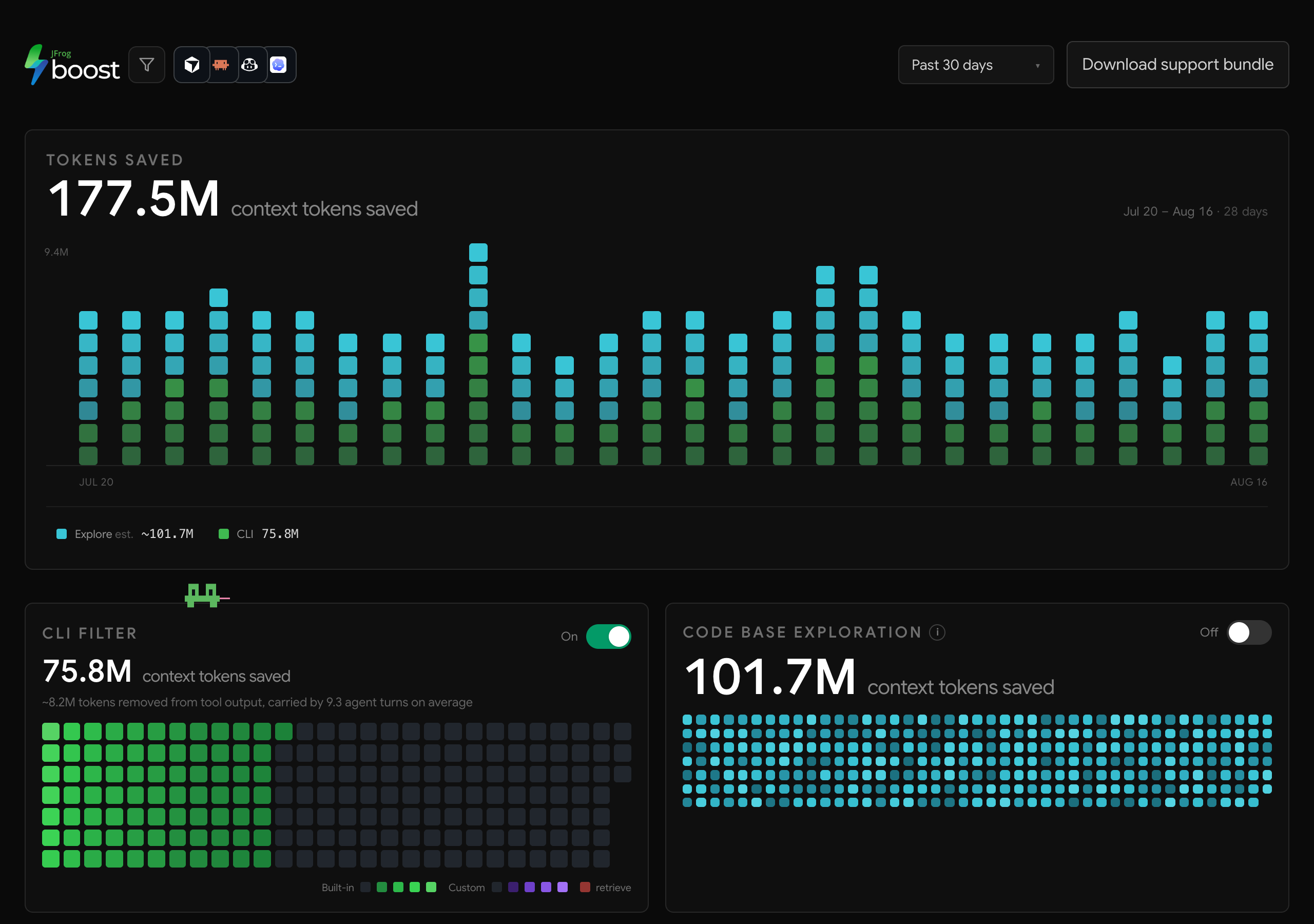
Shows usage and savings in an interactive report with `boost report` or a terminal view with `boost report -t`.
Updates the installed CLI with `boost update`.
curl -fsSL https://boost.jfrog.com/install.sh | bash
irm https://boost.jfrog.com/install.ps1 | iex
boost init

Save tokens. Sharpen agents.
Smart token savings for coding agents and shell commands.







Sponsored by JFrog
English · Español · Français · Deutsch · 日本語 · हिन्दी · עברית

Dependencies, source, secrets, and IaC — scanned on every push to main. What that covers.
Preview Notice: This software is in preview and subject to JFrog's Online Preview Agreement.
Frogi, our mascot, appears when you run just boost.

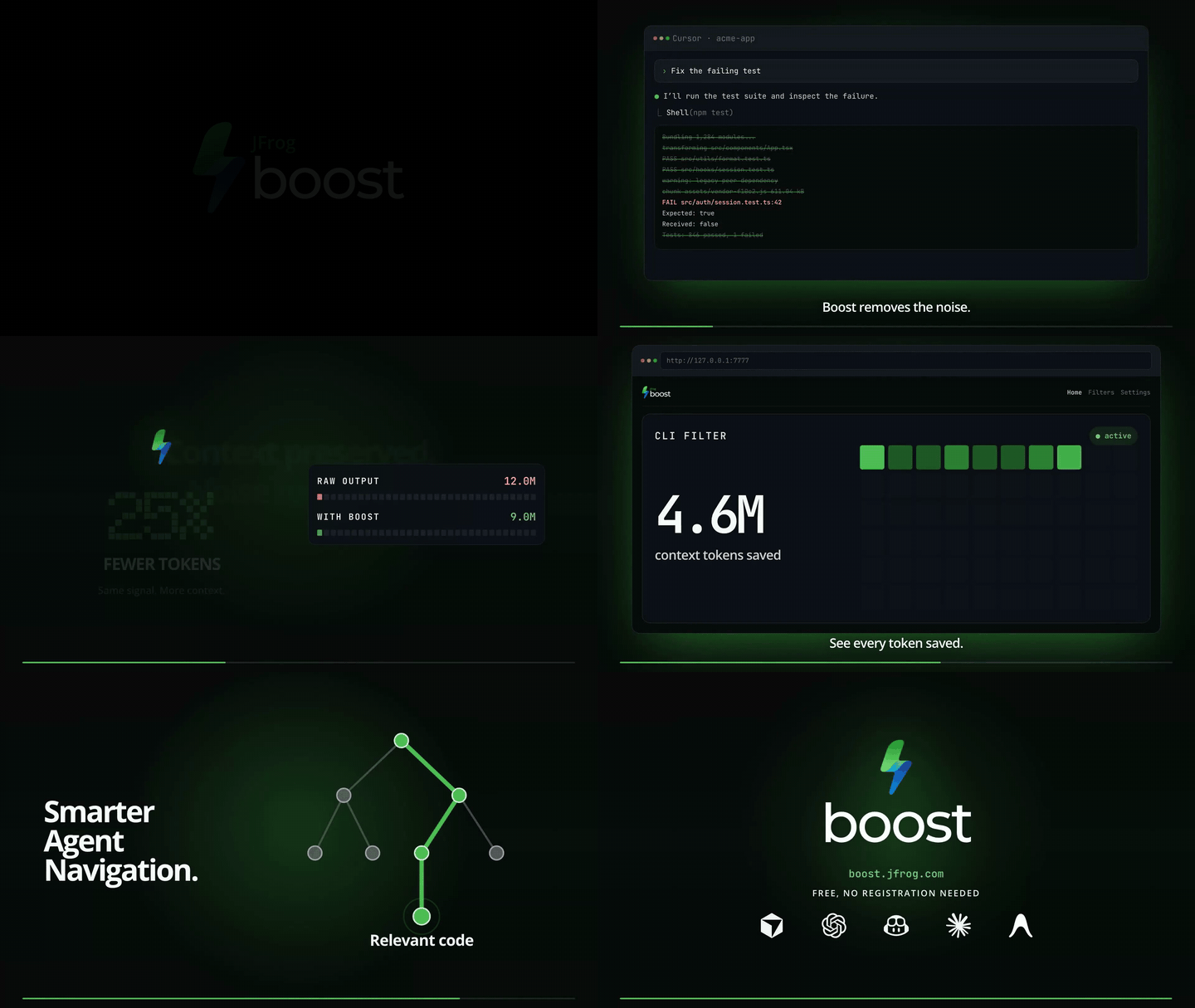
Boost wraps the commands your agents already run, turning noisy logs into compact, structured context that keeps the signal — errors, timings, changed counts, cache hits — while cutting the noise.
Boost never trades quality for savings. It trims only what's safe to drop, so agent output stays just as sharp. Our Terminal-Bench 2.0 benchmark shows it: identical task pass rate, ~12% lower cost — Boost keeps agents optimized without ever breaking their stride.
Install Boost
macOS / Linux / Windows WSL:
curl -fsSL https://boost.jfrog.com/install.sh | bash
Windows PowerShell:
irm https://boost.jfrog.com/install.ps1 | iex
Wire it into Cursor, Claude Code, GitHub Copilot, and Codex CLI:
boost init
For AI coding agents installing Boost on a user's machine, follow AGENT-INSTALL.md.
npm test, pytest, go test, docker build, linters, and logs while keeping failures and summaries.Boost does not just truncate output. It applies command-aware filters that preserve what agents need to reason about the result.
# Without Boost: ~9,800 tokens of install noise
$ npm ci
npm warn deprecated inflight@1.0.6 / rimraf@3.0.2 / glob@7.2.3 …
added 1285 packages, audited 1286 in 45s
found 0 vulnerabilities

# With Boost: ~640 tokens, same outcome, cache-backed
$ boost npm ci
[OK] npm ci · 1,285 packages restored from boost cache in 2.4s · 0 vulnerabilities
The agent sees the useful summary, not the scrollback. On failures, Boost keeps the failing test, compiler error, or stack frame that matters.
| Capability | Boost | RTK | Headroom | Caveman |
|---|---|---|---|---|
| Command output compression | ✓ | ✓ | ✓ | × |
| Full-context and RAG compression | ✓ | × | ✓ | × |
| Assistant reply compression | × | × | × | ✓ |
| Command output recovery | ✓ | ✓ | ✓ | × |
| Native approval sees original executable | ✓ | × | — | — |
| Versioned retrieval feedback | ✓ | × | × | × |
| Auto-disable repeatedly retrieved filters | ✓ | × | × | × |
| End-to-end agent task + cost A/B | ✓ | × | × | × |
After wrapping commands, open the interactive web report:
boost report
For a terminal narrative summary:
boost report -t
# or: boost report --tui
boost docker build ... — compressed build log and layer-cache summaryboost npm ci — dependency summary, local package cache, retry-safe outputboost pytest — quiet output on green runs, useful failures when tests breakboost update
See the full documentation for commands, configuration, and OpenTelemetry export.
Boost's source repository is scanned on every push to main — the same commits every release is built from — by Frogbot, running JFrog Xray with JFrog Advanced Security.
| What gets scanned | |
|---|---|
| ✓ | Dependencies (SCA) — Go modules and npm trees across every module in the repo, matched against JFrog's vulnerability database |
| ✓ | Contextual Analysis — checks whether a reported CVE is actually reachable from Boost's code, so real risk is not buried in noise |
| ✓ | Malicious packages — dependencies flagged as malicious are caught before they reach a build |
| ✓ | Secrets — every tracked file is scanned for leaked credentials and tokens |
| ✓ | Source code (SAST) — Boost's own Go and TypeScript sources |
| ✓ | Infrastructure as Code — CI workflows and deployment definitions |
| ✓ | SBOM — a component inventory is generated per build target on every scan |
Findings land as code-scanning alerts and automated fix pull requests on the source repository. See SECURITY.md for the full scanning and disclosure policy.
*_TOKEN, *_SECRET, AWS_*, DATABASE_URL are redacted before write or export.Full policy, supported versions, and how to report a vulnerability: see SECURITY.md.
Copyright © 2026 JFrog Ltd. All rights reserved. See LICENSE and the Online Preview Agreement.
Dedicated to the memory of Dima Gershovich — a brilliant engineer, a talented musician, and a dear friend. Read Dima's story
Sign in to join the discussion.
No comments yet. Be the first to say what this is good for.
🪨 why use many token when few token do trick — Claude Code skill that cuts 65% of tokens by talking like caveman

The best-benchmarked open-source AI memory system. And it's free.

Orca is the ADE for working with a fleet of parallel agents. Run any coding agent with your own subscription. Available on desktop, mobile and remote runtime.
A cross-platform desktop All-in-One assistant for Claude Code, Codex, OpenCode, OpenClaw, Grok Build & Hermes Agent. Only official website: ccswitch.io

Never stop coding. Free MIT AI gateway: one endpoint, 352 providers (150+ free), 1200+ models Kimi, Claude, GPT, Gemini, GLM, DeepSeek, MiniMax. Works with Claude Code, Codex, Cursor, OpenCode, Cline & Copilot. Quota-aware auto-fallback, RTK+Caveman compression saves 15-95% tokens, MCP/A2A, Desktop/PWA. Built by 550+ contributors

Compress tool outputs, logs, files, and RAG chunks before they reach the LLM. 20% fewer tokens for coding agents, 60-95% fewer tokens for JSON, same answers. Library, proxy, MCP server.