

DietrichGebert/ponytailPlugins
Makes your AI agent think like the laziest senior dev in the room. The best code is the code you never wrote.
138k
1 add
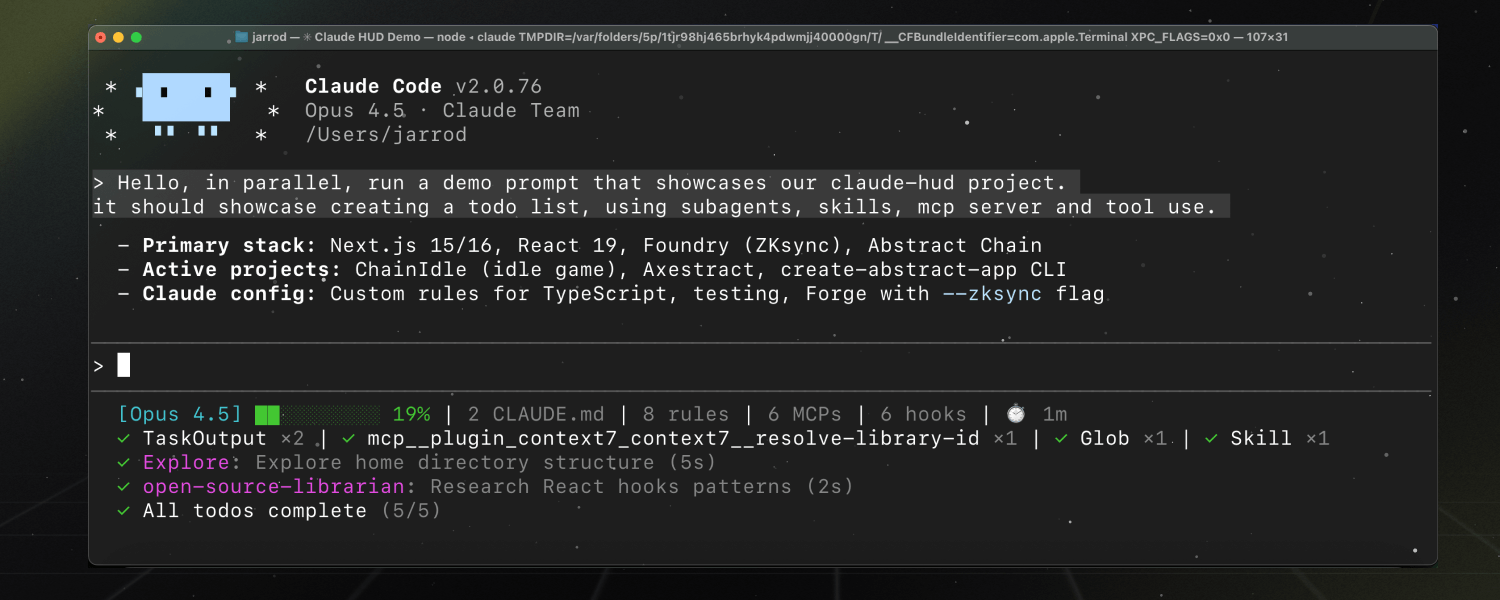
Claude HUD plugs into Claude Code’s native statusline API and updates in the terminal as your session runs. It reads Claude Code’s session data to show model, context usage, tools, agents, and todo progress, with optional configuration for layout and extra lines.
Builders who run Claude Code and want live session status without switching context.
You can see what Claude is doing, how full your context is, and what task progress looks like without re-explaining or guessing.
Shows the current model badge and a visual context bar with usage details.
Can show completed tools like read, edit, and search as they happen.
Can show active subagents and their current work.
Can show task completion progress in real time.
Can show the current project path, git branch, dirty state, and added directories.
Supports presets and manual options for line layout, labels, colors, thresholds, and which HUD elements appear.
/plugin marketplace add jarrodwatts/claude-hud
EXDEV: cross-device link not permitted
mkdir -p ~/.cache/tmp && TMPDIR=~/.cache/tmp claude
/plugin install claude-hud
/reload-plugins
claude plugin marketplace add jarrodwatts/claude-hud
claude plugin install claude-hud@claude-hud
A Claude Code plugin that shows what's happening — context usage, active tools, running agents, and todo progress. Always visible below your input.

🌐 English | 中文文档
Inside a Claude Code instance, run the following commands:
Step 1: Add the marketplace
/plugin marketplace add jarrodwatts/claude-hud
Step 2: Install the plugin
On older Claude Code versions, /tmp being a separate filesystem (tmpfs) caused plugin installation to fail with:
EXDEV: cross-device link not permitted
This Claude Code bug has since been fixed — if you hit it, update Claude Code first. If you can't update, set TMPDIR before installing:
mkdir -p ~/.cache/tmp && TMPDIR=~/.cache/tmp claude
Then run the install command below in that session.
/plugin install claude-hud
After that, reload plugins (no restart needed):
/reload-plugins
Steps 1–2 can also be done outside a session with the Claude Code CLI:
claude plugin marketplace add jarrodwatts/claude-hud
claude plugin install claude-hud@claude-hud
Then run /reload-plugins inside your session (or start a new one).
Step 3: Configure the statusline
/claude-hud:setup
On Windows, Node.js LTS is the supported runtime for Claude HUD setup. If setup says no JavaScript runtime was found, install Node.js for your shell first:
winget install OpenJS.NodeJS.LTS
Then restart your shell and run /claude-hud:setup again.
Done! Claude Code reloads settings automatically — the HUD appears after your next message, no restart needed. If it doesn't show up, restart Claude Code (older versions require a restart to pick up statusLine changes).
Claude HUD gives you better insights into what's happening in your Claude Code session.
| What You See | Why It Matters |
|---|---|
| Project path | Know which project you're in (configurable 1-3 directory levels) |
| Context health | Know exactly how full your context window is before it's too late |
| Tool activity | Watch Claude read, edit, and search files as it happens |
| Agent tracking | See which subagents are running and what they're doing |
| Todo progress | Track task completion in real-time |
[Opus] │ my-project git:(main*)
Context █████░░░░░ 45% │ Usage ██░░░░░░░░ 25% (1h 30m / 5h)
Bedrock, Vertex, MiniMax), project path, git branch/claude-hud:configure)◐ Edit: auth.ts | ✓ Read ×3 | ✓ Grep ×2 ← Tools activity
◐ explore [haiku]: Finding auth code (2m 15s) ← Agent status
▸ Fix authentication bug (2/5) ← Todo progress
Claude HUD uses Claude Code's native statusline API — no separate window, no tmux required, works in any terminal.
Claude Code → stdin JSON → claude-hud → stdout → displayed in your terminal
           ↘ transcript JSONL (tools, agents, todos)
Key features:
/compact, permission changes, vim-mode toggles), debounced at 300msCustomize your HUD anytime:
/claude-hud:configure
The guided flow handles layout, language, and common display toggles. Advanced overrides such as custom colors and thresholds are preserved there, but you set them by editing the config file directly:
| Preset | What's Shown |
|---|---|
| Full | Everything enabled — tools, agents, todos, git, usage, duration |
| Essential | Activity lines + git status, minimal info clutter |
| Minimal | Core only — just model name and context bar |
After choosing a preset, you can turn individual elements on or off.
Edit ~/.claude/plugins/claude-hud/config.json directly for advanced settings such as colors.*,
pathLevels, maxWidth, threshold overrides, display.timeFormat, display.hourCycle, and display.promptCacheTtlSeconds. Running /claude-hud:configure
preserves those manual settings while still letting you change language, layout, and the common
guided toggles.
If you run several Claude config directories via CLAUDE_CONFIG_DIR and symlink plugins/ to a
shared location, plugins/claude-hud/config.json is the same physical file for all of them. Put
per-directory settings in $CLAUDE_CONFIG_DIR/claude-hud.json instead - it uses the same shape,
only needs the keys it changes, and is layered on top of the shared config at load time:
For example, put this in ~/.config/claude/work/claude-hud.json:
{ "display": { "customLine": "Work Team" } }
Simplified and Traditional Chinese HUD labels are available as explicit opt-ins. English stays the default unless you choose a Chinese locale in /claude-hud:configure or set language in config. The zh alias maps to Simplified Chinese, and zh-TW maps to Traditional Chinese. Guided config writes the canonical zh-Hans or zh-Hant value.
| Option | Type | Default | Description |
|---|---|---|---|
language | en | zh | zh-Hans | zh-Hant | zh-TW | en | HUD label language. Use zh or zh-Hans for Simplified Chinese and zh-Hant or zh-TW for Traditional Chinese. |
lineLayout | string | expanded | Layout: expanded (multi-line) or compact (single line) |
pathLevels | 1-3 | full | 1 | Directory levels to show in project path, or full to show the entire absolute path |
maxWidth | number | null | null | Optional fallback width used only when terminal width detection fails completely |
forceMaxWidth | boolean | false | Always use maxWidth when it is set, even if terminal width detection returns a smaller value |
elementOrder | string[] | ["project","addedDirs","context","usage","promptCache","memory","environment","tools","skills","mcp","agents","todos","sessionTime"] | Expanded-mode element order. Omit entries to hide them in expanded mode. Existing configs keep their explicit order until updated. |
projectLineOrder | string[] | [] | Optional leading order of segments within the first line, in both layouts. Visibility stays with the display.show* flags, and omitted segments retain their existing renderer order. model covers provider + model + effort (plus the context bar in compact mode); project covers path + added dirs + git as one segment. Example: ["project","model"] puts the project/git block before the model badge. |
display.mergeGroups | string[][] | [["context","usage"]] | Expanded-mode groups that should share a line when adjacent. Set [] to disable merged lines. |
display.rightAlign | string[] | [] | Starts a right-aligned suffix at the first listed element in a merged row, preserving elementOrder and padding the gap with spaces. Requires the anchor to be in a display.mergeGroups group that actually renders on one line. Ignored when the terminal width is unknown, the anchor is first, or there is no room for padding. Example: ["context"] with a ["project","context","usage"] group keeps project/git left and pins context + usage right. |
gitStatus.enabled | boolean | true | Show git branch in HUD |
gitStatus.showDirty | boolean | true | Show * for uncommitted changes |
gitStatus.showAheadBehind | boolean | false | Show ↑N ↓N for ahead/behind remote |
gitStatus.pushWarningThreshold | number | 0 | Color the ahead count with the warning color at or above this unpushed-commit count (0 disables it) |
gitStatus.pushCriticalThreshold | number | 0 | Color the ahead count with the critical color at or above this unpushed-commit count (0 disables it) |
gitStatus.showFileStats | boolean | false | Show file change counts !M +A ✘D ?U |
gitStatus.branchOverflow | truncate | wrap | truncate | Keep current truncation behavior or let the git block wrap onto its own line boundary when possible |
jjStatus.enabled | boolean | false | Opt in to jj (Jujutsu) status. When enabled and a real .jj directory is found, jj is used instead of git for that repo — never both |
jjStatus.showDirty | boolean | true | Show * when the working-copy commit differs from its parent |
jjStatus.showConflicts | boolean | true | Show a !conflict marker when the working-copy commit has an unresolved conflict |
display.showModel | boolean | true | Show model name [Opus] |
display.modelSource | stdin | auto | transcript | stdin | Controls which source the model name comes from. stdin preserves the default behavior and always uses what Claude Code reports. auto opts into proxy redirect detection by using transcript models only for non-Claude models. transcript always uses the model from the API response. Transcript model values are terminal-sanitized and capped at 80 characters |
display.showProvider | boolean | false | Show the provider label before the model name, e.g. [Bedrock | Opus 4.6]. Useful when a custom proxy serves identically-named models from different providers. When off, an auto-detected provider still trails the model as before |
display.providerName | string | "" | Explicit provider label used with display.showProvider, e.g. for a custom proxy that can't be auto-detected. Falls back to the auto-detected provider (Bedrock/Vertex/MiniMax/Enterprise) when empty; capped at 40 chars |
display.showAddedDirs | boolean | true | Show extra workspace directories from /add-dir (e.g. +sparkle +lib-foo); empty array renders nothing. In both layouts at most 5 dirs render (overflow shown as +N more) and basenames are truncated to 24 chars with … |
display.addedDirsLayout | inline | line | inline | inline puts dirs next to the project name with a +name prefix per dir; line renders them on a separate Added dirs: name1, name2 line (no + prefix, comma-separated) |
display.showContextBar | boolean | true | Show visual context bar ████░░░░░░ |
display.contextValue | percent | tokens | remaining | both | percent | Context display format (45%, 45k/200k, 55% remaining, or 45% (45k/200k)) |
display.autoCompactWindow | number | null | null | When set to a positive number such as 200000, compute the context percentage against this auto-compact window instead of the full model context window, matching the /context figure. Leave unset or null to preserve default full-window behavior. |
display.showConfigCounts | boolean | false | Show CLAUDE.md, rules, MCPs, hooks counts |
display.showCost | boolean | false | Show session cost using Claude Code's native cost.total_cost_usd when available, with a local estimate fallback for direct Anthropic sessions |
display.showRoutedCost | boolean | false | Also show cost for routed providers (Bedrock/Vertex), which showCost hides by default. Requires showCost too. Uses the native cost.total_cost_usd when positive (Cost), otherwise the token estimate (Est.) |
display.showDailyCost | boolean | false | Show today's cumulative spend across sessions as Today $12.34, accumulated from the native cost.total_cost_usd into a small per-day ledger in the plugin data directory. Resets at local midnight. Independent of showCost |
display.showOutputStyle | boolean | false | Show the active Claude Code outputStyle from settings files as style: <name> |
display.showDuration | boolean | false | Show session duration ⏱️ 5m |
display.showSpeed | boolean | false | Show output token speed out: 42.1 tok/s |
display.showUsage | boolean | true | Show Claude subscriber usage limits when available |
display.usageValue | percent | remaining | percent | Usage display format (25% used, or 75% remaining) |
display.usageBarEnabled | boolean | true | Display usage as visual bar instead of text |
display.usageCompact | boolean | false | Display usage in a shorter text form such as 5h: 25% (1h 30m); takes precedence over display.usageBarEnabled |
display.showResetLabel | boolean | true | Show the resets in prefix before usage countdowns |
display.showModelScopedUsage | boolean | true | Show the per-model weekly windows (model_scoped, e.g. Fable), whether they arrive on stdin or from the external usage snapshot. Set to false to render the usage line as if the payload carried none of them |
display.timeFormat | relative | absolute | both | elapsed | elapsedAndAbsolute | relative | How usage-window time is shown: countdown only (resets in 2h 30m), wall-clock reset (resets at 14:30), both, elapsed window percentage (53% elapsed), or elapsed plus wall-clock reset |
display.hourCycle | auto | h11 | h12 | h23 | h24 | auto | Hour cycle for wall-clock reset times (absolute/both/elapsedAndAbsolute modes). auto defers to the system locale; h23 forces 24-hour time (14:30) regardless of locale |
display.showClockSeconds | boolean | false | Show seconds in wall-clock reset times, e.g. at 14:30:07 |
display.sevenDayThreshold | 0-100 | 80 | Show 7-day usage when >= threshold (0 = always) |
display.externalUsagePath | string | "" | Optional absolute path to a local usage snapshot file. Relative paths are ignored. When stdin rate_limits are present, balance_label is appended and model_scoped windows fill in when stdin lacks them; when stdin windows are missing, valid usage windows can be used as a fallback |
display.externalUsageWritePath | string | "" | Optional absolute .json path in an existing directory. When stdin rate_limits exists, ClaudeHUD writes a private snapshot for other local tools. Relative paths, non-json files, and missing parent directories are ignored |
display.externalUsageFreshnessMs | number | 300000 | Maximum allowed age for the external usage snapshot before it is ignored |
display.showTokenBreakdown | boolean | true | Show token details at high context (85%+) |
display.showTools | boolean | false | Show tools activity line |
display.showSkills | boolean | false | Show active Skills detected from Skill tool invocations |
display.showMcp | boolean | false | Show active MCP servers detected from mcp__server__tool invocations |
display.toolNameMaxLength | number | 0 | Maximum displayed tool-name length. 0 keeps full names; MCP names may shorten to their final segment when truncating |
display.toolsMaxVisible | number | 4 | Maximum completed tools shown on the tools line. 0 means unlimited |
display.showAgents | boolean | false | Show agents activity line |
display.showTodos | boolean | false | Show todos progress line |
display.showSessionName | boolean | false | Show session slug or custom title from /rename |
display.showAuth | boolean | false | Show the auth method (subscription plan) of the current login as its own segment at the end of the first line, e.g. Claude Max 20x. Derived from the oauthAccount block in {CLAUDE_CONFIG_DIR}.json; shows API Key when there is no OAuth login but ANTHROPIC_API_KEY is set |
display.showAuthUser | boolean | false | Show the logged-in account (email local part, falling back to profile display name) next to the auth method |
display.authUserLength | number | 8 | Maximum characters of the account name to display before truncating with …. 0 shows the full name |
display.showAdvisor | boolean | false | Inline the model configured via Claude Code's /advisor on the project line, e.g. Advisor: Opus 4.7. Read from the advisorModel field that Claude Code stamps on each assistant transcript record; sanitised and capped at 64 chars before rendering |
display.advisorOverride | string | "" | Optional manual override for the displayed advisor label. When non-empty, replaces transcript-driven detection. Also sanitised and capped at 64 chars |
display.showSessionStartDate | boolean | false | Show the transcript session start timestamp |
display.showLastResponseAt | boolean | false | Show how long ago the last assistant response was written |
display.showCompactions | boolean | false | Show how many context compactions (manual /compact or auto) have occurred this session, counted from transcript compact_boundary entries, e.g. Compactions: 2. Hidden until the first compaction |
display.showEffortLevel | boolean | false | Show the current reasoning effort in the model badge. Ultracode renders as ultracode(xhigh), detected from the session transcript so it tracks /effort changes made at runtime |
display.effortFormat | full | symbol | text | full | How the effort renders when display.showEffortLevel is on: symbol and level text (◑ high), symbol only (◑), or level text only (high). Ultracode keeps the full ◕ ultracode(xhigh) form under symbol so the marker is not lost, and levels without a known symbol fall back to the level text |
display.showClaudeCodeVersion | boolean | false | Show the installed Claude Code version, e.g. CC v2.1.81 |
display.showMemoryUsage | boolean | false | Show an approximate system RAM usage line in expanded layout |
display.showPromptCache | boolean | false | Show the wall-clock time the session's prompt cache expires, read from the transcript |
display.promptCacheTtlSeconds | number | 300 | Compatibility fallback used only when the transcript has not reported a 5-minute or 1-hour cache tier |
colors.context | color value | green | Base color for the context bar and context percentage |
colors.usage | color value | brightBlue | Base color for usage bars and percentages below warning thresholds |
colors.warning | color value | yellow | Warning color for context thresholds and usage warning text |
colors.usageWarning | color value | brightMagenta | Warning color for usage bars and percentages near their threshold |
colors.critical | color value | red | Critical color for limit-reached states and critical thresholds |
colors.model | color value | cyan | Color for the model badge such as [Opus] |
colors.project | color value | yellow | Color for the project path |
colors.git | color value | magenta | Color for git wrapper text such as git:( and ) |
colors.gitBranch | color value | cyan | Color for the git branch and branch status text |
colors.label | color value | dim | Color for labels and secondary metadata such as Context, Usage, counts, and progress text |
colors.custom | color value | 208 | Color for the optional custom line |
colors.barFilled | string | █ | Character used for the filled portion of progress bars |
colors.barEmpty | string | ░ | Character used for the empty portion of progress bars |
colors.barFilled and colors.barEmpty accept a single visible grapheme. Control characters, invisible format characters (bidi controls, zero-width joiners, variation selectors), line/paragraph separators, and noncharacters are rejected. Wide characters (emoji, CJK) may affect bar alignment depending on the terminal.
Supported color names: dim, red, green, yellow, magenta, cyan, brightBlue, brightMagenta. You can also use a 256-color number (0-255) or hex (#rrggbb).
display.showMemoryUsage is fully opt-in and only renders in expanded layout. It reports approximate system RAM usage from the local machine, not precise memory pressure inside Claude Code or a specific process. The number may overstate actual pressure because reclaimable OS cache and buffers can still be counted as used memory.
display.showCost is fully opt-in. ClaudeHUD prefers the native cost.total_cost_usd field that Claude Code provides on stdin when it is available. If that field is absent or invalid for a direct Anthropic session, ClaudeHUD falls back to the existing local transcript-based estimate so the cost line still works on older payloads. The native field is absent before the first API response in a session, so the cost display may stay hidden until then. ClaudeHUD also keeps the cost hidden for known routed providers such as Bedrock and Vertex AI, because cloud-provider billed sessions may report $0.00 or omit the field even though the session was not literally free. Set display.showRoutedCost: true (alongside showCost) to opt into cost for those providers anyway: the native cost.total_cost_usd is shown as Cost when positive, otherwise ClaudeHUD falls back to a token-based Est. from the Anthropic pricing table.
display.showDailyCost is fully opt-in and answers a different question than showCost: what has the whole day cost across sessions, not just the current conversation. On each render ClaudeHUD folds the native cost.total_cost_usd into a small daily-cost.json ledger in the plugin data directory, keyed by session_id, and shows the day's cumulative spend as Today $12.34. The first sighting of a session records a baseline so only spend from that point counts, the counter resets at local midnight, sessions spanning midnight contribute only the current day's part, and entries unseen for more than 24 hours are dropped so the file stays bounded. It only uses the native field (no estimate fallback), so sessions that never render the statusline are not counted, counting starts when the option is enabled, and totals are per machine. Routed providers (Bedrock/Vertex) are excluded unless display.showRoutedCost is also enabled, matching showCost.
Official MiniMax Anthropic-compatible endpoints receive a MiniMax provider label. MiniMax M2.7 can use its published token and cache prices for local estimates; M3 pricing depends on each request's context tier, which cumulative session tokens cannot safely infer, so ClaudeHUD does not guess an M3 estimate.
display.showPromptCache is fully opt-in. When enabled, ClaudeHUD shows the wall-clock time the session's prompt cache expires (e.g. Cache ⏱ until 14:30), or expired once that time has passed. It follows display.hourCycle and display.showClockSeconds like every other clock time in the HUD. If the transcript has no main-session response yet, the cache element stays hidden.
It shows an expiry time rather than a countdown because the statusline only repaints while Claude Code is active. Between turns — exactly when the cache is draining — a countdown freezes at whatever it last displayed and keeps reporting it; a clock time stays true no matter how stal
Sign in to join the discussion.
No comments yet. Be the first to say what this is good for.
Makes your AI agent think like the laziest senior dev in the room. The best code is the code you never wrote.
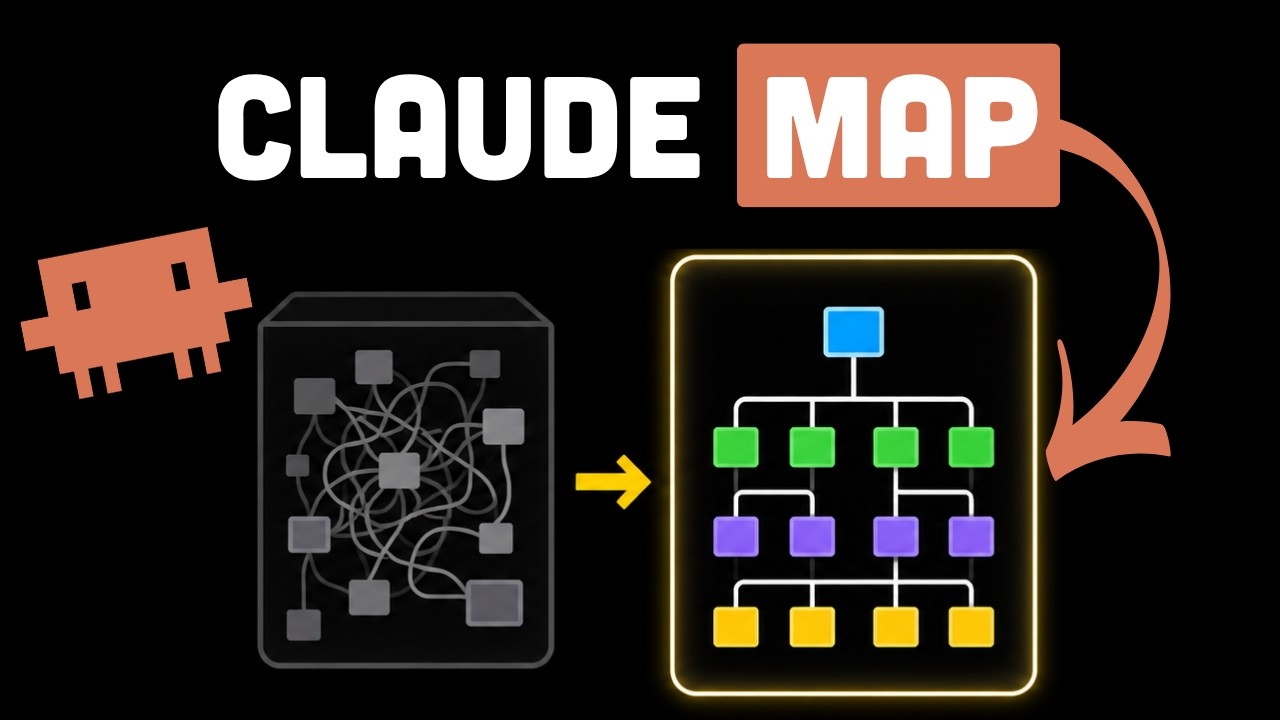
Graphs that teach > graphs that impress. Turn any code into an interactive knowledge graph you can explore, search, and ask questions about. Works with Claude Code, Codex, Cursor, Copilot, Gemini CLI, and more.

OmO: Just type "mass ulw" keyword with your prompt. Now you are the master of graph engineering.
Persistent Context Across Sessions for Every Agent – Captures everything your agent does during sessions, compresses it with AI, and injects relevant context back into future sessions. Works with Claude Code, OpenClaw, Codex, Gemini, Hermes, Copilot, OpenCode + More
Opinionated Oxlint rules for rejecting low-evidence TypeScript and JavaScript patterns
Teams-first Multi-agent orchestration for Claude Code