
affaan-m/
ECC

affaan-m/ECCHarnesses
The agent harness performance optimization system. Skills, instincts, memory, security, and research-first development for Claude Code, Codex, Opencode, Cursor and beyond.
258k
This repo gives you a file-based operating system for agent-led work. Instructions live in `AGENTS.md` and runtime-specific wrappers, while skills in `.agents/skills/` and workflows in `Workflows/` define how work gets done. `Tasks/`, `GOALS.md`, `Knowledge/`, and `Resources/` hold the moving state and context, and `Evals/` plus `scripts/` check that the system still behaves well.
Builders who want Claude Code, Codex, Cursor, Pi, or OpenClaw to follow the same goals, rules, and workflow structure.
You can turn a backlog into prioritized, verification-backed agent work without re-explaining your process each session.
Uses `AGENTS.md` as the common behavior layer, with `CLAUDE.md`, `CODEX.md`, `PI.md`, and `OPENCLAW.md` as runtime wrappers.
Stores reusable procedures in `.agents/skills/*/SKILL.md` with bridge paths for supported runtimes.
Provides markdown workflows in `Workflows/` for planning, review, research, meetings, and wrap-up.
Separates active work in `Tasks/`, reference material in `Knowledge/`, and supporting assets in `Resources/`.
Includes `scripts/run_skill_evals.py`, `scripts/run_routing_evals.py`, and `scripts/run_memory_impact_evals.py` to test behavior changes.
Offers `System/mcp` and related integration points for external services such as Slack, Linear, Google Calendar, and Atlassian.
git clone https://github.com/itseffi/personal-os.git
cd personal-os
chmod +x setup.sh
./setup.sh
Open this repo in your agent and run:
1) "Process my backlog from BACKLOG.md into Tasks/**/*.md using AGENTS.md rules."
2) "Show my P0/P1 unblocked tasks aligned to GOALS.md."
3) "Propose today’s top 3 with required verification evidence and commands."
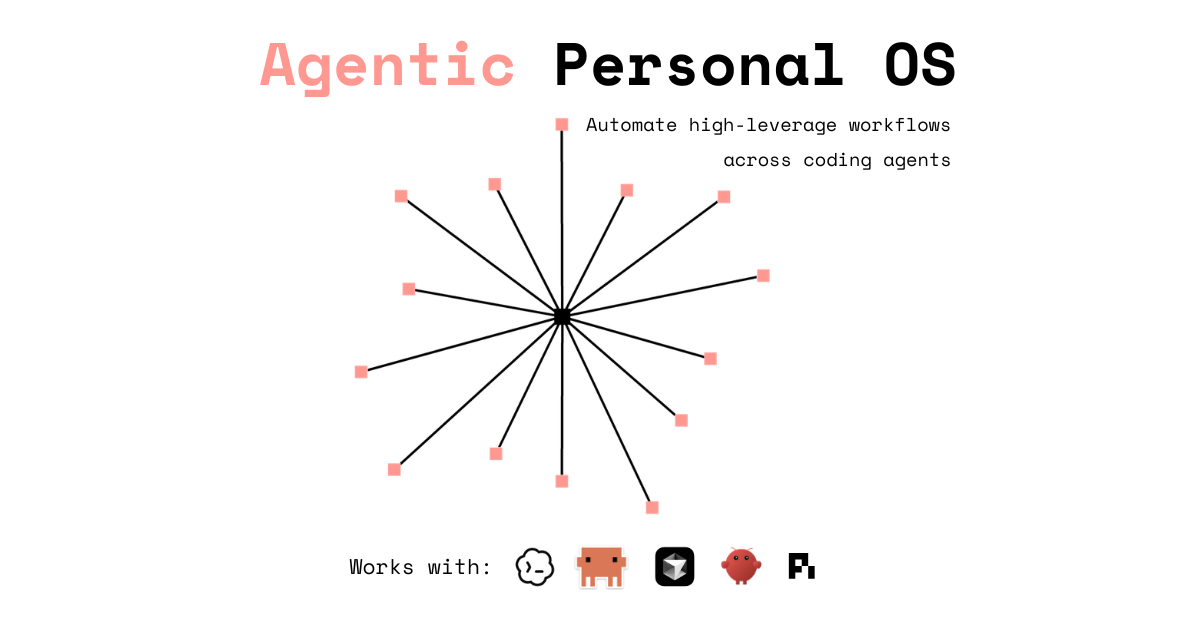
TL;DR: An agentic personal operating system built to automate high-leverage workflows across Claude Code, Codex, Pi, OpenClaw, and other coding agents/runtime platforms.
Clone this repo
git clone https://github.com/itseffi/personal-os.git
cd personal-os
Run setup
chmod +x setup.sh
./setup.sh
Start using This automates high-leverage execution end-to-end: it converts raw backlog into prioritized, goal-aligned, verification-enforced action plans.
Open this repo in your agent and run:
1) "Process my backlog from BACKLOG.md into Tasks/**/*.md using AGENTS.md rules."
2) "Show my P0/P1 unblocked tasks aligned to GOALS.md."
3) "Propose today’s top 3 with required verification evidence and commands."
Build Your Personal OS · Workflows · Canonical Skills · Evals · Tutorials (index)
flowchart TD
    U["User Prompt"] --> A["Agent Runtime<br/>Claude Code | Codex | Pi | OpenClaw"]
    A --> I["Instructions<br/>AGENTS.md + wrappers"]
    A --> S["Skills<br/>.agents/skills/*/SKILL.md"]
    A --> W["Workflows<br/>Workflows/*.md"]
    A --> F["State + Context<br/>Tasks, GOALS, BACKLOG, Knowledge, Resources"]
    A -. optional .-> M["MCP Integrations<br/>System/mcp + external services"]
    A -. optional .-> D["Subagents<br/>runtime-dependent delegation"]
    A --> E["Evals<br/>Evals/ + Evals/skills + scripts/run_skill_evals.py"]

    classDef core fill:#ff9891,stroke:#2b2b2b,color:#111111,stroke-width:1.2px;
    classDef optional fill:#ffd4d0,stroke:#2b2b2b,color:#111111,stroke-width:1.2px,stroke-dasharray: 4 3;
    class U,A,I,S,W,F,E core;
    class M,D optional;
Personal OS is designed to work with Claude Code, Codex, Pi, OpenClaw, and similar coding agent runtimes.
AGENTS.mdCLAUDE.mdCODEX.mdPI.mdOPENCLAW.md.agents/skills/*/SKILL.mdname, description, file path, plus agents/openai.yaml), and load full SKILL.md instructions only when a skill is selected. Canonical skills live in .agents/skills/, with bridge paths for Claude, Pi, and OpenClaw..claude/skills -> ../.agents/skills (symlink).agents/skills/ as its skill sourceskills -> .agents/skills symlink (or load .agents/skills via OpenClaw config)Bridge bootstrap (run once from repo root):
mkdir -p .claude
ln -sfn ../.agents/skills .claude/skills
ln -sfn .agents/skills skills
For Codex/OpenAI-style routing metadata, this repo includes:
.agents/skills/<skill>/agents/openai.yaml
(Claude, Pi, and OpenClaw primarily use SKILL.md and do not require this file format.)You can run Personal OS with Pi using a local/offline model backend (for example llama.cpp) or a hosted endpoint. For full setup instructions (server launch, ~/.pi/agent/models.json, and runtime configuration), see Pi Agent Setup.
personal-os/
├── AGENTS.md           # AI agent instructions (the brain)
├── GOALS.md            # Your goals and priorities
├── BACKLOG.md          # Quick capture inbox
├── Tasks/              # Your active work
├── Knowledge/          # Your notes and docs
├── Resources/          # Voice samples, templates, references
├── Workflows/          # Daily + Product & Strategy workflows
├── .agents/skills/     # Canonical Codex/OpenAI skill packs
├── Evals/              # Session reviews
├── Tutorials/          # Learning guides
└── System/             # MCP server, templates, integrations
Semantics by location: Tasks/**/*.md = actionable work, Knowledge/**/*.md = reference context.
AGENTS.md        →    Instructions layer (how AI behaves)
GOALS.md         →    Priority layer (what matters)
Tasks/**/*.md     →    State layer (current work)
Knowledge/**/*.md →    Context layer (reference)
.agents/skills/* →    Capability layer (how the agent executes specialized workflows)
Personal operating data stays local (gitignored):
Tasks/ - your workKnowledge/ - your notesResources/ - your samplesBACKLOG.md - your inboxSome top-level configuration files (AGENTS.md, GOALS.md, CLAUDE.md, CODEX.md, PI.md, OPENCLAW.md, docs) are version controlled by design. Treat GOALS.md as potentially sensitive and review content before publishing a public repo.
This repo includes structural, behavioral, routing, and memory-impact evals.
Run:
python scripts/validate_skills.py
python scripts/validate_skill_eval_cases.py
python scripts/run_skill_evals.py --provider fixture
python scripts/run_routing_evals.py
python scripts/run_memory_impact_evals.py
Optional live-model run (OpenAI-compatible endpoint, local or remote):
python scripts/run_skill_evals.py --provider openai --model your-model-id
Outputs are written to:
Evals/skills/results/Evals/memory/results/Use these evals as a regression gate when updating .agents/skills/.
Personal OS follows four operating patterns:
.agents/skills/*/SKILL.mdSecurity defaults:
Issues and PRs welcome.
Sign in to join the discussion.
No comments yet. Be the first to say what this is good for.
The agent harness performance optimization system. Skills, instincts, memory, security, and research-first development for Claude Code, Codex, Opencode, Cursor and beyond.
The job search that runs on your machine. AI job application framework built on Claude Code: evaluate postings, tailor CVs, write cover letters, prep interviews. Fork it and own it.
from vibe coding to agentic engineering - practice makes claude perfect
🌊 The original agent meta-harness. Deploy intelligent multi-player swarms, coordinate autonomous workflows, and build conversational AI systems. Features adaptive memory, self-learning intelligence, RAG integration, and native Claude Code / Codex / Hermes and many more Integrated
Practical patterns, starters & CLI tools for loop engineering with AI coding agents. Design systems that prompt and orchestrate agents (inspired by Addy Osmani and Boris Cherny). Includes loop-audit, loop-init, loop-cost.

Git. Ship. Done - Core