

DietrichGebert/ponytailPlugins
Makes your AI agent think like the laziest senior dev in the room. The best code is the code you never wrote.
138k
1 add
Whetstone packages a Claude Code plugin that gives agents a repeatable workflow for planning, building, reviewing, and documenting work. It also ships portable skills and a Codex path, so the same process can follow builders across tools.
Builders who use Claude Code, Codex, or portable agent skills and want more consistent review and verification.
You can make your agent plan before coding, verify before claiming done, and keep useful workflow knowledge for later reuse.
Five `/ia-*` commands cover brainstorm, plan, work, review, and compound documentation.
Skills for architecture, frontend, backend, testing, debugging, writing, prompting, and infrastructure guide the agent by task and file type.
Subagents handle review, research, design, and workflow jobs in isolation.
A hook layer adds behavior around agent actions inside the Claude Code plugin.
The repo includes an MCP server path through the companion codebase and plugin packaging.
The `distillery/` area generates skills from curated sources and supports sharing them across agents.
/plugin marketplace add https://github.com/iliaal/whetstone
/plugin install whetstone@iliaal-marketplace
/reload-plugins
# All skills
npx skills add iliaal/ai-skills

# Single skill
npx skills add iliaal/ai-skills -s code-review

# Target a specific agent
npx skills add iliaal/ai-skills -a cursor
git clone https://github.com/iliaal/whetstone
cd whetstone
bash scripts/install-codex-plugin.sh
bash scripts/refresh-codex-plugin.sh
bun run src/index.ts install ./plugins/whetstone --to opencode
bun run src/index.ts cleanup --target opencode
bun run src/index.ts cleanup --target kilocode
bun run src/index.ts cleanup --target agents



A Claude Code plugin that makes AI coding agents follow engineering discipline. Plan before coding. Verify before claiming done. Find root cause before patching. Review before merge. Skills activate based on file type and task signals, not manual toggling.
Bundles agents, skills, workflow commands, and a skill distillery for PHP, Python, TypeScript, React, and infrastructure workflows.
Teams using Claude Code for real work. You're building with PHP, Python, TypeScript, or React. You want the agent to plan before building, verify before shipping, and debug by reasoning instead of guessing. This plugin provides that structure.
Solo developers who want consistency. Bash tasks receive guidance on strict mode and ShellCheck; Laravel tasks receive strict-type and thin-controller patterns. Skills guide the agent; only checks actually run can establish compliance.
Anyone building with AI agents. Includes skills for multi-agent orchestration, agent-native architecture design, and a distillery that generates new skills from top-rated community sources.
AI coding agents skip planning, claim "done" without verifying, patch symptoms over root causes, and forget what they learned when context resets. The output looks polished. The behavior underneath is undisciplined.
The long-form argument is at AI Agents Don't Lack Capability. They Lack Process.. This plugin supplies that process as instructions and supporting tools.
/plugin marketplace add https://github.com/iliaal/whetstone
/plugin install whetstone@iliaal-marketplace
/reload-plugins
Individual skills work with Claude Code, Cursor, Codex, Gemini CLI, Copilot CLI, OpenCode, and 35+ other agents via the ai-skills repo:
# All skills
npx skills add iliaal/ai-skills

# Single skill
npx skills add iliaal/ai-skills -s code-review

# Target a specific agent
npx skills add iliaal/ai-skills -a cursor
Install Whetstone's portable skills and Context7 integration through the repository's native Codex marketplace:
git clone https://github.com/iliaal/whetstone
cd whetstone
bash scripts/install-codex-plugin.sh
Start a new Codex thread after installation or update. The native package includes Whetstone's cross-harness skills and Context7 MCP server. Claude-specific agents, slash commands, and hooks remain available only through the Claude Code plugin.
Two shared skills retain Claude's explicit-only disable-model-invocation metadata. Codex enforces the equivalent restriction through each skill's agents/openai.yaml. The current Codex runtime installs and loads this dual-harness package, although the standalone plugin-creator validator rejects those two Claude fields. Whetstone's regression suite treats the mapped fields as an intentional compatibility exception; it does not claim validator-clean source metadata.
Normal Whetstone releases refresh the local Codex plugin before publication when codex is on PATH. For source edits between releases, use the wrapper that applies a temporary cachebuster, reinstalls, and restores the tracked release version:
bash scripts/refresh-codex-plugin.sh
The legacy converter remains available for OpenCode and other non-plugin targets.
In this checkout, Codex also discovers the 12 repository commands and skill-distiller through .agents/skills/. Invoke them as $release, $audit-plugin, $write-skill, or $skill-distiller, with arguments after the name. Command wrappers read the maintained .claude/commands/ sources. If an existing session has not refreshed its skill list, start a new Codex session. These repository workflows are separate from the distributed plugin skills.
Same converter, different target. OpenCode reads skills from its per-project config. The converter translates the plugin's SKILL.md format into OpenCode's expected shape and writes output into the current project (override with --output <dir>).
Command-based PreToolUse and PostToolUse hooks use a bundled adapter; unsupported hook events and types cause conversion to fail. Whetstone's injection hook requires Bash and jq on PATH. The installed bundle includes its scripts and skill files, so it does not depend on the source checkout.
bun run src/index.ts install ./plugins/whetstone --to opencode
Cleanup for OpenCode (and other targets) uses the same command:
bun run src/index.ts cleanup --target opencode
bun run src/index.ts cleanup --target kilocode
bun run src/index.ts cleanup --target agents
Use cleanup --target opencode --output <dir> for a custom installation. Default OpenCode cleanup checks the current project and legacy global locations. Cleanup backs up individually identified Whetstone artifacts and preserves unrelated or customized files; files whose ownership cannot be established require manual review.
For tools that read skills directly from ~/.agents/skills or ~/.kilocode/skills, scripts/sync-to-tools.sh symlinks the plugin's skill directory into each path so edits land immediately without re-conversion. It removes legacy Whetstone-owned links from ~/.codex/skills and adds managed Codex exclusions for the same skills discovered through ~/.agents/skills; the native plugin remains Codex's single source.
bash scripts/sync-to-tools.sh              # symlink into shared non-Codex tool dirs
bash scripts/sync-to-tools.sh --dry-run    # preview changes
Five commands form a loop: explore the problem, plan the solution, build it, review it, document what you learned. Each pass makes the next one faster because solutions accumulate as searchable docs.
| Command | What it does |
|---|---|
/ia-brainstorm | Interviews you one question at a time to surface hidden requirements. Produces 2-3 named approaches with trade-offs. No code until a design doc is approved. |
/ia-plan | Turns a brainstorm or feature idea into a file-based plan with atomic tasks, specific file paths, and phased delivery in vertical slices. |
/ia-work | Executes a plan with task tracking, worktree isolation, and verification gates. Each task runs through build/test before marking complete. |
/ia-review | Multi-agent code review: scope-drift detection, spec compliance, code quality, security, performance. Auto-escalates to deep mode on complex diffs. |
/ia-compound | Captures what you just solved as searchable documentation in docs/solutions/ so the next person (or the agent) doesn't re-debug it. |
You don't have to use all five. /ia-review on its own is a solid pre-merge check. /ia-plan works standalone for scoping. Mix and match.
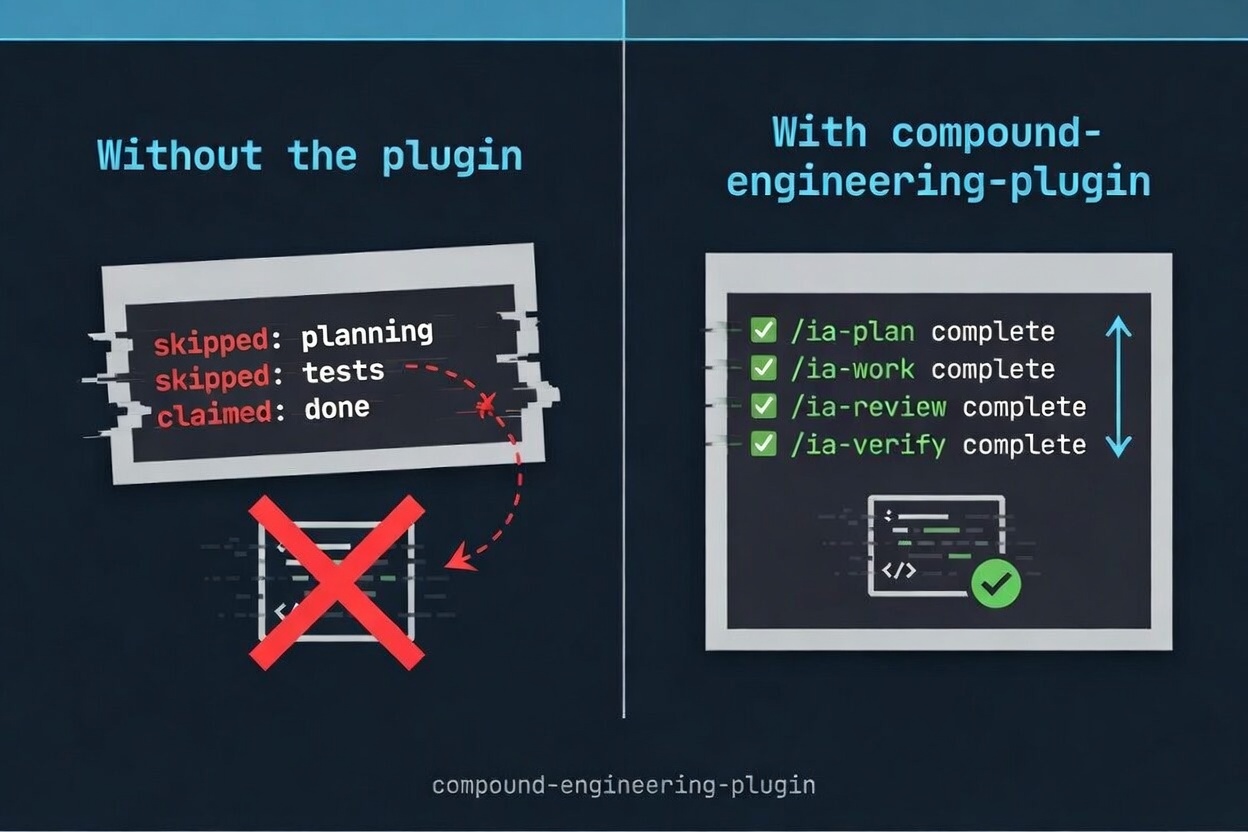
Skills are instructions selected for the task. They guide procedures and identify anti-patterns; they are not runtime enforcement of the agent's decisions.
| Skill | Description |
|---|---|
| ia-agent-native-architecture | 15-area architecture checklist for systems where AI agents are primary actors: tool design, execution patterns, context injection, approval gates, audit trails. For designing agent systems or MCP tools. |
| ia-frontend-design | Requires a design philosophy statement before code, detects existing design systems to match, and bans AI design cliches (purple-to-blue gradients, Space Grotesk, three-card hero layouts). Calibrates output via variance, motion, and density parameters. For work where visual identity matters. |
| ia-simplifying-code | Declutters code without changing behavior. Targets AI slop: redundant comments, unnecessary defensive checks, over-abstraction, verbose stdlib reimplementations. Applies changes in priority order and stops before touching public APIs. For cleanup after AI generation or accumulated complexity. |
| Skill | Description |
|---|---|
| ia-react-frontend | Decision tree routing most "should I use an effect?" questions to non-effect solutions. Separates state tools by purpose (Zustand for client, React Query for server, nuqs for URL). Enforces React 19 patterns, App Router server/client boundaries, and flags that Server Actions are public endpoints. For React, Next.js, and Vitest/RTL testing. |
| ia-nodejs-backend | Strict layered architecture (routes > services > repos) with no cross-layer HTTP imports. Contract-first API design using Zod schemas as the single source of truth. Production patterns like circuit breaker and load shedding as requirements, not suggestions. For Express, Fastify, Hono, or NestJS backends. |
| ia-python-services | Mandates modern tooling (uv, ruff, ty) over legacy equivalents. Structured concurrency via asyncio.TaskGroup, idempotent background jobs, and structured JSON logging with correlation IDs via contextvars. For Python CLI tools, FastAPI services, async workers, or new project setup. |
| ia-php-laravel | declare(strict_types=1) everywhere, PHPStan level 8+, fat models / thin controllers, Form Requests with toDto(), event-driven side effects. Prevents N+1 by disabling lazy loading in dev. Defaults to feature tests through the full HTTP stack. For Laravel codebases. |
| ia-rust-systems | Edition 2024, workspace layout with inward-only deps, thiserror in libraries / anyhow in binaries, no unwrap/expect outside main and tests, every unsafe block needs a // SAFETY: comment. Tokio patterns (JoinSet, CancellationToken, bounded mpsc) and axum service layout. For Rust CLIs, axum services, or cargo workspaces. |
| ia-c-systems | Repo conventions outrank the skill, so it defers on tabs, goto cleanup, and macros that return rather than fighting established C. Function altitudes (orchestrator / leaf / adapter) gated behind a name test that stops over-decomposition, status enums with one producer per error value, public-validates / internal-asserts boundaries. Separate references for memory safety (sanitizers, overflow-checked allocation, recursion to bounded worklists) and PHP extension C. For C11 and later, native extensions, and systems code. |
| ia-cpp-systems | Rule of zero by default and rule of five once a destructor appears, since a user-declared destructor silently suppresses moves. unique_ptr first and shared_ptr third. API rules that break callers when ignored: decide explicit at introduction, keep the narrow overload, delete rather than silently ignore. Separate references for ABI boundaries (exceptions must not cross extern "C", PIMPL, visibility) and CMake tooling. For C++17 and later libraries and services. |
| ia-pinescript | Guides Pine Script v6 syntax, platform limits, signal stability checks, and walk-forward validation. Distinguishes historical indexing from future outcomes and chart-bar confirmation from requested-timeframe confirmation. |
| ia-tailwind-css | Enforces v4's CSS-first config model (@theme, @utility, @custom-variant directives). Provides a v3-to-v4 breaking changes table. Prohibits dynamic class construction, mandates gap over space-x, size-* over paired w-*/h-*. For Tailwind v4 or v3 migrations. |
| Skill | Description |
|---|---|
| ia-postgresql | BIGINT GENERATED ALWAYS AS IDENTITY over SERIAL, TIMESTAMPTZ over TIMESTAMP, indexes on every FK (Postgres doesn't auto-create them). Includes an unindexed FK detection query and mandates EXPLAIN (ANALYZE, BUFFERS) before any optimization claim. For schema design, query tuning, RLS, or partitioning. |
| ia-terraform | Specific file organization, for_each over count to prevent recreation on reordering, remote state with locking, moved blocks for renames, and four-tier testing (validate > tflint > plan tests > integration). For Terraform or OpenTofu. |
| ia-linux-bash-scripting | set -Eeuo pipefail as foundation, EXIT traps for cleanup, printf over echo, arrays over eval, local separated from assignment. Production templates for atomic writes, retry with backoff, and script locking. For any Bash script meant for production. |
| Skill | Description |
|---|---|
| ia-writing-tests | DAMP over DRY, test cases from user journeys not implementation details, real objects over mocks (mocks only at system boundaries). Requires red-green cycles for bug fix tests. Includes a 13-excuse Rationalization Table for when you're tempted to skip tests. Works with any language. |
| ia-code-review | Checks specification compliance before code quality, tracks selected-file coverage, and ranks findings by severity and evidence. Selects deep review when 3+ risk signals apply. Reports suggested action routes without editing during review-only work. For PR reviews and code audits. |
| ia-receiving-code-review | Verify-before-implement for every comment. Different skepticism levels by source: maximum for automated agents, trusted-but-verified for project owners. Requires evidence when pushing back. Prohibits performative agreement. For processing review feedback on your code. |
| ia-debugging | Reproduces the reported symptom, tests evidence-backed hypotheses, and verifies permanent repairs with regressions. Distinguishes authorized incident mitigation from root-cause repair and preserves diagnosis-only scope. Reassesses after 3 failed cycles without imposing a fixed tracing depth. |
| ia-verification-before-completion | Requires fresh evidence through Identify, Run, Read, Verify, Claim. Checks the actual revision and entry point, reports missing coverage, and distinguishes fixtures from live proof. Accepts a clean review when its coverage supports the conclusion. |
| ia-planning | Chooses a durable plan, inline list, or direct implementation from dependencies, recovery needs, and unresolved decisions. File counts are signals rather than automatic triggers. Plans name concrete tasks, ownership, verification, and runnable phase outcomes. |
| Skill | Description |
|---|---|
| ia-brainstorming | Hard gate: no code until a design doc is approved. Reads the codebase first, interviews one question at a time, proposes 2-3 named approaches with trade-offs, saves a structured doc to docs/brainstorms/. For vague requirements or multiple valid interpretations. |
| ia-compound-docs | Explicitly invoked workflow for documenting solved problems. Captures lessons not already recoverable from code and existing documentation, validates YAML frontmatter, checks for duplicates, and detects recurring patterns when 3+ similar issues appear. |
| ia-document-review | Activates specialized lenses (Product, Design, Security, Scope Guardian, Adversarial) based on document signals. Scores on four criteria, identifies one critical improvement, and can dispatch a fresh-eyes sub-agent. For polishing specs or brainstorms before handing them to planning. |
| ia-writing | Edits prose while preserving meaning, facts, and voice. Treats vocabulary and structural tells as contextual signals, with separate edit and detect-only modes and guidance for publication surfaces. For blog posts, PR descriptions, docs, and changelogs. |
| ia-git-worktree | Routes all operations through a manager script handling .env copying, .gitignore updates, and dependency installation. Detects execution context and adapts. For parallel feature development or isolated reviews. |
| ia-md-docs | Treats AGENTS.md as the canonical context file. Verifies every factual claim against the actual codebase before writing. For project documentation that's stale, missing, or needs initialization. |
| ia-file-todos | File-based task tracking with structured YAML frontmatter and naming conventions. Distinct from in-session memory and application-level models. For persistent, human-and-agent-readable todo files with dependency tracking. |
| Skill | Description |
|---|---|
| ia-meta-prompting | Decision modifiers through natural language or prompt markers: /verify-think challenges an answer, /adversarial ranks counterarguments, /edge explores failure scenarios, and /confidence scores claims. Distinct from the /ia-verify command's pre-PR checks. |
| ia-refine-prompt | Assesses against a six-element checklist (task, constraints, format, context, examples, edge cases), rewrites in specification language, validates all gaps addressed. Enforces 0.75x-1.5x length ratio and won't invent missing info. For prompts that produce inconsistent results. |
| ia-reflect | Scans the full conversation for mistakes, friction, and wins, citing specific exchanges. Proposes ranked improvements and audits skills used in the session for token efficiency. For end-of-session lessons learned. |
| Skill | Description |
|---|---|
| ia-orchestrating-swarms | Coordinates independent agents with explicit scope, file ownership, and verification assignments. Uses worktrees or a shared-tree workflow with exclusive writes and parent-owned integration. Defines worker recovery, independent review, and four status signals. |
Specialized subagents dispatched by the main agent or by workflow commands. Each runs in isolation with its own tools and context.
| Agent | Description |
|---|---|
| ia-accessibility-tester | WCAG 2.1 audit across keyboard navigation, screen reader compatibility, contrast ratios, ARIA attributes, and form accessibility. For compliance checks before launch. |
| ia-architecture-strategist | Evaluates architectural soundness, design pattern compliance, and structural consistency. For service additions, refactors, or codebase pattern audits. |
| ia-cloud-architect | Analyzes infrastructure against Well-Architected Framework principles: cost optimization, scalability, disaster recovery across AWS, Azure, and GCP. |
| ia-code-simplicity-reviewer | Produces a simplification report (no code changes) identifying YAGNI violations and over-engineering. For post-implementation analysis. |
| ia-database-guardian | Validates migration safety, referential constraints, and data integrity. For PRs touching migrations, backfills, or data transformations. |
| ia-kieran-reviewer | Opinionated Python and TypeScript review with a high bar for type safety, naming clarity, and modern patterns. |
| ia-performance-oracle | Identifies bottlenecks in algorithmic complexity, database queries, memory usage, and scalability limits. |
| ia-security-sentinel | Threat modeling and vulnerability scanning across authentication, input validation, secrets management, and OWASP categories. |
| ia-spec-flow-analyzer | Maps user flows through specifications to surface edge cases, missing clarifications, and completeness gaps before implementation. |
| Agent | Description |
|---|---|
| ia-best-practices-researcher | Gathers official framework docs, version-specific best practices, and industry standards for any technology. |
| ia-git-history-analyzer | Excavates git history to explain code evolution: traces commits, authors, and context around decisions. |
| ia-learnings-researcher | Mines docs/solutions/ for documented solutions and patterns relevant to the current task. Prevents repeating past mistakes. |
| ia-repo-research-analyst | Analyzes repository architecture, naming conventions, and implementation patterns. For onboarding or understanding project conventions. |
| Agent | Description |
|---|---|
| ia-design-iterator | Iterative UI refinement through screenshot-analyze-improve cycles. For when initial design changes produce mediocre results. |
| ia-figma-design-sync | Compares implemented UI against Figma designs, reports discrepancies, and optionally applies fixes. |
| Agent | Description |
|---|---|
| ia-bug-reproduction-validator | Reproduces bug reports and identifies root causes without applying fixes. Validates whether reports are genuine bugs before engineers invest. |
| [ia-deployment-verificatio |
Sign in to join the discussion.
No comments yet. Be the first to say what this is good for.
Makes your AI agent think like the laziest senior dev in the room. The best code is the code you never wrote.
Graphs that teach > graphs that impress. Turn any code into an interactive knowledge graph you can explore, search, and ask questions about. Works with Claude Code, Codex, Cursor, Copilot, Gemini CLI, and more.

OmO: Just type "mass ulw" keyword with your prompt. Now you are the master of graph engineering.
Persistent Context Across Sessions for Every Agent – Captures everything your agent does during sessions, compresses it with AI, and injects relevant context back into future sessions. Works with Claude Code, OpenClaw, Codex, Gemini, Hermes, Copilot, OpenCode + More
Opinionated Oxlint rules for rejecting low-evidence TypeScript and JavaScript patterns
Teams-first Multi-agent orchestration for Claude Code