
JuliusBrussee/
caveman

🪨 why use many token when few token do trick — Claude Code skill that cuts 65% of tokens by talking like caveman
105k
1 add
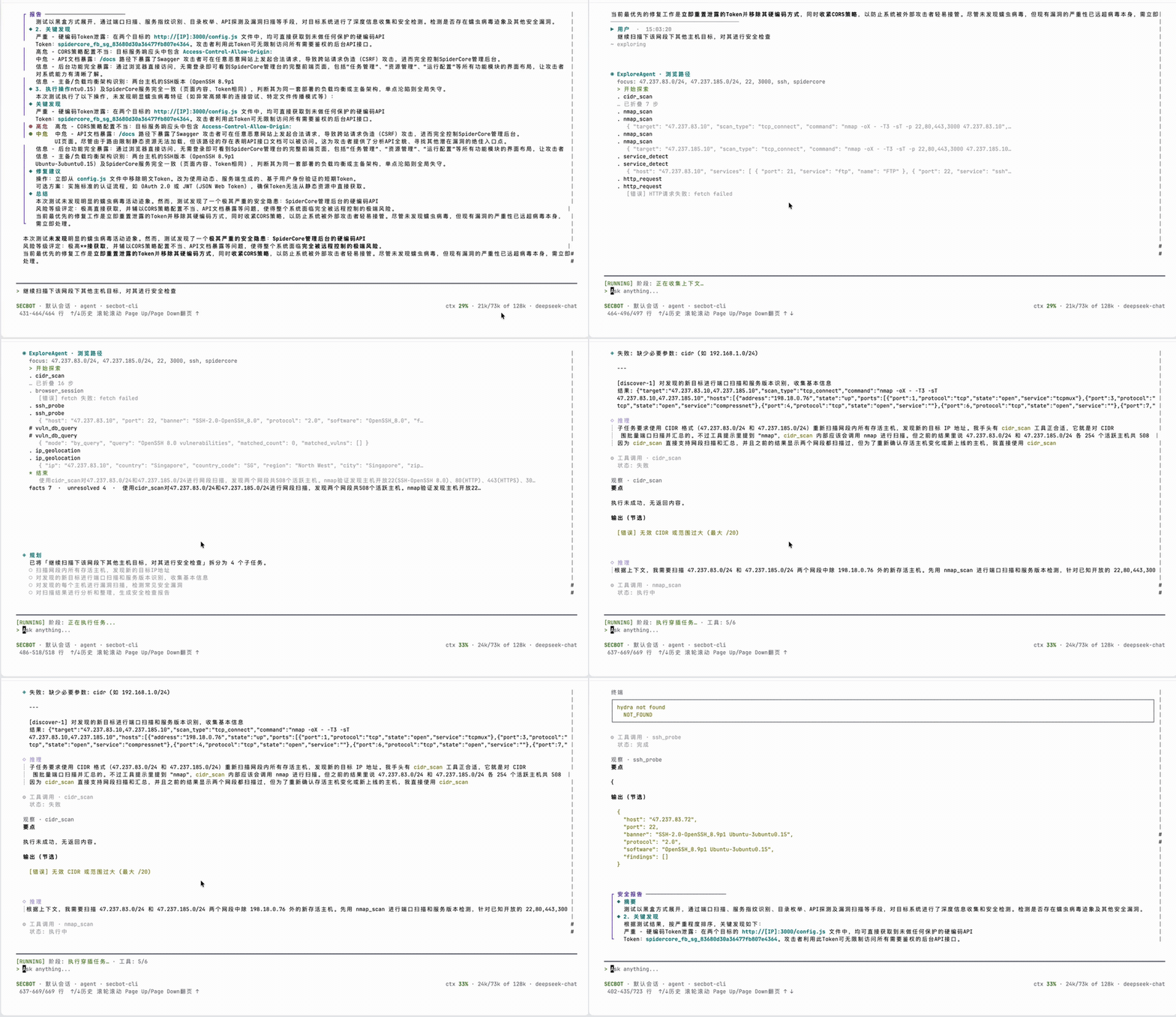
Secbot combines a NestJS backend, an Ink terminal UI, and an MCP server into one security workflow workspace. It can run as a full terminal product, backend-only service, or MCP tool server, and it shares skills across the UI, CLI, REST API, and internal tools. It is built for authorized testing, research, and education only.
Builders who want their agent to run security workflows, manage shared skills, and expose tools through MCP.
You can run authorized security testing from a terminal workspace instead of stitching together separate tools and prompts.
Starts `secbot` as a terminal app that can spawn a local backend by default.
Runs `secbot-server` when you want the NestJS API without the terminal UI.
Runs `secbot-mcp` to expose the Secbot tool catalog over stdio MCP.
Lets you list, view, and create skills through TUI slash commands, CLI subcommands, REST endpoints, and internal tools.
Includes planning, tool execution, MCP bridging, and summarization in one workspace.
Includes built-in tools for web, network, OSINT, defense, and reporting workflows.
Uses the `mcp_call` tool to connect to and invoke other stdio MCP servers.
npm install -g ./opensec-secbot-2.0.0-b2.tgz
secbot
npx ./opensec-secbot-2.0.0-b2.tgz
secbot
secbot-server
secbot-mcp
# Recommended explicit service mode
SECBOT_TUI_BACKEND=service SECBOT_API_URL=http://127.0.0.1:8000 secbot

# Backward-compatible alias
SECBOT_TUI_BACKEND=remote SECBOT_API_URL=http://127.0.0.1:8000 secbot



Secbot is an AI-powered TypeScript security automation workspace with a NestJS backend and an Ink-based terminal UI.
Security notice: this package is for authorized security testing, research, and education only. Do not run scans or exploitation tasks against targets without explicit permission.
| Line | Branch | Releases | Notes |
|---|---|---|---|
| v2 TypeScript product | release | GitHub Releases (.tgz) | Current product line — NestJS + Ink TUI |
| v1 Python stack | pypi-release | v1.10.0+ | Legacy Python edition; maintained on pypi-release |
| Go experiment | pure-go | — | Demo / proof-of-concept only |
NestJS + Ink + SQLite).secbot binary that starts terminal UI with local spawned backend by default.secbot-server binary for backend-only API scenarios.secbot-mcp binary that exposes Secbot tools as a stdio MCP server.From the repository checkout, ChatService routes each turn through IntentRouter (single LLM classify), optionally ExploreAgent (ReAct with vuln_db_query / browser_session, no sensitive tools), then ContextAssemblerService + ContextStore under a per-model context budget. SSE events include intent_decision, explore_*, and context_usage for the TUI token meter. task_simple skips the planner; SummaryAgent runs only when needs_report is true. Contributor-oriented details live in CLAUDE.md; longer user docs: README_CN.md / README_EN.md.
>= 24>= 10 (recommended)Download the latest .tgz from GitHub Releases (currently v2.0.0-b2), then:
npm install -g ./opensec-secbot-2.0.0-b2.tgz
secbot
npx ./opensec-secbot-2.0.0-b2.tgz
Create a .env file in your working directory:
# Cloud model backend (recommended)
LLM_PROVIDER=deepseek
DEEPSEEK_API_KEY=sk-your-api-key
DEEPSEEK_MODEL=deepseek-chat

# Optional local backend (Ollama)
# LLM_PROVIDER=ollama
# OLLAMA_BASE_URL=http://localhost:11434
# OLLAMA_MODEL=llama3.2

# Optional: explore iterations, context debug SSE, adaptive replan, NVD rate limits
# SECBOT_EXPLORE_MAX_ITERS=12
# SECBOT_CONTEXT_DEBUG=1
# SECBOT_ADAPTIVE_REPLAN=false
# NVD_API_KEY=your-nvd-key
secbot
secbot-server
secbot-mcp
Set SECBOT_MCP_ALLOW_SENSITIVE=true only when you intentionally want MCP clients to see sensitive tools.
# Recommended explicit service mode
SECBOT_TUI_BACKEND=service SECBOT_API_URL=http://127.0.0.1:8000 secbot

# Backward-compatible alias
SECBOT_TUI_BACKEND=remote SECBOT_API_URL=http://127.0.0.1:8000 secbot
| Binary | Description |
|---|---|
secbot | Start terminal UI (default: spawn local backend; optional service mode) |
secbot-server | Start NestJS backend only |
secbot-mcp | Expose Secbot tools through stdio MCP |
Secbot now exposes one shared skills layer for product and automation surfaces.
/skills
/skill <name>
/create-skill <name> [--description ...] [--trigger ...] [--tag ...] [--prerequisite ...] [--author ...]
secbot skills list
secbot skills view <name>
secbot skills create <name> --description "..." --trigger recon --tag web
GET  /api/skills
GET  /api/skills/:name
POST /api/skills
Created skills are scaffolded under skills/custom/<slug>/SKILL.md and can also be reached through the internal list_skills, get_skill, and create_skill tools.
Secbot supports MCP in both directions.
secbot-mcp
This exposes the current ToolsService catalog over stdio MCP. Sensitive tools stay hidden by default unless SECBOT_MCP_ALLOW_SENSITIVE=true is set.
Use the built-in mcp_call tool to connect to another stdio MCP server, list its tools, or invoke one of them from Secbot workflows.
git clone https://github.com/iammm0/secbot.git
cd secbot
npm ci

# Backend dev
npm run dev

# Backend dev with file watching
npm run dev:watch

# TUI (in another terminal, default: spawn local backend)
npm run start:tui

# TUI service mode (connect existing backend only)
SECBOT_TUI_BACKEND=service SECBOT_API_URL=http://127.0.0.1:8000 npm run start:tui
| Script | Description |
|---|---|
npm run build | Build the NestJS backend |
npm run build:terminal-ui | Build the Ink terminal UI |
npm run build:web | Build the web frontend bundle |
npm run typecheck | Type-check server code |
npm run lint | Run ESLint |
npm run format:check | Check Prettier formatting |
npm test | Run tests |
npm run release:pack | Build and create npm package tarball |
npm run release:verify | Verify packaged npm release contents |
docs/wiki/This project is licensed under MIT. See LICENSE for details.
Sign in to join the discussion.
No comments yet. Be the first to say what this is good for.
🪨 why use many token when few token do trick — Claude Code skill that cuts 65% of tokens by talking like caveman

The best-benchmarked open-source AI memory system. And it's free.

Orca is the ADE for working with a fleet of parallel agents. Run any coding agent with your own subscription. Available on desktop, mobile and remote runtime.
A cross-platform desktop All-in-One assistant for Claude Code, Codex, OpenCode, OpenClaw, Grok Build & Hermes Agent. Only official website: ccswitch.io

Never stop coding. Free MIT AI gateway: one endpoint, 352 providers (150+ free), 1200+ models Kimi, Claude, GPT, Gemini, GLM, DeepSeek, MiniMax. Works with Claude Code, Codex, Cursor, OpenCode, Cline & Copilot. Quota-aware auto-fallback, RTK+Caveman compression saves 15-95% tokens, MCP/A2A, Desktop/PWA. Built by 550+ contributors

Compress tool outputs, logs, files, and RAG chunks before they reach the LLM. 20% fewer tokens for coding agents, 60-95% fewer tokens for JSON, same answers. Library, proxy, MCP server.