

DietrichGebert/ponytailPlugins
Makes your AI agent think like the laziest senior dev in the room. The best code is the code you never wrote.
138k
1 add
This plugin tracks the estimated carbon footprint of Claude Code sessions from token usage and stores the results locally. It shows a live CO2 value in the status line, saves history in SQLite, backfills old transcripts, and can generate text reports, PNG cards, badges, and PR comments.
Builders who use Claude Code and want their agent sessions recorded with carbon totals.
You can see and keep a local carbon history for Claude Code sessions instead of losing it when transcripts expire.
Shows estimated CO2 next to session cost in the Claude Code status line.
Persists each session to a local SQLite database so records survive transcript purge.
Replays existing `~/.claude` transcripts to recover older session data.
Provides `/carbon-report`, `/carbon-card`, `/carbon-pr`, `/carbon-badge`, and `/carbon-update` commands.
Uses Stop, SessionEnd, and SessionStart hooks to save sessions and catch missed ones.
Stores emission factors in `data/factors.json` and pricing in `data/prices.json` so history can be recomputed.
curl -fsSL https://raw.githubusercontent.com/gwittebolle/claude-carbon/main/install.sh | bash
irm https://raw.githubusercontent.com/gwittebolle/claude-carbon/main/install.ps1 | iex
npx claude-carbon
claude-carbon ⌥ main | 🟢 Opus 5 ▓▓▓░░░░░░░ 35% | $0.50 · 65g CO₂ | Use 24% ↻13:00
# Since a specific date
bash ~/code/claude-carbon/scripts/generate-report.sh --since 2026-03-01

# All time
bash ~/code/claude-carbon/scripts/generate-report.sh --all

# A closed period (--until is an exclusive upper bound: this one stops at June 30th)
bash ~/code/claude-carbon/scripts/generate-report.sh --since 2026-01-01 --until 2026-07-01
curl -fsSL https://raw.githubusercontent.com/gwittebolle/claude-carbon/main/install.sh | CLAUDE_CARBON_DIR=~/my-path/claude-carbon bash


claude-carbon is an open source Claude Code plugin that tracks the carbon footprint of your sessions: a live CO2 estimate in the status line, computed locally from your token usage, next to the session cost.

~/.claude transcripts/carbon-report (text), /carbon-card (PNG), /carbon-pr (footprint of a pull request)1. Install (or update):
macOS, Linux, WSL:
curl -fsSL https://raw.githubusercontent.com/gwittebolle/claude-carbon/main/install.sh | bash
Windows (PowerShell), which needs Git for Windows and two packages first - see Windows:
irm https://raw.githubusercontent.com/gwittebolle/claude-carbon/main/install.ps1 | iex
Or, on any platform with Node.js:
npx claude-carbon
Same command to install and to update to the latest version (all three run the same installer).
2. Restart Claude Code. Your CO2 appears in the status line:
claude-carbon ⌥ main | 🟢 Opus 5 ▓▓▓░░░░░░░ 35% | $0.50 · 65g CO₂ | Use 24% ↻13:00
Segments, left to right: project + git branch, model + context window %, session cost + CO2, 5h block usage % + reset time. A 🔥 prefix appears when the sustained burn rate would overshoot 100% of the limit by the end of the 5h block (after a 15 min grace window, only once usage reaches 15%).
Where the CO2 shows up. The status line is a feature of the Claude Code terminal UI. It is displayed only when you run
claudein a terminal, including the integrated terminal of VS Code or JetBrains. The IDE extensions' chat panel has no status line at all, so nothing is displayed there even though the hooks still run and your sessions are recorded:/carbon-reportcovers them. If you use the VS Code panel and want the live CO2, open a terminal in VS Code (Ctrl+`) and runclaudefrom there. The web app (claude.ai/code) and the desktop app run neither the status line nor the hooks, so nothing is displayed or recorded there.
5h quota source. The percentage comes directly from Anthropic's /api/oauth/usage endpoint (the same data Claude Code displays in /usage). No heuristic, no token-limit file to seed. Two sources in order:
rate_limits.five_hour.used_percentage in the statusline JSON, that value is used straight away.GET https://api.anthropic.com/api/oauth/usage with the bearer token from macOS Keychain, CLAUDE_CODE_OAUTH_TOKEN, or ~/.claude/.credentials.json. Cached 60s in ~/.claude/claude-carbon/oauth-usage.json.Accurate on every plan, including Max 20x.
3. Use the slash commands:
/carbon-report - text report with totals, equivalences, top sessions/carbon-card - generate shareable PNG report cards (requires playwright-core, see Dependencies)/carbon-update - update to the latest version and re-price history (see Updating)
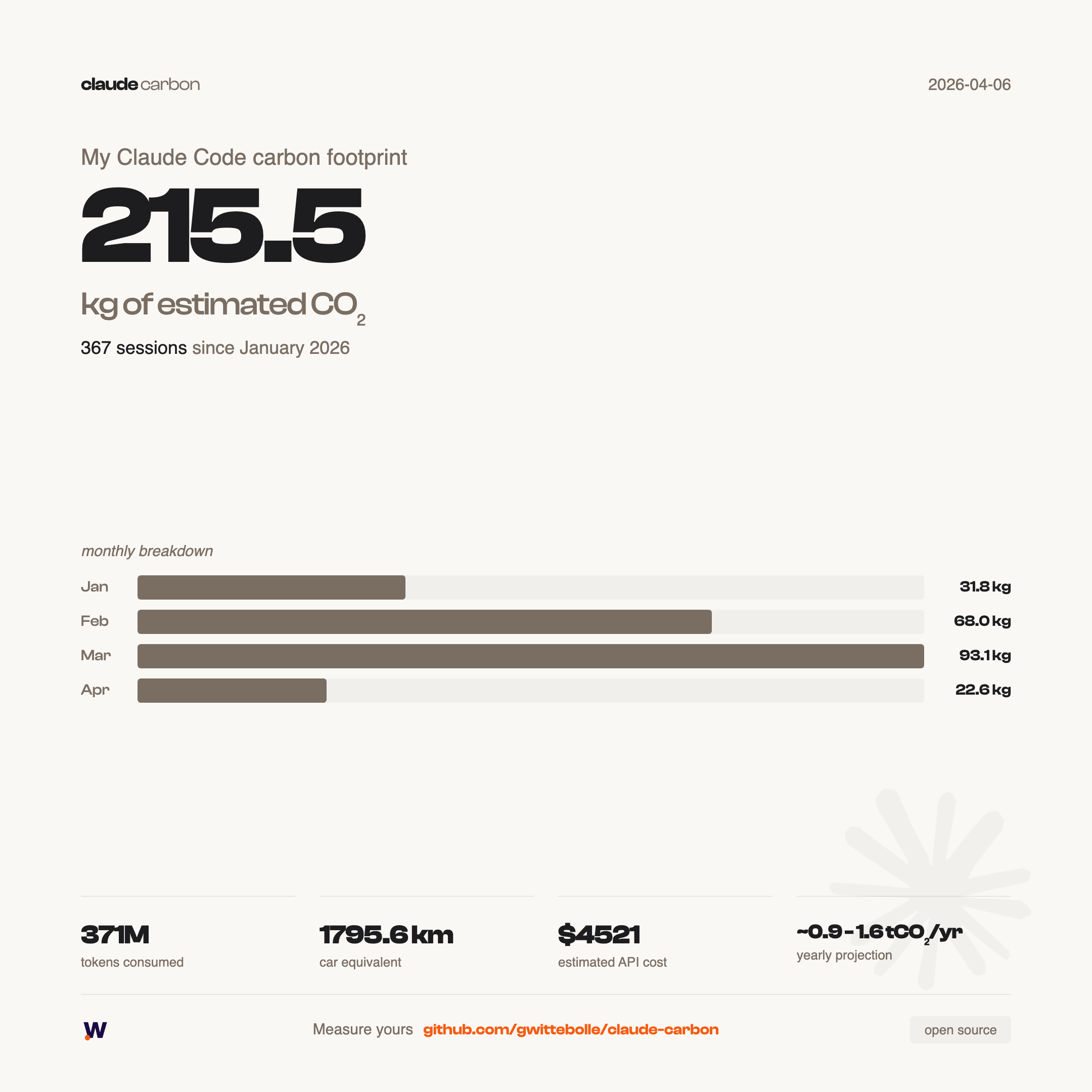
Generate yours with /carbon-card in Claude Code. The summary and detailed PNGs land in
~/Downloads/claude-carbon/ (the Windows Downloads folder follows the system setting, so a
OneDrive-redirected one is honoured) and the folder opens in your file manager, with the
card selected on macOS. CLAUDE_CARBON_EXPORT_DIR picks another folder;
CLAUDE_CARBON_NO_OPEN=1 skips the opening.
From the 1st to the 10th of each month the status line ends with 📊 August wrapped · /carbon-card:
the month just closed has its bar on the card, under the running total. Generating a card
clears it for the month; it goes quiet on its own after the 10th. CLAUDE_CARBON_CARD_NUDGE_UNTIL_DAY
moves the cut-off, CLAUDE_CARBON_NO_CARD_NUDGE=1 removes the nudge. Nothing is posted anywhere:
sharing stays a human decision.
# Since a specific date
bash ~/code/claude-carbon/scripts/generate-report.sh --since 2026-03-01

# All time
bash ~/code/claude-carbon/scripts/generate-report.sh --all

# A closed period (--until is an exclusive upper bound: this one stops at June 30th)
bash ~/code/claude-carbon/scripts/generate-report.sh --since 2026-01-01 --until 2026-07-01
curl -fsSL https://raw.githubusercontent.com/gwittebolle/claude-carbon/main/install.sh | CLAUDE_CARBON_DIR=~/my-path/claude-carbon bash
The env var has to sit on the bash side of the pipe, not the curl side, or the installer never sees it.
If you run a second Claude Code environment out of its own config directory, e.g.
alias claude-work="CLAUDE_CONFIG_DIR=~/.claude-work claude"
install claude-carbon into that same directory by passing CLAUDE_CONFIG_DIR to the installer:
curl -fsSL https://raw.githubusercontent.com/gwittebolle/claude-carbon/main/install.sh | CLAUDE_CONFIG_DIR=~/.claude-work bash
The status line, the hooks, the database and the /carbon-* commands all live under that config dir, so each environment tracks its own sessions independently. When CLAUDE_CONFIG_DIR is unset everything falls back to ~/.claude as before.
git clone https://github.com/gwittebolle/claude-carbon.git ~/code/claude-carbon
bash ~/code/claude-carbon/scripts/setup.sh
bash ~/code/claude-carbon/scripts/configure-settings.sh
The second script merges the block below into ~/.claude/settings.json (additively: an existing status line or third-party hooks are left alone) and symlinks the /carbon-* commands. To wire it by hand instead, skip it and add:
{
  "statusLine": {
    "type": "command",
    "command": "~/code/claude-carbon/scripts/statusline.sh"
  },
  "hooks": {
    "Stop": [
      {
        "matcher": "",
        "hooks": [
          {
            "type": "command",
            "command": "~/code/claude-carbon/scripts/persist-session.sh"
          }
        ]
      }
    ],
    "SessionEnd": [
      {
        "matcher": "",
        "hooks": [
          {
            "type": "command",
            "command": "~/code/claude-carbon/scripts/persist-on-exit.sh"
          }
        ]
      }
    ],
    "SessionStart": [
      {
        "matcher": "",
        "hooks": [
          {
            "type": "command",
            "command": "~/code/claude-carbon/scripts/safety-rescan.sh"
          }
        ]
      }
    ]
  }
}
The Stop hook records the session after each turn, and SessionEnd records it once more as it closes, so a last turn interrupted before Stop fired is still counted. The SessionStart one re-scans for sessions both missed (crash, kill) and drives the daily update check the status line reads; without it you are never told a new version exists.
Restart Claude Code.
claude-carbon measures one developer's sessions, locally. If the question comes from your CTO, a client RFP or a CSR committee, the same methodology exists as a hosted layer:
The only places the OSS points there are a one-line footer in /carbon-report and a small credit on the /carbon-card PNGs. No status-line promo, no email capture: nothing leaves your machine.
The number reviewers rarely see is what the PR cost to develop: your local Claude Code sessions while building the branch. /carbon-pr (or scripts/generate-pr-report.sh) sums the recorded sessions of the current branch and posts one sticky comment on its open PR, through your own gh auth. Run it after your push; running it again updates the same comment in place.
**Claude Code carbon report** · developing this PR
124 g CO2e · $3.00 · 180k tokens · 1.5M cache reads · 2 sessions
How the sessions are attributed: the Stop hook stores each session's git branch (read from the transcript), and the report selects project + branch. Sessions recorded before this column existed carry no branch; scripts/backfill.sh repairs them while their transcripts are still on disk (about 30 days). Sessions started from a subdirectory of the repo are stored under the subdirectory's name and stay out of the sum. A session that ends on another branch than it started is attributed to where it finished.
Turning it off is the default: nothing is posted unless you run it. --dry-run previews the comment, --pr <number> targets a specific PR, and deleting the comment on GitHub is the full cleanup.
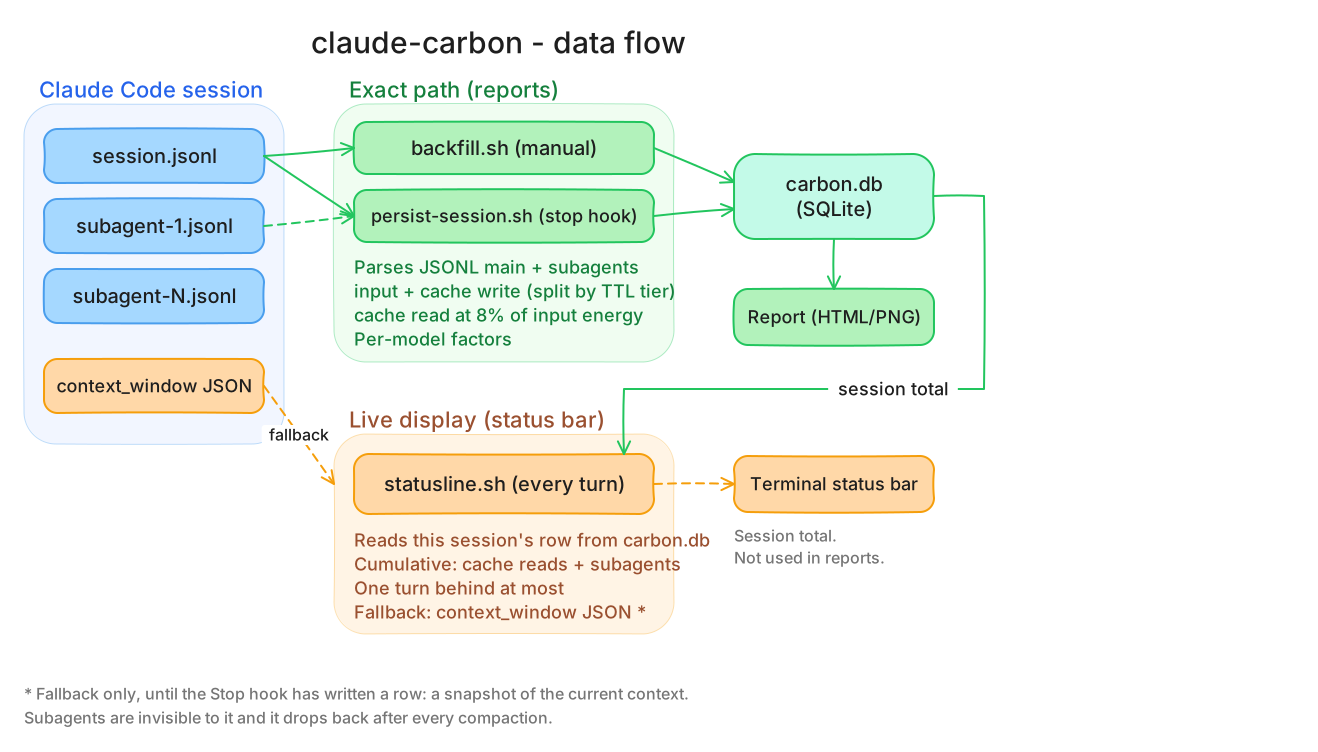
Three data paths, two levels of accuracy:
| Script | Trigger | Data source | Subagents | Cache reads | Accuracy |
|---|---|---|---|---|---|
backfill.sh | Manual / setup | JSONL files | Included | Counted (8% energy) | Best estimate |
persist-session.sh | Stop + SessionEnd hooks | JSONL files | Included | Counted (8% energy) | Best estimate |
statusline.sh | Every turn (live) | carbon.db row | Included | Counted (8% energy) | One turn late |
backfill and persist-session parse the raw JSONL transcripts (main session + subagent files), applying per-model emission factors. They deduplicate assistant messages by (message.id, requestId), so resumed and compacted sessions are not double-counted (this matches ccusage; without it the token sum inflates roughly 3x). Each session stores its raw token breakdown (input, cache write, cache read, output), which feeds the SQLite database used by reports.
Cost is the theoretical API list value (pay-as-you-go), not your subscription price: input, output, cache write, and cache read (0.1x input) at current Anthropic rates, set in data/prices.json. Cache writes are billed per TTL tier, 1.25x input for the 5-minute tier and 2x for the 1-hour one; each session's split is read from its transcript rather than assumed (Claude Code writes at the 1-hour tier). On deduplicated data it matches ccusage.
statusline reads this session's row from carbon.db at each turn, so the CO2 it shows is the session total on the same basis as the reports, one turn behind at most. Before that row exists (first turn, or no database yet) it falls back to an estimate from context_window.total_input_tokens, which is the size of the current context rather than a running total: subagents are invisible to it and every compaction sends it back down. Either way the status line displays, it never feeds the reports.
Claude Code deletes JSONL transcripts after about 30 days, so the SQLite database is the durable record. The Stop and SessionEnd hooks capture each session before its transcript ages out, and a once-a-day background re-scan (SessionStart hook, safety-rescan.sh) catches any session they missed while its transcript still exists, including one whose transcript kept growing after its row was written. Because each row stores raw token counts, recompute.sh regenerates cost and CO2 from data/factors.json + data/prices.json at any time, with no transcript needed. When Anthropic changes a price or a factor is revised, edit the config and run:
bash scripts/recompute.sh
| Command | What it does |
|---|---|
/carbon-report | Text report with totals, equivalences, top sessions |
/carbon-card | Generate shareable PNG report cards |
/carbon-badge | Shields.io badge of your total footprint for your READMEs |
/carbon-pr | Post the dev footprint of the current branch on its PR |
/carbon-update | Update to the latest version and re-price history |
| Script | What it does |
|---|---|
setup.sh | Init database, backfill historical sessions, show total |
statusline.sh | Status line script (called automatically by Claude Code) |
persist-session.sh | Stop hook (saves session data after each turn) |
persist-on-exit.sh | SessionEnd hook (saves the session once more as it closes, in the background) |
safety-rescan.sh | SessionStart hook (throttled background re-scan, catches missed sessions) |
backfill.sh | Re-parse all historical JSONL transcripts (incl. subagents) |
recompute.sh | Re-derive cost/CO2 from stored tokens after a price/factor change (no transcripts needed) |
generate-report.sh | Export PNG report cards (CLI, with --since / --until / --all) |
generate-badge.sh | Print the shields.io badge markdown + URL (CLI) |
generate-pr-report.sh | Post the branch's dev footprint on its PR (CLI, --dry-run / --pr) |
Note: backfill now derives project names from the transcript's cwd (matching the live hook). Sessions backfilled before this change keep their old, possibly truncated names; delete those rows and re-run backfill.sh to normalize them.
/carbon-badge prints a ready-to-paste shields.io badge with your measured all-time footprint, clickable back to this repo:
That badge is live, not a mockup: the author's own total, 1,025 sessions measured between 15 January 2026 and 20 August 2026. It is one developer's footprint, not the project's.
[](https://github.com/gwittebolle/claude-carbon)
The badge is a static image built from your local database, so the number is measured, not estimated on the fly. Re-run /carbon-badge whenever you want to refresh it.
Numbers follow the locale the report uses (fr prints 12,4 kg, us and the world default print 12.4 kg); CLAUDE_CARBON_LOCALE forces a set.
Claude Code accepts a single statusLine command, so claude-carbon's full status line and ccstatusline cannot run side by side. If ccstatusline drives your status line, embed the CO2 segment instead: in the ccstatusline TUI, add a Custom Command widget pointing to
~/code/claude-carbon/scripts/statusline.sh --segment
(adjust the path if you installed with CLAUDE_CARBON_DIR). The widget receives the same status JSON on stdin and prints just the cost + CO2 pair, e.g. $0.68 · 35g CO₂. Segment mode never touches the network. Recording to the local database is unaffected either way: persistence runs from hooks, not from the status line.
Factors from Jegham et al. 2025, an arXiv preprint that estimates the energy consumption of LLM inference on AWS infrastructure from public API performance data (latency, throughput) over inferred hardware configurations.
| Model | Input (gCO2e/Mtok) | Output (gCO2e/Mtok) | Basis |
|---|---|---|---|
| Fable | 156 | 3304 | Extrapolated (2x Opus) |
| Opus | 78 | 1652 | Extrapolated (2x Sonnet) |
| Sonnet | 39 | 826 | 3-point fit (Jegham v6) |
| Haiku | 20 | 413 | Extrapolated (0.5x Sonnet) |
Important: these are order-of-magnitude estimates, not precise measurements.
ANTHROPIC_BASE_URL) are stored with their raw tokens but zero cost/CO2 and excluded from reports - a datacenter factor doesn't apply to them. Add patterns to exclude_models in data/factors.json to exclude more models by name.data/factors.json). A cached token skips most of the prefill compute; the factor is the residual. This is an engineering estimate derived from the literature, not Anthropic's 0.1x billing ratio. The decode-phase re-read of the cache grows with context length x generated tokens and is not modelled yet; every session stores that product (output_context_sum) so a calibrated term can be applied to history later. See METHODOLOGY.md.Report equivalences follow your locale, since a car and a kWh differ by ~2x between countries: ADEME/SNCF factors on a French or undetected locale, EPA ones in miles on a US locale, world-average ones otherwise (200 gCO2/km by car, 8.7 g per smartphone charge). Force a set with CLAUDE_CARBON_LOCALE (fr, us, world, or any locale string). The factors live in data/factors.json under equivalences.
Factors are editable in data/factors.json. See METHODOLOGY.md for the full scientific basis, formula, and equivalences.
The methodology is pinned by golden test vectors in tests/methodology-vectors.json: hand-computed expected CO2/cost values for known token breakdowns, replayed by bash tests/run-vectors.sh in CI on every push. Downstream consumers (such as TokenClimate) keep a copy of this file and verify weekly that their implementation produces the same numbers. If you edit data/factors.json or data/prices.json, update the vectors in the same commit, otherwise CI fails.
When a newer version is available, the status line shows a discreet ⬆ /carbon-update hint. The check runs in the background (at most once a day, never on the status line's hot path); opt out with CLAUDE_CARBON_NO_UPDATE_NOTIFIER=1.
To update, run /carbon-update in Claude Code, or re-run the installer:
curl -fsSL https://raw.githubusercontent.com/gwittebolle/claude-carbon/main/install.sh | bash
scripts/recompute.sh --with-cost yourself only after a price change.data/factors.json or data/prices.json locally, the update keeps your edits; on a conflict with upstream it saves yours to *.local.bak and tells you./plugin update instead.jq - JSON parsingsqlite3 - local databasegit - branch detection in status line (optional)curl - 5h quota usage via Anthropic's /api/oauth/usage endpoint (optional, 60s cache)node + playwright-core + Chromium - PNG export for /carbon-card (optional)jq and sqlite3 are pre-installed on macOS. On Linux: apt install jq sqlite3. On Windows, see below.
To use /carbon-card, install Playwright and its Chromium browser:
npm install -g playwright-core
npx playwright install chromium
claude-carbon is bash, and stays bash on Windows. That is deliberate rather than a shortcut: on native Windows, Claude Code runs status line and hook commands through the bash that ships with Git for Windows, falling back to PowerShell only when Git Bash is absent (status line docs, hooks docs). The plugin speaks the shell its host already spawns.
Native Windows. Install Git for Windows, plus the two commands it does not ship:
winget install Git.Git --source winget
winget install jqlang.jq --source winget
winget install SQLite.SQLite --source winget
Then, in the same terminal:
irm https://raw.githubusercontent.com/gwittebolle/claude-carbon/main/install.ps1 | iex
Everything else the plugin needs - bash, awk, sed, grep, date, curl,
git, cygpath - comes with Git for Windows.
WSL 2. Nothing special: run the curl | bash installer inside your distribution.
Claude Code, its transcripts and claude-carbon all live on the Linux side. This is
the path to pick if your projects are already in WSL. VS Code reaches it through the
Remote - WSL extension.
Marketplace install. /plugin install claude-carbon@claude-carbon behaves the
same as on macOS, once Git for Windows, jq and sqlite3 are present.
.sh file. claude doctor tells you which shell it picked. If
Git is installed somewhere unusual, point Claude Code at it in settings.json:
{"env": {"CLAUDE_CODE_GIT_BASH_PATH": "C:\\Program Files\\Git\\bin\\bash.exe"}}.settings.json use forward slashes (C:/Users/you/code/claude-carbon/...).
Git Bash eats unquoted backslashes, and the command then fails with no visible error.
The installer writes them correctly; only hand-edits need the care./carbon-report and friends are copied into
~/.claude/commands/ and refreshed on every update./carbon-card additionally needs Node.js: winget install OpenJS.NodeJS --source winget.SSL certificate problem: unable to get local issuer certificate. Git for Windows
checks certificates against its own bundled CA list, which does not know the root
such tools re-sign traffic with; the Windows certificate store does. Switch git to
it (verification stays on) and rerun the installer:
git config --global http.sslBackend schannel. The installer prints this hint
when it detects the case. The same interception is why winget needs
--source winget on those machines: the Microsoft Store source fails its
certificate check and, without an explicit source, winget aborts instead of
falling back.CI runs the full test suite on windows-latest under Git Bash, alongside Ubuntu,
plus two Windows-only suites: tests/run-windows-e2e.sh (native paths through the Stop
hook and the status line, hook manifests spawned the way Claude Code spawns them) and
tests/run-install-ps1-tests.ps1.
Measuring is step one. The levers below are ordered by what the 2026 measurement literature and this tool's own sensitivity run on real transcripts say matters most. None of them comes with a percentage: the emission factors carry a wider uncertainty band than any gain figure would. /carbon-report before and after a change, over several sessions, is the measurement that applies to you. The mechanism, the direction and the sources of each lever are in docs/reduce.md.
/clear when the subject changes, /btw for side questions, subagents for exploration and verbose operations./compact <instructions> at a natural break, /rewind when abandoning a path, /autocompact 150k to bound the window, CLAUDE_CODE_DISABLE_1M_CONTEXT=1 on models that run at 1M by default./context shows it. A short CLAUDE.md with the rest in skills, unused MCP servers off with /mcp, a CLI over an MCP server where both exist./usage shows the hit ratio and the likely cause of the last miss./clear after two failed corrections, no /loop left running on an idle session.--help costs nothing./effort low on routine work, set at session start; Haiku for subagents via CLAUDE_CODE_SUBAGENT_MODEL.The same document covers what does not hold up (shell output filters, prompt compressors, adding up percentages), the harness as a lever, and what is out of your hands for now.
Every Claude Code session uses real compute, real energy, real emissions. The number is small per query, but it adds up. Making it visible is the first step to owning it.
If claude-carbon's numbers or methodology end up in your article, talk or product, a citation is appreciated. GitHub's "Cite this repository" button generates BibTeX/APA from CITATION.cff. Short form:
Wittebolle, G. (2026). claude-carbon: carbon footprint tracker for Claude Code sessions. https://github.com/gwittebolle/claude-carbon
The shareable report cards already carry this attribution in their footer, so reposting a card as-is credits the tool.
claude-carbon is free and open source under the MIT license. Contributions welcome.
Built by Gaetan Wittebolle.
Sign in to join the discussion.
No comments yet. Be the first to say what this is good for.
Makes your AI agent think like the laziest senior dev in the room. The best code is the code you never wrote.
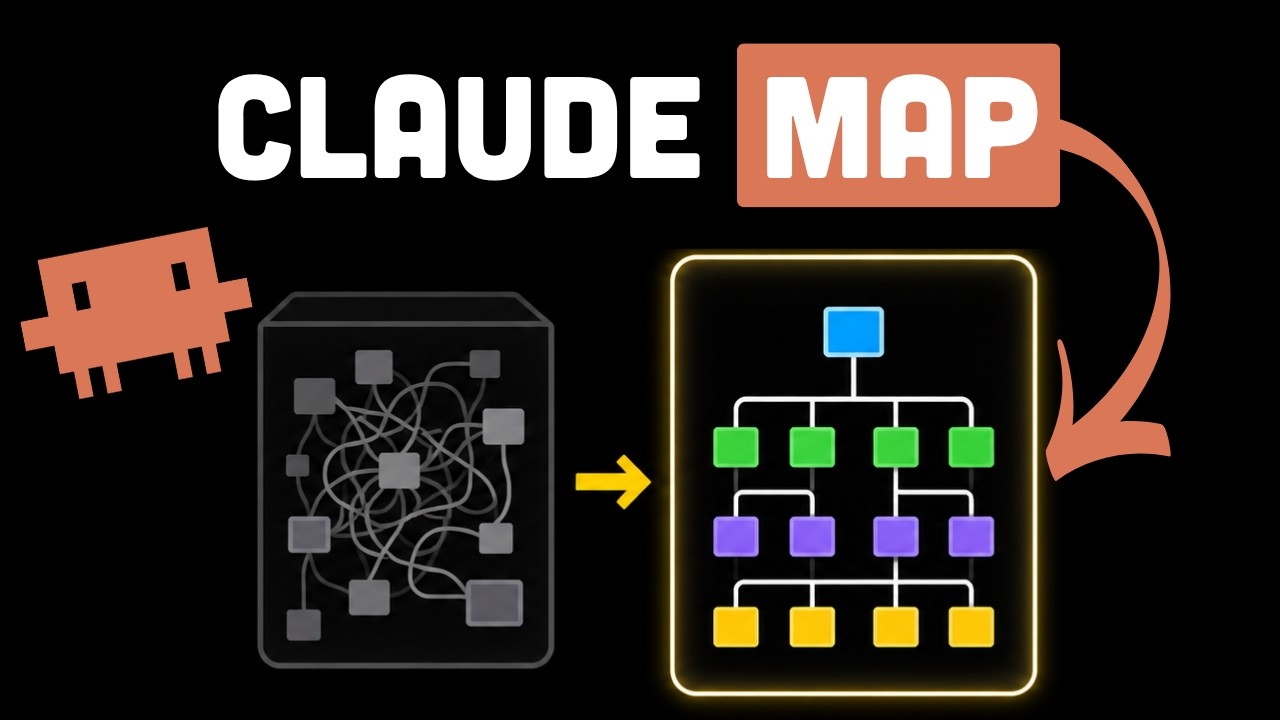
Graphs that teach > graphs that impress. Turn any code into an interactive knowledge graph you can explore, search, and ask questions about. Works with Claude Code, Codex, Cursor, Copilot, Gemini CLI, and more.

OmO: Just type "mass ulw" keyword with your prompt. Now you are the master of graph engineering.
Persistent Context Across Sessions for Every Agent – Captures everything your agent does during sessions, compresses it with AI, and injects relevant context back into future sessions. Works with Claude Code, OpenClaw, Codex, Gemini, Hermes, Copilot, OpenCode + More
Opinionated Oxlint rules for rejecting low-evidence TypeScript and JavaScript patterns
Teams-first Multi-agent orchestration for Claude Code