
obra/
superpowers

obra/superpowersSkills
An agentic skills framework & software development methodology that works.
285k
1 add
This repo gives builders a staged product methodology for AI-native work. The orchestrator routes you through needs discovery, direction framing, experiments, system design, business model, growth, UX, release, operations, team design, judgment, and aesthetics. Each stage lives as a skill file, so you can use the whole system or pull in one step at a time.
Builders who want their agent to help them decide what to build, validate it, and ship it with structure.
You can move from a product idea to a validated plan without re-inventing the method at each step.
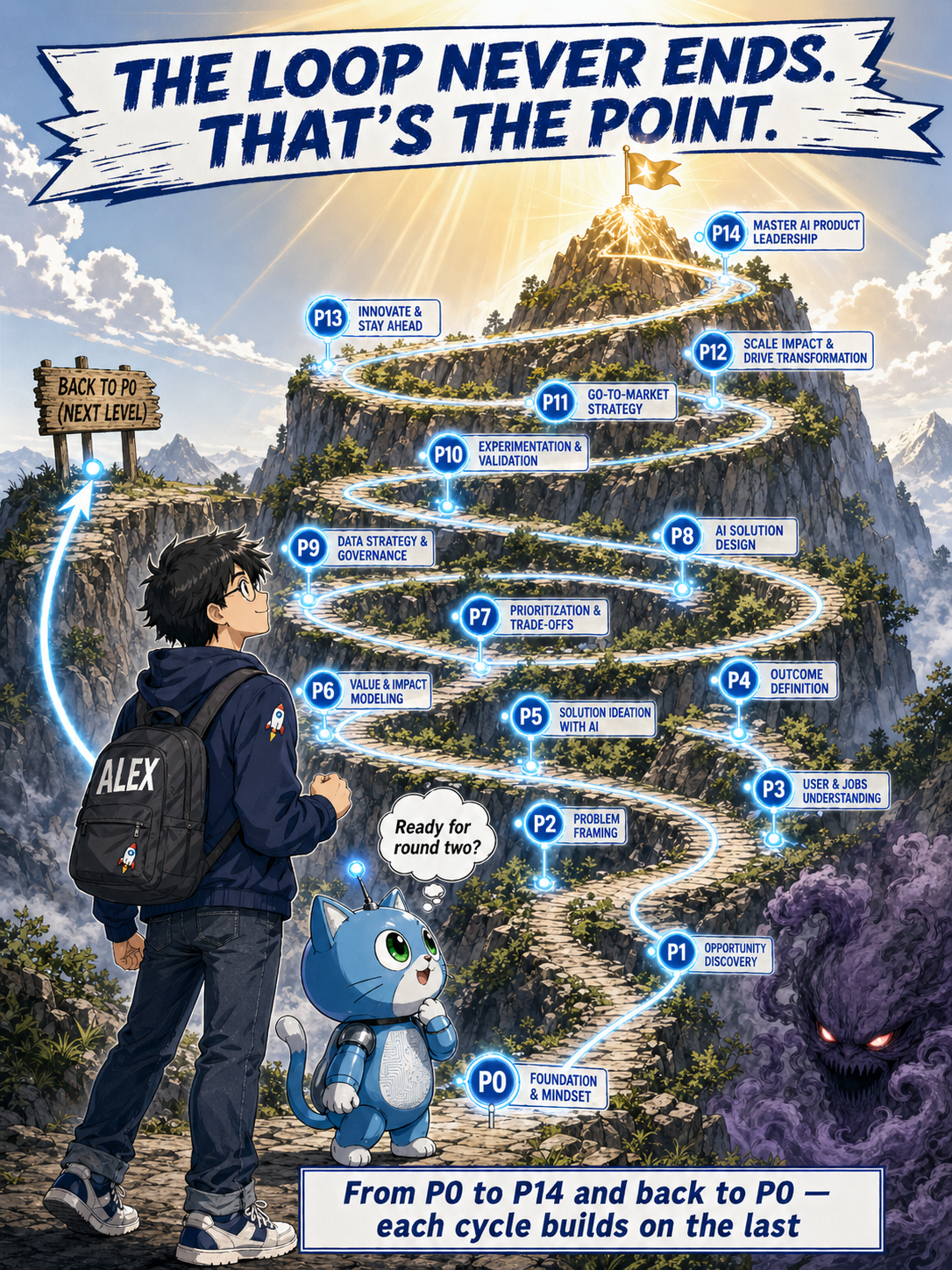
Covers P0 through P14, from needs discovery to aesthetic authority.
Uses `orchestrator/SKILL.md` to route requests and detect conflicts across stages.
Ships 80 skill definitions under `skills/`, each focused on one product decision or task.
Includes combo skills such as needs-to-direction, business-to-growth, and UX-to-audit.
Adds references for stage routing, product context schema, and conflict detection.
Provides `install.sh` plus Python scripts for initialization and validation.
# Install all 80 skills + orchestrator
curl -fsSL https://raw.githubusercontent.com/gmaxxxie/ai-native-product-agent-skills/main/install.sh | bash

# Start a product project
hermes run "I want to build an AI customer service product, help me start from direction framing"
git clone https://github.com/gmaxxxie/ai-native-product-agent-skills.git
cd ai-native-product-agent-skills
bash install.sh   # copies all skills to ~/.hermes/skills/ai-native-pm/
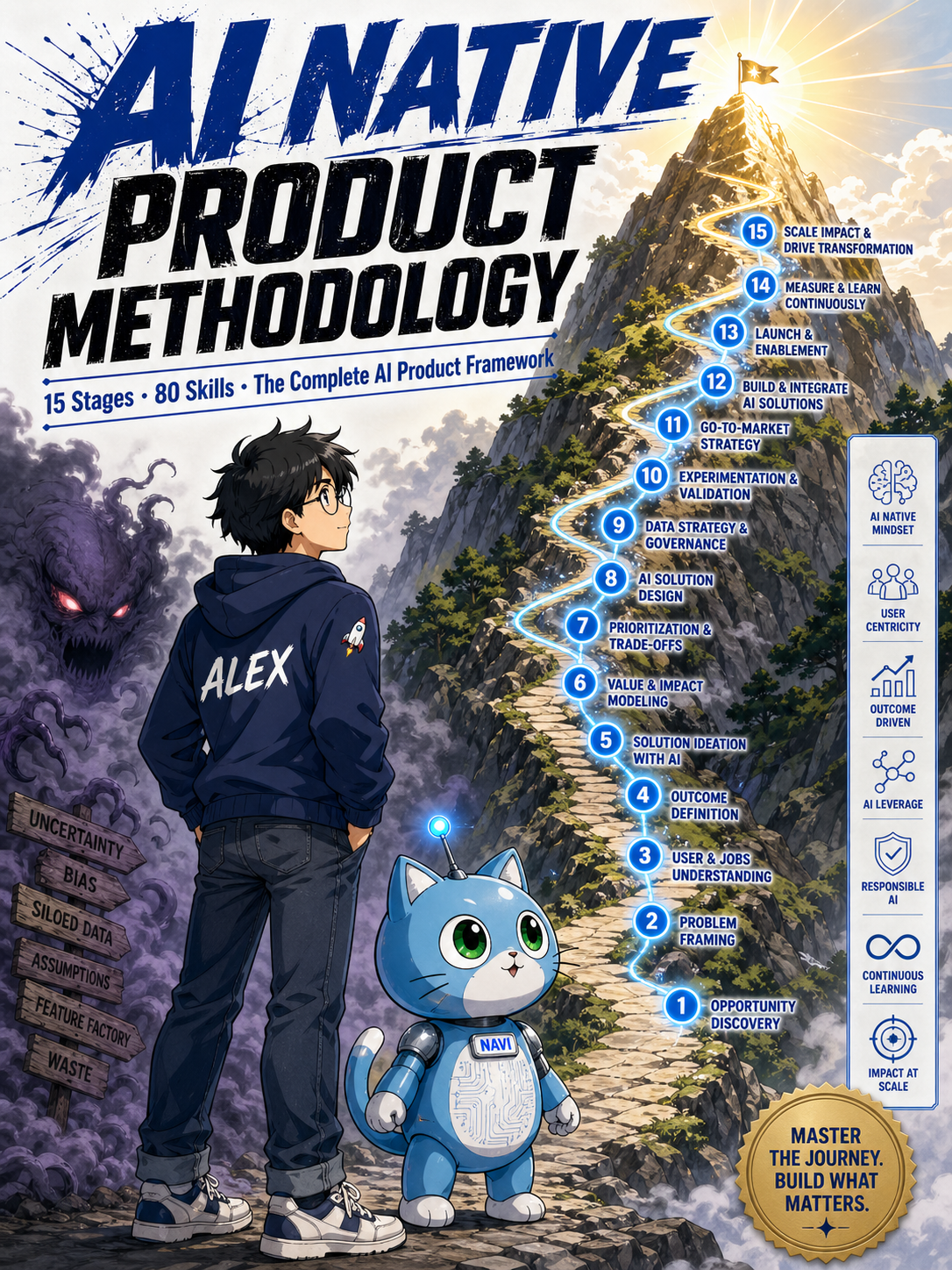
An AI product coach that asks "Is this direction really worth pursuing?" — with structured methodology backing every decision, from spark of inspiration to production deployment.
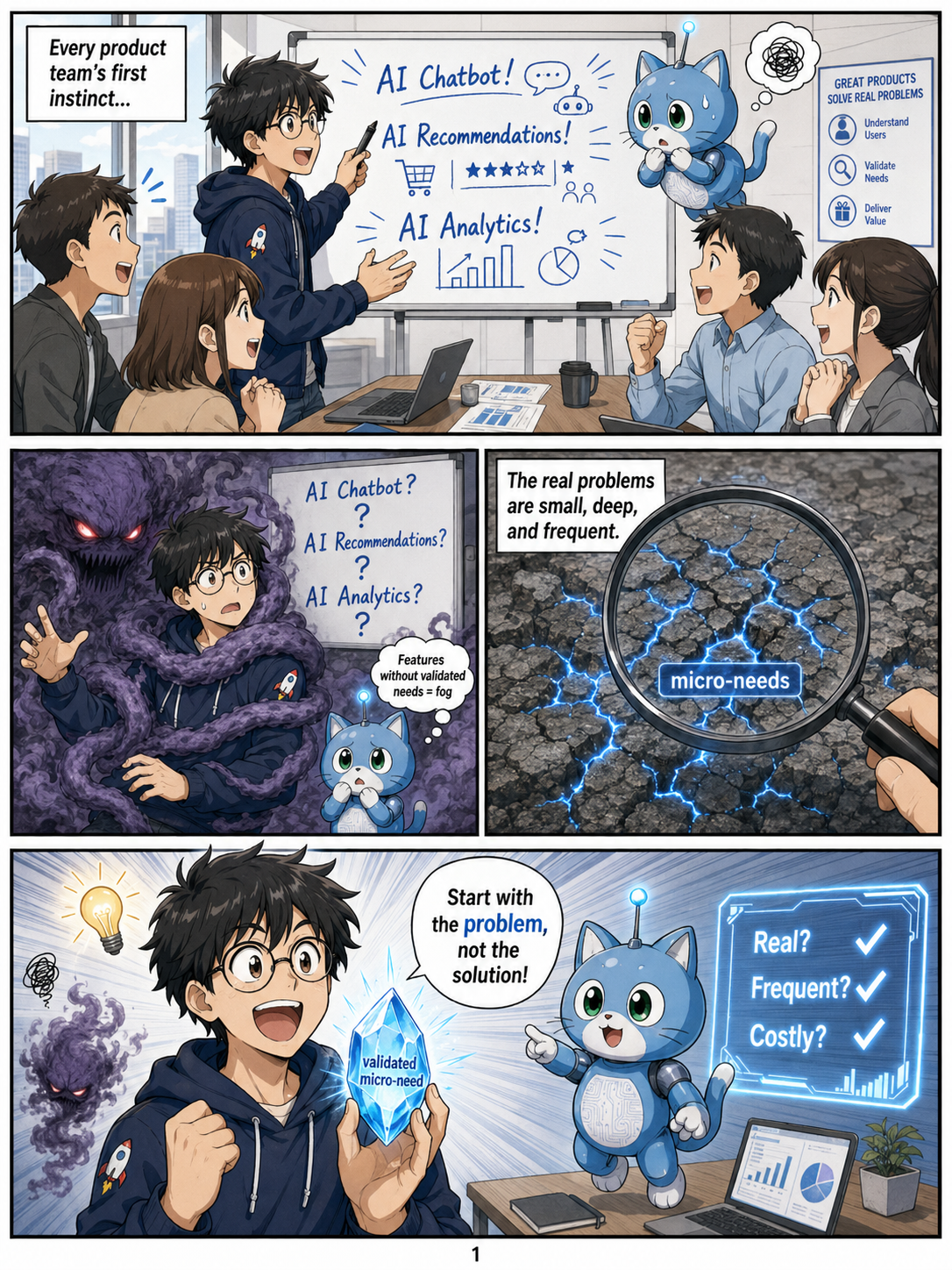
90% of AI product teams die in the same traps:
This Agent doesn't write code for you — it makes you pause at every critical decision point and verify with structured methods.
Traditional product frameworks (Lean Startup, Jobs-to-be-Done, Design Thinking) were built for a world where prototyping was expensive and AI didn't exist. They break down in the AI era because:
| Traditional Assumption | AI Era Reality |
|---|---|
| Build-Measure-Learn takes weeks | AI prototypes are near-free — you can build the wrong thing faster |
| User needs are relatively stable | AI creates new needs and makes old ones obsolete overnight |
| Product boundaries are clear | AI crosses lines you didn't draw — compliance, ethics, autonomy |
| Cost scales with features | Token costs scale with usage — business model can invert |
| Launch is a milestone | AI products degrade post-launch (hallucinations, drift, adversarial inputs) |
This methodology is AI Native from the ground up: it starts with boundary design before capability design, validates with certainty rather than confidence, and prices on risk reduction rather than feature count. Every stage assumes AI is in the loop — and designs for what happens when it goes wrong.
▶ Click to play the 30s introduction video (2.3 MB MP4)
Core Capabilities: 80 executable Skills across 8 stages + Stage auto-routing + Conflict detection + Evidence chain tracking
Scenario: You want to build an "AI Contract Review Assistant"
The Agent validates the need with tool cards:
Output: Needs validated + Agent boundary design
The Agent asks you:
Output: Direction Brief — clear go/no-go with conditions
The Agent prices using the Certainty Premium formula:
Output: Pricing strategy — $5/review, 10x compensation for missed clauses
The Agent checks:
Output: Release boundary document — Auto-execute zone / Human handoff zone / Disabled zone
# Install all 80 skills + orchestrator
curl -fsSL https://raw.githubusercontent.com/gmaxxxie/ai-native-product-agent-skills/main/install.sh | bash

# Start a product project
hermes run "I want to build an AI customer service product, help me start from direction framing"
Install individual skills on demand:
# Orchestrator (entry point)
hermes skills install \
  https://raw.githubusercontent.com/gmaxxxie/ai-native-product-agent-skills/main/orchestrator/SKILL.md \
  --name ai-native-pm-agent

# Any individual skill
hermes skills install \
  https://raw.githubusercontent.com/gmaxxxie/ai-native-product-agent-skills/main/skills/p1-direction-framing/SKILL.md \
  --name p1-direction-framing
git clone https://github.com/gmaxxxie/ai-native-product-agent-skills.git
cd ai-native-product-agent-skills
bash install.sh   # copies all skills to ~/.hermes/skills/ai-native-pm/
These skills work as structured prompts — they're not tied to any specific agent framework.
The simplest way: just tell your AI agent to install from this repo.
| Agent | Install Command |
|---|---|
| Hermes Agent | hermes skills install https://github.com/gmaxxxie/ai-native-product-agent-skills |
| Claude Code | claude "Install all skills from https://github.com/gmaxxxie/ai-native-product-agent-skills into this project" |
| OpenAI Codex | codex "Clone and set up https://github.com/gmaxxxie/ai-native-product-agent-skills — read all SKILL.md files and make them available as product methodology tools" |
| OpenCode | opencdoe run "Install AI Native PM Agent from https://github.com/gmaxxxie/ai-native-product-agent-skills" |
| Any LLM | Just paste: "Read the skills from https://github.com/gmaxxxie/ai-native-product-agent-skills and apply the methodology to my product idea" |
💡 Tip: Claude Code, Codex, and OpenCode can all
git clonethe repo and read SKILL.md files directly. Just give them the repo URL and tell them to install — they'll figure out the rest.
Each stage is an independent Skill you can call individually:
| Stage | Trigger Phrase | Output |
|---|---|---|
| P0 Needs Discovery | "I have a pain point…" | Needs validation report |
| P0a Micro-Needs | "Is this problem too small to matter?" | Micro-needs list |
| P0b Real Needs | "Is this need real or fake?" | Real/fake verdict |
| P0c Decomposition | "Help me decompose this need" | Four-layer breakdown |
| P0d Archaeology | "What's the deep need?" | Deep needs report |
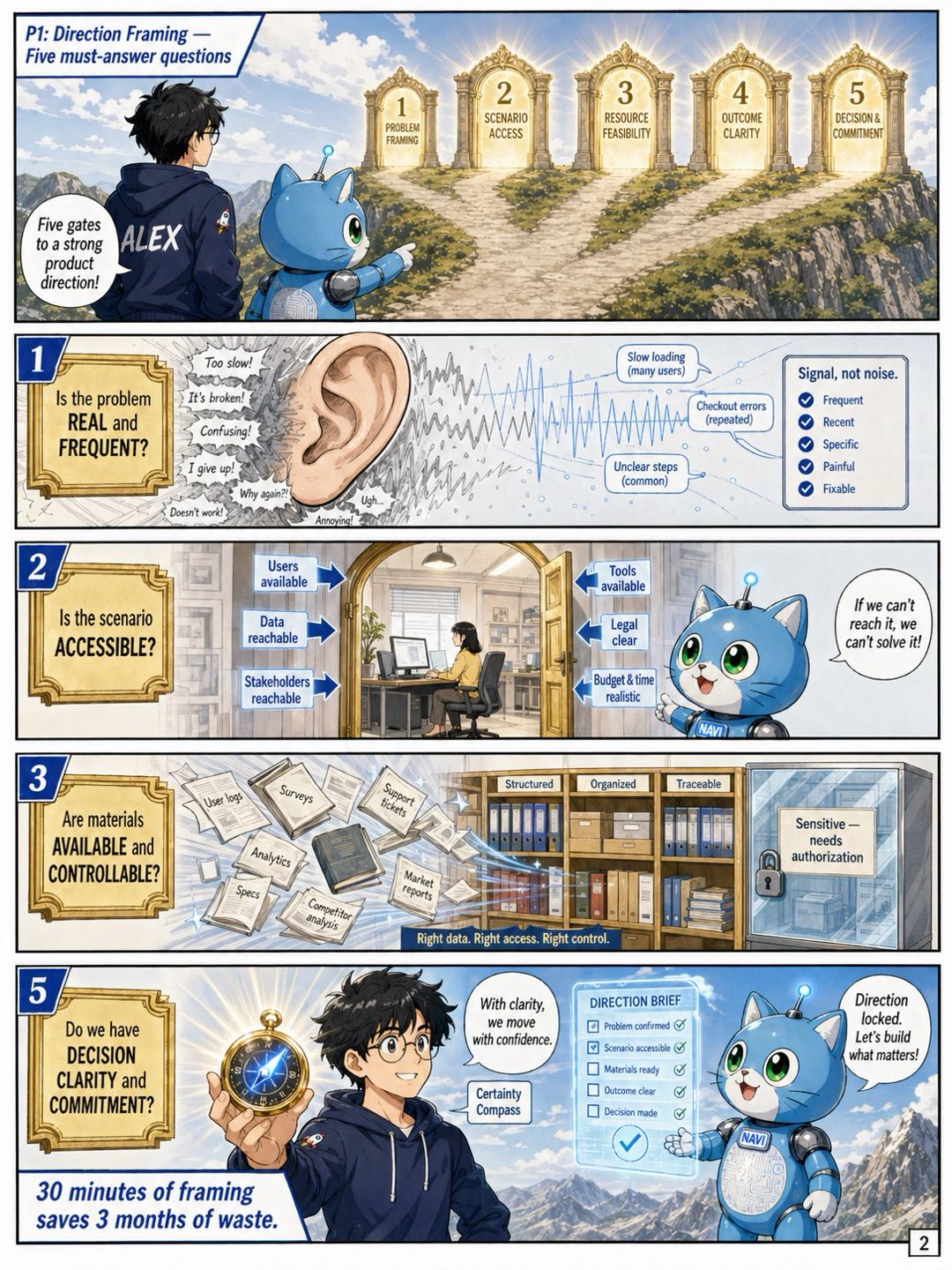
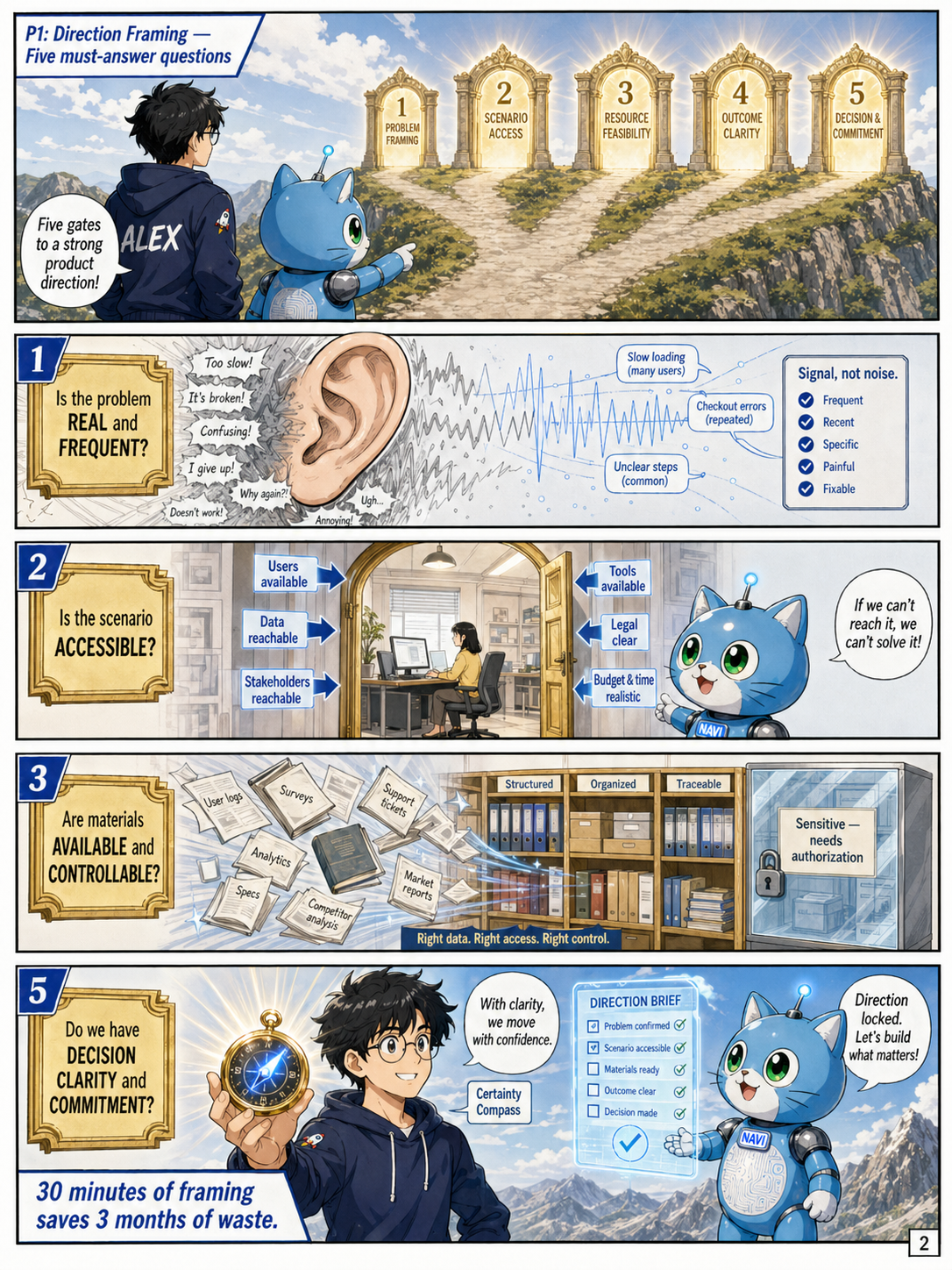
| P1 Direction Framing | "I have an idea…" | Direction Brief |
| P2 Experiment Engine | "Help me design experiments…" | Experiment plan + Rubric |
| P3 System Building | "How to go from experiment to product…" | System architecture |
| P5 Business Model | "How to price this…" | Pricing strategy |
| P6 Growth Strategy | "How to get cold start…" | Growth plan |
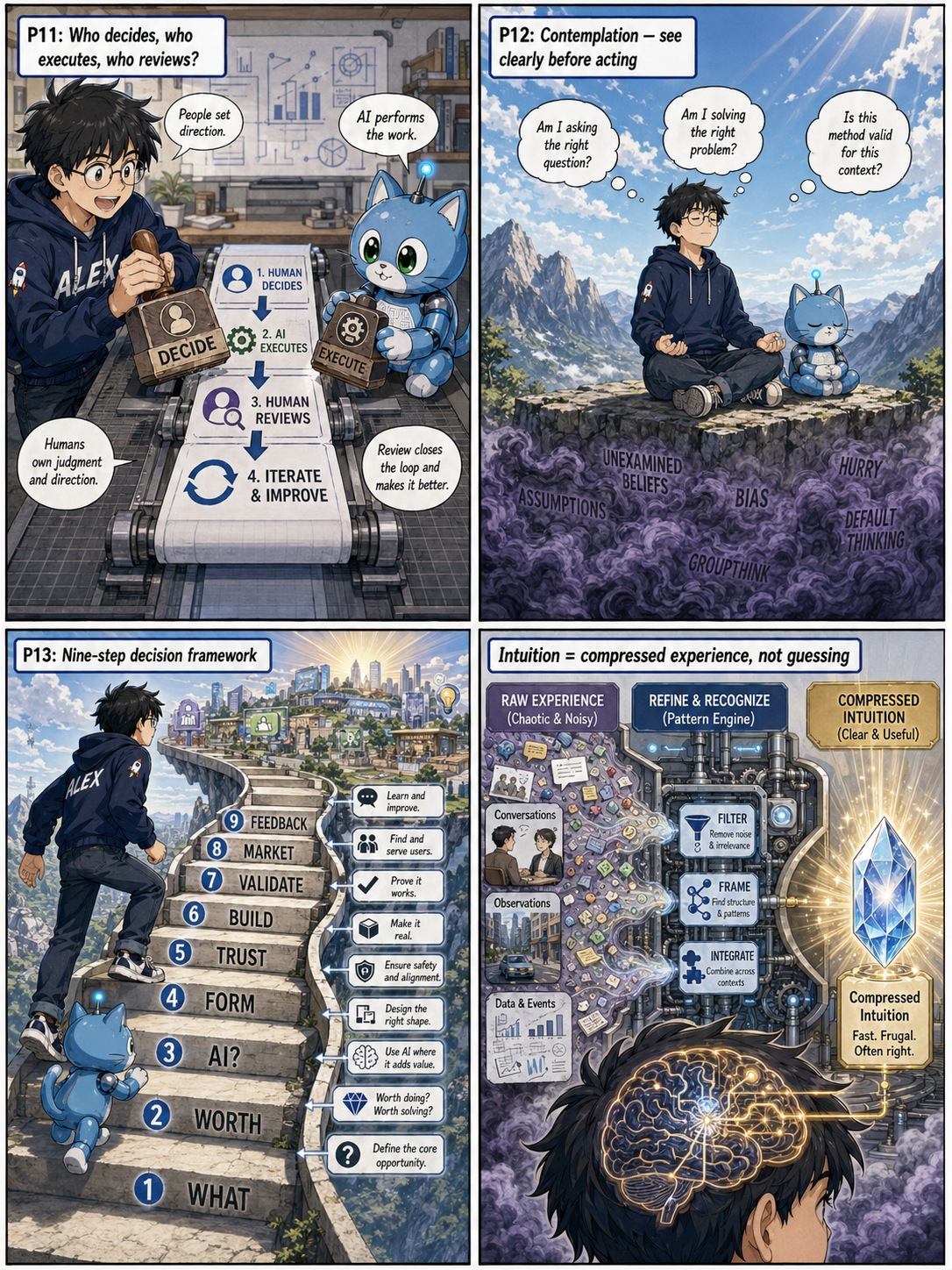
| P8 UX Design | "How should this AI feel to use?" | UX design + trust tiers |
| P9 Audit & Release | "Ready to launch, check it…" | Release boundary document |
| P10 Production Ops | "It's live, how do I keep it healthy?" | Monitoring + feedback loops |
| P11 Product Team | "How should humans and AI collaborate?" | Team structure + roles |
| P12 Contemplation | "Am I even asking the right question?" | View correction + prerequisite check |
| P13 Judgment & Intuition | "How do I make better decisions?" | Nine-step decision framework |
| P14 Aesthetic Authority | "What makes this feel premium?" | Aesthetic system + selection criteria |
| Combo | Trigger Phrase | Output |
|---|---|---|
| Needs → Direction | "Take me from pain point to direction framing" | Direction Brief |
| Business → Growth | "How should pricing and growth align?" | Pricing-growth alignment |
| UX → Audit | "Is this UX design safe to release?" | UX audit report + release recommendation |
| ID | Name | What It Does |
|---|---|---|
| p0-needs-orchestrator | Needs Discovery Orchestrator | Coordinates six tool cards for systematic needs discovery |
| p0-product-needs | AI Native Product Needs | Unified needs discovery + fake needs detection |
| p0a-micro-needs-detector | Micro-Needs Five Questions | Detects overlooked micro-needs |
| p0b-real-needs-validator | Real-Needs Five Questions | Distinguishes real needs from fake ones |
| p0c-needs-decomposer | Needs Four-Layer Decomposition | Expression / Scenario / Situation / Cost layers |
| p0d-needs-archaeologist | Needs Archaeology Five Steps | Uncovers deep needs and historical constraints |
| p0e-good-question-generator | Good Questions Six Dimensions | Discovers good questions from six perspectives |
| p0f-agent-boundary-designer | Agent Boundary Checklist | Defines AI permission boundaries |
| p0g-diverse-recommendation-rewriter | Diverse Recommendation Rewrite | From "guess what you like" to "help you discover" |
| p0g-diversity-rewrite-checklist | Diversity Rewrite Checklist | Validates diversity rewrite quality |
| p0h-ai-product-triple-balance | AI Product Triple Balance | Business / Humanity / Technology balance |
| p0h-triple-balance-assessor | Triple Balance Assessor | Evaluates product triple balance state |
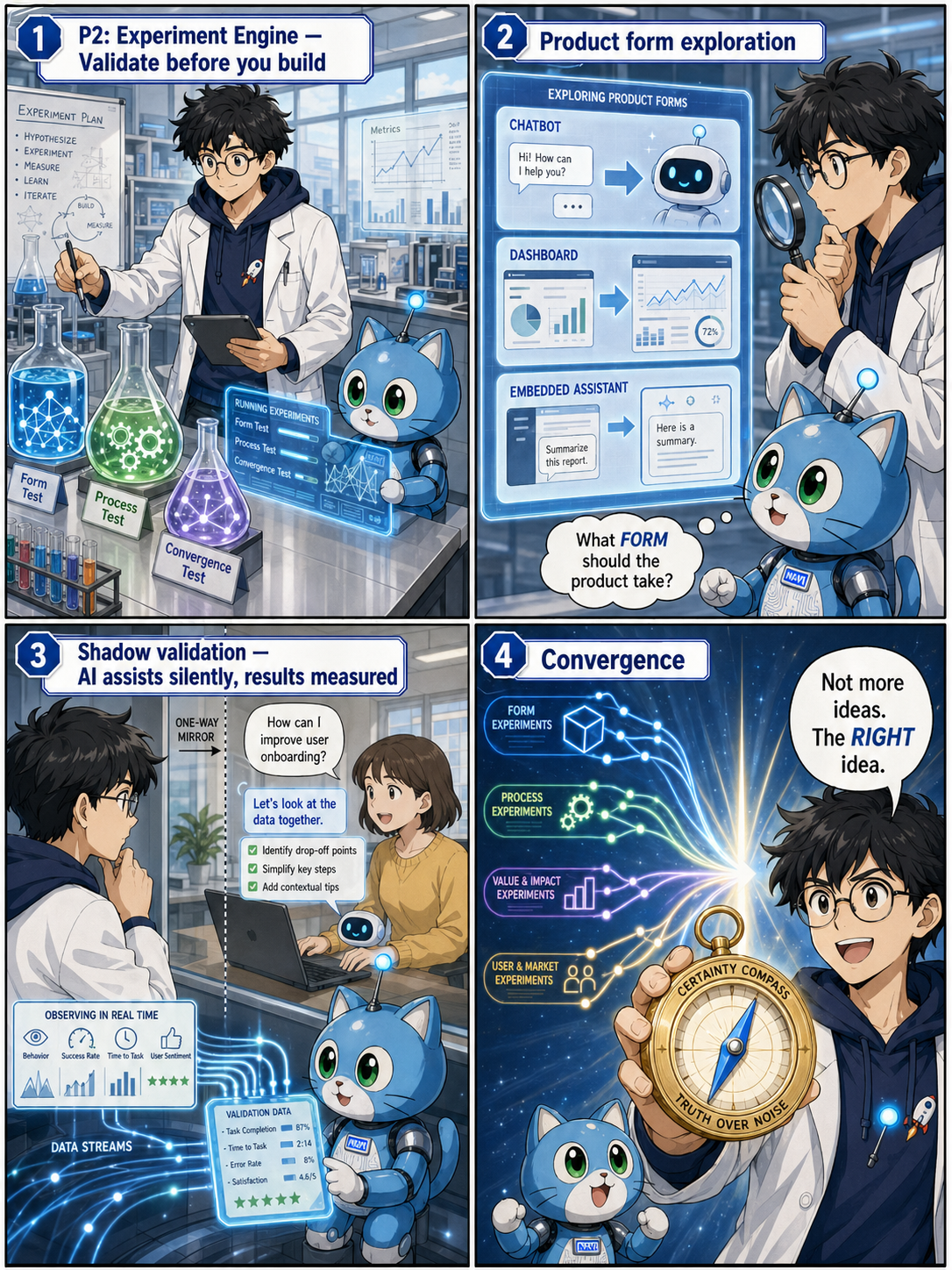
| ID | Name | What It Does |
|---|---|---|
| p1-direction-framing | Direction Framing | Five-dimension judgment, Direction Brief |
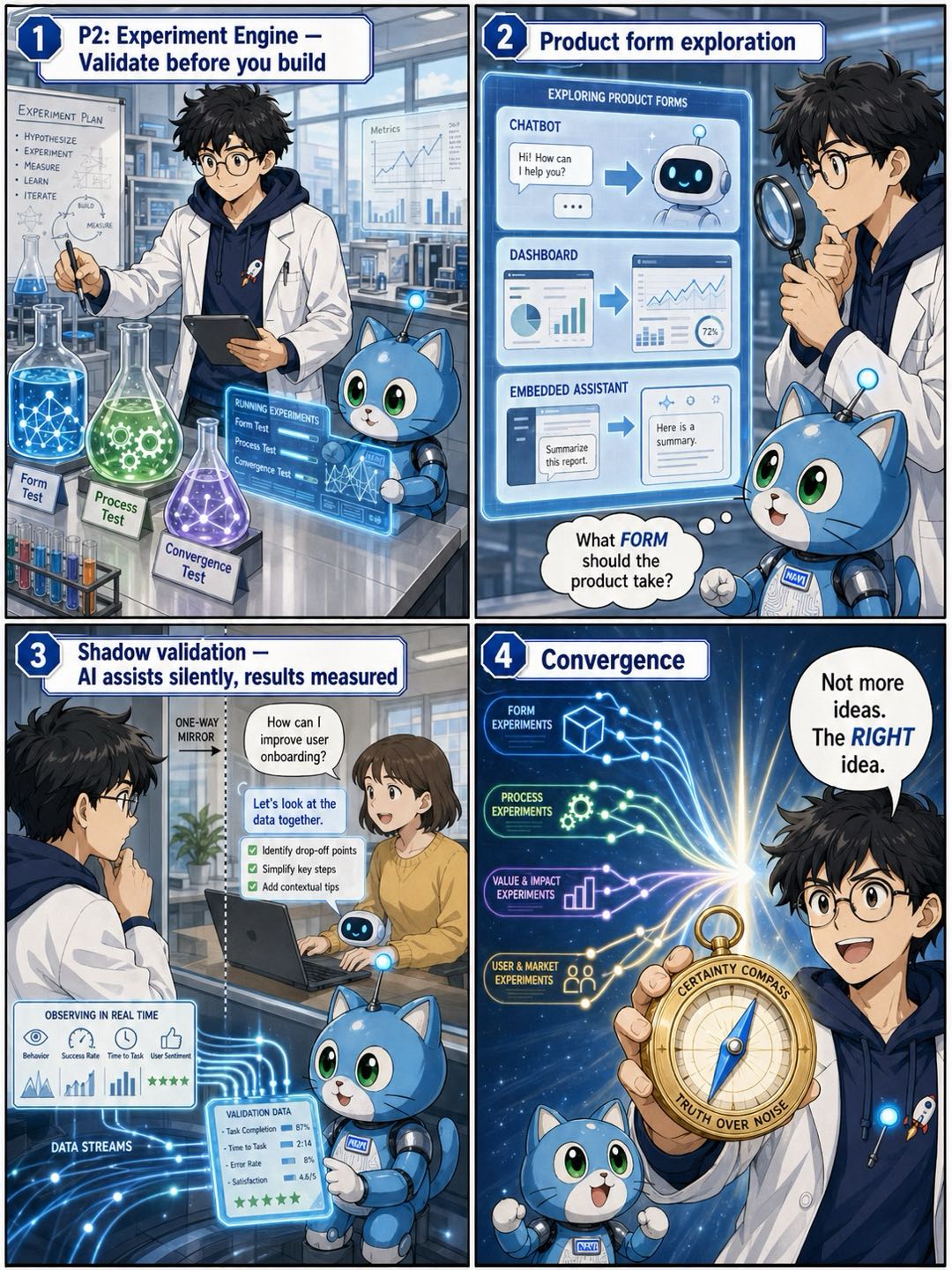
| p2-experiment-engine | Experiment Engine (Overview) | Capability / Product / Business three-layer experiments |
| p2a-experiment-overview | Experiment Overview | Materials prep, three-layer design, evaluation Rubric |
| p2b-product-form-exploration | Product Form Exploration | Capability boundary, interaction prototype, form judgment |
| p2c-process-redesign | Process Redesign | Task decomposition, human-AI collaboration mode |
| p2d-convergence-decision | Convergence Decision | Experiment records, convergence signals, continue/pause/stop |
| p2e-shadow-validation | Shadow Validation | Shadow system, parallel run, human comparison, audit evidence |
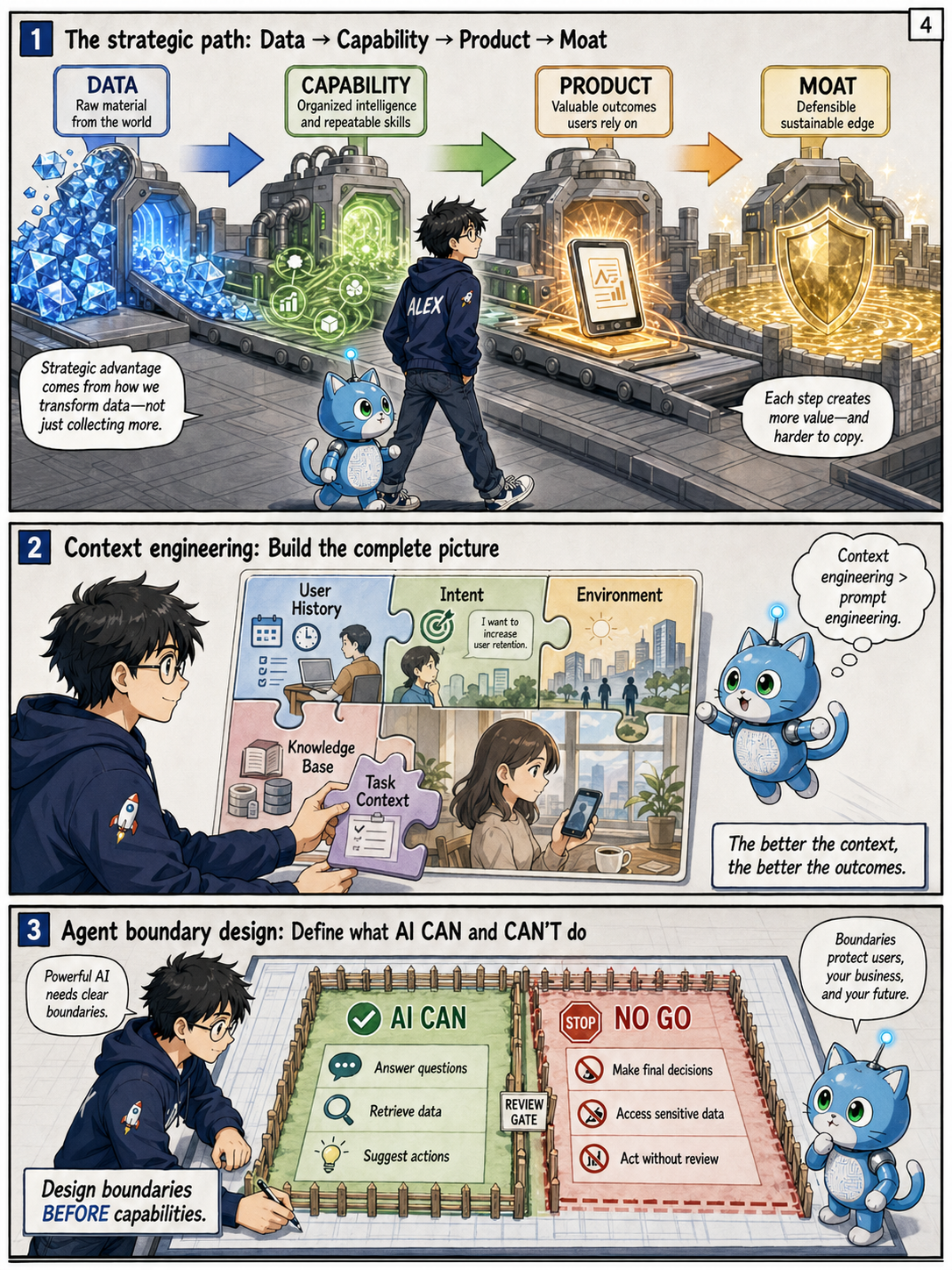
| ID | Name | What It Does |
|---|---|---|
| p3-system-building | System Building | From experiments to product |
| p4-agent-skill-design | Agent & Skill Unit Design | Agent/Skill unit design |
| p5-memory-system | Memory System Design | AI product memory architecture |
| p6-context-engineering | Context Engineering | Context management system |
| p7-knowledge-rag | RAG & Knowledge System | Knowledge management + RAG design |
| ID | Name | What It Does |
|---|---|---|
| p6-business-model | AI Native Business Model (Overview) | Certainty Premium business model design |
| p6a-certainty-premium-calculator | Certainty Premium Calculator | Calculates certainty premium |
| p6b-arbiter-mode-designer | Arbiter Mode Designer | "Truth-as-a-Service" business model |
| p6c-insurance-mode-designer | Insurance Mode Designer | "Result Guarantee" business model |
| p6d-prediction-arbitrage-designer | Prediction Arbitrage Designer | "Time Arbitrage" business model |
| ID | Name | What It Does |
|---|---|---|
| p7-marketing-growth | AI Native Marketing & Growth (Overview) | Growth flywheel & marketing strategy |
| p7a-data-flywheel-builder | Data Flywheel Builder | Assesses and builds self-reinforcing data flywheels |
| p7b-intent-prediction-designer | Intent Prediction Designer | From audience targeting to individual foresight |
| p7c-predictive-retention-designer | Predictive Retention Designer | From post-churn recovery to pre-churn prevention |
| p7d-marketing-productizer | Marketing-as-Product Designer | Turns marketing activities into product features |
| p7e-customer-loop | Customer Loop | Early customer filtering, co-creation boundaries, feedback loops |
| ID | Name | What It Does |
|---|---|---|
| p8-ux-design | AI Native UX Design (Overview) | UX design methodology |
| p8a-rax-risk-assessor | RAX Risk Assessor | Risk / Ambiguity / eXposure assessment |
| p8b-trust-tier-designer | Trust Tier Designer | Progressive trust system design |
| p8c-progressive-disclosure | Progressive Disclosure Checklist | Feature reveal pacing design |
| ID | Name | What It Does |
|---|---|---|
| p9-audit-release | Audit & Release | Go/no-go decision |
| p10-production-ops | Production Operations | Monitoring & feedback loops |
| p10a-value-discovery-loop | Value Discovery Loop | From value signal to direction correction闭环 |
| p10b-aiops-case | AIOps Case Template | Complete methodology path for high-risk scenarios |
| p10c-customer-service-case | AI Customer Service Case | Service collaboration, Copilot, experience leverage |
| p10d-saas-case | AI Native SaaS Case | Semantic layer, capability moats, data flywheels |
| p11-product-team | AI Native Product Team | Human-AI division, capability gaps, team roles |
From: Contemplation — Product Judgment, User Understanding, and Decision Correction in the AI Era
| ID | Name | What It Does |
|---|---|---|
| p12-contemplation-orchestrator | Contemplation Orchestrator | Routes to correct chapter skill, chains full decision-correction flow |
| p12a-contemplation-right-view | Right View | Three-layer problem framing: phenomenon / situation / relationship |
| p12a-contemplation-view-correction | View Correction | Default checks, evidence validation, consequence inquiry, eight correction angles |
| p12a-contemplation-prerequisite-check | Prerequisite Check | Identifies situational changes, validates assumptions, reassigns methods |
| p12a-contemplation-right-thinking | Right Thinking | Dissect judgment chain, distinguish premise/evidence/reasoning/emotion |
| p12a-contemplation-right-speech | Right Speech | Language cleaning, meeting health check, honest expression practice |
| p12a-contemplation-right-action | Right Action | Value/cost/emotion/exit-right quadruple check before execution |
| p12a-contemplation-right-livelihood | Right Livelihood | Revenue source review and incentive bias check |
| p12a-contemplation-right-effort | Right Effort | Zero-based analysis, pause strategy, stop-loss decision |
| p12a-contemplation-right-mindfulness | Right Mindfulness | Establish personal and team decision awareness |
From: Intuition — Judgment and Intuition in the AI Era
| ID | Name | What It Does |
|---|---|---|
| p13-intuition-orchestrator | Intuition Orchestrator | Nine-step closed-loop decision roadmap router |
| p13a-judgment-metacognition | Judgment Metacognition | Understanding judgment, identifying judgment scenarios |
| p13b-systemic-thinker | Systemic Thinking | Structural analysis, relationship mapping, feedback loop identification |
| p13c-product-psychology | Product Psychology | User mental models, behavior design, motivation analysis |
| p13d-intuition-training | Intuition Training | Compress intuition into cognitive models and pattern recognition |
| p13e-nine-step-framework | Nine-Step Framework Overview | Complete framework from "what to do" to feedback loop |
| p13f-first-half-judgment | First Half — What & Worth | "What to do, is it worth it, should we use AI" judgment |
| p13g-mid-judgment | Mid — Form & Trust | "What form, how much trust, how to do it" judgment |
| p13h-validation-market | Second Half — Validation | "How to validate, how to enter market, feedback loop" |
| p13i-judgment-traps | Judgment Traps | Common judgment errors and cognitive bias defenses |
| p13j-organizational-judgment | Organizational Judgment | Translating personal judgment into team judgment capability |
| p13k-intuition-evolution | Intuition Evolution | Continuous judgment training, standard improvement mechanism |

From: AI Beaty — Aesthetic Authority in the Age of AI
| ID | Name | What It Does |
|---|---|---|
| p14-beauty-orchestrator | Beauty Orchestrator | Routes to aesthetic training and aesthetic authority system |
| p14a-beauty-redefinition | Aesthetic Redefinition | Generation anxiety, six aesthetic dimensions, dual-axis model |
| p14b-beauty-ai-roles | AI's Role in Aesthetics | Amplifier / sparring partner / collaborator, not aesthetic itself |
| p14c-beauty-selection | Selection Over Generation | Selection is the new core skill — Context determines output ceiling |
| p14d-beauty-narrative | Narrative as Aesthetic | Story structure, emotional rhythm, information architecture aesthetics |
| p14e-beauty-human-edge | Human Indispensability | Aesthetic as moat, standard evolution, human core advantage |
| p14f-beauty-commercial | Commercial Value of Aesthetics | Market acceptance, aesthetic premium, experiential aesthetics |
| p14g-beauty-system | Aesthetic Training System | Systematic aesthetic standard accumulation and calibration |
| p14h-beauty-preface | Preface & Core Proposition | Aesthetic authority as core competitive advantage when everything can be generated |
| ID | Name | What It Does |
|---|---|---|
| combo-needs-to-direction | Needs → Direction | Pain point to Direction Brief in one pass |
| combo-business-to-growth | Business → Growth | Pricing-flywheel alignment design |
| combo-ux-to-audit | UX → Audit | RAX assessment + trust tiers + release recommendation |
ai-native-pm-agent-skills/
├── README.md / README_CN.md         # This document (EN / 中文)
├── ARCHITECTURE.md                  # System architecture design
├── skill-registry.yaml              # Skill registry (80 skills registered)
├── orchestrator/SKILL.md            # Main orchestrator: stage routing + conflict detection
├── install.sh                       # One-click install script
├── assets/                          # Hero banner, pipeline flow, industry matrix, methodology books
├── skills/
│   ├── p0-needs-orchestrator/        # P0 Needs Discovery orchestrator
│   ├── p0-product-needs/             # P0 unified needs discovery
│   ├── p0a-micro-needs-detector/     # P0a micro-needs detection
│   ├── p0b-real-needs-validator/     # P0b real vs fake needs
│   ├── p0c-needs-decomposer/        # P0c four-layer decomposition
│   ├── p0d-needs-archaeologist/     # P0d deep needs archaeology
│   ├── p0e-good-question-generator/ # P0e good questions six dimensions
│   ├── p0f-agent-boundary-designer/ # P0f AI boundary design
│   ├── p0g-diverse-recommendation-rewriter/    # P0g diversity rewrite
│   ├── p0g-diversity-rewrite-checklist/       # P0g diversity checklist
│   ├── p0h-ai-product-triple-balance/         # P0h triple balance
│   ├── p0h-triple-balance-assessor/           # P0h balance assessor
│   ├── p1-direction-framing/        # P1 direction framing
│   ├── p2-experiment-engine/        # P2 experiment overview
│   ├── p2a-experiment-overview/     # P2a experiment setup
│   ├── p2b-product-form-exploration/ # P2b product form
│   ├── p2c-process-redesign/       # P2c process redesign
│   ├── p2d-convergence-decision/    # P2d convergence decision
│   ├── p2e-shadow-validation/       # P2e shadow validation
│   ├── p3-system-building/          # P3 system building
│   ├── p4-agent-skill-design/       # P4 agent & skill design
│   ├── p5-memory-system/           # P5 memory system
│   ├── p6-context-engineering/      # P6 context engineering
│   ├── p7-knowledge-rag/            # P7 RAG & knowledge
│   ├── p6-business-model/           # P6 business model overview
│   ├── p6a-certainty-premium-calculator/    # P6a certainty premium
│   ├── p6b-arbiter-mode-designer/  # P6b arbiter mode
│   ├── p6c-insurance-mode-designer/ # P6c insurance mode
│   ├── p6d-prediction-arbitrage-designer/   # P6d prediction arbitrage
│   ├── p7-marketing-growth/         # P7 marketing overview
│   ├── p7a-data-flywheel-builder/   # P7a data flywheel
│   ├── p7b-intent-prediction-designer/      # P7b intent prediction
│   ├── p7c-predictive-retention-designer/   # P7c predictive retention
│   ├── p7d-marketing-productizer/   # P7d marketing productizer
│   ├── p7e-customer-loop/           # P7e customer loop
│   ├── p8-ux-design/               # P8 UX design overview
│   ├── p8a-rax-risk-assessor/       # P8a RAX risk assessment
│   ├── p8b-trust-tier-designer/     # P8b trust tier design
│   ├── p8c-progressive-disclosure/  # P8c progressive disclosure
│   ├── p9-audit-release/           # P9 audit & release
│   ├── p10-production-ops/          # P10 production operations
│   ├── p10a-value-discovery-loop/  # P10a value discovery loop
│   ├── p10b-aiops-case/            # P10b AIOps case
│   ├── p10c-customer-service-case/  # P10c AI customer service case
│   ├── p10d-saas-case/              # P10d SaaS case
│   ├── p11-product-team/           # P11 product team design
│   ├── p12-contemplation-orchestrator/     # P12 Contemplation orchestrator
│   ├── p12a-contemplation-right-view/      # P12 right view
│   ├── p12a-contemplation-view-correction/ # P12 view correction
│   ├── p12a-contemplation-prerequisite-check/   # P12 prerequisite
│   ├── p12a-contemplation-right-thinking/    # P12 right thinking
│   ├── p12a-contemplation-right-speech/      # P12 right speech
│   ├── p12a-contemplation-right-action/      # P12 right action
│   ├── p12a-contemplation-right-livelihood/   # P12 right livelihood
│   ├──
Sign in to join the discussion.
No comments yet. Be the first to say what this is good for.
An agentic skills framework & software development methodology that works.
Turn any codebase, with its docs, SQL schemas, configs, and PDFs, into a queryable knowledge graph. A /graphify skill for Claude Code, Cursor, Codex, and Gemini CLI: local deterministic AST parsing, every edge explained, no vector store.

Topic in, narrated explainer video out. A Claude Code / Codex skill that turns any topic into a black-canvas motion-graphics explainer video with TTS voiceover, subtitles and a chapter progress bar. Chinese or English; every frame drawn in code with Remotion.
Public repository for Agent Skills
Open-source AI job search: scan job portals, evaluate listings into a structured A-H report with a global 1-5 score, tailor your CV, track applications — runs locally in your AI coding CLI (Claude Code, Codex, OpenCode, Antigravity…)
Production-grade engineering skills for AI coding agents.