

obra/
superpowers

obra/superpowersSkills
An agentic skills framework & software development methodology that works.
285k
1 add
This repo packages reusable workflows as open-standard Agent Skills. Each skill defines a loop that proposes a change, runs it in your environment, checks a real signal, keeps the change only if it improves the result, and repeats until a stopping condition is met.
Builders who want their agent to iterate on research, writing, analysis, optimization, or security tasks with a measurable gate.
You can turn one-off prompting into repeatable loops that keep only changes that pass your own checks.
Each loop runs against a real signal such as tests, metrics, hashes, or a judged score before keeping a change.
Includes loops for autoresearch, literature review, scientific writing, data analysis, code and SQL optimization, and red-team style testing.
The skills follow the open Agent Skills standard and are meant to work across hosts, with Claude Code verified and Codex and Cursor supported in skill form.
Ships `.claude-plugin/plugin.json` and `.claude-plugin/marketplace.json` so the collection can be installed as a Claude Code plugin.
Includes `showcase/` ledgers and charts plus `docs/` for compatibility, authoring rules, and API key setup.
/plugin marketplace add gaasher/agent-loop-skills
/plugin install agent-loops@agent-loop-skills
npx skills add gaasher/agent-loop-skills                   # auto-detects host, installs to the right dir
gh skill install gaasher/agent-loop-skills --agent <host>  # claude-code | codex | cursor | …  (--pin, gh skill update)
git clone https://github.com/gaasher/agent-loop-skills

cp -r agent-loop-skills/loops/* ~/.agents/skills/   # cross-tool: Codex, Cursor, Pi, OpenClaw, …
cp -r agent-loop-skills/loops/* ~/.claude/skills/   # Claude Code
# Hermes: hermes skills tap add gaasher/agent-loop-skills
Autoresearch · scientific writing · data analysis · code/SQL/prompt optimization · red/blue/purple-teaming — each a generic, reusable loop you bind to your own task at invocation time, that iterates against a real signal until the work is actually better.





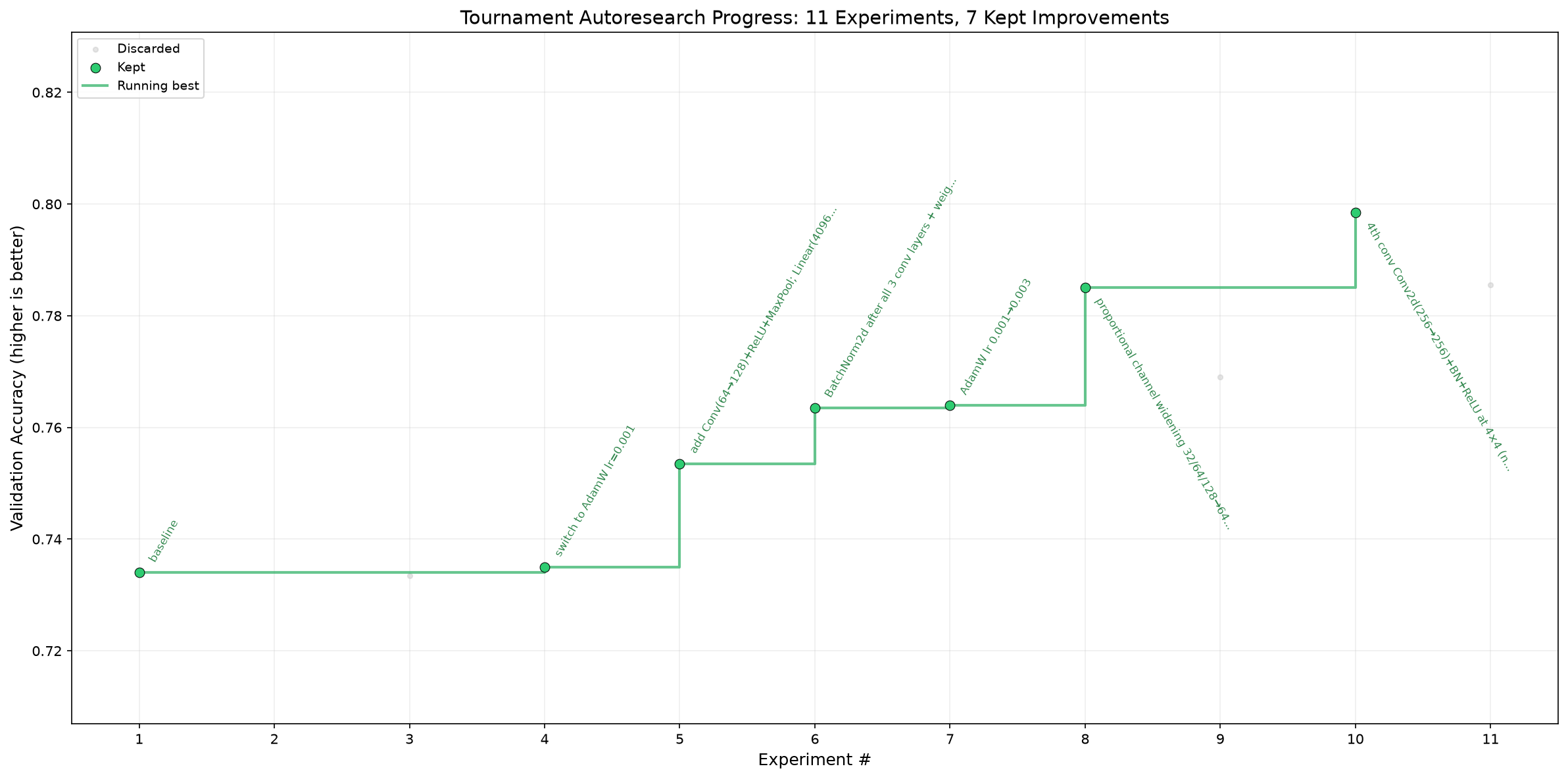
A real run. The tournament-autoresearch loop on a CIFAR-10 model under a fixed 5-epoch budget —
competing agents propose a change each step, a self-calibrating judge keeps the winners (green) and discards the regressions (gray):
0.734 → 0.798 val_acc, hands-off, 7 of 11 kept. Full ledger: showcase/tournament-autoresearch.
Far from SOTA by design — a deliberately tiny CNN at 5 epochs on a laptop GPU (Apple MPS). The demo is the loop's decision-making, not the absolute accuracy.
Two ideas collided in late 2025, and this repo lives in the overlap:
SKILL.md now runs across
~30 hosts (Claude Code, Codex, Cursor, …).This repo makes the loop be the skill. Instead of task-specific skills, each entry is a generic loop — program · artifact · feedback signal · run ledger · termination — that you bind to your task at invocation time. Paste your goal; the loop proposes a change, runs it in your environment, scores it on a real signal (tests, latency, a metric, a calibrated judge), keeps it only if it's better, logs it, and repeats.
The honest part: unsupervised agent loops are famous for spinning forever and confidently shipping garbage — at 90% per-step accuracy, a 5-step chain fails ~40% of the time. Every loop here is verification-gated: an objective feedback signal decides each step and an explicit termination condition ends it. That discipline — not autonomy for its own sake — is the point. (See Limitations.)
flowchart LR
  T["bind your task<br/>(artifact + signal + budget)"] --> P["propose<br/>one change"]
  P --> R["run it in<br/>your env"]
  R --> S{"score<br/>tests · metric · judge"}
  S -->|better| K["keep + log"]
  S -->|worse| X["revert"]
  K --> G{stop?}
  X --> G
  G -->|"plateau · budget · threshold"| B(["best artifact"])
  G -->|no| P
Every loop decomposes into the same five ingredients — program (SKILL.md), artifact slot
(what's improved), feedback signal (what drives the next step), run ledger (append-only log), and
termination (when to stop). Skills ship zero heavy dependencies: your code (a torch trainer, a SQL
database, a dataset) runs in your environment via a bound run command; the skill shells out and reads the
result. Multi-role loops use spawn-or-degrade — real isolated subagents on Claude Code, the same roles
inline elsewhere.
Any one of these installs all the loops:
Claude Code — plugin marketplace (add once, then install):
/plugin marketplace add gaasher/agent-loop-skills
/plugin install agent-loops@agent-loop-skills
Loops install namespaced as agent-loops:<name> (e.g. agent-loops:karpathy).
Any Agent-Skills host — the standard installers:
npx skills add gaasher/agent-loop-skills                   # auto-detects host, installs to the right dir
gh skill install gaasher/agent-loop-skills --agent <host>  # claude-code | codex | cursor | …  (--pin, gh skill update)
Manual — clone, then copy the loops into your host's skills dir (pick the line for your host):
git clone https://github.com/gaasher/agent-loop-skills

cp -r agent-loop-skills/loops/* ~/.agents/skills/   # cross-tool: Codex, Cursor, Pi, OpenClaw, …
cp -r agent-loop-skills/loops/* ~/.claude/skills/   # Claude Code
# Hermes: hermes skills tap add gaasher/agent-loop-skills
Then just describe your task — the host loads the matching loop. Research loops also call the shared
literature-search skill; installing everything puts it alongside them, and any
loop degrades gracefully (to WebSearch) if it's absent.
Most skill repos tell you what a skill is. Here's what these loops actually do — real Sonnet runs,
full ledgers in showcase/.
tournament-autoresearch — competing ideas, a self-calibrating judge<n> agents pitch competing changes each step; a judge critiques them, picks one, runs it, and recalibrates
by comparing its predicted vs realized gain. On a CIFAR-10 SmallCNN under a fixed 5-epoch budget it
climbed 0.734 → 0.798 val_acc, keeping 7 of 11 changes and reverting all 4 that regressed —
escaping the plateaus a single-thread loop gets stuck on. (That's the run charted up top.)
→ showcase/tournament-autoresearch
ml-autoresearch — analysis-first, every change traced to a causeThis loop reads inside each run — gradient flow, dead neurons, the loss curve — and grounds the next
change in that evidence rather than guessing: "FC grad 57% vs first conv 3.3% — severe imbalance; 54% dead
neurons" → add BatchNorm; "cosine schedule fixed the epoch-3 dip entirely (monotonic!), +0.033". It also
reverts what hurts (augmentation, over-aggressive LR). The point isn't a leaderboard number — it's that
every accepted change has a measured reason behind it. → showcase/ml-autoresearch
data-analysis — findings with a number behind every oneHypothesis → verify, stdlib-only. On a planted dataset it surfaced 3 real findings and correctly refuted 2,
with effect sizes matching ground truth and no hallucinations: enterprise vs consumer order value
184.90 vs 109.16 (Cohen's d = 2.13), mobile return rate 32.8% vs 8.2% (RR 4.0) — and it reversed a
plausible-but-wrong claim once it spotted a mobile confound. → showcase/data-analysis
| Loop | What the run did |
|---|---|
optimize-loop | Correctness-gated speedup: a SQLite query 1,131.75 ms → 1.055 ms (~1,073×), result-set hash matching baseline on every kept iteration; in code mode cut cyclomatic complexity 23 → 15 (nesting 7 → 3) with 13/13 tests green. |
research-proposal | ScholarEval graded a proposal against the literature; Judge + Reviser iterated grade 45 → 84 (soundness 2→4, contribution 1→4) over 5 rounds. |
scientific-figure | Same ImageNet top-1-accuracy bar-chart brief, with vs without the loop: a single call truncated the y-axis at 50% and used non-paper numbers; the loop verified every value against the arXiv papers, flagged GoogLeNet's borrowed top-1, and iterated 80 → 96 (PASS). |
red-team | Against a naive content filter, surfaced all 5 planted weaknesses (case bypass, leetspeak, spacing, synonyms, over-block) — 39 bypasses + 6 over-blocks — with a one-line root-cause fix each. |
power-analysis | Solved n = 100/group for 80% power via Monte-Carlo, fixed all 6 validity flaws, and emitted a full pre-registration. |
research-question | Sharpened 5 vague drafts → 3 strong questions (≥75), with real web novelty checks pivoting already-answered questions toward the open sub-problem. |
† = multi-role (real subagents on Claude Code, inline elsewhere). Browse any folder for its SKILL.md.
| Loop | Why you'd reach for it |
|---|---|
karpathy | The minimal baseline — propose, train, keep-if-better, loop. A faithful nod to Karpathy's autoresearch. |
ml-autoresearch † | Analysis-first: diagnoses each run and grounds the next change in evidence. A literature dial adds paper-grounded changes. |
exploratory-autoresearch | Forces broad exploration via a temperature/swing scheduler — escapes hill-climbing one idea forever. |
tournament-autoresearch † | Competing changes judged each step by a self-calibrating judge. |
dueling-autoresearch † | Two approaches race the same metric in parallel and borrow ideas across lanes. |
alpha-evolve † | Population-based evolution (MAP-Elites + islands, diff-mutate, cascade-eval). |
Literature & writing
| Loop | Why you'd reach for it |
|---|---|
literature-search | Shared toolchain (not a loop): paper discovery, snippets, citation-graph, full-text over Semantic Scholar + arXiv. |
literature-survey | Builds a saturating evidence/contradiction matrix of sources × claims. |
research-question | Sharpens a vague topic into strong, novel, feasible research questions. |
hypothesis-gen † | Generates and literature-vets a pool of research hypotheses. |
research-proposal † | Grades a proposal against the literature (ScholarEval) and revises until it passes. |
scientific-writer † | Specialist judges + an independent peer-reviewer critique a draft; a writer revises until the score clears a bar. |
scientific-figure † | A generator drafts a publication figure from your data/brief; an adversarial critic grades it against a fixed rubric — both can consult the literature (S2/arXiv) — and the two iterate until it's paper-ready. |
Data
| Loop | Why you'd reach for it |
|---|---|
data-analysis | Hypothesis → verify discovery; every finding backed by a reproduced number at a meaningful effect size. |
anomaly-investigation | Diagnoses the cause of a known anomaly by forming, testing, and eliminating candidates. |
claim-verify | Adversarially verifies a results draft's claims against the underlying data. |
tabular-cleanup | Cleans a messy table to an inferred data contract with deterministic checks. |
Code & optimization
| Loop | Why you'd reach for it |
|---|---|
optimize-loop | Evaluator-optimizer with a pluggable correctness gate + minimized metric — refactor code (tests green + complexity↓) or speed up SQL (identical results + latency↓). |
prompt-optimize | Evolves a prompt against a user-supplied scoring command (a black-box oracle). |
plan-loop † | Refines a prompt into an executable plan — first-principles decomposition → PR-sized tasks (deps, tests, subtasks) → a principal-engineer critique loop; emits plan.md + a validated tasks.json. |
swe-loop † | Executes plan-loop's tasks.json task-by-task — an Engineer subagent writes the code (source only), a QA subagent authors the tests + grades a strict simplicity/readability rubric (tests only); they loop until the task's tests pass, regression stays green, and quality holds, then commit. |
Security — authorized testing only
| Loop | Why you'd reach for it |
|---|---|
red-team | Adversarial loop-until-dry that surfaces distinct failure classes of a system you own. |
blue-team | The defensive fixer — closes a failure catalogue's classes under a regression gate, then opens a PR. |
purple-team † | Orchestrates red → blue → re-verify until a fresh attack pass stays dry; opens a PR with the patch set. |
Other
| Loop | Why you'd reach for it |
|---|---|
power-analysis | Sizes and pre-registers a two-arm experiment to hit a target statistical power. |
Skills (a SKILL.md the model invokes) work broadly across the open standard. A loop dispatching a
subagent from a role file at runtime is confirmed only on Claude Code — elsewhere multi-role loops (†)
run their roles inline (still correct, just serial). Single-agent loops run fully everywhere.
| Host | Skills | Loop-dispatched subagents |
|---|---|---|
| Claude Code | ✅ | ✅ real, isolated, parallel — verified |
| Claude Agent SDK | ✅ | ✅ |
| Codex CLI · Cursor | ✅ | ➖ inline |
| Hermes · Antigravity · Pi · OpenClaw | ✅ (reported) | ➖ inline |
Full, citation-backed matrix and the precise "why subagents are Claude-Code-only" reasoning:
docs/compatibility.md. Off Claude Code, don't rely on parallel subagent isolation.
These are self-contained, open-standard skills, so they coexist with any other collection — install both into
the same skills dir and use them together. For example alongside
K-Dense scientific-agent-skills:
npx skills add gaasher/agent-loop-skills              # these loops
npx skills add K-Dense-AI/scientific-agent-skills     # + a domain-skill library
They install as sibling folders (Claude Code namespaces each plugin; other hosts load all and pick by
description). A loop's analysis step can invoke any other installed skill — the same mechanism the research
loops use to call literature-search.
Loops are most useful when they're honest about what's next. PRs on any of these are very welcome:
blue-team (the
defensive fixer) and purple-team (find → fix → re-verify), with the pull
request as the communication interface to the target's owner.sandbox/ eval cases committed for every loop, so anyone can reproduce a run end-to-end.delegate_task) so multi-role loops get
real isolation beyond Claude Code.See open issues and grab a
good first issue.
Non-goals (deliberate scope, not missing features): these are human-supervised loops, not fully-autonomous agents; not a model or runtime (bring your own host); not domain-exhaustive — for a very custom workflow, fork a loop, that's what they're for.
I love open source, and this repo is built to be added to. You don't need to be an expert and you don't
need to write code — a sharper description, a new loop, a bug report, or a pasted run transcript all make
it better. New loops are welcome, and so are wild ideas.
Start with CONTRIBUTING.md and the authoring rubric in
docs/skill-authoring-rules.md; grab a
good first issue. Be kind, have
fun, and if a loop helped you, a ⭐ genuinely helps others find it.
karpathy — a faithful adaptation of Andrej Karpathy's autoresearch program-as-skill idea.alpha-evolve — a simplified, ML-bent re-creation of AlphaEvolve
(Novikov et al., 2025, arXiv:2506.13131) +
OpenEvolve.research-proposal — its ScholarEval evaluator faithfully reimplements
ScholarEval (arXiv:2510.16234).scientific-agent-skills.agent-loop-skills/
├── loops/ # one self-contained, installable skill per folder (SKILL.md + tools/roles/schemas/rubrics/examples)
├── showcase/ # real archived runs (ledgers + results) behind the examples above
├── assets/ # generated progress charts
├── docs/ # authoring rules, compatibility, api-keys, authoring quickstart
└── .claude-plugin/ # plugin.json + marketplace.json (Claude Code plugin / marketplace)
Sign in to join the discussion.
No comments yet. Be the first to say what this is good for.
An agentic skills framework & software development methodology that works.

Turn any codebase, with its docs, SQL schemas, configs, and PDFs, into a queryable knowledge graph. A /graphify skill for Claude Code, Cursor, Codex, and Gemini CLI: local deterministic AST parsing, every edge explained, no vector store.

Topic in, narrated explainer video out. A Claude Code / Codex skill that turns any topic into a black-canvas motion-graphics explainer video with TTS voiceover, subtitles and a chapter progress bar. Chinese or English; every frame drawn in code with Remotion.
Public repository for Agent Skills
Open-source AI job search: scan job portals, evaluate listings into a structured A-H report with a global 1-5 score, tailor your CV, track applications — runs locally in your AI coding CLI (Claude Code, Codex, OpenCode, Antigravity…)
Production-grade engineering skills for AI coding agents.