
obra/
superpowers

obra/superpowersSkills
An agentic skills framework & software development methodology that works.
285k
1 add
This skill gives Claude Code a camera-backed way to inspect physical outputs like panels, wiring, and chip markings. It uses `snap.sh` to fetch frames from supported camera backends, with setup and config handled by `setup.sh` and env files.
Builders who use Claude Code to work on hardware, displays, and wiring and want the agent to inspect the real object.
You can have Claude verify the panel, wiring, or label it is seeing instead of guessing from code and logs alone.
Captures still images from IP Webcam, camera-streamer, or any HTTP snapshot URL.
Lets Claude zoom in or trigger autofocus so small text, bands, and markings are readable.
Helps compare a build against its wiring table and catch polarity or pin mistakes.
Can take multiple frames over time for “watch this” style checks.
Includes setup notes and fixes for Claude Code sandbox and proxy issues.
git clone https://github.com/fcavalcantirj/claude-code-eyes.git \
  ~/.claude/skills/claude-code-eyes
git clone https://github.com/fcavalcantirj/claude-code-eyes.git \
  /path/to/your/project/.claude/skills/claude-code-eyes
bash ~/.claude/skills/claude-code-eyes/setup.sh
# writes the config and verifies it in one shot (add --auth user:pass if needed)
bash ~/.claude/skills/claude-code-eyes/setup.sh --url http://192.168.0.42:8080 --type ipwebcam
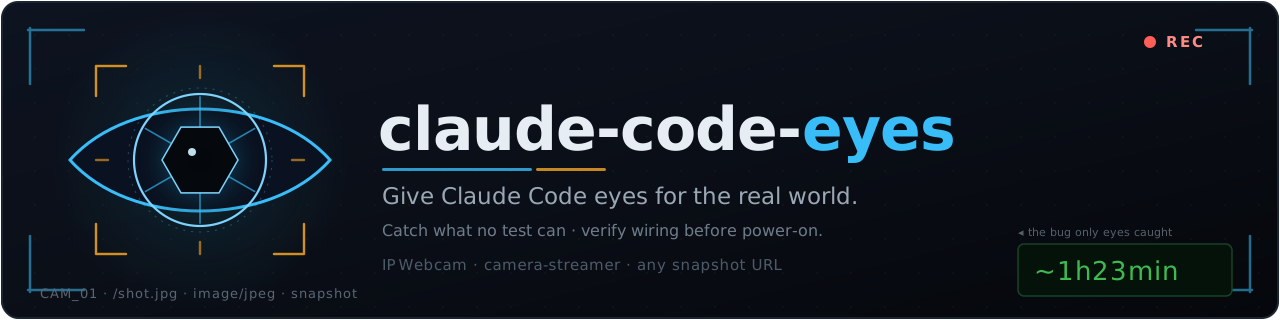
Give Claude Code eyes. A camera skill so Claude doesn't just read about your hardware — it sees it and drives the whole loop: write the firmware, flash the board, connect the API, look at the display, fix the UI, reflash — verifying its own work where it actually lives: on the glass.
Built by a quadriplegic dev who watched Claude Code wire up an ESP32 and fix its on-screen UI — by looking. This skill is how Claude sees.
Most of what Claude works with is text: code, logs, API responses. But some outputs
live where no test can reach them — a font that silently drops characters, a wire in
the wrong hole, a number clipped at the edge of an LCD. claude-code-eyes grabs the
current camera frame so Claude can read it like any other file — then act on it:
edit, reflash, and look again until the real thing is right.
🔍 New in v1.1 — Claude can zoom the lens. Too small to read? It zooms in and looks again instead of guessing, then puts the camera back where it found it. Chip markings, resistor bands, silkscreen, fine print.
| Version | |
|---|---|
| v1.1.1 | LAN cameras bypass the proxy |
| v1.1.0 | Claude can zoom the lens |
| v1.0.0 | First public release — Claude sees through your camera |
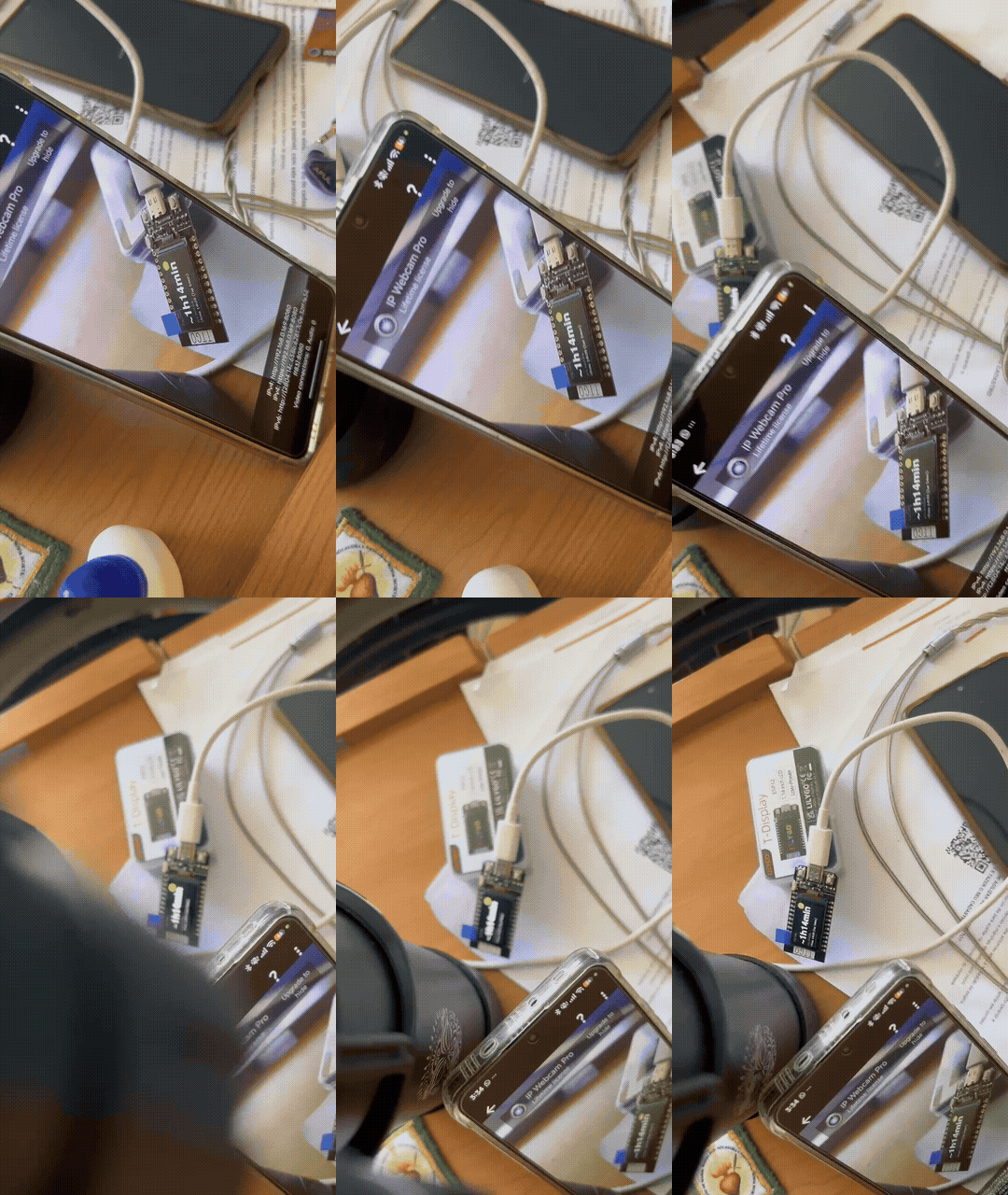
▶️ Watch the full 25-second demo — Claude drives the build from the laptop, the board runs the live countdown, and the phone (IP Webcam) is the eye Claude looks through.
🤯 What Claude Code pulled off here — from a prompt, my home Wi-Fi, and the API it would use, and with zero hardware help from me: it designed the board → relay → API architecture, wrote the ESP32 firmware and a Go relay service, flashed the board, shipped 5 clean OTA updates, wrote its own tests (and caught two of its own that were testing nothing) — and found and fixed a UI bug on the display that every green test missed, by looking at the panel through this camera. My whole job: set the goal, plug in the cable, press the button, aim the phone. Claude did the engineering.
The primary, best-supported camera source is the IP Webcam Android app — it turns any spare Android phone into an HTTP snapshot camera.
http://192.168.0.42:8080. That
IP:port is your camera URL.export CCE_CAM_TYPE=ipwebcam
export CCE_CAM_URL=http://192.168.0.42:8080 # the IP:port the app shows
# optional, if you enabled "Login/password" in the app:
# export CCE_CAM_AUTH=user:pass
No Android phone? Any camera that can serve a still image over HTTP works — see Camera backends for a Raspberry Pi or a fully generic snapshot URL.
The skill is a folder with a SKILL.md and a snap.sh. Put it where Claude Code
looks for skills:
Personal (all your projects):
git clone https://github.com/fcavalcantirj/claude-code-eyes.git \
  ~/.claude/skills/claude-code-eyes
Project-scoped (shared with a repo):
git clone https://github.com/fcavalcantirj/claude-code-eyes.git \
  /path/to/your/project/.claude/skills/claude-code-eyes
Or just copy the skill's files into a claude-code-eyes/ folder under either
skills/ location. That's the whole skill.
From the installed skill folder, run the setup helper — it writes your camera config and grabs a test frame, so there's nothing to hand-edit:
bash ~/.claude/skills/claude-code-eyes/setup.sh
It asks for your camera URL — or, if you leave it blank, scans your LAN for an IP Webcam and lets you pick one. Prefer non-interactive?
# writes the config and verifies it in one shot (add --auth user:pass if needed)
bash ~/.claude/skills/claude-code-eyes/setup.sh --url http://192.168.0.42:8080 --type ipwebcam
Other flags: --scan (just list IP Webcams on the LAN), --local (write
./.cce.env for this project instead of the global config), --show (where config
lives). You can still set the env vars or edit the config by hand — see
Configuration.
Then ask Claude to look:
"Are you seeing this? Is the yellow wire in G4?" "Look at the display — does it say
~1h23minin full?" "Watch this — I'm going to press the button."
A rendered screen is an output no unit test can see. Snap before and after a render change and diff the frames; check the frame against what the spec/API says the screen should show; report the mismatch. It has a small case library baked into the skill: font coverage / dropped characters, text-vs-graphic collisions, clipping at a panel edge, and stale-vs-live renders.
Claude drives the lens itself. When a marking, band, or line of text won't resolve, it zooms and takes another look rather than reporting a guess or "the image is too blurry":
bash snap.sh --zoom 5      # 5x, capture, then restore the previous zoom
bash snap.sh --focus       # soft rather than small? autofocus, then capture
--zoom is a plain magnification from 1 to 10, snapped to a step your camera
actually supports, and the previous level is restored afterwards — so a zoomed
look never silently changes what the next capture sees. Needs
CCE_CAM_TYPE=ipwebcam; other backends say so and still capture. Full
details ↓
Ask Claude to check a build's wiring against its wiring table before you apply power: it calls out mismatches, verifies polarity and voltage rails (no 5 V on a 3.3 V-only pin), and — importantly — refuses to guess a pin it can't read, zooming in for a better look and asking you to aim the camera closer if that still isn't enough.
Selected with CCE_CAM_TYPE:
CCE_CAM_TYPE | Source | Request |
|---|---|---|
ipwebcam | Android IP Webcam app | GET $CCE_CAM_URL/shot.jpg |
camera-streamer | Raspberry Pi camera-streamer | GET $CCE_CAM_URL/snapshot |
url (default) | Anything that returns a still image over HTTP | GET $CCE_CAM_URL (verbatim) |
The url mode is the escape hatch: point it at any endpoint that returns a JPEG or
PNG (a webcam server, an ESP32-CAM, a signed snapshot URL, ?action=snapshot,
etc.). snap.sh verifies the response is actually an image (by magic bytes), so a
web page served with 200 OK won't be mistaken for a photo.
# Raspberry Pi camera-streamer
export CCE_CAM_TYPE=camera-streamer
export CCE_CAM_URL=http://raspberrypi.local:8080

# Any snapshot URL
export CCE_CAM_TYPE=url
export CCE_CAM_URL=http://192.168.0.50/cam/snapshot.jpg
If you have a USB/built-in webcam and ffmpeg installed, you can grab a single
frame directly. This is not shipped as a snap.sh backend because it can't be
tested in an automated/headless environment (macOS in particular blocks camera
access behind an interactive permission prompt). The portable, supported path is a
snapshot URL via one of the backends above. If you want to wire a local camera in
yourself, these are the one-liners:
# macOS (avfoundation) — index 0 is usually the built-in camera
ffmpeg -y -loglevel error -f avfoundation -framerate 30 -i "0:none" -frames:v 1 out.jpg

# Linux (v4l2)
ffmpeg -y -loglevel error -f v4l2 -i /dev/video0 -frames:v 1 out.jpg
Grant your terminal camera permission first, run it manually, and confirm out.jpg
is a real image before trusting it.
Set config however you like — snap.sh resolves it in this order (first wins):
./.cce.env in the current working directory.${XDG_CONFIG_HOME:-$HOME/.config}/claude-code-eyes/config.Config files only fill in values you haven't already exported, and they are
read, never executed (snap.sh parses KEY=VALUE for a fixed allowlist of
keys — a config file cannot run code or set anything else). Example .cce.env:
CCE_CAM_TYPE=ipwebcam
CCE_CAM_URL=http://192.168.0.42:8080
# CCE_CAM_AUTH=user:pass
| Key | Meaning |
|---|---|
CCE_CAM_URL | Camera URL (interpreted per CCE_CAM_TYPE) |
CCE_CAM_AUTH | Optional HTTP basic auth user:pass |
CCE_CAM_TYPE | ipwebcam | camera-streamer | url (default url) |
CCE_OUT_DIR | Where frames are written (default ./.claude-code-eyes) |
When you can't read a silkscreen label, a resistor band, or a chip marking, zoom in and look again instead of guessing:
bash snap.sh --zoom 4        # 4x, capture, then restore the previous zoom
bash snap.sh --focus         # trigger autofocus, then capture
bash snap.sh --zoom 6 3 2    # 6x + watch mode: 3 frames, 2s apart
--zoom takes a magnification from 1 to 10, not raw device units, and snaps
to the nearest step the camera actually supports. The previous zoom is restored
after the capture (including on Ctrl-C), so a zoomed shot never silently changes
what the next one sees.
Needs CCE_CAM_TYPE=ipwebcam. Other backends say so and still capture the frame.
| Backend | Snapshot | Zoom | Focus |
|---|---|---|---|
ipwebcam | yes | yes | yes |
camera-streamer | yes | no | no |
url | yes | no | no |
| Purpose | Endpoint | Notes |
|---|---|---|
| Set zoom | /settings/zoom?set=V | absolute; V must be an allowed step, 100=1x … 1000=max |
| Set zoom | /ptz?zoom=P | percent 0–100 of the range — not an absolute value |
| Focus | /focus, /nofocus | momentary trigger; focusmode is unchanged |
| Capabilities | /status.json?show_avail=1 | the device's own allowed zoom steps |
Success is signalled by the response body containing Ok — the status code is
200 either way, so checking the code alone is not enough.
Trap 1: /ptz?zoom= is a percentage. /ptz?zoom=200 does not mean 2x — it
clamps to maximum zoom. This skill uses /settings/zoom?set= instead.
Trap 2: curvals.zoom lags several seconds behind a change. Code that reads it
straight back sees the old value, so restoring from an immediate read restores the
wrong level. snap.sh polls until the value settles.
Note: pydroid-ipcam documents zoom as /settings/ptz?zoom=N; that path returns
404 on the device tested here.
bash snap.sh 3 2 # 3 frames, 2 seconds apart — for "watch this"
Captured frames are written under ./.claude-code-eyes/ (override with
CCE_OUT_DIR) and their paths are printed one per line. They land in the working
directory, not $TMPDIR, on purpose — see the sandbox note below.
Claude Code runs Bash commands inside a sandbox. It changed two things this skill depends on. Both are handled as of the current version, but if you are on an older copy — or you see the symptoms below — this is why.
Symptom: Claude reports the camera as unreachable, but the exact same
curl works in your own terminal.
The sandbox pre-allows no network destinations. How it blocks depends on the address, and the two cases need different fixes (measured on Claude Code 2.1.236):
| Camera address | How it's blocked | Fix |
|---|---|---|
Private / LAN (192.168.x, 10.x, 172.16-31.x, localhost, *.local) | Below the proxy — the connection just fails, with no HTTP status | sandbox.excludedCommands |
| Public host or public IP | The proxy answers 403 | sandbox.network.allowedDomains |
Almost every camera is on your LAN, so this is usually the one you want.
The quickest unblock needs no config at all: when the capture fails under the sandbox, Claude offers to rerun the command outside the sandbox — approve that and the frame is captured. For a permanent fix, exclude the capture command so the sandbox stays on for everything else:
{ "sandbox": { "excludedCommands": ["bash /Users/me/.claude/skills/claude-code-eyes/snap.sh"] } }
Use your path — snap.sh prints the exact line for you on failure, already
filled in. It must be the path you actually invoke, because entries are matched
exactly or by prefix, never fuzzily:
prefix: cmd === entry || cmd.startsWith(entry + " ")
exact:  cmd === entry
A bare "bash snap.sh" therefore never matches bash /path/to/snap.sh. As a
prefix, the absolute entry also covers watch mode (snap.sh 3 2).
sandbox.network.allowedDomains does not work for a LAN camera: private
ranges are rejected from the domain lists, which require public domain names.
For a camera on a public host, it is the right fix:
{ "sandbox": { "network": { "allowedDomains": ["cam.example.com"] } } }
IPs must be listed exactly — wildcards never match an IP.
Put either in ~/.claude/settings.json and restart Claude Code. setup.sh
prints the correct one for your camera, and snap.sh prints it on failure. Run
/sandbox to inspect the active policy.
A blocked LAN camera and a sleeping camera look identical at the network layer — both are just a failed connection.
snap.shwill not claim the sandbox is at fault when it cannot tell; it reports the connection failure and notes the sandbox as a possibility. The deciding test: if your own terminal can reach the camera and Claude cannot, it is the sandbox.
set: pipefail: invalid option name — CRLF line endingsSymptom: it fails instantly, before ever touching the camera:
snap.sh: line 29: $'\r': command not found
snap.sh: line 30: set: pipefail: invalid option name
The script has Windows (CRLF) line endings and bash chokes on the carriage
returns. git config core.autocrlf defaults to true on Windows, so a clone can
introduce this on its own — as can saving the file from a Windows editor.
snap.sh cannot warn you about this itself: bash is already dead. setup.sh
checks for it and says so. To fix a copy you already have:
perl -pi -e 's/\r$//' snap.sh        # or: sed -i'' -e 's/\r$//' snap.sh
git config core.autocrlf input       # stop it coming back
This repo ships a .gitattributes pinning *.sh to eol=lf, so a fresh clone is
safe.
Symptom: a 403 whose headers name a proxy, e.g.
X-Proxy-Error: blocked-by-allowlist — or a plain connection failure with no
HTTP response at all.
If Claude runs in a cloud session with a device bridge (Cowork and similar), your
camera is on a network that session cannot reach. This is not the Claude Code
Bash sandbox, and no local settings change opens it — the allowlist belongs to the
bridge, not to you. snap.sh prints whatever the proxy says about itself so you
can tell which system refused you.
snap.sh now bypasses the proxy for LAN cameras automatically — it passes
--noproxy <camera-host> whenever the camera is on a private address, so a proxy
that could never serve a LAN address is simply not consulted. Public hosts keep
using the proxy, since for them it may be the only route out.
That covers the common corporate-proxy case. Two traps remain worth knowing:
no_proxy CIDR entries need curl 7.86+. no_proxy=192.168.0.0/16 looks
right and is silently ignored by older builds — which is why the explicit
--noproxy above is used instead of relying on it.What works instead: fetch the snapshot from a browser running on the LAN host
(e.g. Claude in Chrome opening http://<camera-ip>:8080/shot.jpg), which bypasses
the session's egress entirely. Confirmed in the field: full page text and small
print were legible that way. It is also, in the words of the person who found it,
"SUPER clunky" — so it is a workaround, not an answer.
📌 Tracked in issue #2, with a one-command triage that tells this apart from the two fixable causes above. Running into it? Please add your setup to the cloud-session discussion — more datapoints make the upstream case stronger.
$TMPDIR were unreadableSymptom: snap.sh prints a path, but Read cannot open it.
Sandboxed commands get a different $TMPDIR than the Read tool sees, so a
$TMPDIR path is not a shared address between them. snap.sh therefore writes
frames under the working directory (./.claude-code-eyes/), which both agree on.
Add that directory to your project's .gitignore.
Symptom: the first capture fails, a retry moments later succeeds.
Android dozes the Wi-Fi radio, so the IP Webcam server refuses the first
connection while the phone wakes. snap.sh retries 3 times before giving up.
I'm a quadriplegic developer. I'm fluent in code, and I knew nothing about electronics or IoT — I'd never wired a board in my life. So I ran an experiment: could Claude Code connect an ESP32 to my system and just… do the whole thing?
It did. Given a goal, my Wi-Fi, and the API it would talk to, Claude designed the
architecture, wrote the firmware and a relay service, flashed the board, ran OTA
updates, and wrote its own tests. The part I didn't expect: it fixed the UI on
the little display. A 48-pixel clock font was silently dropping characters —
handed ~1h23min it rendered 1 24m on the panel — and every automated test
stayed green, because the bytes really were ASCII; the narrow thing was the
font's glyph coverage, which lives on the glass and nowhere else. Claude only
caught it by looking at the panel.
And that's where the friction was. Before this skill, "let Claude see the board"
meant a soul-crushing manual loop: screenshot the display → send it to myself over
WhatsApp → download it → paste it into Claude Code. Every. Single. Iteration.
claude-code-eyes deletes that loop — Claude grabs the frame itself, reads it,
fixes the code, reflashes, and looks again.
"This is fucking awesome. And yeah — I'm a quad developer."
Honest footnote: I still set the spec, plugged in the cable, and pressed the button — and on one layout bug it was my own eyes that caught what Claude had already marked "pass." Eyes help; they're not infallible. That humility is baked into the skill: it refuses a blurry frame, and it knows what an instrument can and cannot see — a blank frame is not a "no" until the camera is proven to be looking.
MIT — see LICENSE.
Sign in to join the discussion.
No comments yet. Be the first to say what this is good for.
An agentic skills framework & software development methodology that works.
Turn any codebase, with its docs, SQL schemas, configs, and PDFs, into a queryable knowledge graph. A /graphify skill for Claude Code, Cursor, Codex, and Gemini CLI: local deterministic AST parsing, every edge explained, no vector store.

Topic in, narrated explainer video out. A Claude Code / Codex skill that turns any topic into a black-canvas motion-graphics explainer video with TTS voiceover, subtitles and a chapter progress bar. Chinese or English; every frame drawn in code with Remotion.
Public repository for Agent Skills
Open-source AI job search: scan job portals, evaluate listings into a structured A-H report with a global 1-5 score, tailor your CV, track applications — runs locally in your AI coding CLI (Claude Code, Codex, OpenCode, Antigravity…)
Production-grade engineering skills for AI coding agents.