

koala73/worldmonitorConnectors
Real-time global intelligence dashboard. AI-powered news aggregation, geopolitical monitoring, and infrastructure tracking in a unified situational awareness interface
86k
caldav-mcp connects an agent to a CalDAV server so it can list calendars, read events, and create, update, or delete events and todos. It works as an MCP server, with tools defined in `src/tools` and wired through the TypeScript server in `src/index.ts`.
Builders who want their agent to work with calendars and tasks through CalDAV.
You can let an agent manage calendar events and todos instead of handling them manually.
Returns calendar names and URLs from the connected CalDAV server.
Lists events between a start and end date for a chosen calendar URL.
Lets the agent add events, edit existing ones by UID, and remove them.
Shows VTODO items with status, due-date filters, and pagination.
Supports task creation, edits, completion, and removal in a CalDAV calendar.
Provides a ready-to-copy MCP server block using `npx caldav-mcp` and CalDAV environment variables.
npm run dev
🗓️ A CalDAV Model Context Protocol (MCP) server to expose calendar operations as tools for AI assistants.





{
  "mcpServers": {
    ...,
    "calendar": {
      "command": "npx",
      "args": [
        "caldav-mcp"
      ],
      "env": {
        "CALDAV_BASE_URL": "<CalDAV server URL>",
        "CALDAV_USERNAME": "<CalDAV username>",
        "CALDAV_PASSWORD": "<CalDAV password>"
      }
    }
  }
}
Run the MCP server in development mode with auto-reload:
npm run dev
This will run the TypeScript code directly with watch mode and automatically load environment variables from .env.
Alternatively, you can compile TypeScript to JavaScript and run it:
npx tsc
node dist/index.js
List all calendars returning both name and URL
Parameters: none
Returns:
List all events between start and end date in the calendar specified by its URL
Parameters:
start: string — Start date (ISO 8601)end: string — End date (ISO 8601)calendarUrl: stringReturns:
uid, summary, start, end, and optionally description and locationCreates an event in the calendar specified by its URL. For all-day events, set wholeDay to true. For a single-day all-day event, use start and end datetimes on the same calendar date; they do not need to be identical timestamps.
Parameters:
summary: stringstart: string — Start datetime (ISO 8601)end: string — End datetime (ISO 8601)wholeDay: boolean (optional) — Create as a whole-day eventcalendarUrl: stringdescription: string (optional)location: string (optional)recurrenceRule: object (optional)
freq: enum (DAILY | WEEKLY | MONTHLY | YEARLY) (optional)interval: number (optional)count: number (optional)until: string (optional)byday: array of string (optional)bymonthday: array of number (optional)bymonth: array of number (optional)Returns:
Updates an existing event in the calendar specified by its URL. Only provided fields are changed. For a one-day full-day event, set wholeDay to true and set start and end to the same calendar day.
Parameters:
uid: string — Unique identifier of the event to update (obtained from list-events)calendarUrl: stringsummary: string (optional)start: string (optional)end: string (optional)wholeDay: boolean (optional) — Update whether this is a whole-day eventdescription: string (optional)location: string (optional)recurrenceRule: object (optional)
freq: enum (DAILY | WEEKLY | MONTHLY | YEARLY) (optional)interval: number (optional)count: number (optional)until: string (optional)byday: array of string (optional)bymonthday: array of number (optional)bymonth: array of number (optional)Returns:
Deletes an event in the calendar specified by its URL
Parameters:
uid: string — Unique identifier of the event to delete (obtained from list-events)calendarUrl: stringReturns:
List tasks (VTODOs) in the calendar specified by its URL. By default returns only open tasks (NEEDS-ACTION and IN-PROCESS), sorted by manual order then due date. Use status to include completed (COMPLETED) or all (ALL) tasks, and limit/offset to page through long lists.
Parameters:
calendarUrl: stringstatus: enum (OPEN | ALL | NEEDS-ACTION | COMPLETED | IN-PROCESS | CANCELLED) (optional) — Filter by status. OPEN (default) = NEEDS-ACTION + IN-PROCESS; ALL = everything; or an exact status (NEEDS-ACTION, COMPLETED, IN-PROCESS, CANCELLED).due_before: string (optional) — Only tasks with a due date at or before this (ISO 8601). Undated tasks are excluded when a due window is set.due_after: string (optional) — Only tasks with a due date at or after this (ISO 8601). Undated tasks are excluded when a due window is set.limit: number (optional) — Max tasks to return (default 50, max 500)offset: number (optional) — Tasks to skip (default 0)Returns:
{ todos, total, limit, offset } where total is the count before pagination. Each todo has uid, summary, status, and optionally due, start, completed, description, location.Creates a task (VTODO) in the calendar specified by its URL. Only summary is required; a task may have no dates. Use due for a deadline and start for when work should begin.
Parameters:
summary: stringcalendarUrl: stringdue: string (optional) — Due datetime (ISO 8601)start: string (optional) — Start datetime (ISO 8601)description: string (optional)location: string (optional)status: enum (NEEDS-ACTION | COMPLETED | IN-PROCESS | CANCELLED) (optional) — Defaults to NEEDS-ACTION when omittedReturns:
Updates an existing task (VTODO) in the calendar specified by its URL. Only provided fields are changed. To mark a task done, prefer the complete-todo tool.
Parameters:
uid: string — Unique identifier of the todo to update (from list-todos)calendarUrl: stringsummary: string (optional)due: string (optional)start: string (optional)description: string (optional)location: string (optional)status: enum (NEEDS-ACTION | COMPLETED | IN-PROCESS | CANCELLED) (optional)Returns:
Marks a task (VTODO) as done. Sets its status to COMPLETED and records the completion time.
Parameters:
uid: string — Unique identifier of the todo to complete (from list-todos)calendarUrl: stringReturns:
Deletes a task (VTODO) in the calendar specified by its URL
Parameters:
uid: string — Unique identifier of the todo to delete (from list-todos)calendarUrl: stringReturns:
MIT
Sign in to join the discussion.
No comments yet. Be the first to say what this is good for.
Real-time global intelligence dashboard. AI-powered news aggregation, geopolitical monitoring, and infrastructure tracking in a unified situational awareness interface
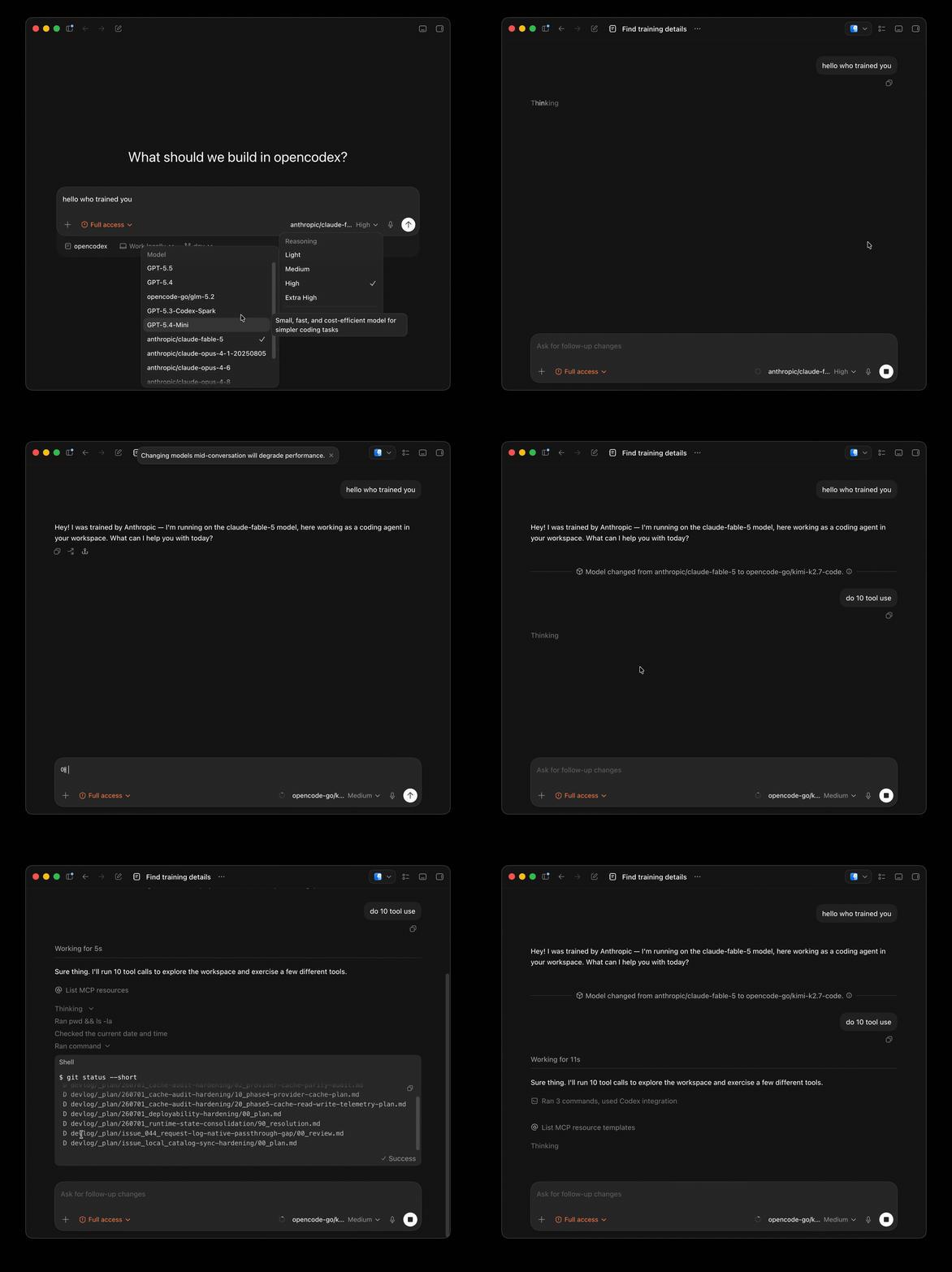
Universal provider proxy for OpenAI Codex & Claude Code — use any LLM (Claude, Gemini, Grok, DeepSeek, Ollama…) with Codex CLI, App, SDK, and Claude Code

BankMCP™: your AI can now read your bank. Self-hosted, read-only MCP server for your own bank accounts via open banking (Enable Banking). Standard MCP; tested with Claude and Ollama.
Open-source auth gateway connecting 1400+ SaaS providers to AI agents through SDK, CLI, MCP, HTTP, and OpenAPI.
Open-source 3D architectural editor with a local CLI, MCP tools, and practical workflows for humans and AI agents.

Open-source MCP server for comparing products and asking the buyer before purchase.