
DietrichGebert/ponytailPlugins
Makes your AI agent think like the laziest senior dev in the room. The best code is the code you never wrote.
138k
1 add
This plugin adds Ralph RLM to OpenCode: a supervisor model manages a background loop, starts a fresh worker for each attempt, and uses your verify command to decide when the task is done. Progress lives in protocol files like `PLAN.md`, `CURRENT_STATE.md`, and `CONVERSATION.md`, so you can inspect and steer the work without digging through a long chat.
Builders who use OpenCode and want reusable agent loops for ongoing coding tasks.
You can hand off a goal, let the loop keep working, and come back to finished changes that passed your tests.
Runs a background loop through `ralph-rlm/supervisor` and manages attempts, pause, resume, and stop actions.
Starts a new worker session each attempt so progress is carried in files instead of chat memory.
Writes and updates `PLAN.md`, `RLM_INSTRUCTIONS.md`, `CURRENT_STATE.md`, and handoff notes for durable context.
Uses a user-chosen `verify.command` as the single stop condition for the loop.
Includes session bridge, worker plugin, and autostart wiring under `.opencode/plugins`.
Ships the `interview-and-create-plan` skill to turn a vague goal into an authored plan before the loop starts.
npx skills add doeixd/opencode-ralph-rlm
Use the setup-opencode-ralph-rlm skill to install Ralph RLM in this project.
npm install -D @doeixd/opencode-ralph-rlm
npx @doeixd/opencode-ralph-rlm setup
npx @doeixd/opencode-ralph-rlm setup --dry-run
npx @doeixd/opencode-ralph-rlm serve
# optional: --port 8787 --opencode-url http://127.0.0.1:4096
#           --worktree /path/to/your/repo
export RALPH_SUPERVISOR_API_KEY="..."
export RALPH_SUPERVISOR_MODEL="gpt-5.4-mini"   # + RALPH_SUPERVISOR_BASE_URL for non-OpenAI endpoints
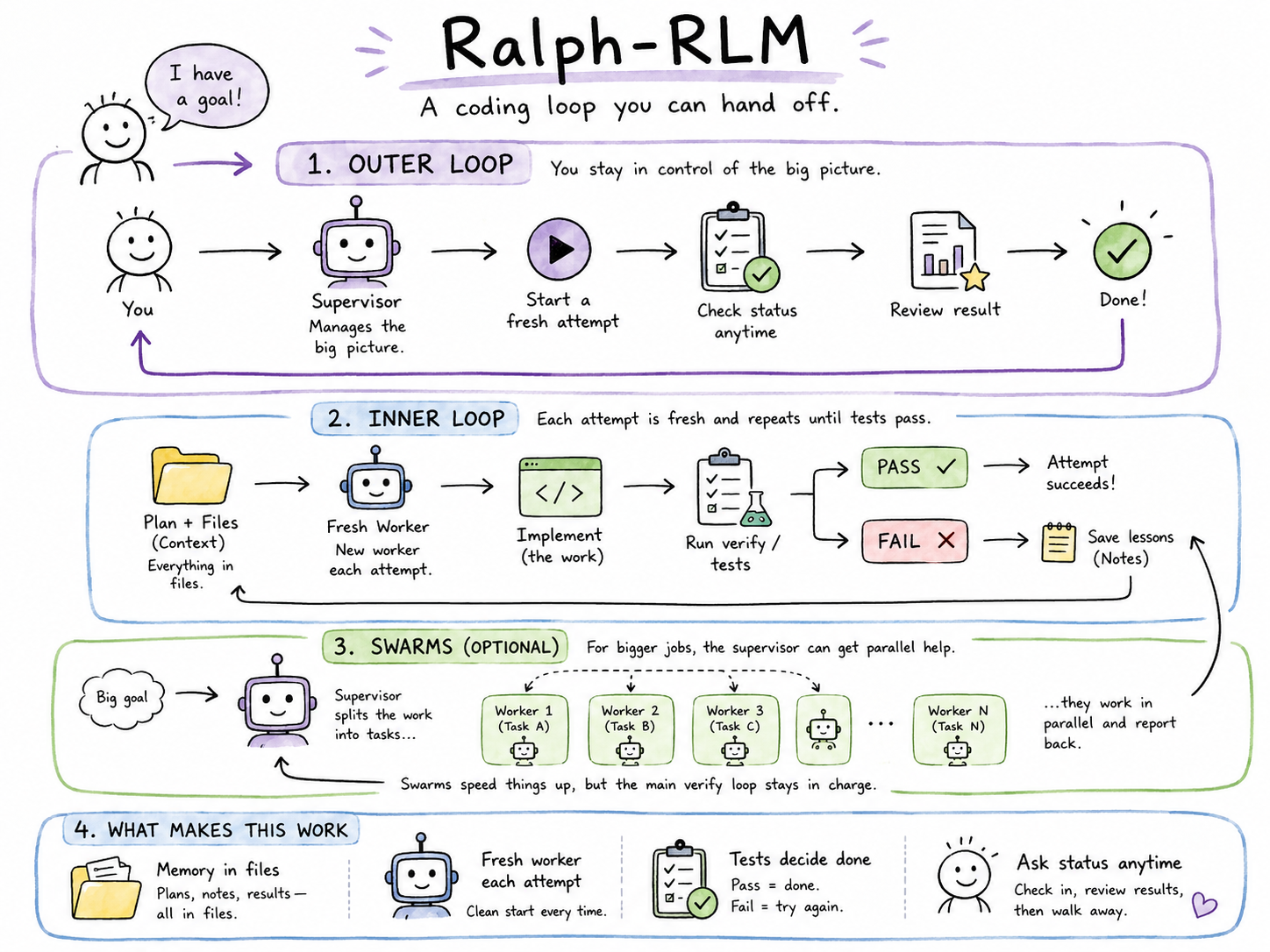

An OpenCode integration for long-running, hands-off coding work. Describe a goal, walk away, and come back to finished work. Behind the scenes a fresh agent keeps working in a loop — checking itself against your tests after every attempt — until the job is actually done.
It combines two ideas:
You talk to one model in the OpenCode TUI — ralph-rlm/supervisor. Behind it, a small local helper runs the loop for you: it plans the work with you, starts a fresh worker for each attempt, runs your test command to decide "done," and carries lessons forward between attempts — all in the background. You steer in plain language ("status?", "pause", "the API changed, replan") and review durable files, not an endless chat log.
verify.command you choose is the single source of truth for "done" — not vibes.PLAN.md, notes, …) you can version and steer.You: Add JWT auth; the test suite must pass.
Ralph: Let's plan first — refresh tokens too? which test command counts as "done"?
You: yes, refresh tokens; npm test
Ralph: Plan locked (PLAN.md). Attempt 1 running in the background — ask "status?" anytime.
…worker implements → verify fails → notes the reason → attempt 2 → verify passes…
You: status?
Ralph: Done — verify passed on attempt 2. Summary is in CONVERSATION.md.
Fastest path — let your agent set it up. From your project, install the setup skill:
npx skills add doeixd/opencode-ralph-rlm
Then paste this to your coding agent:
Use the setup-opencode-ralph-rlm skill to install Ralph RLM in this project.
That's it — the skill inspects the repo, installs the wiring, picks a sensible verify.command, runs diagnostics, and offers to add Ralph guidance to your AGENT.md. Then jump to Start the provider.
Prefer to drive it yourself? The same steps by hand:
The two commands above are the whole step. The skill handles repo inspection, setup, config review, verify.command, diagnostics, and asks whether to add Ralph guidance to AGENT.md / AGENTS.md.
In your target repo:
npm install -D @doeixd/opencode-ralph-rlm
npx @doeixd/opencode-ralph-rlm setup
This path uses Node/npm; Bun is not required for end users.
This creates conservative project-local wiring:
.opencode/plugins/ralph-worker.ts.opencode/plugins/ralph-session-bridge.ts.opencode/plugins/ralph-autostart.ts — auto-starts the provider when OpenCode loads (skip with setup --no-autostart).opencode/ralph.jsonopencode.json provider entry for ralph-rlm/supervisorExisting managed files are skipped unless you pass --force. Preview changes with:
npx @doeixd/opencode-ralph-rlm setup --dry-run
Manual examples remain in .opencode/opencode.provider.example.json and .opencode/ralph-provider.example.json.
For full setup options, including manual installation, see INSTALLATION.md.
After setup, the provider auto-starts when you open OpenCode (via the ralph-autostart plugin) — so you can usually skip this. To run it manually (or if you used --no-autostart / RALPH_AUTOSTART=0):
npx @doeixd/opencode-ralph-rlm serve
# optional: --port 8787 --opencode-url http://127.0.0.1:4096
#           --worktree /path/to/your/repo
Supervisor LLM credentials (provider process). If you've already authenticated a keyed provider in OpenCode (e.g. Google, OpenCode Zen via opencode auth login), the provider auto-detects it — no extra config needed. To force a specific provider/model instead:
export RALPH_SUPERVISOR_API_KEY="..."
export RALPH_SUPERVISOR_MODEL="gpt-5.4-mini"   # + RALPH_SUPERVISOR_BASE_URL for non-OpenAI endpoints
Or .opencode/ralph-provider.json — see .opencode/ralph-provider.example.json. Check what resolved with curl http://127.0.0.1:8787/api/health (supervisor.ready / model / source).
opencode
Choose ralph-rlm/supervisor and delegate a goal:
Implement JWT auth; tests must pass when done.
The supervisor starts attempt 1 in the background. Ask status? anytime.
npx @doeixd/opencode-ralph-rlm doctor --worktree .
# automated HTTP smoke (provider must be running with RALPH_TEST_MODE=1, or use --spawn):
bun run e2e-smoke -- --spawn
| Doc | Start here if you want to… |
|---|---|
GETTINGSTARTEDGUIDE.md | Set it up and run your first loop (start here) |
INSTALLATION.md | Compare install paths (agent skill, CLI, manual) |
MIGRATION.md | Upgrade from the v0.1 plugin |
CHANGELOG.md | See what changed |
| DeepWiki | Browse / ask questions about the codebase |
The rest of this README is reference material — tools, config, the management API, and how it works under the hood. New here? Follow the getting-started guide instead, or ask DeepWiki anything about the code.
A loop is only as good as its PLAN.md — every worker treats it as authority over chat history. The interview-and-create-plan skill turns a vague goal into an authored plan before attempt 1, two ways:
repo_search / repo_grep), interviews you to sharpen the goal and stress-test the design, writes PLAN.md via write_plan, agrees a strong verify.command with you (set_verify + run_verify to confirm it fails before the work is done), and only calls start_loop after you approve.interview-and-create-plan skill in a normal session (full tools, your chosen model). It writes PLAN.md to the path opencode-ralph-rlm plan-path reports (the active plan dir, not necessarily the repo root). Then switch to ralph-rlm/supervisor and say "go" — start_loop detects the authored plan and launches against it without re-bootstrapping.Both paths share one source of truth: the skill at skills/interview-and-create-plan/SKILL.md (a repo-local copy overrides the baked-in default). start_loop never overwrites an authored plan, and when it does bootstrap a fresh one it weaves your goal in instead of leaving a placeholder.
Each user message is a short supervisor turn. Long work runs in the background:
You:  Implement JWT auth; tests must pass
Model: Started loop — attempt 1 running. Ask for status anytime.

[background: worker → idle → verify → fail → rollover → attempt 2 → …]

You:  status?
Model: Attempt 2. Last verify failed. Worker idle. …
verify.command in .opencode/ralph.json (single source of truth for “done”)..ralph-rlm/plans/<name>/, or repo root in legacy mode) — not chat history.edit/bash until ralph_load_context(); provides FFF-accelerated rlm_grep, rlm_file_search, rlm_glob, and rlm_slice. Its ralph_* / rlm_* tools are hidden from your normal OpenCode sessions — they're denied globally and re-enabled only in the dedicated ralph-worker agent that workers run under.Created on first start_loop (bootstrap) and updated across attempts:
| File | Role |
|---|---|
PLAN.md | Goal and definition of done |
RLM_INSTRUCTIONS.md | Worker playbooks (debug, refactor, repo conventions) |
CURRENT_STATE.md | Scratch pad for the active attempt only |
PREVIOUS_STATE.md | Snapshot after failed verify |
AGENT_CONTEXT_FOR_NEXT_RALPH.md | Handoff: verdict + next-step instructions |
NOTES_AND_LEARNINGS.md | Curated durable knowledge — editable, not append-only; link to domain glossary / ADRs / design docs |
CONTEXT_FOR_RLM.md | Large reference — workers use rlm_grep + rlm_slice only |
SUPERVISOR_LOG.md / CONVERSATION.md | Engine + worker progress feed |
.opencode/loop_attempt.json | Attempt marker (worker ralph_ask sync) |
Supervisor updates strategy via update_plan / update_rlm_instructions. Workers may patch PLAN.md / RLM_INSTRUCTIONS.md with ralph_update_plan / ralph_update_rlm_instructions when playbooks need to change mid-attempt.
Protocol files live in a per-plan directory so you can keep multiple versions and switch between them:
.ralph-rlm/plans/
  default/      PLAN.md  RLM_INSTRUCTIONS.md  NOTES_AND_LEARNINGS.md  …  .state/
  jwt-auth/     …
  refactor-api/ …
  .active       → active plan name
plans.dir in .opencode/ralph.json (default .ralph-rlm/plans). Set it to "" or "." for the legacy root layout.PLAN.md (a pre-named-plans install) and no .ralph-rlm/plans, the legacy root layout is auto-detected and kept.list_plans, select_plan <name>, and new_plan <name>. start_loop, read_protocol, and write_plan all target the active plan. The active plan is tracked by the .active pointer (per worktree).ralph.json is read from .ralph-rlm/ralph.json first, then .opencode/ralph.json.loop_attempt.json, pending_input.json) live in each plan's .state/ dir, so plans don't collide.v0.2 ships opinionated defaults so loops work without hand-authored prompts:
| Layer | Source | What it defines |
|---|---|---|
| Supervisor | packages/provider/server/lib/supervisor-agent.ts | Role boundaries, user-intent → tool routing, communication style |
| Worker system | packages/engine/src/templates.ts → injected by worker plugin | File-first protocol, one-pass lifecycle, anti-patterns |
| Worker spawn | templates.workerPrompt | Numbered steps per attempt (ralph_load_context → … → ralph_verify → STOP) |
| Bootstrap | templates.bootstrapPlan, bootstrapRlmInstructions | Initial PLAN.md + RLM_INSTRUCTIONS.md on start_loop |
| Rollover | templates.continuePrompt | Next-step block in AGENT_CONTEXT_FOR_NEXT_RALPH.md after failed verify |
Customize without forking:
| Variable | Overrides |
|---|---|
RALPH_WORKER_SYSTEM_PROMPT | Worker system prompt (use @path/to/file for multiline) |
RALPH_COMPACTION_CONTEXT | Context injected on session compaction |
RALPH_CONTEXT_GATE_ERROR | Message when edit/bash blocked before ralph_load_context() |
Tune RLM_INSTRUCTIONS.md and PLAN.md in your repo after the first failures — that is the durable steering surface for workers.
The provider supervisor LLM calls these internally — you steer in natural language.
| Tool | Purpose |
|---|---|
start_loop | Bootstrap protocol files, begin attempt 1 (launches against an authored PLAN.md when one exists) |
repo_search / repo_grep | Planning-phase repo exploration (cross-reference the goal against the code) |
write_plan | Write the authored PLAN.md after the planning interview is approved |
list_plans / select_plan / new_plan | List, switch, or create named plans (versions) under the configured plans dir |
loop_status | Attempt, paused/done/stopped, worker id, last verify |
pause_loop / resume_loop / stop_loop | Control background orchestration |
peek_worker | Tail of CURRENT_STATE.md |
read_protocol | Read allowlisted protocol file |
update_plan / update_rlm_instructions | Unified diff patches + changelog |
get_verify / set_verify / run_verify | Read / write / dry-run verify.command — craft & validate the loop's stop condition with the user |
last_verify_output | Raw verify stdout/stderr |
list_worker_questions / answer_worker | Worker ralph_ask queue |
spawn_swarm | Parallel side agents (declarative tasks) |
swarm_status / swarm_cancel / swarm_collect | Manage swarms |
swarm_unsafe_runtime_code_eval | Opt-in SDK script eval (localhost only) |
Test mode (no external LLM): RALPH_TEST_MODE=1 npx @doeixd/opencode-ralph-rlm serve --worktree .
Available in background worker sessions (ralph-worker plugin):
| Tool | Purpose |
|---|---|
ralph_load_context | First call every attempt — loads protocol files + agent rules |
ralph_report | Progress to SUPERVISOR_LOG.md / CONVERSATION.md |
ralph_set_status | running | blocked | done | error |
ralph_verify | Run verify.command once; then STOP |
rlm_file_search | Fuzzy file search across the worktree |
rlm_glob | Fast glob discovery, e.g. **/*.ts |
rlm_grep / rlm_slice | Search/slice large files (especially CONTEXT_FOR_RLM.md) |
ralph_update_plan / ralph_update_rlm_instructions | Durable strategy patches |
ralph_ask | Blocking question to supervisor (use sparingly) |
rlm_file_search, rlm_glob, and rlm_grep use optional @ff-labs/fff-node acceleration when it is available. If the native package cannot load or scan, Ralph keeps working: rlm_grep falls back to its exact TypeScript file scan and the discovery tools return a structured unavailable reason.
Run side parallel agents alongside the main verify loop (does not replace verify.command):
Spawn parallel agents for auth, api routes, and test fixes.
The supervisor uses spawn_swarm with structured tasks. Caps: swarm.maxConcurrent, swarm.maxTasksPerRun, maxSubAgents in ralph.json.
swarm_unsafe_runtime_code_eval runs supervisor-authored TypeScript in a subprocess with an injected OpenCode SDK client. Disabled by default.
{ "swarm": { "unsafeEvalEnabled": true } }
or RALPH_SWARM_UNSAFE_EVAL=1. Scripts are audited under .opencode/swarm/runs/<id>/. Prefer declarative spawn_swarm for normal use.
OpenCode does not forward session IDs to custom providers by default. Load ralph-session-bridge.ts so each TUI session gets its own LoopRun.
Confirm after your first supervisor message: response header x-ralph-session-source should be header:x-opencode-session-id, not anonymous. See GETTINGSTARTEDGUIDE.md § Session correlation.
With npx @doeixd/opencode-ralph-rlm serve --worktree . running:
| Endpoint | Purpose |
|---|---|
GET /api/health | Provider + OpenCode connectivity |
GET /api/loops | Active loop runs |
GET /api/loops/:sessionId | Loop status |
POST /api/loops/:sessionId/pause | Pause |
POST /api/loops/:sessionId/resume | Resume |
POST /api/loops/:sessionId/stop | Stop + abort worker |
POST /api/loops/:sessionId/message | Inject an out-of-band message to the supervisor (watchers/scripts) |
GET /api/swarms | List swarms (?sessionId=) |
POST /api/swarms/:swarmId/cancel | Cancel swarm |
OpenAPI UI: http://127.0.0.1:8787/_scalar
Scripts and schedulers can send the supervisor a message out-of-band — useful for "watch for X, then tell the supervisor." The message is recorded to the active plan's CONVERSATION.md / SUPERVISOR_LOG.md, shown as a TUI toast, and (by default) runs a supervisor turn so it can act autonomously (pause, replan, spawn a swarm, even start a loop).
# Discover the session id, then send a message
opencode-ralph-rlm sessions
opencode-ralph-rlm send-message -s <sessionId> -m "CI went red — pause and replan."

# Just notify (record + toast), don't run a supervisor turn:
opencode-ralph-rlm send-message -s <sessionId> -m "deploy finished" --no-run --source deploy-bot
Or hit the endpoint directly so any language/cron can drive it:
curl -s http://127.0.0.1:8787/api/loops/<sessionId>/message \
  -H 'content-type: application/json' \
  -d '{"message":"main branch updated — rebase and re-verify","source":"git-hook"}'
A watcher then becomes a small script the agent can write, e.g. PowerShell polling a condition:
while ($true) {
  if (Test-Path .\BUILD_FAILED) {
    opencode-ralph-rlm send-message -s $env:RALPH_SESSION -m "Build failed — stop and diagnose."
    Remove-Item .\BUILD_FAILED
  }
  Start-Sleep -Seconds 30
}
Body fields: message (required), source (label), toast (default true), runTurn (default true; false records + toasts only). The provider is localhost-only by default and the management API is unauthenticated — keep it bound to loopback.
.opencode/ralph.json| Key | Default | Notes |
|---|---|---|
enabled | true | Master switch |
maxAttempts | 20 | Stop after N failed verify cycles |
verify.command | — | Required for real loops |
verifyTimeoutMinutes | 0 | 0 = no timeout |
heartbeatMinutes | 15 | Staleness warning threshold |
gateDestructiveToolsUntilContextLoaded | true | Worker must call ralph_load_context() first |
agentMdPath | — | Static rules file (e.g. AGENT.md) |
plans.dir | .ralph-rlm/plans | Base dir for named plans. ""/"." = legacy root layout |
plans.active | default | Default active plan name (overridden by the .active pointer) |
fff.enabled | true | Optional native search acceleration |
fff.scanTimeoutMs | 10000 | Initial FFF index scan timeout |
subAgentEnabled | true | Required for swarms |
swarm.enabled | true | Declarative swarms |
swarm.maxConcurrent | 5 | Parallel spawn cap |
swarm.unsafeEvalEnabled | false | Script eval gate |
Legacy keys (autoStartOnMainIdle, strategistHandoffMinutes, reviewer settings) remain in schema for compatibility but are ignored by the v0.2 provider.
| Variable | Used by |
|---|---|
RALPH_SUPERVISOR_API_KEY | Provider supervisor LLM |
RALPH_SUPERVISOR_MODEL | Provider supervisor LLM |
RALPH_SUPERVISOR_BASE_URL | Provider supervisor LLM |
RALPH_OPENCODE_AUTH_PATH | Override path to OpenCode auth.json for supervisor credential auto-detect |
OPENCODE_BASE_URL | Engine SDK (default http://127.0.0.1:4096) |
RALPH_PROVIDER_PORT | Provider port (default 8787) |
RALPH_WORKTREE | Default worktree for opencode-ralph-rlm doctor / serve |
RALPH_TEST_MODE | Scripted supervisor (tests / CI / smoke) |
RALPH_SESSION_DEBUG | Log session correlation headers on completions |
RALPH_ALLOW_ANONYMOUS_SESSION | Opt-in anonymous session key (1) — avoid in production |
RALPH_SWARM_UNSAFE_EVAL | Enable unsafe swarm scripts (1) |
RALPH_WORKER_SYSTEM_PROMPT | Override worker system prompt |
RALPH_COMPACTION_CONTEXT | Override compaction context block |
RALPH_CONTEXT_GATE_ERROR | Override context-gate error message |
RALPH_FFF_DISABLED | Disable optional FFF worker search acceleration (1) |
You don't need this to use Ralph — it's here if you want to know what's running.
v0.2 uses a provider-as-supervisor design. The loop is exposed as a custom OpenCode provider model (ralph-rlm/supervisor), so you talk to one session while deterministic code owns verify, rollover, and worker lifecycle behind the API.
You — OpenCode TUI (model: ralph-rlm/supervisor)
        │  POST /v1/chat/completions (+ session bridge headers)
        ▼
packages/provider — Nitro :8787
  SupervisorAgent (LLM + tools)  →  LoopEngine  →  OpenCode SDK :4096
        │                                              │
        │                                              ▼
        │                         Worker sessions + ralph-worker plugin
        ▼
Protocol files (PLAN.md, RLM_INSTRUCTIONS.md, CURRENT_STATE.md, …)
| Layer | Module | Role |
|---|---|---|
| Supervisor API | packages/provider | OpenAI-compatible /v1/chat/completions, management /api/* |
| Loop engine | packages/engine | Verify, rollover, worker spawn, swarms — no LLM orchestration |
| Worker tools | packages/worker-plugin | RLM tools, context gate, ralph_ask |
| Session bridge | .opencode/plugins/ralph-session-bridge.ts | Injects x-opencode-session-id on provider requests |
The legacy monolithic plugin (.opencode/plugins-legacy/ralph-rlm.ts) remains for reference and is not loaded by default. Do not use ralph_spawn_worker() or ralph_create_supervisor_session() in v0.2.
bun install
bun run verify              # typecheck + 55 tests + Nitro build (CI uses bin/verify.ts)
bun run e2e-smoke -- --spawn   # HTTP smoke against ephemeral provider
bun run ralph-serve
Monorepo modules: packages/engine, packages/provider, packages/worker-plugin.
CI: .github/workflows/verify.yml
Published as a single package with subpath exports:
npm install @doeixd/opencode-ralph-rlm
| Import | Contents |
|---|---|
@doeixd/opencode-ralph-rlm | Legacy v0.1 bundle (dist/ralph-rlm.js) |
@doeixd/opencode-ralph-rlm/engine | Loop + swarm engine |
@doeixd/opencode-ralph-rlm/worker-plugin | Thin OpenCode worker plugin |
@doeixd/opencode-ralph-rlm/provider | Nitro supervisor server entry |
Recommended for users: run npx @doeixd/opencode-ralph-rlm setup, then npx @doeixd/opencode-ralph-rlm serve.
Recommended for development: clone this repo and run bun run ralph-serve.
Sign in to join the discussion.
No comments yet. Be the first to say what this is good for.
Makes your AI agent think like the laziest senior dev in the room. The best code is the code you never wrote.
Graphs that teach > graphs that impress. Turn any code into an interactive knowledge graph you can explore, search, and ask questions about. Works with Claude Code, Codex, Cursor, Copilot, Gemini CLI, and more.

OmO: Just type "mass ulw" keyword with your prompt. Now you are the master of graph engineering.
Persistent Context Across Sessions for Every Agent – Captures everything your agent does during sessions, compresses it with AI, and injects relevant context back into future sessions. Works with Claude Code, OpenClaw, Codex, Gemini, Hermes, Copilot, OpenCode + More
Opinionated Oxlint rules for rejecting low-evidence TypeScript and JavaScript patterns
Teams-first Multi-agent orchestration for Claude Code