

affaan-m/
ECC

affaan-m/ECCHarnesses
The agent harness performance optimization system. Skills, instincts, memory, security, and research-first development for Claude Code, Codex, Opencode, Cursor and beyond.
258k
GAAI drops a `.gaai/` folder into a git project and uses markdown, YAML, and bash to structure how agents discover work and deliver it. Discovery creates backlog stories with acceptance criteria, while Delivery runs in isolated sessions with planning, implementation, and QA steps.
Builders who want their coding agents to work from backlog items, remember project patterns, and stay within scope.
You can turn agent-led coding into a repeatable delivery loop with clear criteria, memory, and separate execution contexts.
Discovery gathers requirements and writes refined stories; Delivery executes only what is in the backlog.
Project memory lives in `.gaai/project/contexts/memory/` so agents can reuse decisions and patterns later.
`/gaai-daemon` polls the backlog and runs multiple stories in parallel through tmux sessions.
Supports Claude Code, Codex CLI, Gemini CLI, Cursor, Windsurf, and other AGENTS.md-compatible tools through thin adapters.
Uses markdown, YAML, and bash instead of an SDK or package, so the framework stays readable and local.
git clone https://github.com/Fr-e-d/GAAI-framework.git /tmp/gaai && \
  bash /tmp/gaai/.gaai/core/scripts/install.sh --wizard && \
  rm -rf /tmp/gaai


A .gaai/ folder you drop into any git project. Markdown, YAML and bash, with a vendored Python runtime and a few Node helpers. No SDK. No package to install. No external services.
GAAI turns AI coding tools into reliable agentic software delivery systems.
You:        /gaai-discover
Discovery:  "What do you want to build?"
You:        "Add rate limiting — 100 req/min per user, 429 on exceeded."
Discovery:  "Got it. Checking memory for existing middleware patterns..."
            → Generates Epic E03 + Story E03S01 with acceptance criteria
            → Runs validation: artefact complete, criteria testable, no scope drift
            → Adds to backlog: status: refined
Discovery:  "Done. E03S01 is ready. Run /gaai-deliver when you're ready."

You:        /gaai-daemon
            → Launches the Delivery Daemon (polls backlog, delivers in parallel via tmux)
Delivery:   → Reads E03S01 from backlog
            → Loads middleware conventions from memory
            → Planning Sub-Agent: produces execution plan
            → Implementation Sub-Agent: adds rate-limiting middleware
            → QA Sub-Agent: all acceptance criteria PASS
            → Story marked done, PR merged to staging
Delivery:   "E03S01 complete. No further Stories in backlog."
Two slash commands. Two isolated contexts. Discovery reasons — it never executes. Delivery executes — it never decides scope. They never share a context window — Delivery runs as a separate OS process (claude -p via tmux), so system prompts can't contaminate each other. The backlog is the contract between them.
/gaai-deliverdelivers a single Story in the current session./gaai-daemonlaunches a background daemon that polls the backlog and delivers multiple Stories in parallel (each in its own tmux session). See Delivery Daemon →
AI coding tools are fast — but without governance, speed creates drift: agents touch code they shouldn't, forget decisions from prior sessions, and ship features no one can verify against criteria. GAAI adds the missing layer.
Built for developers who already have product clarity — solo founders, senior engineers, small teams who know what to build and need an agent that ships it reliably without going off-script. If you've ever said "the agent broke something it wasn't supposed to touch," this is for you.
| vs. | Difference |
|---|---|
| AGENTS.md / cursor rules | Solves one session. GAAI adds cross-session memory, scope authorization, and structured delivery. |
| BMAD-METHOD | Simulates a multi-agent Agile team. GAAI is lighter on Discovery, more rigid on Delivery governance. |
| LangGraph / AutoGen / CrewAI | Code-first orchestration for building AI systems. GAAI governs the use of AI coding tools. Different abstraction level. |
| Spec Kit (GitHub) | Spec-driven pipeline (spec → plan → tasks → implement). GAAI adds governance enforcement, multi-agent delivery with QA gates, structured cross-session memory, and automated daemon delivery. |
Discovery — you talk to the Discovery Agent in your current session. Clarify what to build. Output: a Story with acceptance criteria in the backlog. Discovery reasons. It does not execute.
Delivery — always runs in an isolated process. /gaai-daemon launches the Delivery Daemon, which runs each Story in its own claude -p session via tmux — a completely separate OS process with no Discovery residue and no conversation history bleed. The Delivery Agent orchestrates specialized sub-agents (Planning, Implementation, QA) per Story. Real-time visibility via tmux attach. No improvisation. No scope drift. No context contamination.
The delivery workflow is portable to sub-agent-capable AI coding runtimes. Claude Code is the reference implementation — the daemon uses claude -p because Claude Code was the first coding agent to expose sub-agent primitives (isolated contexts per sub-task, required for Planning → Implementation → QA separation). Discovery and governance work with any AI coding tool.
The backlog is the contract. Nothing gets built that isn't in it.
your-project/
└── .gaai/
    ├── core/                  ← framework engine (auto-synced from your project)
    │   ├── README.md          ← start here (human + AI onboarding)
    │   ├── GAAI.md            ← full reference
    │   ├── QUICK-REFERENCE.md ← daily cheat sheet
    │   ├── VERSION
    │   ├── agents/            ← Discovery + Delivery + Bootstrap agent specs
    │   ├── skills/            ← execution units
    │   ├── contexts/rules/    ← framework rules
    │   ├── workflows/         ← delivery loop, bootstrap, handoffs
    │   ├── scripts/           ← bash utilities
    │   ├── hooks/             ← git hook dispatcher + core hooks
    │   └── compat/            ← thin adapters per AI tool
    └── project/               ← your project data (never overwritten by updates)
        ├── agents/            ← custom project agents
        ├── skills/            ← custom project skills
        ├── scripts/           ← project-specific scripts
        ├── hooks/             ← project-specific git hooks
        ├── workflows/         ← custom workflow overrides
        └── contexts/
            ├── rules/         ← project rule overrides
            ├── memory/        ← persistent memory (decisions, patterns, context)
            ├── backlog/       ← execution queue (active, blocked, done)
            └── artefacts/     ← stories, epics, plans, reports
No SDK. No npm package. No pip install — nothing is fetched when you install. Governance is markdown, YAML and bash: readable by humans and by any AI tool. Delivery also needs python3 and node on PATH, plus the vendored PyYAML runtime shipped in .gaai/core/vendor/ — the one binary in the tree.
Copy the .gaai/ folder into your project. That's it.
Download from GitHub, drop .gaai/ into your project root, and tell your AI tool: "Read .gaai/core/README.md and bootstrap this project."
Paste this into your AI tool's chat:
Install the GAAI framework into my current project.

Determine {user-tool} by identifying which AI coding tool is running this
prompt. Valid values: claude-code | cursor | windsurf | other.
If you cannot determine it, ask the user before proceeding.

Then run:
  rm -rf /tmp/gaai
  git clone https://github.com/Fr-e-d/GAAI-framework.git /tmp/gaai
  bash /tmp/gaai/.gaai/core/scripts/install.sh --target . --tool {user-tool} --yes
  rm -rf /tmp/gaai

After install, show the user the next steps exactly as printed by the
installer.
The installer copies .gaai/ and deploys the right adapter for your tool (CLAUDE.md, AGENTS.md, or .cursor/rules/).
git clone https://github.com/Fr-e-d/GAAI-framework.git /tmp/gaai && \
  bash /tmp/gaai/.gaai/core/scripts/install.sh --wizard && \
  rm -rf /tmp/gaai
/gaai-deliver delivers a single Story in the current session. /gaai-daemon launches the Delivery Daemon, which delivers Stories autonomously. Requires a git repo with a staging branch:
refined stories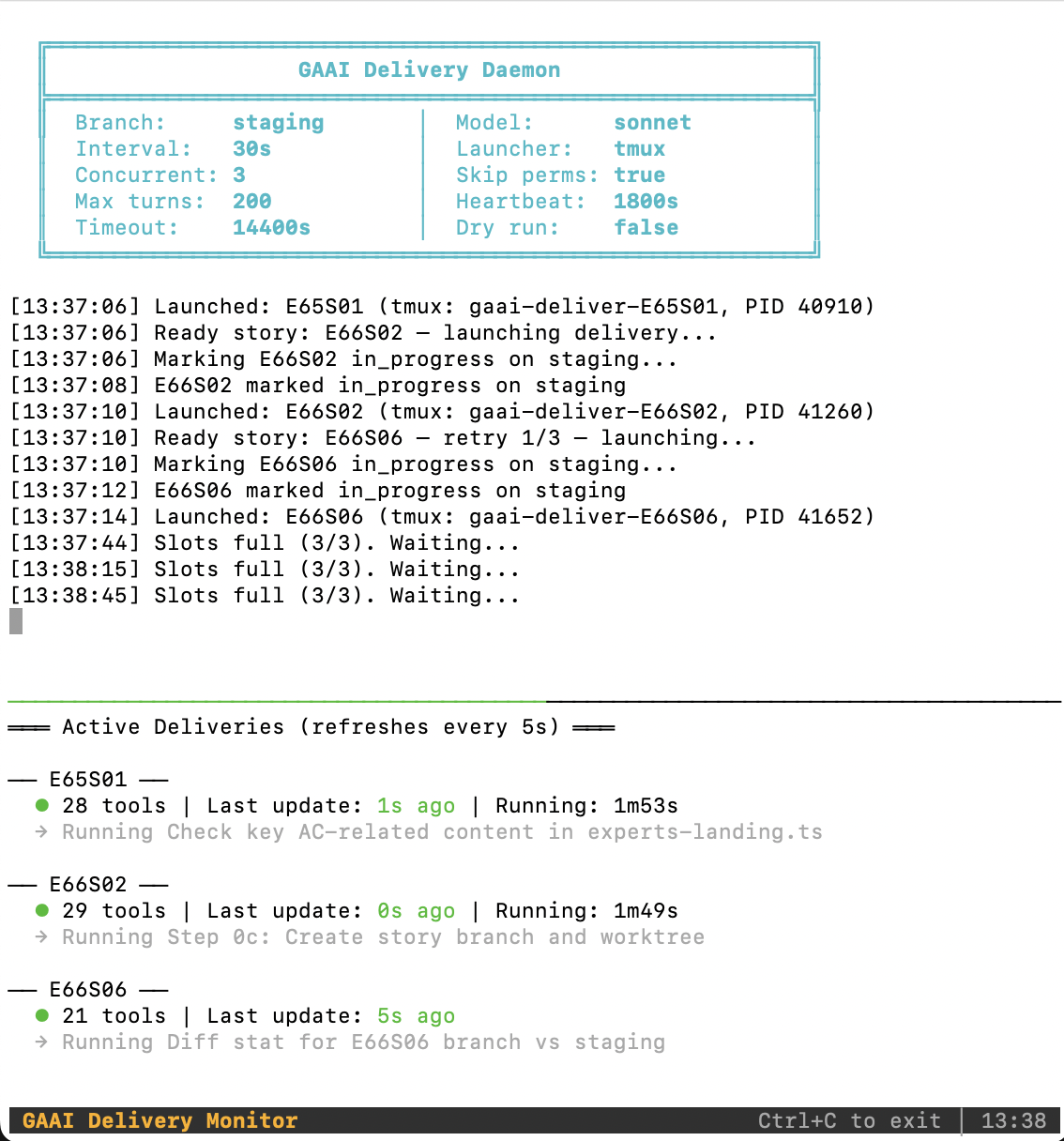
Setup (one-time):
.gaai/core/scripts/daemon-setup.sh
Invoke it directly. daemon-setup.sh and daemon-start.sh are executables carrying a
#!/bin/bash -p shebang: prefixing either with a plain bash interpreter is refused with
entry_authority_invalid, because a non-privileged interpreter has already applied BASH_ENV
and imported exported functions before the script's first instruction. The only alternative is
an absolute, verified Bash invoked --noprofile --norc -p <script>.
daemon-setup.sh is also the only command that may create or update the dedicated daemon
home worktree. Startup verifies that home and refuses if it is absent, stale, dirty, foreign or
on the wrong branch — it never repairs it, and there is no fallback to your working checkout.
Because the entry rebuilds a closed allowlist of configuration, a shell exporting GIT_EDITOR,
GIT_CONFIG_COUNT, PYTHONPATH and similar cannot start the daemon. That is the contract, not
a defect — start it from a clean environment, e.g.
env -i PATH=/usr/bin:/bin HOME="$HOME" TERM="$TERM" .gaai/core/scripts/daemon-start.sh.
Usage:
/gaai-daemon                        # start daemon (3 slots)
/gaai-daemon --max-concurrent 3     # 3 parallel deliveries
/gaai-daemon --status               # read-only lifecycle status (mutates nothing)
/gaai-daemon --monitor              # attach the monitoring dashboard
/gaai-daemon --stop                 # graceful shutdown
/gaai-deliver= one Story, current session./gaai-daemon= background daemon, parallel delivery.
Requires: git repo,
stagingbranch, Claude Code CLI (claudein PATH, default) or Codex CLI (codexin PATH, viaGAAI_DAEMON_EXECUTOR=codex),python3,node, and tmux — required, not optional (3.2 is the nominal floor; a real capability probe is the admission authority). There is no Terminal.app ornohupfallback: a fallback launcher is how process ownership used to be inferred from ambient state instead of proven.Note: The Delivery Daemon explicitly supports two local headless executors — Claude Code CLI (default) and Codex CLI. An unknown or unavailable executor stops before governed work begins with an actionable error. Discovery and governance work with any AI tool — this requirement applies only to autonomous delivery.
Tested on: macOS (Apple Silicon). Linux and WSL (Windows) are expected to work but not yet validated — issues and feedback welcome.
Deep integration — slash commands, auto-loaded context, SKILL.md auto-discovery:
| Tool | Adapter |
|---|---|
| Claude Code | CLAUDE.md + .claude/commands/ |
AGENTS.md compatible — full GAAI capability via manual activation prompts:
| Tool | Adapter |
|---|---|
| OpenCode | AGENTS.md |
| Codex CLI | AGENTS.md |
| Gemini CLI | AGENTS.md |
| Antigravity | AGENTS.md |
| Cursor | .cursor/rules/*.mdc |
| Windsurf | AGENTS.md |
| Any other | Read .gaai/core/README.md directly |
One canonical source (.gaai/). Thin adapters per tool. No duplication. Discovery, governance, and manual delivery work with any AI coding tool. The delivery workflow is portable to sub-agent-capable AI coding runtimes — Claude Code is the reference implementation today.
git, python3, node and tmux must already be on PATH for the Delivery Daemon, and the vendored runtime is a binary zipapp rather than readable source.source-available under the Elastic License 2.0 (ELv2) — see LICENSE for the full terms.
If you find this framework valuable, please consider showing your support:
Created by Frédéric Geens
Sign in to join the discussion.
No comments yet. Be the first to say what this is good for.
The agent harness performance optimization system. Skills, instincts, memory, security, and research-first development for Claude Code, Codex, Opencode, Cursor and beyond.
from vibe coding to agentic engineering - practice makes claude perfect
🌊 The original agent meta-harness. Deploy intelligent multi-player swarms, coordinate autonomous workflows, and build conversational AI systems. Features adaptive memory, self-learning intelligence, RAG integration, and native Claude Code / Codex / Hermes and many more Integrated
Practical patterns, starters & CLI tools for loop engineering with AI coding agents. Design systems that prompt and orchestrate agents (inspired by Addy Osmani and Boris Cherny). Includes loop-audit, loop-init, loop-cost.

Git. Ship. Done - Core

The most RAM efficient harness